BLACK CANARY: BREAKING SILENCE: DC ICONS SERIES (audiobook) by Alexandra Monir


Published in 2020 by Listening Library.
Read by Kathleen McInerney.
Duration: 8 hours, 29 minutes.
Unabridged.

Synopsis:

The DC ICONS series tells alternate origin stories for DC superheroes, focusing on them in their high school years. This is the fourth in this YA series that I have listened to as an audiobook. My previous ones were the "big three" of the DC Comics Universe - Superman, Batman, and Wonder Woman. This time I listened to an often overlooked character, Black Canary. 

To be clear, this book focuses on Dinah Lance, the daughter of the original Black Canary. Black Canary was talented at martial arts but her main power was the ability to use her singing voice as a weapon.

The book is set in a dystopian future Gotham City. Think Gotham City meets The Handmaid's Tale. It is a generation after Batman and Commissioner Gordon have passed away. 

Based on a single comment from one of the characters, women's rights have been rolled back across the country. That being said, Gotham City is the most regressive city. Women have to wear approved types of clothing. Girls have only recently been allowed to go back to school, but they have a limited curriculum and will not go on to college. Women are not allowed to speak out in public, create art, or perform. All records of women in any sort of leadership position or performing musically have been expunged from all public records.

Gotham City is controlled by a group descended from some of the original founding families of Gotham City called The Court of Owls. Their leader is Mayor Cobblepot. DC Fans may remember that Cobblepot is the family name of The Penguin. It turns out that Mayor Cobblepot took some of The Penguin's research to create a chemical that robs women of their power to sing. Of course, this ended the power of the original Black Canary.

Dinah Drake is unhappy. She is a senior in high school and she feels restricted by the She knows that women used to be leaders, used to wear what they wanted and used to sing. She discovered a hidden treasure trove of old magazines and has seen photos of women singing on stage.

And now a new boy named Oliver Queen has moved to Gotham City...

My Review:

The first 90% of this audiobook was the most compelling of the 4 books I have read in this series.

***********Spoiler Alert************

The book had the makings of the beginning of a series with Dinah Drake pushing back against the totalitarian rule of the Court of Owls. I was imagining a reverse of the traditional Batman role. Black Canary and Green Arrow would not be the enforcer of laws, instead this team would make sure unjust laws were not enforced.

Instead, the book very neatly clears out the totalitarian rulers and everything is fixed ( the rest of the country was too?) Too bad - this could have been a great series. I am removing 1 star for ruining a great series.

***********End Spoilers**************

I rate this audiobook 4 stars out of 5. It can be found on Amazon.com here: BLACK CANARY: BREAKING SILENCE: DC ICONS SERIES by Alexandra Monir.

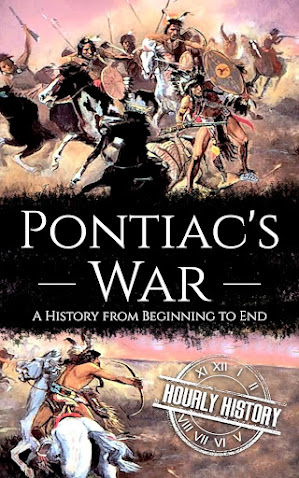
PONTIAC'S WAR: A HISTORY from BEGINNING to END (kindle) by Hourly History


Published by Hourly History in 2021.

Hourly History publishes histories and biographies that you can read in about an hour. That can be a tough job for larger topics in history like "The Industrial Revolution" or "The Roman Empire" but it works out about right for this short war (1763-1766.)

The war arose directly from unaddressed issues as a consequence of the French and Indian War (1754-1763.) In the French and Indian War, the American frontier became a battlefield. American settlements were wiped out, Native American villages were destroyed. French and English soldiers participated and ultimately agreed to a settlement that ignored the realities of the vast borderlands between the colonies and the Native Americans.

The biggest issue was constant push westward from European (American) settlers into areas that were already inhabited by Native Americans. The colonies were all for this westward push, even if the British government was ambivalent or even against the idea. 

Pontiac was an Ottawa. They were centered in the Great Lakes in and around Michigan. Pontiac wanted the French government to resume control of the area - something that simply was not going to happen.

Pontiac was sick of the English colonies moving westward. He encouraged all of the Native American groups to join together to overwhelm the British forts in Michigan, Indiana, Ohio, Pennsylvania and upstate New York. He led an attack against Fort Detroit that failed, but a number of smaller forts fell, including Fort Ouiatenon near modern-day Lafayette, Indiana. I only mention Fort Ouitatenon because I live in Indiana, have been to the fort, and this is the only time I have ever seen the fort mentioned in a history book.

Once the British figured out that it was a united push against their forts and settlements they slowly pushed more troops into the area. They began with only 500 soldiers to hold an area that comprises all or parts of upstate New York, western Pennsylvania, Ohio, Indiana, Michigan, part of Illinois and nearby areas of southern Canada.  Transportation was horribly slow and more than once the united Native Americans attacked, blocked or diverted attempts to reinforce forts. 

It isn't quite clear how big a part Pontiac had in this war. The British considered him to be one of the big leaders - big enough that they called the war Pontiac's Rebellion. But, seeing the number of other critical errors and misunderstandings they committed during the war, it is entirely possible that they imagined him to be THE leader when he was actually one of a number of leaders.

The agreements in this war didn't last for long and did not resolve the underlying issues. There were three other wars and countless skirmishes in this area with the exact same issues in the 50 years that followed. 

I rate this short e-book 5 stars out of 5. It can be found on Amazon.com here: PONTIAC'S WAR: A HISTORY from BEGINNING to END by Hourly History.

THE CORRUPTION of LINDSEY GRAHAM: A CASE STUDY in the RISE of AUTHORITARIANISM (kindle) by William Saletan


Winner of a 2024 Webby Award

The author of this short book (129 pages) makes it clear that he has no particular grudge against South Carolina Senator Lindsey Graham. Lindsey Graham serves as a stand-in for the Republican Party in general. He is a particularly good stand-in because he was there from the very beginning of the Donald Trump phenomenon because he was one of the many candidates for the 2016 Republican nomination. 

President Donald J. Trump and
Senator Lindsey Graham
Graham is also an amazingly frequent guest on the Sunday morning political talk shows, the evening shows on Fox, local TV, and talk radio. Graham loves to talk into microphones and because of that it is very easy to track his gradual moves from being a loudly outspoken opponent of Trump to the most vociferous defender of and apologist for the former president. 

Saletan thoroughly documents this transition and backs up each of these subtle changes with hundreds of actual links to videos, transcripts, and news articles. The reader can check for him/herself. I checked a ton of the links because there were so many ridiculous things that the 45th President has done and said that I simply forgotten about some of them.

This explains the idea behind
the book quite well.
This book is unlikely to change the minds of a MAGA friend of relative so don't even bother. But, if you are wondering how someone like Lindsey Graham could go from saying that Donald Trump was "hateful," a "demagogue," a "kook" and a "race-baiting, xenophobic, religious bigot" (page 8) to being his most prominent apologist, this book documents every baby step that Graham and the Republicans took to get there.

I rate this e-book 5 stars out of 5. It can be found on Amazon.com here: THE CORRUPTION of LINDSEY GRAHAM: A CASE STUDY in the RISE of AUTHORITARIANISM by William Saletan.

See my review of a that book has a similar theme but looks at several other Republicans in addition to Lindsey Graham: 
THANK YOUR for YOUR SERVITUDE: DONALD TRUMP'S WASHINGTON and the PRICE of SUBMISSION by Mark Leibovich.


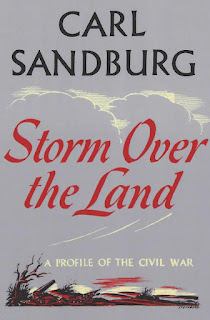
STORM OVER the LAND: A PROFILE of the CIVIL WAR by Carl Sandburg


I read a 2009 re-print published by Konecky and Konecky.

Carl Sandburg (1878-1967)
In 1940, the famed poet, journalist and author Carl Sandburg won a Pulitzer Prize for his four volume biography Abraham Lincoln: The War Years (published in 1939.)

In 1942, his publishers came to him and asked him to re-work the biography into a history of the Civil War in response to America's recent entry into World War II. 

The result is a pretty solid history of the Civil War from basically the Union point of view. 

Carl Sandburg is best known as a poet and that shines though with some of his prose. From time to time, he comes up with a different and interesting way of telling the story of the war. 

The most obvious weakness to this history is the story of African-Americans in the war - the free, the enslaved, the recently freed, the soldiers and others. He mentions them, but does not look at them very hard. To be fair to Sandburg, this book was published 81 years ago and he covered the topic about as well as any mainstream history would have.

I rate this history 4 stars out of 5. It can be found on Amazon.com here: STORM OVER the LAND: A PROFILE of the CIVIL WAR by Carl Sandburg.

WHEN WE'RE HOME in AFRICA (audiobook) by Themba Umbalisi


Published in 2021 by Next Chapter Audio LTD.
Read by Crawford B. Bunkley III.
Duration: 4 hours, 34 minutes.
Unabridged.


I have no idea where I found this book. I think it was a freebie on Audible through Amazon's Prime Reading program. I know that I got it because I am a big reader of Civil War histories and fiction and this sounded like it was right up my alley.

Synopsis:

The description of this book is accurate, to a point. It is about a freed slave who joins the Union Army and then goes from job to job and place to place with a goal of settling in Africa.

My Review:

This book is basically a Forrest Gump type of story - one man goes on an epic journey and ends up going through a lot of the historical movements of the era.

Warning: Lots of *********SPOILERS********all the way to the end of this review.

This audiobook comes in at almost exactly 50% of the run time for FORREST GUMP and covers maybe even more territory. Our hero (his name changes multiple times) begins as a slave in Georgia who is freed by the Union Army. He goes on to:

1. Join the Union Army as an infantry soldier.
2. Participate in the Battle of the Crater.
3. Muster out of the Army.
4. Meet a woman and live with her for a while.
5. Join the Cavalry.
U.S. Army "Buffalo Soldiers"
6. Serve on Indian patrol as a Buffalo Soldier. Fight a number of battles.
7. Serve on the U.S./Mexican border as a Buffalo soldier. Fight a number of battles.
8. Go on trial as a horse thief simply for doing his job.
9. Almost get lynched.
10. Flee into the wilderness to escape the lynching mob.
11. Meet another woman and live with her for a while.
12. Eventually arrive in San Francisco.
13. Get shanghaied onto a ship.
14. Go around the tip of South America to the Atlantic Ocean.
15. Get involved in a mutiny somewhere near the Falkland Islands.
16. Escape the ship with a friend on a little boat with a sail just before the mutineers turn on each other.
17. Sail/Row the boat around the tip of Africa and land on the Indian Ocean side of South Africa.
18. Meet native Africans.
19. Join the British Army in South Africa as a scout. Fight a number of battles.
20. Leave the British Army and join the Zulus.
21. Get married.
22. Become the royal firearms specialist for the Zulu.
23. Watch the Zulu loose to the British and flee to the mountains.
24. Find a group of refugees.
25. Become king of these refugees and make a people out of them.
26. Start a family.

Those are 26 big steps in a 4 hour and 34 minute audiobook. This could have been epic if it were slowed down and each of these steps were explored. I actually skipped things (lots of women end up sleeping with this man) and there were actually steps that were explored in detail, which means that the others got even more of the short shrift treatment.

For example, the women always end up being a side story and the hike from Texas to San Francisco is an epic trip going through multiple Indian territories and crossing the Rocky Mountains and it gets just a few minutes.

This book is really more of a serious treatment of a book series rather than a single book. It is too busy and not filled in with enough detail to make a story. It could have been a decent series.

About the narration. Crawford B. Bunkley III has a great voice, but he read this book too fast. Commas are ignored. Periods are ignored. Just this wonderful voice pushing forward as fast it can while reading a story that just wants to push on as fast as it can.

The only reason that I am giving it 2 stars is because I actually finished it.

This book can be found on Amazon.com here: 
WHEN WE'RE HOME in AFRICA by Themba Umbalisi.

WHITE EVANGELICAL RACISM: THE POLITICS of MORALITY in AMERICA (audiobook) by Anthea Butler


Published by Tantor Audio in 2021.
Read by Allyson Johnson.
Duration: 3 hours, 44 minutes.
Unabridged.


This book takes a short look at how the people that refer to themselves as Evangelicals and their forebears have dealt with race over time.

An interracial marriage protest. The signs
claim that interracial marriage is Communist
and a sign of the anti-Christ.
The book starts with the justifications that religious leaders used to defend slavery. After the Civil War, they modified those justifications slightly to defend the Jim Crow system. Butler contends that the Evangelical movements in the 1900's were worried about things like Communism, but it usually had a racial overtone to it - like when Martin Luther King was accused of spreading Communism to Black communities all over the country when he was just asking for the rights that White Americans already had.

The heart of her book is about Billy Graham and what she calls out as a wishy-washy approach to racism. I am a bit more forgiving of Billy Graham because there was no model in American history for true racial equality, including (and sadly) in the church. Graham probably felt like he was taking giant steps, but nowadays he was clearly taking baby steps. What if he had taken bigger steps? Would he have lost his place as America's Evangelist or would he have moved the country forward?

I have no qualms with her look at Trump Era White Evangelicals. She calls out the hypocrisy correctly (including well-deserved criticism of Billy Graham's son Franklin Graham.)

However, I am only going to give this book 3 stars out of 5. Not because it is incorrect and not because it is not well-written. It is simply too short and does not include a wide enough net in its discussion. For example, women's rights are not discussed in any meaningful way.

The reason I am giving it 3 stars is because this topic has already been dealt with better and more extensively in the book JESUS and JOHN WAYNE: HOW WHITE EVANGELICALS CORRUPTED a FAITH and FRACTURED a NATION by Kristen Kobes du Mez.

This book can be found on Amazon.com here WHITE EVANGELICAL RACISM: THE POLITICS of MORALITY in AMERICA by Anthea Butler.

TEN CAESARS: ROMAN EMPERORS from AUGUSTUS to CONSTANTINE (audiobook) by Barry Strauss


Published by Simon and Schuster Audio in 2019.
Read by Arthur Morey.
Duration: 12 hours, 52 minutes.
Unabridged.


Barry Strauss is a professor of the history of Ancient Greece and Ancient Rome. As the title clearly says, Strauss tells his reader/listeners about what he judges to be the ten most important Roman emperors and ends up telling a decent political history of the Roman Empire along the way.

Bronze statue erected c.175 AD of 
Marcus Aurelius (121-180 AD), one of
the Roman Emperors featured in 
this book.
When I say he chose the ten most important emperors, that doesn't mean he chose the ten best emperors. He has more than one emperor that demonstrates how a bad leader can abuse the political consensus, damage the political system, and leave a lot of confusion in his/her wake. But, change is not necessarily a bad thing - especially when handled by talented leaders like Augustus and Constantine. 

This was an interesting listen and well-read by Arthur Morey. I did enjoy how the book was not merely about the interactions of a few well-connected families at the top (although there are a few emperors that were hyper-connected to past and future emperors) but it was also about how emperors reacted to outside movements like rebellions in Judea, the rise of Christianity and foreign wars.

I rate this audiobook 5 stars out of 5. It can be found on Amazon.com here: TEN CAESARS: ROMAN EMPERORS from AUGUSTUS to CONSTANTINE by Barry Strauss.

Featured Post

<b><i>BAN THIS BOOK (audiobook)</i></b> by Alan Gratz

Published in 2017 by Blackstone Audio, Inc. Read by Bahni Turpin. Duration: 5 hours, 17 minutes. Unabridged. My Synopsis Ban This Book is t...

Popular posts over the last 7 days