PLAYER PIANO by Kurt Vonnegut


Originally published in 1952.

Synopsis:

Paul Proteus is the director of the Ilium Works in New York State in an alternate timeline to our current one. It is roughly the 1950's after yet another World War. 

That war taught the engineers to trust mechanization and the government to continue the central planning model that won the war (a more extreme model of the system the real United States used during World War II.)

In the Ilium works there are multiple factory buildings full of machines, but there are no people because the whole thing is automated. Proteus and the other engineers replaced all of the people with machines in the name of efficiency. Even the best human workers make mistakes or get an illness and miss work or, eventually, die. 

The machines don't have that problem. They work and work and work until the day they are replaced with even faster machines.

Kurt Vonnegut (1922-2007)
in 1952
This is the source of the title, Player Piano. A player piano plays itself thanks to a roll that is inserted. In the town across the river from Ilium Works, there is a player piano in the bar where all of the unemployed factory workers drink their days away.

The major theme of the book is that it is not good for humans to have no work, no skills to master and no sense that they have put in a good day's work, even if it is more efficient for machines to do it all.

And...Paul Proteus is starting to come around to that way of thinking.

My Review:

This is Vonnegut's first novel. It follows a more normal narrative form than his later, more famous novels. It's too long. It has too many characters. I has too many side plots that don't really go anywhere.

But, it is amazingly prophetic. Vonnegut was working in the public relations department of General Electric when he wrote this novel. He was constantly being exposed to miraculous "labor-saving" devices and his imagination took him to a world where so much labor has been saved with labor-saving devices that there is practically nothing for anyone to do anymore because a person with nothing to do has no reason to be here at all.

Just look at all of the jobs that have been replaced by technology - Line workers in factories, print setters, cashiers, most farm labor and on and on and on. Everyone thinks all of the jobs have gone oversees, but 85% of them have actually been lost to technology. So it goes.

The book gets better as it goes along and has a bittersweet ending.  

I rate this book 4 stars out of 5. It can be found on Amazon.com here: Player Piano by Kurt Vonnegut.

JOURNEY to STAR WARS: THE FORCE AWAKENS: SHATTERED EMPIRE (graphic novel) by Greg Rucka and James Robinson


Published in 2016 by Marvel Enterprises.
Illustrated by Marco Checchetto, Angel Unzueta, Emilio Laiso, and Tony Harris

This is an attempt to bridge some of the space in the Star Wars story line between Episode VI: Return of the Jedi and Episode VII: The Force Awakens. It starts (oddly, in my mind) at the beginning of the last big battle over the second Death Star in Return of the Jedi and introduces Poe Dameron's parents. His mother is a pilot who flew in the attack on the second Death Star and his father was in the ground forces that fought alongside Han Solo. 

There is plenty of action, but I found the art did a "meh" job of conveying the action of a space battle and there were lots and lots of them. The story really depended a lot on space fighting action and was pretty shallow.

I did enjoy the last story. It was done by a different artist, written by a different author, and is not connected to the main story line. It features C-3P0 and is actually touching. 

I rate this collection 3 stars out of 5. It can be found on Amazon.com here: JOURNEY to STAR WARS: THE FORCE AWAKENS: SHATTERED EMPIRE by Greg Rucka and James Robinson.


THE LAST SAXON KING: A JUMP in TIME NOVEL, BOOK ONE (audiobook) by Andrew Varga


Published by Imbrifex Books in March of 2023.
Read by Mark Sanderlin.
Duration: 8 hours, 49 minutes.
Unabridged.


Synopsis:

Dan Renfrew is a self-described homeschooled nerd and his life has been turned upside down. He watched his father get stabbed by a stranger who invaded their house and he has no idea if he is even alive. 

Now, thanks to a magical device, Dan is in Medieval England and caught up in an army on the move. He learns that his father is a "time jumper" - men tasked to fix glitches in time and make sure the timeline plays out the way it is supposed to.

The year is 1066 - just a few days before King Harold Godwinson meets and defeats one of the last Viking invasions of England at the Battle of Stamford Bridge. Even more importantly, King Harold will be forced to meet the forces of William, the Duke of Normandy in just a few days and will be defeated at the Battle of Hastings.

But, something is wrong and even though Dan has almost no idea what to do, he has to make sure that history isn't manipulated by sinister forces that can also travel in time...

My review:

Harold Godwinson from the Bayeux Tapestry
I liked this book quite a bit. The history is gritty and full of gore thanks to Dan being plunked in the middle of (arguably) the two most important battles of the  English medieval era. Limbs get hacked off, blood sprays in people's faces and intestines spill out onto the ground. None of this glorified in the book - in fact, Dan is horrified over and over again at the brutality of it all. 

The addition of the evil "time jumpers" adds a level of danger and intensity to the experience, especially when the reader finds out more about them in the last part of the book. And, it turns out that Dan is not the only good "time jumper" back in 1066, which lets the reader learn more about what is going on bit by bit as Dan learns.

The epilogue at the end of the story fleshes out the history that Dan just went through a bit more to give the reader some additional context. 

Since this book is the start of a series, the most important questions is "Would you read book 2 in the series?"

The answer is yes, I think this series looks like it could be quite strong. 

I rate this audiobook 4 stars out of 5. It can be found on Amazon.com here: THE LAST SAXON KING: A JUMP in TIME NOVEL, BOOK ONE by Andrew Varga.

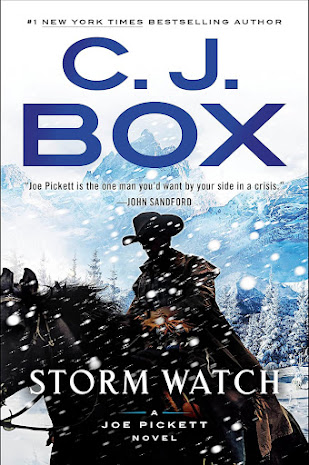
STORM WATCH (Joe Pickett #23) (audiobook) by C.J. Box


Published by Recorded Books in February of 2023.
Read by David Chandler.
Duration: 9 hours, 4 minutes.
Unabridged.


Synopsis:

Game Warden Joe Pickett is out in a snowstorm chasing down an elk with a broken leg. An out of state driver plowed into an elk herd while consulting the GPS app on his phone and an injured elk somehow limped away. 

Joe and his dog Daisy are on a big ranch owned by an out of state multi-millionaire trying to track down the elk to put it out of its misery. Joe finds the elk, an SUV from a different part of the state, a metal building that is very out of place in this out of the way valley, and a dead man. 

Joe starts to nose around and gets shot at twice by snowmobilers at the top of the valley and that's just the beginning of his troubles...

My review:

For the past 13 years I have been happily reviewing C.J. Box's novels. I went back and looked at those reviews and bit-time politics has been a part of them since almost the beginning. His early books featured eco-terrorists, an EPA ruling about water rights, wind turbines, and more. 

Warning: ***spoilers***

But lately, the books are just getting more and more over the top. There is a running commentary by the lazy sheriff in the last few books that Joe Pickett keeps finding trouble. In the last two books Joe found a man who had been burned to death by Hungarian Nazis. He found his old lady neighbor was killed by the same Nazis. In this book, he discovered a Chinese communist spy who had been killed by meth-heads (actually he discovered it twice because the body was moved). He discovered a dead meth addict, and was nearly assassinated (don't worry - the bad guy was killed.) Joe's friend and self-appointed body guard Nate Romanowski along with Geronimo Jones (Geronimo is Nate Romanowski's Nate Romanowski) kill 6 more men. That's a body count of over a dozen in a county in America's least populated state (576,000 people) in just a few months. In the book before that 5 or 6 people died as well! 18 people dead in this one county in less than a year!

It seems to me that this lazy sheriff has a really good point. In 2020, Wyoming only had 25 murders and that was up quite a bit from previous years. 

I love the Joe Pickett game warden stories with Joe being out in the wild doing game warden stuff. He has fought terrorists with a missile, Nazis, dirty FBI agents, Mexican drug cartel hit teams, uncovered a Chinese Communist plot, fought Antifa extremists (extreme even for Antifa), and found body after body after body. There's a point where it gets to be too much. Who else can you take down after you have taken down Nazis, Communists, and the FBI?

***End Spoilers***

All of the griping being said, the book does move along quite well and, if you have read all of the books, is full of a lot of satisfying moments. 

This book wraps up so many loose ends that it may very well be close to the end of the Joe Pickett series. There are hints of another set of adventures with his daughter or Geronimo Jones or even with a Wyoming state trooper. 

I rate this book 3 stars out of 5. It can be found on Amazon.com here: STORM WATCH (Joe Pickett #23) by C.J. Box.

THE ADVENTURES of HUCKLEBERRY FINN (audiobook) by Mark Twain


Originally published in 1884 (U.K.) and 1885 (U.S.)
This audiobook version published in 2008 by Tantor Audio.
Read by William Dufris.
Duration: 9 hours, 44 minutes.
Unabridged.


I would feel silly writing a synopsis of this book. This is the book that Ernest Hemingway said is the source of all modern American literature. It is almost universally recognized as not only "a" Great American Novel, but is oftentimes acclaimed as "THE" Great American Novel.

So, I will skip all of that discussion and just move on to a review of the audiobook presentation and what I thought of the book.

The audiobook reader was William Dufris (1958-2020),  a celebrated voice over actor and the reader of dozens and dozens of audiobooks. He did a fantastic job of creating voice after voice after voice. It was quite impressive.

An original illustration by E.W. Kemble
from the 1884 printing of this book
As for the novel, well that was less impressive than I remembered. I read this book in elementary school and almost all of the satire and character growth went right over my head. I re-read it in high school for an AP Literature class. We had to write a lengthy paper that we literally worked months on. We even took a trip to a university library to dig through the stacks to find literary criticisms and cite them. It was, by far, more complicated and longer than any other paper I wrote in my college career.

All of that work writing about the same book soured me on re-reading the book until now, 38 years later. 

So, what did I think?

I was surprised at how many of the plot points I had forgotten. For example, Tom Sawyer is in this book a lot more than I remembered and he is really annoying. I know that is intentionally built in as a part of the book for thematic reasons - Huck is on his way to being a man and Tom is still a boy in many ways - but I still felt that it was tough going when Tom is in the story.

It took me quite a while to get through this audiobook. I could only go for 20 minutes or so at a time and then I had to leave it for a while. In comparison, I listened to a different audiobook today for more than 4 hours. Maybe it was because it was told in first person, I am not sure. 

Despite the importance of this novel, I honestly can't rate it any more than 3 stars out of 5.

This book can be found on Amazon.com here: THE ADVENTURES of HUCKLEBERRY FINN by Mark Twain.

OF BOYS and MEN: WHY the MODERN MALE IS STRUGGLING, WHY IT MATTERS, and WHAT to DO ABOUT IT (audiobook) by Richard V. Reeves


Published in September of 2022 by Blackstone Publishing.
Read by the author, Richard V. Reeves.
Duration: 6 hours, 55 minutes.
Unabridged.

Men, as a group, are struggling in today's economy. The average male's income has falling in inflation-adjusted terms, especially so when you factor out upper class and upper middle class men.

Men are more likely to be arrested, be addicts, be homeless, and more likely to succeed at killing themselves.

Boys are struggling in today's educational system. They are far more likely to be suspended, expelled or placed in a special education program. They are far less likely to graduate from high school. They far less likely to attempt any sort of post-secondary education (a majority of all college students are female) or training and far less likely to complete that training or degree - even in the rare situations where the post-secondary training and/or education are essentially free.

Reeves, an economist with the Brookings Institutions, sees these trends as part of a larger problem and does not see it as a problem caused by women being part of the workplace, going to college or participating in advanced training. That is a reality and he has literally no interest in changing it. He makes this point several times. 

I highly recommend this book. It offers an honest assessment of where we are as a country and that assessment is often depressing. But, Reeves  doesn't just list a bunch of problems. He offers practical solutions that are based on policies that have already proven successful in other ways.

The audiobook is read by the author. He does an excellent job, which is not always the case when authors decide to read their own audiobooks.
 
I rate this book 5 stars out of 5. It can be found on Amazon.com here: OF BOYS and MEN: WHY the MODERN MALE IS STRUGGLING, WHY IT MATTERS, and WHAT to DO ABOUT IT by Richard V. Reeves.

SUCKER'S PORTFOLIO (kindle) by Kurt Vonnegut


Published in 2012 by Amazon Publishing.

Amazon collected 6 short stories, 1 essay and 1 unfinished sci-fi story and added yet another collection to the Vonnegut library.

Kurt Vonnegut (1922-2007) started writing during the Golden Age of sci-fi, when magazines were filling their pages with short stories. Some of these are sci-fi, some are just little human stories. 

Indianapolis native quoting fellow Hoosier author 
James Whitcomb Riley's poem "Little Orphan Annie"
I particularly enjoyed the first story, called "Between Timid and Timbuktu." It is a "Twilight Zone" type of story that I found satisfying in a gruesome sort of way. I also enjoyed the title story. It actually had a surprise twist that was pretty much out of character for a Vonnegut story. 

The seventh entry is an essay from 1992. Vonnegut was a prodigious writer of essays in the latter half of his career. I generally am more of a fan of his caustic and insightful essays than his fiction and this one did not disappoint. 

But, for me, the eighth entry was the surprise. It was an unfinished dystopian future story set in a small town after a human-robot war. It had a lot of zip to it and I was really intrigued right up to the moment it ended in mid-sentence.

I rate this e-book 4 stars out of 5. It can be found on Amazon.com here: SUCKER'S PORTFOLIO (kindle) by Kurt Vonnegut.

Featured Post

<b><i>BAN THIS BOOK (audiobook)</i></b> by Alan Gratz

Published in 2017 by Blackstone Audio, Inc. Read by Bahni Turpin. Duration: 5 hours, 17 minutes. Unabridged. My Synopsis Ban This Book is t...

Popular posts over the last 7 days