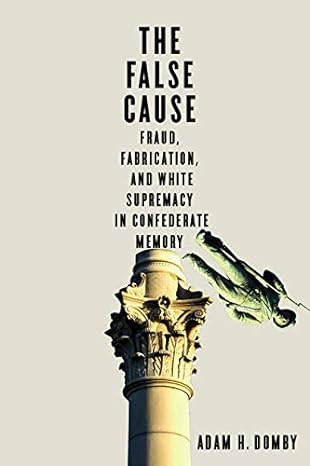
THE FALSE CAUSE: FRAUD, FABRICATION, and WHITE SUPREMACY in CONFEDERATE MEMORY (audiobook) by Adam H. Domby


Published by Blackstone Publishing in 2022.
Unabridged.

The cover of the book and the short description offered by my library app gives the impression that this book is pretty much about the "Silent Sam" Confederate memorial that stood at the University of North Carolina from 1913-2018.

This book is much more than that, though. It uses Silent Sam as an entry point into a larger discussion of how North Carolina chose to remember how it performed in the Civil War (more than 10% of Civil War soldiers from North Carolina actually fought for the Union.)

He also discusses how White men lied about their service to get Confederate pensions and the government turned a blind eye in the name affirming White unity and White Supremacy. Whites that fought for the Union (but couldn't qualify for a Union pension) or actively fought the Confederate draft with violence or by simply going AWOL at every point possible were given pensions. 
The idea is that by the late 1800s and early 1900s the idea was to deny that any Whites had ever disagreed with the Confederacy in the first place. If a little graft and fraud had to be tolerated to achieve the illusion of White Unity than that was a reasonable price to pay.
A billboard during the height of the 
Silent Sam controversy

A large chunk of the book is devoted to making the point of the previous paragraph. It is convincing and a little tedious. Much more profound is the text of the speech that was given by a Confederate veteran and political bigwig at the 1913 dedication. Julian Carr was a political moderate when it came to African Americans in North Carolina, but he makes it abundantly clear that the Silent Sam statue is there as a visible reminder to everyone of the "good old days" when all Whites stood together against the North and all Blacks knew their place. 

Interestingly, that is exactly what the modern day anti-monument protesters claimed and exactly what the Neo-Confederates denied. 

The book patiently lays out all of its arguments (there are a lot more than I have laid out here) and proves its points - just not always in the most compelling manner. 

I rate this audiobook 4 stars out of 5. It can be found on Amazon.com here: 
THE FALSE CAUSE: FRAUD, FABRICATION, and WHITE SUPREMACY in CONFEDERATE MEMORY by Adam H. Domby.

CALIFORNIA GOLD RUSH (kindle) by Hourly History


Published in 2022 by Hourly History.

The short histories produced by Hourly History are designed to read in about an hour. In some cases the size limit makes for a very incomplete history. In this case, I thought that topic and the size limit matched up pretty well.

This e-book details from the beginning (spoiler alert: John Sutter of Sutter's Mill fame was clearly not a good guy) and details the good as well as the bad of the Gold Rush.

Turns out there was a lot of bad, such as environmental destruction on an unprecedented level (they used mining techniques that were outlawed just a few years later. How obviously bad were they if people who let children into mines said that these techniques are clearly out of bounds?!??) 

The white miners also used genocidal techniques to wipe out the local Native American populations, killed Chinese immigrants that came across the Pacific to find gold and, of course, jumped the claims of other white miners and killed them. All of the gold and the lure of the possibility of getting rich quick just brought out the worst in almost everybody.

It also brought poor hygiene and possibly even worse building standards and this led to tragedy. Disease outbreaks were common and when there were earthquakes a lot of people were killed. But...a lot of gold was discovered and a lot of people got rich selling to the other gold seekers.

I thought this was a solid re-telling of the history of the California Gold Rush - warts and all. I rate this short history 5 stars out of 5. It can be found on Amazon.com here:  CALIFORNIA GOLD RUSH (kindle) by Hourly History.

MEXICAN WHITEBOY by Matt de la Peña


Originally published in 2008.

Synopsis:

Danny is spending the summer in San Diego living with his father's family - his grandmother, his uncles, his aunts, and his cousins. He dreams of visiting his father in Mexico and is disdainful of his mother who is spending the summer in San Francisco with her very serious boyfriend.

What complicates the matter is that Danny's mom is white and Danny basically speaks no Spanish. He feels out of place when he is with his mom in her neighborhood because of his Mexican heritage. He feels out of place with his father's family because of his white heritage. He also knows there are family secrets that they are hiding from him.

What Danny has going for him is baseball. He can do it all, but he is a brilliant young pitcher. He finds another ball player named Uno. Uno is half black and half Mexican and understands how Danny feels out of place everywhere he goes.

Together, Danny and Uno come up with a plan to leverage their baseball skills...

My review: 

I was excited to read this novel after having read the author's coming of age novel about Superman. That was a great novel with an action-driven plot. Mexican WhiteBoy is more of a novel about relationships and family secrets. The middle 1/3 of the book meanders around until the plan to use their baseball skills come to fruition. 

Not a bad novel. Not a great novel. I rate this novel 3 stars out of 5. It can be found on Amazon.com here: MEXICAN WHITEBOY by Matt de la Peña.

In November of 2023 it was announced that the group Moms for Liberty had challenged more than 300 books in Florida. This is one of the books that the Moms challenged. Read more about the books here.

THE REST I WILL KILL: WILLIAM TILLMAN and the UNFORGETTABLE STORY of HOW a FREE BLACK MAN REFUSED to BECOME a SLAVE (audiobook) by Brian McGinty


Read by Sean Crisden.
Duration: 4 hours, 19 minutes.
Unabridged.


At the beginning of the Civil War, the Confederacy authorized ships to be privateers. Privateers are basically pirates with the explicit backing of a government. The idea was to authorize as many ships as possible to attack Union shipping as part of the Confederate war effort. 

William Tillman (c. 1834-?)
One of the early victims of these attacks was the S.J. Waring, a ship out of New York City bound for South America. On July 4, 1861 the ship was attacked, captured, and most of the crew was taken off the Waring to the privateer ship but they did leave a few people behind, including the ship's cook - a free black man named William Tillman. 

The privateers made it very clear that they were going to sell Tillman in the slave market in Charleston and Tillman was not going to let that happen...

Unfortunately, there just isn't a lot of information about William Tillman - either before this event or after he became an early celebrity of the war. The author expanded the book with a look at slavery in Delaware. It was literally the smallest of the slave states at the beginning of the Civil War and it had the weakest attachment to the slave-owning culture. That is not to say that it was easy for free blacks or the slaves, but it does explain why Delaware never really considered joining the Confederacy.

He also looked at privateering during the war, the attitudes toward slavery in New York City and other events that took place early in the Civil War. 

I rate this audiobook 4 stars out of 5. It can be found on Amazon.com here: THE REST I WILL KILL: WILLIAM TILLMAN and the UNFORGETTABLE STORY of HOW a FREE BLACK MAN REFUSED to BECOME a SLAVE by Brian McGinty.


A MAN WITH ONE of THOSE FACES (Dublin trilogy #1)(audiobook) by Caimh McDonnnell


Published by McFori Ink Ltd in 2018.
Read by Morgan C. Jones.
Duration: 11 hours, 11 minutes.
Unabridged.


Synopsis:

This comic romp features Paul Mulchrone - an unmotivated ne'er do well who is forced to volunteer 6 hours per week (and stay out of trouble) to maintain the weekly payments he receives as an inheritance from a hated aunt. He works those hours at a local hospital for older people in the memory care wing. He visits the patients and pretends to be relatives or friends that they want to talk to. Between failing eyesight, confusion and wishful thinking it works.

The author, Caimh McDonnell
It also works because Mulchrone is pretty good at improv and because he has "one of those faces" and looks a whole lot like just about everybody.

One day, he is asked to visit an old man in the hospice who is clearly dying. The old man gets confused, thinks he is the son of an old partner in crime and stabs Mulchrone with a knife he had stashed away.

Mulchrone gets treated and heads home - unhappy and confused. When another man tries to kill him, Mulchrone knows that he has stumbled onto something really dangerous...

My review:

The mystery in this book is pretty good, but the non-stop comic romp of the book got a little old after a while. Also, the ending was jarring compared to the rest of the book and was really quite creepy. It just didn't feel like it belonged. 

Not a bad book, but I don't think I will be continuing on with this trilogy.

I rate this book 3 stars out of 5. It can be found on Amazon.com here: A MAN WITH ONE of THOSE FACES (Dublin trilogy #1)_by Caimh McDonnnell.

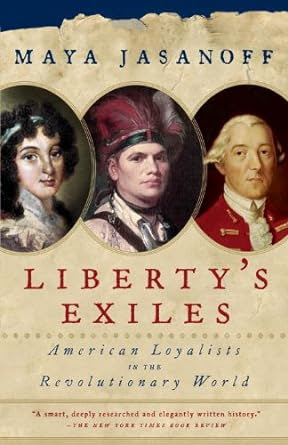
LIBERTY'S EXILES: AMERICAN LOYALISTS in the REVOLUTIONARY WORLD (audiobook) by Maya Jasanoff

Published by Recorded Books in 2012.
Read by L.J. Ganser.
Duration: 16 hours, 10 minutes.
Unabridged.


In 1783, at the end of the Revolutionary War, Loyalists (Americans who opposed the American Revolution and stayed loyal to Britain) had a choice to make - stay and ride out the anti-Loyalist bias in the United States or move somewhere else.

In the two years between the last major engagement (Yorktown) and the official end of the war and withdrawal of British troops the British decided to evacuate any Loyalists that wanted to go to other parts of the British Empire. One of the biggest advocates of this position was Guy Carleton, the British commander in America after Yorktown who later went on to become the Governor-in-Chief of Canada. He had more to do with what happened in this history than any other single person.

Guy Carleton (1724-1808)
The British government made an effort to make things right for these Loyalists. Not many Loyalists were completely reimbursed, but the fact that an effort was made was extraordinary for the day. In some cases, Loyalists were offered large grants of land, in other cases they were offered smaller grants of land and in other cases they were offered pensions and partial reimbursements for lost property. All of these offers were new innovations and a sign that the British government wished to honor the loyalty they had shown.

Some loyalists wanted nothing more than to start over, some looked to just work themselves up the British societal ladder, some wanted to get away from British society and some looked for a chance to get even with the Americans. 

There was a racial component to this as well. The British had offered freedom for any slaves that left their masters and joined their armed forces. The Americans pressured them to return the runaway slaves (including slaves from George Washington and Thomas Jefferson) but the British refused to go back on their deal with the former slaves as a point of honor. However, those former slaves oftentimes were given less money and less land than white Loyalists when they arrived at their new homes.

The British tried to honor the commitments shown by the Native American allies as well, but not nearly as much. 

Loyalists ended up going all over the empire but mostly to Canada. There were several families that went to Bermuda and Jamaica and back to England itself. Several families of African descent moved to Sierra Leone in Africa as part of an experimental colony. A few went even further to India. 

The section on the Canadian settlement was, at first, interesting but it soon got bogged down. It was all relevant detail, but just too much for me. In fact, that's pretty much my review of the entire book.

I rate this audiobook 3 stars out of 5. It can be found on Amazon.com here: LIBERTY'S EXILES: AMERICAN LOYALISTS in the REVOLUTIONARY WORLD (audiobook) by Maya Jasanoff.

CRIMEAN WAR: A HISTORY from BEGINNING to END (kindle) by Hourly History


E-book published by Hourly History in 2020.

Hourly History specializes in histories and biographies that take about an hour to read. In the case of the Crimean War (1853-1856), I think that's about right.

The war was the result of European alliance politics. Russia was looking to push into Ottoman territory. The Ottomans were considered to be pretty weak and certainly on the decline after centuries of being a major power. The Austrian Empire was a traditional ally to the Russians, but decided to stay neutral. The Prussians were just starting out so no one really cared what they did. Even though they had been traditional rivals for centuries, England and France decided that they had to intervene on behalf of the Ottoman Empire in order to stop Russia from becoming too powerful. 

The French and the English sent troops all of the way to the Ottoman Empire and then up into the Black Sea and landed troops on the Crimean Peninsula and the war was on.

The war itself is worthy of note for several reasons, including:

1) France and England worked together as allies. It was the beginning of what has mostly been the default position ever since;
2) Florence Nightingale's work as a nurse;
3) The Charge of the Light Brigade and the poem of the same name describing the futility of the attack and the by Alfred, Lord Tennyson featuring the line "Theirs not to reason why, Theirs but to do and die";
4) Exposed the weaknesses of Russia and the Ottoman Empire. Those weaknesses led to revolutions within 70 years;
5) It was demonstrated that rifled weapons were vastly superior to older style weapons;
6) Trench warfare was introduced. This pointed towards what would be the signature fighting style of World War I sixty years later;
7) The media of the day was able to relatively quickly send stories back from the front due to new technologies;
8) Photography brought realistic views of the war back to the English and French public.

This book does a good job of explaining the war, the causes, the military results and the short term and long term results. 

I rate this e-book 5 stars out of 5. It can be found on Amazon.com here: Crimean War: A History from Beginning to End

Featured Post

<b><i>BAN THIS BOOK (audiobook)</i></b> by Alan Gratz

Published in 2017 by Blackstone Audio, Inc. Read by Bahni Turpin. Duration: 5 hours, 17 minutes. Unabridged. My Synopsis Ban This Book is t...

Popular posts over the last 7 days