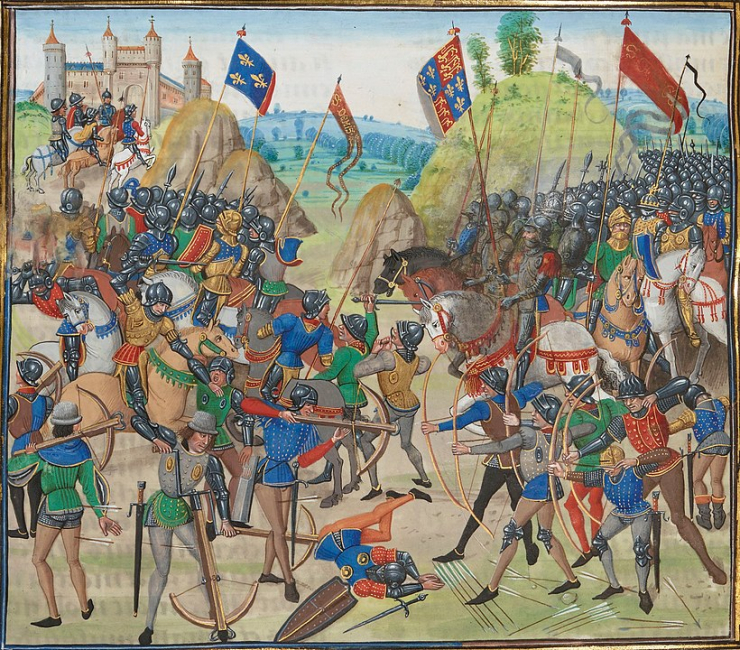
THE HUNDRED YEARS WAR: A HISTORY from BEGINNING to END (kindle) by Hourly History


E-book published in 2019 by Hourly History.

Hourly History is a series of histories and biographies that a reader can read in about an hour. Sometimes, that works out quite well. Sometimes, the topic is just too big to cover in an hour.

I think the Hundred Years War is one of those topics. 

Before I read this book I knew a few facts about the war: It was over dynastic struggles over the throne of France, the Battle of Agincourt, Joan of Arc.

Nothing in this book is incorrect, but I didn't really learn a lot more than I knew before. There is a parade of kings, royal family members and advisors - but there's rarely any detail that makes it interesting. For example, the book mentions an insane French king, but it does not mention that he believed that he was made out of glass and believed that he had to be careful that he would get bumped over and would smash to pieces. 


If you know literally nothing of the war, this is an adequate place to start.

I rate this audiobook 2 stars out of 5. It can be found on Amazon.com here:  
THE HUNDRED YEARS WAR: A HISTORY from BEGINNING to END (kindle) by Hourly History.

NO COMMON GROUND: CONFEDERATE MONUMENTS and the ONGOING FIGHT for RACIAL JUSTICE (audiobook) by Karen L. Cox


Published in 2021 by Tantor Audio.

At it's core, this book is a history of Confederate monuments and what they mean(t) to all of the people who live and work around them.

These monuments are tied in with the "Lost Cause" view of history that teaches that the Confederate cause was a just one, that the war had nothing to do with slavery and that the Confederate cause is only suppressed, but not dead.

These monuments are a vivid reminder about the "not dead" part. When the first big waves of monuments were out up (late 1800's) the Jim Crow laws were becoming standardized. During this time period, the Supreme Court decided in favor of racial segregation in the case Plessy v Ferguson (1896) and that project continued in earnest throughout the South. 

The monuments did honor the Confederate veterans, but they were also placed in symbolic areas like courthouses and town squares told African-Americans that they were not in charge and would never be in charge. The statue of the guy that fought to keep them enslaved in front of the halls of justice is a constant reminder. The author found multiple references to African Americans who stated they never entered the court house on the side where the statue was as a way of refusing to be intimidated. 

The book details some more current struggles over Confederate monuments, including monuments that some people are still trying to put up even today(!) The arguments for them are pretty much the same as they were 100 years ago and they were pretty weak and tone deaf arguments back then.  How were they tone deaf? People argue that the monument is to honor the region's culture and it is really just to honor a bunch of white guys from the region who fought to keep the region's black people in slavery. If you cannot imagine why the region's black people don't want to honor those soldiers...well, you are more than a little slow on the uptake (or racist - take your pick). 

I rate this audiobook 4 stars. It can be found on Amazon.com here: NO COMMON GROUND: CONFEDERATE MONUMENTS and the ONGOING FIGHT for RACIAL JUSTICE (audiobook) by Karen L. Cox.

This book is good, but not quite as good as a book that covered the same topic that I read about 18 months ago: 
DOWN ALONG with THAT DEVIL'S BONES: A RECKONING with MONUMENTS, MEMORY, and the LEGACY of WHITE SUPREMACY (audiobook) by Connor Towne O'Neill.


GOD BLESS YOU, DR. KEVORKIAN by Kurt Vonnegut


Originally published in 1999.
Version with Neil Gaiman foreword published in 2010 by Seven Stories Press.

Synopsis:

In the late 1990's Kurt Vonnegut made a series of 90 second recordings for WNYC, the local NPR station for New York City. The premise of each spot was simple enough - Vonnegut travels to the afterlife to conduct a very short interview with someone (some famous, some not) and then he brings word back to the land of the living to tell us the wisdom he has learned.

How does he get to afterlife? Dr. Jack Kevorkian, the creator of the assisted suicide machine works with Vonnegut to render him about 3/4 dead in the very room and on the very bed where the state of Texas administers the death penalty via lethal injection. One of the people he interviews is a murderer who had just been executed - Karla Faye Tucker, although Vonnegut misspells her first name as Carla.

The Vonnegut mural in his hometown
of Indianapolis. Photo by DWD.
Since he is 3/4 dead, Vonnegut is able to travel to the afterlife and is called back away when he is revived. Eventually, St. Peter gets tired of Vonnegut going back and forth and he is told he must wait just outside of the Pearly Gates. 

All of this going back and forth is cut short by the real life arrest of Kevorkian in Michigan in 1998, an event that Vonnegut refers to at the end of the book.

My review:

This short book is not Vonnegut's best work, but it is certainly packed with Vonnegut's famous biting sarcasm. It is an up and down book and it was clearly printed with an eye to making it seem to be a bigger book than it actually is - with extra wide margins, blank pages between chapters and the like. 

I rate this book 3 stars out of 5. It can be found on Amazon.com here: GOD BLESS YOU, DR. KEVORKIAN by Kurt Vonnegut.

BIG MOUTH & UGLY GIRL by Joyce Carol Oates


Published in 2003 by HarperTempest.

Synopsis:

This book features two high school juniors - Matt Donaghy (Big Mouth) and Ursula Riggs (Ugly Girl.)

Matt Donaghy's a popular guy, but not the most popular guy in school. He's got a reputation as a funny guy and his mouth gets the best of him sometimes. His world gets turned upside down when he makes a joke that is wrongheadedly "misinterpreted" as a serious threat. The police are called and Donaghy is taken into custody and suspended. His name is kept out of the papers, but schools are like small towns - everybody knows all of the details (or thinks they do) soon enough.

Ursula Riggs is a star athlete. 
Her mom clearly prefers her little sister who is a ballerina and her dad is always away on business. Ursula is big for a girl and feels like she is out of place. She adopts the persona of "Ugly Girl" as a way of coping. "Ugly Girl" is a heartless warrior on the basketball court and acts the same way in the hallways of the school (even though she really does care.)

The author, Joyce Carol Oates
Riggs overheard Donaghy's comments and knows that they were intentionally taken in the wrong way and she ignores everyone's advice and tells the principal that a horrible mistake has been made.

And that is when things change for Big Mouth and Ugly Girl.

My review:

I teach high school and these characters felt pretty real to me. After a slow start with Ursula Riggs, I found myself totally buying into this book. 

I rate this book 4 stars out of 5. It can be found on Amazon.com here: BIG MOUTH & UGLY GIRL by Joyce Carol Oates.

MY LIFE AMONG the UNDERDOGS: A MEMOIR by Tia Torres


Published by HarperAudio in 2019.
Read by the author, Tia Torres.
Duration: 5 hours, 50 minutes.
Unabridged.


Tia Torres is the director of the Villalobos Rescue Center, a dog rescue center featured on the Animal Planet TV show Pitbulls and Parolees. The rescue center used to be primarily for wolves and wolf hybrids but it morphed into pit bulls when police departments and city animal shelters would ask them to take in pit bulls on the theory that if you could handle a wolf you could handle a pit bull.

Turns out, they were right. Now she runs one of the largest pit bull rescue centers in the country.

This memoir talks about Torres' early life, her family and her early experiences with animals. But, the primary focus of the book are the special dogs that she and her family have had over the years. 

The author and one of her dogs
I have to confess to being a fan of the show. My wife started watching it and I was drawn in. Soon enough, we had marathoned through all 18 seasons of the show and you feel like you are invested in Tia, her family and, of course, the dogs.

If you are a fan of the show, this is a must read. If you have never heard of the show, this book will most likely be of limited interest.

I rate this audiobook 4 stars out of 5. It can be found on Amazon.com here: MY LIFE AMONG the UNDERDOGS: A MEMOIR by Tia Torres.

THIS REPUBLIC of SUFFERING: DEATH and the AMERICAN CIVIL WAR (audiobook) by Drew Gilpin Faust


Published by Blackstone Audio in 2008.
Read by Lorna Raver.
Duration: 10 hours, 54 minutes.
Unabridged.


This unique Civil War history isn't driven by the timeline of the Civil War, the strategies, or the personalities. Instead, it is a look at how the soldiers, the government, the families on the home front and post-war politics were affected by the massive amount of death that the war created as it ground on.

In all previous wars, the U.S. government did not worry too much about how to bury the dead because there just weren't that many when compared to the Civil War. Soldiers were properly buried, but there wasn't much thought given to keeping records about where they were buried, marking their graves or even keeping track of who had died.

The sheer quantity of death in the Civil War made the government change its approach. 
The book starts with a look at how dying a glorious death was all everyone wrote about. But, once the reality of the war was apparent, the talk shifted from glory to the value of sacrifice and that shift helped change the attitude of the government towards dead soldiers. More Union soldiers died in combat in the Battle of Shiloh than died in combat in the entire Mexican War and if mother's sons were being sacrificed that meant that the sacrifice needed to be respected. A sign of that respect would be a proper burial spot in a proper cemetery.

A series of proper cemeteries was out of the scope of federal power before the Civil War. The bureaucracy to track down every single improvised grave, disinter every soldier and rebury them in a federal cemetery had to be created. 

The bureaucracy had to be created to track every soldier that entered into service and keep track how they left (death, injury, end of their time in service, mustered out at the end of the war) and how to deal with the pensions for the widows and fatherless children. All of that paperwork needed a bureaucracy. The government had to grow in order to print, send out, sort through, file and store and access the paperwork. 
The national government had to become much more centralized to do things like that so that is what it did because the sacrifices had to be honored.

The book also delves into the racial component of death in the Civil War and into how literature changed by looking at several key authors. The literature section delved too much into interpretation and was, quite frankly, boring. Cutting it down by 2/3 would have only helped.

The last section looked at how the presence of Union cemeteries in the South helped Southern women contribute to the Lost Cause mythology. The theme of sacrifice existed in the South as well and Confederate widows didn't appreciate the way that Confederate war dead were sometimes left to rot in the fields while Union war dead were placed in special cemeteries with individual grave markers at public expense. This helped contribute to the monument culture we are dealing with now.

I read a lot of Civil War-related books (this is my 146th according to the tags on my blog) and this one showed me there was an angle I had never thought of before. It wasn't a perfect book - the language was often stilted and formal and the literature portion was tedious, but what else would you expect when the author was a former president of Harvard University?

I rate this audiobook 4 stars out of 5. A must-read for Civil War enthusiasts, people with a casual interest in the Civil War probably won't enjoy it much.

This book can be found on Amazon.com here: THIS REPUBLIC of SUFFERING: DEATH and the AMERICAN CIVIL WAR (audiobook) by Drew Gilpin Faust.

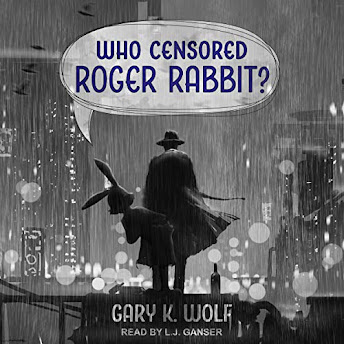
WHO CENSORED ROGER RABBIT (audiobook) by Gary K. Wolf


Book originally published in 1981.
Audiobook edition published in 2019 by Tantor Audio.
Read by L.J. Ganser.
Duration: 7 hours, 36 minutes.
Unabridged.


This book is the inspiration for the much-celebrated Disney movie Who Framed Roger Rabbit? but readers should know that it is not much like the movie.

Three of the main characters are the same - Private Investigator Eddie Valiant, Toon movie star Roger Rabbit and his Toon wife Jessica Rabbit.

But, the world they inhabit is different than the world in the movie. In the movie, Toons make cartoon movies. They are filmed like regular movies. In the book, Toons don't make movies, they make comic books and comic strips. Toons in the book have the little voice bubbles that appear over their heads just like you see in comic books and comic strips. The actors pose for the comic strip pictures and photographers take their pictures.

A quote from the book. Also, a very true statement.
In the book, Roger Rabbit is actually killed and Eddie Valiant is on the case looking for his murderer. There is not Toon World like there is in the movie - Toons just live and work among humans and are certainly second class citizens.

The Toons are a running commentary on the racial situation in the United States and that fact is essential to the book. They were living in North America when colonists from Europe displaced them. They were imported to work on the railroads in the late 1800's. Toons have their civil rights, but when a Toon moves into the neighborhood, people move away and the property values drop. Some Toons are lucky enough to "pass" for human. 

This book is a much darker story than the movie. That doesn't bother me any. But, this story has some unnecessary complicated powers of Toons that make the story line clunky. I think Disney made a lot of improvements when they adapted this story to make the movie. That being said, the book is pretty strong as its own independent work and was a very creative idea.

The audiobook was read by L.J. Ganser who did a great job with a lot of very different kinds of characters, including a lot of Toons who speak in, well, cartoonish voices. 

I rate this audiobook 4 stars out of 5. It can be found on Amazon.com here: WHO CENSORED ROGER RABBIT (audiobook) by Gary K. Wolf.

Featured Post

<b><i>BAN THIS BOOK (audiobook)</i></b> by Alan Gratz

Published in 2017 by Blackstone Audio, Inc. Read by Bahni Turpin. Duration: 5 hours, 17 minutes. Unabridged. My Synopsis Ban This Book is t...

Popular posts over the last 7 days