SILVERFIN: THE GRAPHIC NOVEL (A James Bond Adventure #1) by Charlie Higson and Kev Walker


Published by Disney Hyperion Books in 2008

Silverfin is the first of 9 books in the Young Bond graphic novel series. Bond's parents are dead due to an accident during while exploring. His aunt and uncle (a former spy) have sent Bond to the super-elite boarding school Eton College (ages 13-18) which has long been known as a school for multiple royal families and future military and political leaders. 
One of James Bond's signature lines being used
as he arrives at Eton.

Bond makes one really good friend and also one really devoted enemy who really tries his best to be James Bond's bully. When the term is over, he goes home to the family manor in Scotland and, as happens so often in teen movies and TV shows, he finds out that his wannabe bully lives fairly close by. In this case, the wannabe bully's family just bought a manor in the area. That could be rough - but it turns out that this manor is thought to be the source of a lot of strange activities that have been going on in the area and Bond wants to check it out...

The only real problem that I have with this graphic novel is that it is incredibly fast-paced. Bond makes a friend at school - all we know about him is that he is smart, nice, a bit pudgy and from India. What else about his schooling at Eton? There seem to be a lot of physical contests. I assume that Eton had something to do with Bond's adult adventures.

I also assume that the writers of the first book wanted to emphasize the action and that required a Bond-type villain for Bond to fight and that required the plot to move very quickly in order to do some literary world-building to set the scene. It might have been better to build the world a bit more and then have a small confrontation at the end with the hint of an even larger confrontation to come. But, that's neither here nor there since this book was printed 13 years ago.

All that being said, it was an entertaining story. Notice my complaints with the story are only that it was paced too fast - the underlying story is solid and full of good characters. Kev Walker's illustrations are almost always clear and easy to follow and the multitude of new characters are easy to tell apart. 

I rate this graphic novel 3 stars out of 5. It can be found on Amazon.com here: SILVERFIN: THE GRAPHIC NOVEL (A James Bond Adventure #1) by Charlie Higson and Kev Walker.

THE ANTHROPOCENE REVIEWED: ESSAYS on a HUMAN-CENTERED PLANET (audiobook) by John Green


This collection of essays is, from what I understand, mostly a re-working of essays that Green has published on his blog or his YouTube channel. However, they were all new to me because I haven't seen more than a few snippets of his videos that my oldest daughter has shown me. 

I know a bit about John Green because I live in Indianapolis, which is my adopted hometown just like it is John Green's adopted hometown. Green doesn't go out of his way to make his presence felt in his adopted hometown, but he is our current well-known author, replacing Kurt Vonnegut (1922-2007) with a completely different kind of vibe. Vonnegut gives off a whip-smart angry feeling with sarcasm to spare. Very clever. Green gives off a smart, understanding melancholy feeling. Just as smart as Vonnegut, but different. Vonnegut grew up here and moved away. He was always proud to be FROM Indianapolis but never lived here as an adult. Green grew up other places and is glad to live IN Indianapolis. 

The premise of this book is that it is a series of Amazon-type reviews of items from the Anthropocene Era (a term for the era of Earth since humans arrived on the scene, like the Jurassic or the Cretaceous). Green dislikes the 5 star review system and he assigns the different topics he writes about a different star value.

This collection of essays can be very personal. Green is very open about his personal struggles with depression, a discussion that makes you feel like you are being brought in close, like a friend, as you listen to the audiobook. His style comes off as very conversational, like a friend is telling you a story. All that's missing is the reader occasionally saying things like "Uh-huh" and "Really?" from time to time.

The World's Largest Ball of Paint in Alexandria, IN.
My family painted this yellow layer. Wondering why I
included this picture? It all makes sense if you read
this book. 
Green writes about a wide variety of topics, including the Academic Decathalon, Diet Dr. Pepper, Canada Geese, the Nathan's Famous Hot Dog Eating Contest, Sunsets, CNN, The Smallpox Vaccine, Sycamore Trees, The World's Largest Ball of Paint, Super Mario Kart, Indianapolis, the Indy 500, and Piggly Wiggly. Some are basically information about a topic, some like the Super Mario Kart essay have a nice twist of political commentary at the end that make you think.

This is generally not a funny book, but there are parts that are literally laugh out loud funny. I laughed so hard that I cried during his essay enititled "Mortification". On the other hand, "Sycamore Trees" came very close to making me cry from his poignant commentary on living life with depression. We have a daughter that deals with depression and it struck home to me in a very personal way. When I finished hearing it as I was driving, I immediately called my wife and told her that she had to read it right away.

Highly Recommended. 5 stars out of 5.  I may be coming back to this one in a couple of years for a re-read. 

This book can be found on Amazon.com here:THE ANTHROPOCENE REVIEWED: ESSAYS on a HUMAN-CENTERED PLANET (audiobook) by John Green.

ROBERT E. LEE and ME: A SOUTHERNER'S RECKONING with the MYTH of the LOST CAUSE by Ty Seidule


Published in 2021 by Macmillan Audio.

Read by the author, Ty Seidule.
Duration: 10 Hours, 45 minutes.
Unabridged

I have been studying the Civil War since I was in college 35+ years ago. My thoughts on Robert E. Lee have evolved over the years. I used to be a lightweight proponent of the Lost Cause theory of the Civil War. I never was comfortable with the concept of slaves being content with slavery, but I certainly believed that the Southern officers were generally a noble and heroic lot when compared to the Union officers and the most noble and heroic officer of them all was Robert E. Lee. 

My thoughts the war and Lee have changed as I have read more and gotten older and perhaps a bit wiser. This book will be the 131st book I have reviewed that has been tagged "Civil War" and the 42nd book tagged "Robert E. Lee". I have widened my readings to include more of the Antebellum Period and more of the Reconstruction Era. Reading the Declarations of Causes of Seceding States (documents designed to be much like the United States' Declaration of Independence in 1776) gave me additional insight. I like to think I have picked up a more informed perspective.

Ty Seidule
This mirrors the shift in perspective that the author of Robert E. Lee and Me went through, although his was certainly more dramatic. He grew up in the South and Robert E. Lee was his hero. It was only when he was a history professor at West Point that he started to think about Robert E. Lee and what he actually did.

Seidule doesn't come at this topic as an outsider. He is a retired Brigadier General who served with the 82nd Airborne and as a member of the 81st Armor Regiment. He is a career Army man, something he notes over and over again. But, being a career Army man doesn't mean that he supports everything the Army has ever done - it means that he wants to support what the Army does right and fix what it does wrong and honoring Confederate leaders like Robert E. Lee is certainly wrong.

Seidule notes that moves to honor Confederate leaders tended to follow Civil Rights advances, as a pushback against them. D
espite being a former head of West Point, Lee was practically purged from the facility after the Civil War. But, when black students started being appointed to West Point, Southerners began to push for naming things after Robert E. Lee, mirroring a phenomenon in the larger American culture. 

But, Seidule goes farther and looks at Robert E. Lee as an officer of the U.S. Army. He notes that with every promotion, an officer takes an oath. Lee took this oath many times, including a little more than 3 weeks before the resigned to join the Confederacy (he was promoted to colonel on March 28 and resigned on April 20). Seidule has no tolerance for oathbreaking. He now finds it ironic that he proudly took his first oath at Washington and Lee University next to a memorial to Robert E. Lee.

There is a frequently made argument that Lee resigned to defend his state and that most officers did. Seidule dug through the Army records and discovered there were fifteen colonels from states that seceded in the U.S. Army before the Civil War (remember - the Army was much, much smaller back then). Twelve of the fifteen remained with the Union. Of those fifteen colonels, eight were from Virginia. Only one colonel from Virginia resigned to join the Confederacy - Robert E. Lee. 

Seidule's book looks at the entire "Lost Cause of the Confederacy" phenomenon that excused the Confederacy from any wrong-doing, downplays the central role of slavery in the conflict and similarly downplays the evils of slavery itself.

I leave this review with a comment for Union General George H. Thomas, a Virginian who stayed with the Union, provided an early Union victory, saved the Union Army from certain destruction at Chickamagua, participated in capture of Atlanta and literally destroyed a Confederate Army at Franklin, Tennessee:

[T]he greatest efforts made by the defeated insurgents since the close of the war have been to promulgate the idea that the cause of liberty, justice, humanity, equality, and all the calendar of the virtues of freedom, suffered violence and wrong when the effort for southern independence failed. This is, of course, intended as a species of political cant, whereby the crime of treason might be covered with a counterfeit varnish of patriotism, so that the precipitators of the rebellion might go down in history hand in hand with the defenders of the government, thus wiping out with their own hands their own stains; a species of self-forgiveness amazing in its effrontery, when it is considered that life and property—justly forfeited by the laws of the country, of war, and of nations, through the magnanimity of the government and people—was not exacted from them.

— George Henry Thomas, November 1868


I rate this audiobook 5 stars out of 5. Highly Recommended. 

It can be found on Amazon.com here: ROBERT E. LEE and ME: A SOUTHERNER'S RECKONING with the MYTH of the LOST CAUSE by Ty Seidule.


IN PRAISE of WALKING: A NEW SCIENTIFIC EXPLORATION (audiobook) by Shane O'Mara


Published by Highbridge in 2020.

Read by Liam Gerrard.
Duration: 5 hours, 46 minutes.
Unabridged

I picked up In Praise of Walking because I am a recent convert (the last 4 years or so) to the joys of walking and hiking and have personally seen it change my health. I was hoping to learn some more information about it and experience a bit of confirmation bias from an expert who told me what I already knew - walking and hiking are great forms of exercise with limited chances of injury.

While O'Mara says all of this, I think that this book has been been mis-described in by its publisher. The title is very accurate when it says that this book is "a new scientific exploration." But, the blurb description starts by describing this book as "a hymn to walking, the mechanical magic at the core of our humanity."

Calling it "a hymn" sounds like it is going to be a more literary, story-filled approach to the topic, as authors like Malcolm Gladwell and Mary Roach have done with numerous science topics. Both of them have considerable skill at making obscure scientific concepts very approachable.

If you like those authors, this book may disappoint you. It certainly did disappoint me. 

I had no problem with O'Mara's conclusions - I agree with them wholeheartedly. O'Mara asserts that walks are good for the body and the mind, that walks are a great way to connect to your environment (rural or urban), that walking can be a profoundly social experience and that urban environments must be more friendly to pedestrians.

My problem is that in a nearly six hour audiobook, O'Mara makes those (and similar) points for about half of the book. For the remainder, he often wanders off topic into areas that only vaguely support his thesis. For example, we are told about fish that "walk" for a short period in their lives and then they settle on a spot, attach themselves to a rock and never move from it again. These fish then go through a metamorphosis and absorb their eyes and their vestigial brain. Why are we told this? I think it was to support the idea that you need a brain to walk and walking around may have encouraged human brain development.

Fair enough, but that bit about the fish was tedious to listen to. I think we can all agree that humans have highly developed brains without having to go into the evolutionary steps of how we got here.  O'Mara could just skip into one of his discussions of how the brain maps out its location in the world, or how the brain seems to work better when the body is walking around (the second point was interesting, the first was sort of interesting the first time it was made, less interesting every time that followed). But we could have completely skipped the commentary on the fish that absorbs its own brain.

There was also a long discussion about urban sewage systems and how the 1800's saw a revolution dealing with human bodily waste. All of this discussion was in support of the idea that urban areas need to be more pedestrian friendly. It was a long way to go to make a tenuous connection.

He wandered so far to make these tenuous connections that I often found my mind wandering as I drove and listened during my daily commute. If the audiobook cannot hold my attention, it cannot receive a good rating.

This book just felt like it was a missed opportunity to be so much more. The interesting conclusions were buried in repetitive scientific commentary that wasn't necessarily needed. 

I rate this audiobook 2 stars out of 5. It can be found on Amazon.com here: IN PRAISE of WALKING: A NEW SCIENTIFIC EXPLORATION (audiobook) by Shane O'Mara.

NINE NASTY WORDS: ENGLISH in the GUTTER: THEN, NOW, and FOREVER (audiobook) by John McWhorter


Published in May of 2021 by Penguin Audio.

Read by the author, John McWhorter.
Duration: 6 hours, 52 minutes.
Unabridged.

John McWhorter is a linguist who teaches at Columbia University. He does the nitty gritty linguistic work that professional linguists love to read about, but he also is pretty good at explaining linguistics to the non-professionals as well.

The author, John McWhorter
In Nine Nasty Words, McWhorter explores the origins of nine taboo words in English. Naturally, this brings to mind the familiar cast of "four letter words", but he also looks into other words that are similarly potent, such as the infamous "n word".

I found the book to be entertaining and an accessible look at how language changes over time - and sometimes it changes very quickly. McWhorter cites written sources, music, plays, musicals, TV shows and movies as artifacts to show when the words were used, how they were used and if there was a change in their use. For example, the word a**hole arrived fairly late and then underwent a dramatic change from being a wimp to being an obnoxious person. 

I found this to be a very entertaining audiobook. I rate it 5 stars out of 5. It can be found on Amazon.com here: NINE NASTY WORDS: ENGLISH in the GUTTER: THEN, NOW, and FOREVER by John McWhorter.

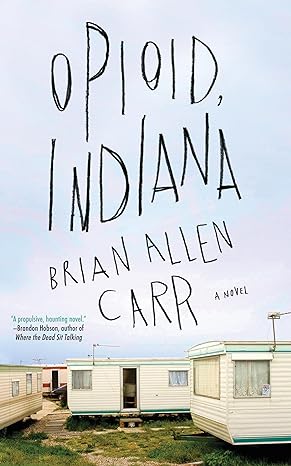
OPIOID, INDIANA by Brian Allen Carr


Published in 2019 by SOHO Press.

I received a gift card from a book store and I decided to get this book by a local author for several reasons: 1) it is set in my area; 2) it deals with the opioid crisis; 3) I like to encourage local authors. 

Turns out that the author is NOT a local (Indiana) author - he is from Texas. Small town Texas and small town Indiana do have a lot in common when it comes to drugs and alcohol, though.

Riggle is 17 years old and lives in a town in central Indiana and suspended from high school for a week due to a suspension for having a vape pen at school. His week won't be used to lay around in bed or play videogames, though. 

Riggle lives with his uncle, his sole guardian after the deaths of his parents and his uncle has gone missing. His uncle's live in girlfriend (not much older than Riggle) has no idea where his uncle is. This is not necessarily an unusual thing - he has been know to abuse substances and go on all night benders, but he's been gone for too long - and the $800 in back rent is due on Friday. If it is not paid, they will be evicted in the middle of winter. 

Riggle has been given two tasks by his uncle's girlfriend - find his uncle and find $800...

The opening chapter in the book was very good, the characters felt and sounded authentic but Riggle's adventures around town got bogged down with a series of stories about how the various days of the week got their names that Riggle's mother had told him before she passed away. I am not really sure what the author was trying to do with these little stories, but I felt like they just disrupted the flow of the story and weren't particularly entertaining. 

I rate this novel 3 stars out of 5. It can be found on Amazon.com here: OPIOID, INDIANA by Brian Allen Carr

THE DESIRE of the EVERLASTING HILLS: THE WORLD BEFORE and AFTER JESUS (Hinges of History #3) by Thomas Cahill


Published in 1999 by Nan A. Talese, an imprint of Doubleday.

The Desire of the Everlasting Hills is the third book in The Hinges of History Series by Thomas Cahill. It is a series of histories that look at important long term movements in history that helped create Western Civilization. 

Nearly 20 years ago I read this book and the second book in this series, 
The Gifts of the Jews and then parked them on a bookshelf. I never read more books in the series and simply forgot all about them. With the pandemic quarantine came a purging of the bookshelves and these books returned to the to-be-read pile. 

Overall, I enjoyed The Gifts of the Jews, despite some slow spots. I had high hopes for this book because I thought it would fit in well with the strongest parts of its predecessor. But, I found this book to be a mostly plodding history with an absolutely excellent and inspiring last chapter attached to it. 

And, I have solved the mystery of why I never pursued the rest of the books in this series 20 years ago.

I rate this history 3 stars out of 5. It can be found on Amazon.com here: 
THE DESIRE of the EVERLASTING HILLS: THE WORLD BEFORE and AFTER JESUS (Hinges of History #3) by Thomas Cahill.

Featured Post

<b><i>BAN THIS BOOK (audiobook)</i></b> by Alan Gratz

Published in 2017 by Blackstone Audio, Inc. Read by Bahni Turpin. Duration: 5 hours, 17 minutes. Unabridged. My Synopsis Ban This Book is t...

Popular posts over the last 7 days