A HOBBIT, A WARDROBE and a GREAT WAR: HOW J.R.R. TOLKIEN and C.S. LEWIS REDISCOVERED FAITH, FRIENDSHIP and HEROISM in the CATACLYSM of 1914-1918 (audiobook) by Joseph Laconte


Published in 2015 by Thomas Nelson.
Read by Dave Hoffman.
Duration: 6 hours, 38 minutes.
Unabridged


A Hobbit, a Wardrobe and a Great War is a decent introductory history of World War I from the point of view of the common English soldier, a decent (but incomplete) look at the philosophical and religious trends of the West before and after World War I, decent introductory biographies of C.S. Lewis and J.R.R. Tolkien and really kind of a pleasant mess of a book.
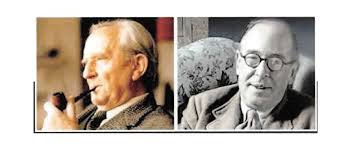
Tolkien (1892-1973) and Lewis (1898-1963)
All of these topics are thrown into the mix in a willy nilly. If that concept bugs you, this is not your book. I found it to be a pleasant enough listen, even if not particularly deep. 

I think the author makes his best points about the complete and utter waste and despair of a World War I battlefield when he compares it to the waste and desolation of Tolkien's Middle Earth battlefields and its heroes. The heroes are not generally the big leaders - they are flawed. They refuse to fight, have preconditions, are misinformed or are so full of their own agendas that the war becomes secondary.

Instead, the true heroes are people like Faramir, the younger brother of the "chosen one" hero whose pride and greed almost ruins the venture from the start. Or, it is 2 little hobbits who no one expects anything from. They literally have no power and yet they convince the very trees of the forest to stride out and destroy one of the enemies' strongholds. Of course, Sam Gamgee stands as the greatest hero of them all in my mind. He is the modeled from the stereotypical British World War I common foot soldier who heads off to fight in the war because it is his duty and keeps slogging all the way through to the end because his friends need him and it is simply the right thing to do. No pretense, just heart.

The connections with C.S. Lewis' fiction were a little less strong for me because I am not as familiar with his work. 

I rate this audiobook 4 stars out of 5. It can be found on Amazon.com here: A HOBBIT, A WARDROBE and a GREAT WAR: HOW J.R.R. TOLKIEN and C.S. LEWIS REDISCOVERED FAITH, FRIENDSHIP and HEROISM in the CATACLYSM of 1914-1918 by Joseph Laconte.

HOW ROBERT E. LEE LOST THE CIVIL WAR by Edward H. Bonekemper, III


Published in 1998 by Sergeant Kirkland's Museum and Historical Society, Inc.

Bonekemper lived the dream of most students of the Civil War - once he retired as an attorney, he created a second career as a Civil War author, college lecturer and a frequent guest on C-SPAN to talk about leadership in the Civil War. He also gave 10 lectures at the Smithsonian!

Bonekemper is an unabashed fan of the Union side in the war, especially General Grant. I reviewed a book he wrote about Grant here. As Bonekemper loves to point out, only 4 armies were captured during the Civil War and Grant captured 3 of them Grant's subordinate Sherman captured the fourth after Lee had already surrendered his army to Grant. The only general on the Confederate side that can compare to Grant is, of Course, Robert E. Lee. Lee is generally celebrated as the best general in the war and Bonekemper dedicates How Robert E. Lee Lost the Civil War to proving that wrong. 

Bonekemper ignores the easiest place to go after the iconic image Lee - his betrayal of his oath as an officer of the U.S. Army to go fight for the Confederacy. Literally, no human being is responsible for more deaths of American soldiers than Robert E. Lee. Instead, he goes after Lee's record as a general on the battlefield - the part that is supposed to be unassailable. 

Bonekemper doesn't argue that Lee's tactical skills on the battlefield weren't formidable and sometimes even brilliant. 

Instead, Bonekemper argues that Lee was a failure when it came to national military strategy for the Confederacy. Lee spent most of the war as CSA President Jefferson Davis's main military advisor - oftentimes the only one Davis took seriously. At the end of the war he commanded every soldier in the entire Confederacy.

Yet, he never left the Army of Northern Virginia to see what else was happening. He never demonstrated that he understood the value of any army other than his own except that they might send him extra troops (which they did on a regular basis. The exception was when he loaned out a chunk of his army with Longstreet for a few months to Braxton Bragg in Tennessee and Georgia. Within a few weeks Lee was lobbying to have them returned)

All Lee had to do was not lose. This sounds obvious, but it is much easier than the North's goal. The North had to actually conquer the South - defeat all of its armies, stop it from operating as a government and take away its ability to keep on fighting. Lee's model should have been George Washington in the Revolutionary War. Washington hung around long enough that the British home front got sick of the war and agreed to terms.

Lee's surrender at Appomattox in April of 1865.
But, instead of fighting for time and playing defense, Lee acted like he was trying to conquer the North. Twice he invaded the North (Antietam and Gettysburg) and twice he was defeated and came back to Virginia with nothing to show for it except the worst losses he suffered in the war. After Gettysburg he never was able to gather enough troops to go on the offense in any meaningful way again. 

The Battle of Chanecellorsville is symptomatic of the problem with Lee. Lee was outnumbered by more than 2 to 1 and still won the battle with a combination of speed, daring and confidence. It is an impressive victory by any standard. But it came at a massive cost. The Union had 17,000 casualties out of 130,000 (13%) that were replaced within weeks. Lee had 12,000 casualties out of 60,000 (20%) that were only replaced by pulling troops away from other fronts and causing them to lose. 

If it costs you a greater percentage of your force to win battles and you have the smaller army you cannot win. Almost every battle Lee fought in could be described in that way. 

Bonekemper argues that Lee ground his army to dust, refused to consider the needs of other theaters and kept fighting for months after it had become obvious that he had no hope of winning the war, costing the lives of tens of thousands of soldiers on both sides.

The research is impeccable and the facts become overwhelming as the pages go rolling along. It almost becomes tedious - another battle, another costly win (usually) that bled away irreplaceable men for a win that did little to further the war effort. Meanwhile, Generals Grant, Sherman and Thomas chewed up every army in the West, conquered or cut off every state except for Virginia and North Carolina until Lee finally surrendered.

Ironically, if Lee had stayed with the Union, the rumor was that he would have been offered the command of Union forces. He would have been the general that that army desperately needed - not afraid to attack, not afraid to strike the enemy to win the war and he would have had the extra men and resources that his fighting style required. It might have been a short war.

5 stars out of 5 because it proves a long-needed point.

This book can be found on Amazon.com here: 
HOW ROBERT E. LEE LOST THE CIVIL WAR by Edward H. Bonekemper, III.

MIRACLE on the 17th GREEN by James Patterson and Peter de Jonge


Originally published in 1996 by Little, Brown and Company.

The high school I teach at is in the midst of library book purge. I have no idea why Miracle on the 17th Green was ever in a high school library because it is aimed at adults. I don't mean that it has "adult themes" like a movie might label them (drugs, sex, violence, etc.), I mean that it has adult themes like questioning whether you have made the right choices in life, which comes first - family or career? Is it okay to put your family at risk just to achieve your personal goals, especially when they are a long shot?

I really enjoyed this book despite never having played even one hole of real golf (I have played plenty of putt-putt golf, but that doesn't really apply, does it?). It didn't really matter - the story was compelling and I faked my way through the golf stuff.

James Patterson has a long history of co-writing books. I always figure he's lending his name to up and coming authors in exchange for a little bit of co-writing, a lot of advising and a paycheck. This book was his first co-writing venture and Patterson and de Jonge have co-written 5 books in total.

I rate this book 5 stars out of 5. It can be found on Amazon.com here: 
MIRACLE on the 17th GREEN  by James Patterson and Peter de Jonge.

Note: there are 2 sequels that were added to this book to make a trilogy in 2105 and 2019. I am not going to read them because this book ended at a good place.

SPACE COWBOY by Justin Stanchfield


Published in 2008 by Usborne Publishing, Ltd.

In Space Cowboy, Travis McClure is a teenaged cowboy with a horse named Deuce. He's good at his job and starting to work more and more on his own and he really enjoys being trusted with more responsibility, even if the work is hard and mostly boring. If they make enough money his family can finally return to their own ranch on Earth and make a go of it.

You see, Travis and his family are part of a terraforming operation in a future where human beings are starting to move out into the galaxy. They are on Aletha Three, a planet with a climate and atmosphere similar to Earth's. Terraformers bring a few animals, a few planets and try to jump start a biosphere by spreading grass the old-fashioned way - by having animals eat the seeds and spread them in their manure. Or, as the book more delicately describes it: "On Earth, animals like wild bison and wild horses had once covered the grasslands, their hoofs churning the barren soil like a million tiny plows, spreading seed as they moved. Here, the scattered herds of hardy, more manageable cattle served the same purpose."

The planet was supposed to be confirmed lifeless before they started, but Travis has a feeling that there is something very dangerous out there. It's bigger than the coyotes that were brought along and it sometimes screeches in the canyonlands when Travis is alone moving the cows along.

When he finally sees it, everything will change...

This was an enjoyable YA novel. There is nothing here but a lot of adventure and the promise of a bit of romance, but it was still a fun read. Don't think too hard, just go along for the ride.

I rate this novel 4 stars out of 5. It can be found as a kindle e-book on Amazon.com here: SPACE COWBOY by Justin Stanchfield.

TULAROSA (audiobook) (Kevin Kerney #1) by Michael McGarrity


Published by Recorded Books in 2012.
Read by George Guidall.
Duration: 8 hours, 16 minutes.
Unabridged.

Tularosa features Kevin Kerney, a retired police detective living in New Mexico.

His former partner has come to him with a plea for help. His former partner's son (Kerney's godson) has gone AWOL from White Sands Missle Range in New Mexico. He had been a model soldier up to the time of his disappearance with clear plans to attend art school once he left Army career. 

Here's the difficulty. It wasn't Kerney's choice to retire - he was at the top of his game when he was shot twice in the line of duty in his gut and his knee. This happened because his partner and best friend was out of place -- drinking. 

It has been three years. It took Kerney a long time to physically and mentally rehabilitate and he never forgave his former partner for letting him get hurt.

Kerney is not asked to forgive his former partner, but to put aside his dislike to go and find his godson.

Kerney agrees and finds a whole lot more than he expected...

I really enjoyed veteran audiobook reader George Guidall's reading of the book - he is a classic narrator who set a high standard for all that followed. He has read more tham 1,200 audiobooks and did a good job with this one.

Well, he did as good job as one could with this book. The first half of the book was very good, but somewhere near the halfway point McGarrity started splitting the point of view that the story was told from more and more often (it had primarily been told from Kerney's point of view in the first part of the book) and it takes a lot of the steam out of the story. The mystery is removed from a story and then the book simply becomes a question of HOW the bad guy gets caught by the good guy and not IF the good guys can work out the mystery. It's too bad because McGarrity has one very good surprise twist in the middle that I did not see coming but he doesn't keep up with it.

I rate this audiobook 3 stars out of 5. It can be found on Amazon.com here: TULAROSA by Michael McGarrity.

DIVIDED WE FALL: AMERICA'S SECESSION THREAT and HOW to RESTORE OUR NATION (audiobook) by David French


Published in September of 2020 by Macmillan Audio.

Read by Sean Patrick Hopkins and David French.
Duration; 7 hours, 18 minutes.
Unabridged.

David French is, like me, a Never Trump Republican, which means he is a man without a party right now. French starts Divided We Fall with some observations that rang very true to me. For example, he noted that while he was still a part of the two party system, he didn't really think about the automatic intensely negative reaction both sides have to the other side's proposals. The other side isn't just misinformed, they are evil. They are not just mistaken, they are trying to overthrow America and all of its institutions. They want to murder us in our sleep by taking away our rights. They HATE us.

The author
It doesn't matter which side is the "they" and which side is the "us" - it is the same argument, it is a dangerous pattern and it threatens to tear the country apart as we self-segregate into communities that tend to think alike and sometimes literally don't know someone from the other party. 

The middle part of the book consists of possible scenarios that could cause a secession crisis. They are not meant to be literal predictions. Rather, they are possible futures in which one region becomes so disenchanted that it attempts to secede and what that means for national politics, the national . This section was valuable but it was stretched out way too long.

His answer to the problem (a renewed commitment to federalism and states' rights combined with an ironclad guarantee of the rights of minorities in every state) is probably the only real solution to the problem, but it will not be easy.  

This book is well worth reading, but the section with multiple secession scenarios was simply too long and almost felt like French was padding the book to achieve a pre-specified length. Also, what does it say about our the state of American politics right now when a book published in September of 2020 already felt a little dated because of the election of in November, the refusal to accept the result of the election throughout December and the January 6 attack on the Capitol Building?

I rate this audiobook 4 stars out of 5. It can be found on Amazon.com here: DIVIDED WE FALL: AMERICA'S SECESSION THREAT and HOW to RESTORE OUR NATION by David French.

EVERYWHERE that MARY WENT (audiobook)(Rosato and Associates #1) by Lisa Scottoline


Originally published in 1994.

Audiobook version published in 2016 by HarperAudio.
Read by Teri Schnaubelt.
Duration: 9 hours, 5 minutes.
Unabridged.


Back in the 1990's, I worked at a used book store. A copy of Everywhere That Mary Went came in. I was intrigued so I read it.  After that, whenever a fan of legal thrillers would come in and ask if we had anything new or a little different I'd hand them that book. Soon enough, we were sold out and we kept on selling them whenever they came in. I even talked a group of ladies to use it for their book discussion group and they loved it. I sort of feel like I had a part in promoting Lisa Scottoline when she was starting out.

Eventually, this one book grew into a series of eleven books and I read most of them (maybe all of them - it's been a while). 

While I was scrolling through my possible choices of my next audiobook, I decided to go back and revisit this series. 

Mary DiNunzio is a lawyer from a working class background about to make partner in a fancy Philadelphia law firm. Things seem to be going well for her, except for the strange typewritten letters and the hang up phone calls at home and at the office. Also, there's the car that seems to be following her. Is it her imagination? Is it related to one of her cases? Is it from one of the other lawyers trying to make partner? Is it the creepy judge? Her supervisor?

I liked the audiobook, but I remember absolutely loving this book 25 years ago. It had funny scenes and endearing characters and it had been so long that I really didn't remember the plot at all. 

I rate it 4 stars out of 5. 

This book can be found on Amazon.com here: 
EVERYWHERE that MARY WENT (audiobook)(Rosato and Associates #1) by Lisa Scottoline.

Featured Post

<b><i>BAN THIS BOOK (audiobook)</i></b> by Alan Gratz

Published in 2017 by Blackstone Audio, Inc. Read by Bahni Turpin. Duration: 5 hours, 17 minutes. Unabridged. My Synopsis Ban This Book is t...

Popular posts over the last 7 days