1942: THE YEAR THAT TRIED MEN'S SOULS by Winston Groom


Originally published in 2004.


Winston Groom is best known as the author of Forrest Gump. He is also the author of 14 different non-fiction books and shows a real talent for writing narrative history.

1942: The Year that Tried Men's Souls focuses on the year that Groom considers to be the crisis year for the Allies and America in particular in World War II - 1942.  He starts his story just before World War II with the attack of Pearl Harbor on December 7, 1941 and ends it in February of 1943 with the ending of the fighting on Guadalcanal.

This was a bad time, especially early in 1942 when Japan conquered one territory after another and American forces were seemingly caught off guard or under-prepared everywhere.

Groom focuses primarily on the Pacific Theater in this book (75 % or more), although he does offer a decent look at the North African campaign. His look at the fall of the Philippines and the Bataan Death March was very compelling.

Groom has no problem pointing out incompetent leadership when he sees it. He also looks at the American home front, describes in detail the work to figure out Japan's secret code and how that successful effort affected the war.

Claire Phillips (1907-1960)
Groom likes to point out the stories of individuals in the middle of the war. He looks at a couple of pilots who took part in an extraordinary escape from a Japanese prison in China and eventually worked their way all of the way to India. He also looks at non-military people, like Claire Phillips, a night club owner in the Philippines who provided information to anti-Japanese forces and helped to sneak food and clothing into a Japanese-run POW camp of American soldiers. She believed her husband was in the camp, but continued to help after she discovered he had been dead for months. Her nickname was "High Pockets" because she used her bra to store money and useful information.

Very readable, informative and well-done.

I rate this book 5 stars out of 5. It can be found on Amazon.com here: 1942: THE YEAR THAT TRIED MEN'S SOULS by Winston Groom.

THE CHRISTMAS SCORPION (Jack Reacher #22.5) (kindle) (short story) by Lee Child


Published in 2018 by Delacorte Press.


In this 26 page short story, Reacher is near Barstow, California. He always heads south for the winter and he assumed that Barstow would be south enough to avoid the winter cold. But, a once-in-a-lifetime blizzard hits the area, the power is cut off, the phones are down and Reacher is walking through three feet of snow along an impassable highway (to cars, at least).

He stumbles upon a bar and inside finds a bartender an older couple and two

British soldiers...

The Christmas Scorpion
is exclusively published as an e-book. Lee Child was a prolific author (he has since retired) and it is not uncommon for him to generate additional short stories featuring Jack Reacher. These short stories are a mixed bag, at best.

I don't know Lee Child's writing process. Some authors plan out every detail meticulously before they start writing, others claim to make up the entire story as they go along - they are finding out what happens as they write. If Lee Child writes uses the second model, many of his short stories feel like novels that he started but just didn't build enough momentum to become full-fledged novels.

This short story would not be a good place to start with Jack Reacher. If you are a big fan of this series, you might consider reading it just to check it off of your list. It only costs $1.99 of Amazon. I borrowed from my local library on its e-book platform.

I rate this book 2 stars out of 5. I think it could have been expanded into more, but it wasn't so there it is - an interesting start with a hurried ending.


It can be found on Amazon.com here: The Christmas Scorpion by Lee Child.

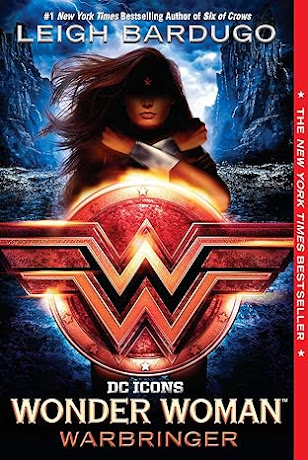
WONDER WOMAN: WARBRINGER: DC ICONS (audiobook) by Leigh Bardugo


Published in 2017 by Listening Library.
Read by Mozhan Marno.
Duration: 11 hours, 56 minutes.
Unabridged.

D.C. Comics' DC ICONS series creates a new YA version of their flagships character's origin stories. DC went out and found established YA authors and let them do their thing in books like Wonder Woman: Warbringer.

Leigh Bardugo is an established YA fantasy author and she brings that vibe to

the story of Princess Diana of Themyscira, the character who will eventually be better known as Wonder Woman.

Diana is a teen that lives on the island of the Amazons - female warriors who died in battle but were reborn on Themyscira, where they can no longer intervene in the lives of mortals. Her mother is the queen of the island. Diana witnesses an explosion of a ship off the coast of Themyscira and breaks the rule of non-intervention by rescuing the sole survivor, a teenage girl and brings her back to the island.

And then everything started to fall apart...

This book borrows a lot on themes of Greek mythology without feeling the need to be beholden to it. It has a nice surprise twist at the end but it moves a little slow at about the 1/3 mark. That makes for a rating of 4 stars out of 5.

Mozhan Marno read the audiobook and she did a great job of creating different voices and creating a sense of drama. The action scenes had a lot of zing and she helped create that.

This audiobook can be found on Amazon.com here: WONDER WOMAN: WARBRINGER: DC ICONS (audiobook) by Leigh Bardugo.

CLEANING the GOLD: A JACK REACHER and WILL TRENT SHORT STORY by Karin Slaughter and Lee Child


Published in 2019 by HarperAudio.
Read by Eric Jason Martin and Jeff Harding.
Duration: 2 hours, 4 minutes.
Unabridged.


The title says this is a short story, but the print version of Cleaning the Gold is 129 pages and I would call that a novella.

Karin Slaughter's Will Trent character works with the Georgia Bureau of Investigation. He is working on a cold case murder based on the activities of the very first Jack Reacher novel, The Killing Floor. Trent is looking for Jack Reacher based on a 20 year old DNA sample.

Reacher is working in Fort Knox and Trent assumes an undercover identity to
Pallets of gold in Fort Knox - they are featured
in the audiobook.
find him...

The book is all written in third person with Slaughter writing the Will Trent sections and Child writing the Reacher sections.

Lee Child is one of my favorites, but Karin Slaughter is certainly not. In fact, she's one of the few authors I refuse to read any longer. Just to compare, including this review I have reviewed 26 Jack Reacher books or short stories and just 3 Karin Slaughter books. This novella suffers from being mostly written by Karin Slaughter.

The readers were okay. One read for Will Trent, the other for Jack Reacher. The reader for Jack Reacher was doing his best to sound like Dick Hill, the reader that has read most of Lee Child's audiobooks.

In the end, this wasn't much of a story. There were amusing observations about Jack Reacher, but the story wasn't much. Reacher did most of the work and even then they made leaps of deduction that I couldn't fathom.

I rate this audiobook 2 stars out of 5 (mostly because of the aforementioned observations about Reacher and the fact that I learned a few things about the gold reserves at Fort Knox. I can only recommend it if you are trying to round out your Jack Reacher or Will Trent collection. This audiobook can be found on Amazon.com here: CLEANING the GOLD: A JACK REACHER and WILL TRENT SHORT STORY by Karin Slaughter and Lee Child.

AMERICAN HERITAGE: GREAT MINDS of HISTORY interviews by Roger Mudd


Published in 1999 by Wiley and Sons.

Roger Mudd, formerly of CBS and NBC news, interviewed five historians about their special topics of expertise. They are all solid interviews that allow the historians to tell why their topics are important. Mudd does a great job of letting the interviews flow along a natural conversational path, but he does interrupt with questions that ask for clarification or challenge a point.

The historians are: Gordon Wood discussing the American Revolution; James McPherson discussing the Civil War; Richard White discussing Westward Expansion; David McCullough discussing the Industrial Era; and Stephen Ambrose discussing World War II/Eisenhower/Nixon.

This was a lot like sitting down with a talented professor in a coffee shop and letting him/her go on about their favorite topic. They weren't lectures, but more like a conversation. I know the work of four of these five historians and have read quite a bit of McCullough, Ambrose and McPherson.

McPherson is my favorite of these three since he and I share a deep interest in the Civil War. I was surprised to learn that he came to study the Civil War later than I thought. McCullough's interview is interesting because of his wide-ranging interests. He discussed the Industrial Era, but he has done a lot of work outside of that time as well, including a great biography of Truman and a history of just the year 1776 during the American Revolution. Ambrose's interview very much felt like my previous impressions of Ambrose - great historian, occasionally a prickly personality.

I rate this book 5 stars out of 5. Very enjoyable read. It can be found on Amazon.com here: AMERICAN HERITAGE: GREAT MINDS of HISTORY interviews by Roger Mudd.

LIVING DOLLS: THE RETURN of SEXISM by Natasha Walter


Published in 2010 by Virago Press.

Natasha Walter is an English feminist who is looking at how modern culture treats women. She has two main points in Living Dolls: The Return of Sexism. I will reverse the order of their presentation in my review.

Her second main point is the new belief in biological determinism, meaning men and women have areas that they are naturally better at - and that fact overrides everything.

She notes that the scientific studies that this belief is based on have never really
The author, Natasha Walter
been scientifically proven, meaning that they were limited and not replicated on a regular basis. Some have never been replicated even once.

The danger is that people just assume things like "girls aren't good at math" and "men can't take care of babies or children" and they become reality. I see it in the classroom all the time - parents tell their kid they struggled with a certain class and they understand if the kid struggles and the kid struggles. It's a self-fulfilling prophecy.

The main point that she presents at the beginning of the book is more complicated and controversial. She laments that modern Western culture's willingness to affirm female sexuality has, all too often, been appropriated by men to promote male sexual fantasies. She interviewed a lot of women for this book and makes a compelling argument that men have co-opted this idea to encourage women to strip, pole dance, make porn movies and basically do over thing that used to be considered damaging to women -all in the name of feminism.

Her argument is not that female sexuality is a bad thing, but rather that it has become, for too many, the only tool that women have to get ahead. Or, going back to that theme of a self-fulfilling prophecy, too many women think that sex is their only way to get ahead in the world.

She hints at, but never quite labels another way these two thoughts go together. Could it be that the biological determinism theme is reinforcing her argument from the beginning of the book by taking options away from women so that they feel that they have to fall back on sex to get ahead?

This was an interesting book, even if I am reading it as an outsider (being a male). I flew through it. I rate it 5 stars out of 5. It can be found here: LIVING DOLLS: THE RETURN of SEXISM by Natasha Walter.

THE STORY of the CHEROKEE PEOPLE by Tom B. Underwood


Originally published in 1961.


According to the price tag on this book, I picked it up at a souvenir store in The Great Smoky Mountains National Park. I couldn't tell you when for sure, but my best guess is that it was about 45 years ago. This is a small book, almost like a large children's book, so it just moved along with me wherever I went and I never read it until now.

The cover of the book is deceiving. The cover looks like it was written for small


children (that is most certainly how I acquired it) but the pictures in the book are much more detailed and complicated, much more like those found in an old-fashioned encyclopedia or an old-style museum. The text is certainly not written for small children, although it does have a slightly paternalistic tone. It feels dated.

The one really strong feature to this book is a seven page testimony about the Trail of Tears from Private John Burnett. Burnett was ordered to accompany the Cherokee because he could speak their language. The inclusion of his story brings the rating for this book up to 3 stars out of 5.

This book can be found on Amazon.com here: The Story of the Cherokee People by Tom B. Underwood.

Featured Post

<b><i>BAN THIS BOOK (audiobook)</i></b> by Alan Gratz

Published in 2017 by Blackstone Audio, Inc. Read by Bahni Turpin. Duration: 5 hours, 17 minutes. Unabridged. My Synopsis Ban This Book is t...

Popular posts over the last 7 days