FUNNY, YOU DON'T LOOK AUTISTIC (audiobook) by Michael McCreary


Published by Annick Press in 2019.
Read by the author, Michael McCreary.
Duration: 3 hours, 37 minutes.
Unabridged.


Michael McCreary is a pretty unique thing in this world - a stand-up comic who is on the autistic spectrum. He uses the word Asperger's to describe himself in promotional materials.

But, one of McCreary's points in this book and in his shows is that he is not all that unique. People on the autistic spectrum are not necessarily like the Dustin Hoffman character in Rain Man. McCreary cautions his readers not to assume too much and think that everyone is on the autistic spectrum. He has compulsive behaviors that are more than the average person would experience.

McCreary has some genuinely funny moments in Funny, You Don't Look Autistic, but for me I got the most out of this as a teacher. It is not unusual to have students on the spectrum in my classes, and listening to this very self-aware talkative former student talk about his experiences shed a little light on the matter. It's not like I can go up to one of my students and say, "Hey, you're autistic. How's that going for you?"

On the other hand, this memoir felt like it was just too rushed, and that falls right back to McCreary's compulsive behaviors. Once he gets an idea in his head, he pushes forward until he gets it done. I can see him wondering what he could do besides act and perform stand-up and this book idea just popped in his head. After all, comics write books all of the time.

The author, Michael McCreary
The problem is, McCreary isn't even 30 years old. He's not even close to 30 years old. Some of the things that he talks about are interesting and many of his stories would certainly not make the cut or even be considered if a 50 year old Michael McCreary was writing this book. Most are cute, but not compelling. He simply hasn't lived enough of a life to fill a book with compelling stories, even a little 176 page book.

So, in the end, I rate this book 3 stars out of 5. It has its moments, a few funny lines and a tough story towards the end, but it still isn't must-read material. It can be found on Amazon.com here: FUNNY, YOU DON'T LOOK AUTISTIC by Michael McCreary.

Great quote from the book: "Every time a system is changed for the better, it's because of someone saying, 'I have a problem,' loudly enough."

ROANOKE: THE MYSTERY of the LOST COLONY by Lee Miller


Published in 2007 by Scholastic Nonfiction.
Suggested for readers grades 9-12
.

I've read my fair share of articles about the lost colony of Roanoke. They all have a similar story line. They tell the story from the colonists' point of view. And why wouldn't you tell it that way? It's a compelling story when it is told that way. Roanoke: The Mystery of the Lost Colony comes at this story differently - it incorporates the court politics back in England and the mixed motivations for creating the coloy in the first place.

If you are not familiar with the story. Roanoke was England's first serious attempt to put a colony in the New World. It originally had a duel purpose. The first was simple enough. Sir Walter Raleigh had legal claim to the land as part of an inheritance, but only if he could establish a permanent colony on it by 1591. It was an immense piece of property, if he could keep it. It would have included all of the North American coast north of Spanish Florida and south of Newfoundland.

The second purpose of the colony was to provide a protected port to allow English ships to attack Spanish galleons full of gold, silver and other riches. The barrier islands of North Carolina looked like a perfect fit.

But, Raleigh was not allowed to supervise the colony because he was required to stay in the Queen's court, at her request (or demand - she was a queen, after all). So, he sent out a military-type expedition in 1585. It failed, but it did offer some valuable information for the next attempt in 1587. 

A painting by John White. 

John White participated in the 1585 venture as the expedition's artist. His paintings and maps fill this book and most are quite beautiful. in 1587, White led the second attempt to start a colony. If you have studied the original English colonies, you will recognize the familiar pattern - the colony struggles with the local environment and the local people, sends for more supplies and more people and will go on to grow and prosper.

Except that Roanoke sent for more supplies and more people but none were sent out to reinforce the colony...

As I alluded to above, most stories of Roanoke spend a lot of time looking at where the missing colonists might have gone but gloss over why the English never sent more supplies and more people. Lee Miller focuses on the intrigue in the Elizabethan Court and how Raleigh was prohibited from sending out relief supplies. I thought this was a fascinating take on the story. It becomes a story of backroom deals, spies, betrayal and desperation.

John White was convinced to leave behind his family in late 1587, including an infant granddaughter, to personally ensure that the relief supplies were delivered and he was stymied at every turn. By the time he returned almost three years later the colony was gone with only a couple of mysterious clues as to where they may have gone. They were never found and England didn't successfully plant a colony until 1607.

I rate this book 5 stars out of 5. It can be found on Amazon.com here: ROANOKE: THE MYSTERY of the LOST COLONY by Lee Miller.

HERODOTUS: ON the WAR for GREEK FREEDOM. Translated by Samuel Shirley and James Romm. Edited by James Romm.


Published in 2003.

Originally published about 440 B.C.


Herodotus, if you don't know, is widely considered to be the West's first historian. He investigated and wrote about the rise of the Persian Empire and the Greco-Persian wars that came as a result of a struggle over Hellenic city-states on the Mediterranean coast of modern-day Turkey. Persia took them over and Athens inspired them to rebel, only to be re-conquered. After that Persia led three separate invasions of modern-day Greece by land and by sea, taking Athens twice but eventually being defeated all three times.
Herodotus (484-425 B.C.)


There are many familiar stories in Herodotus: On the War for Greek Freedom, including the Battle of Marathon (the inspiration of our modern marathon run because a soldier ran the 26.2 miles from the battle to Athens to tell the results of the battle and then died) and the Battle of Thermopylae where the 300 Spartans held off a massive Persian army.

Herodotus also attempts ethnographic studies of several cultures in from Egypt all of the way to the Black Sea. Some are pretty accurate from what we know nowadays, some are clearly quite ridiculous.

The editor, James Romm, edited Herodotus' nine volume set of histories to include just the background for the Greco-Persian wars, the three invasions and a little of the aftermath. Often, he includes a well-written summary to bridge together the pieces. It is intended as an introduction to Herodotus.

I am rating this book 4 stars out of 5. I found Herodotus' style to be a little stilted, much like reading the historical books of the Old Testament, like 1st and 2nd Kings. Sometimes, the stories have real zing, sometimes they're tedious description. Nonetheless, the sheer importance of Herodotus (his name came included in my spell check) and his work makes me raise my rating to 4 stars.

This book can be found at Amazon.com here: HERODOTUS: ON the WAR for GREEK FREEDOM.

A PILGRIMAGE to ETERNITY: FROM CANTERBURY to ROME in SEARCH of a FAITH (audiobook) by Timothy Egan


Published by Penguin Audio in 2019.
Read by the author, Timothy Egan.
Duration: 12 hours, 42 minutes.
Unabridged.


At the beginning of this pilgrimage, author Timothy Egan describes himself as a lapsed Catholic, perhaps even an agnostic. He was raised Catholic in Washington State and decided to go on a long-established pilgrimage route called the Via Francigena to contemplate his faith and how the church has betrayed its own faithful with the ongoing sexual abuse scandal.

The Via Francigena runs from the cathedral at Canterbury in England, through France and Switzerland into Italy and ends in Rome at the Vatican. It is one of the most established pilgrimage routes in Europe, but not as well known as the Pilgrimage of Compostela in Spain. 


Egan gives the listener little history lessons as he tells the story of his own pilgrimage through Europe. Those are usually interesting and informative. He tells his thoughts about faith and Christianity as he travels as well. When possible, he initiates discussions with the clergy as he travels. Sometimes, that works out well, other times you wonder why the clergyman became a minister. His best discussion is with a Lutheran minister in Switzerland.

While he is a lapsed Catholic, Egan does not focus solely on Catholicism. He discusses the Anglican Church, the French Huguenots, Martin Luther, and John Calvin as well. He is fair with Martin Luther, discussing the good and the bad. John Calvin gets bad marks most of the way around, but that is par for the course (and well-deserved, in my opinion).

While I enjoyed the history lessons, religious discussions, including discussion of Egan's struggles with the faith, his mother's faith and how he saw her relationship with the church and his discussions with his wife and children, I did not enjoy the culinary information that he threw in as well. It was an extra layer of detail that didn't fit with the overall theme of the book. Religion and historu go hand in hand. Religion and discussion of pasta don't. It just bogged the book down, in my opinion.

The audiobook was read by the author, Timothy Egan. He was so good that I didn't realize that he read his own book until I looked up the information to write this review.

I rate this audiobook 4 stars out of 5. It can be found on Amazon.com here: A PILGRIMAGE to ETERNITY: FROM CANTERBURY to ROME in SEARCH of a FAITH by Timothy Egan.

THE RUNNING MAN by Stephen King writing as Richard Bachman


Originally published in 1982.

Published in 2010 by Simon and Schuster.

Read by Kevin Kenerly.
Duration: 7 hours, 42 minutes.
Unabridged.


Stephen King's long and storied career is legendary. At this point, he has 61 novels, including 7 written under the pen name Richard Bachman. At first, he wrote books under the Bachman pen name because the publishing industry had a rule of thumb - no more than one book per year per author. Clearly, with a prolific author like Stephen King that rule would be problematic. This edition of The Running Man includes an essay by Stephen King that talks about Richard Bachman and his relationship with his pen name.

The Bachman books have a darker tone than the Stephen King books by design. The Running Man has a particularly dark tone. Set in 2025 in an alternate history (even though it was written in 1982, it refers to things in 1978 that did not happen) in which America has become a corporate oligarchy.

The economy is ruled by a company called General Atomics (presumably a mixture of General Electric and General Motors) and the Games Network. 
Every house, every apartment, every hotel room, no matter how broken down, is wired with a working cable TV system called Free-Vee. The Games Network runs a series of violent, often deadly, game shows that are designed to keep the great underclass entertained and quiet (think: Roman "Bread and Circuses").

Ben Richards lives in a horrible neighborhood called Co-op City. He can't get work because he has been blacklisted for complaining that his job at General Atomics was giving people radiation 
poisoning. His wife can only earn money through prostitution and they desperately need money. Their 18-month child, the only child they will ever have because Ben is now sterile due to radiation poisoning, is dying from pneumonia. Any decent medicine costs more than they have any hope of scraping together.

Ben decides to try out for one of the game shows. His surly attitude, intelligence and physical stature qualify him for the most lucrative and most dangerous game show: The Running Man. In this show, the contestant becomes an enemy of the state and is given a 12 hour head start before the Games Network releases its crack team of investigators and killers. Anyone who gives the Games Network information leading The Running Man's death or capture will receive a big reward, including police officers. The longer he runs, the more money he makes. If he makes it 30 days, he will receive $1 billion. No one has ever made it more than 8 days, 5 hours.

But, then again. no one's every had to go up against Ben Richards before...

This is a tough book. It is unrelentingly depressing, even for a novel featuring a dystopian future. Ben Richards is an impressive, but generally unlikable character. For me, the most interesting thing was the gradual revealing of the larger setting of America in 2025.

Kevin Kenerly read the book and did an excellent job.

Note: this book does not follow the same plot as the Arnold Schwarzenegger movie of the same title. That book was the inspiration for the movie, but, at best, you could argue that they could have taken place in the same universe.

I rate this audiobook 4 stars out of 5. It can be found on Amazon.com here:  THE RUNNING MAN by Stephen King writing as Richard Bachman.

Note: In November of 2023 it was announced that the group Moms for Liberty had challenged hundreds of books in Florida. This book was one of those books. Learn more about the list here.

NEVER ALONE: A PERSONAL WAY to GOD by the AUTHOR of JOSHUA by Joseph F. Girzone


Originally published in 1994.

Joseph F. Girzone (1930-2015) discusses faith, prayer and God in this short book. Girzone is best known for his book Joshua, a powerful and effective re-telling of the Jesus story in the modern world. NEVER ALONE: A PERSONAL WAY to GOD is a pleasant read, but it doesn't deliver the emotional impact of Joshua.

For me, the strongest part of the book was his discussion of how the modern church is great on staking out positions on social issues, but they miss "...the fundamental purpose of religion, to foster and mold spirituality among its members..." and "...to teach their people the ways of prayer and how to develop a deeper intimacy with God." (p. 8)

He continues, "We are brought up to follow unquestioningly the practices of our religion, whatever our denomination." This has value, but too often we "...are not familiar with the message as Jesus delivered it." Following the practices of a religion are a "way of life" but "...not an immediate personal relationship with Jesus." (p. 24)

The author
Girzone goes into his personal story, which has a lot of twists and turns. He planned to go a certain way his career as a Catholic priest, but it didn't work out that way. At age 51, he was forced to retire due to health reasons. Ironically, that is when he became a much more effective minister through his books, beginning with his 1983 book Joshua. He continued on with more than 20 books, a movie, a center to teach people all over the world about Jesus, and a philanthropic foundation.

Girzone also writes about spiritual maturity and how it is achieved. If you are searching for a quick arrival at spiritual maturity, that is not the way it works. It requires "dark nights and humbling experiences" that change "our attitudes toward ourselves and toward others." Those experiences teach us about our own frailties and give us "a new appreciation of other people's struggles and experiences. This gives us a tolerance and an understanding we did not have before, and deepens our compassion for the pain and anguish others are going through on their way to God." (p. 110)

I rate this book 4 stars out of 5. It can be found on Amazon.com here: NEVER ALONE: A PERSONAL WAY to GOD by the AUTHOR of JOSHUA by Joseph F. Girzone.

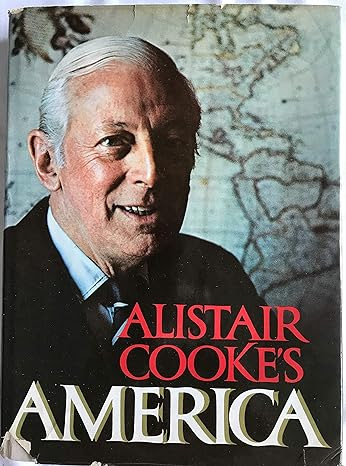
ALISTAIR COOKE'S AMERICA by Alistair Cooke


Published in 1973.

In 1973, undoubtedly to prepare for the upcoming 1976 bicentennial of the American Declaration of Independence, BBC reporter and author Alistair Cooke released a book and a television mini-series telling the history of the United States to the U.K. The book and the series came to America as well with the book selling nearly 2 million copies. This massive "coffee table" type book has 393 pages and weighs in at 3 pounds, 9 ounces (compare that to a random paperback book I weighed at just 5 ounces).

Photo by Lewis Hine
Cooke presents a straight-forward history of America, skimming over lots of details but getting the highlights. This has to be the case when you cover more than nearly 500 years of history in less than 400 pages. He focuses half of the book on the exploration/colonial/Revolutionary War/Constitutional era and it is by far the strongest part of the book.

This book is filled with beautiful, sometimes profound photographs. On pages 312-313 there is a two page spread of a lynching. Cooke claims that "no one knows who took this picture, or exactly when." (p. 311)   It was taken by Lawrence Beitler in Marion, Indiana on August 7, 1930. Beitler sold this photo for 10 days straight to sell as souvenirs of the lynching. Here is a link to a great book on the topic: 
A Lynching in the Heartland: Race and Memory in the Heartland by James H. Madison. Here is a link to the Wikipedia page on this lynching: Lynching of Thomas Shipp and Abram Smith.

The photograph of the girl working in a clothing factory in North Carolina is another great photograph in book full of great paintings and photographs. I have included it in this review.


It is very readable, but clearly a product of its time, and Cooke is a reporter, not an historian. The book has a bit of a racist feel to it. For example, when discussing where the United States lays on the globe (not too hot, not too cold), he notes: "...the United States spans the limits of the climates that white men can live and work in." Cooke mostly skips over the Native American civilizations that inhabited the Americas before Columbus. He spends almost as much time discussing entertaining but mostly nonsensical theories about the Phoenicians settling in the Americas as he does the actual Native American civilizations themselves. Cooke's reasoning is that he is covering a history of the United States itself, so Native Americans get the short end of the stick, except as an impediment to American expansion for the first 2/3 of the book.

Cooke does a similarly poor job dealing with African Americans, a group that he cringingly calls "the blacks" throughout. 
He does, however, clearly observe (in a clunky manner) that slavery and the continuing racial prejudice against African Americans is an ongoing open sore and has never been dealt with properly.

Final rating - 4 stars out of 5, keeping in mind that this history book is clearly old enough to be an historical artifact itself.

It can be found on Amazon.com here: 
ALISTAIR COOKE'S AMERICA by Alistair Cooke.

Featured Post

<b><i>BAN THIS BOOK (audiobook)</i></b> by Alan Gratz

Published in 2017 by Blackstone Audio, Inc. Read by Bahni Turpin. Duration: 5 hours, 17 minutes. Unabridged. My Synopsis Ban This Book is t...

Popular posts over the last 7 days