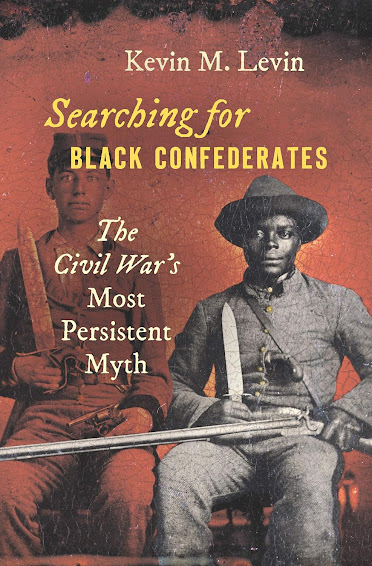
Published in August of 2019 by The University of North Carolina Press.
As the title states, one of the most common myths of "the Civil War had nothing to do with slavery" crowd is that thousands and thousands of African-Americans served in organized units in the Confederate Army.
To be fair to the mistaken people that advocate for this position, there were African-American people traveling with the Confederate Army. They were not there as volunteers - they were there as body servants to their masters. There were also a great number of slaves that were commandeered by the Confederate government to dig ditches and fortifications, much like horses were taken to pull wagons and replace cavalry mounts. They were there as property - as tools, but not as soldiers.
Is it conceivable that some of those slaves picked up a gun in the midst of a fight and fired it in anger? Certainly. I am absolutely certain that it happened. But, was that the plan? No, that is simply what happened in the chaos of battle. It was literally against the law for African Americans to join the military in the Confederacy. The Confederate reactions to the creation of African American units in the Union Army was revulsion, panic and fear that the North was trying to incite a slave rebellion by arming former slaves. There was a lot of denial that African Americans would even make decent soldiers - it was frequently commented that they were too docile to make decent soldiers. Why would they say that if the Confederacy had "thousands" of African American soldiers?
Clearly, there weren't.
I would compare it to female soldiers in the Civil War. Were there women that fought in the war? Yes. It is well-documented that several women pretended to be men and fought. But they were not registered as female soldiers - they lied to join up and were discharged when discovered. It is documented that some of the officers brought their wives along to camp. It is certainly possible that some of those women fired a weapon in the middle of a battle. That is not the same as enlisting women in the army.
The Confederate States of America did change its position at the end of the war on March 13, 1865 . Less than a month before the surrender of Robert E. Lee, they sent out a call to arm the slaves. If the Confederacy had already put African American soldiers, why would they debate and argue for months about arming the slaves in the winter of 1864-1865? Why argue about something you are already doing?
Even more important is a point that Levin makes: "What has gone entirely unnoticed by the Confederate heritage community is that in all the records produced by the slave enlistment debate, including letters, diaries, and literally thousands of newspaper articles, not a single officer or soldier suggested that slaves were already serving as soldiers in the Confederate army."
He quotes the Confederate Secretary of War who commented during this debate: "T
he foundation of the Southern theory of the racial superiority of whites would crumble if blacks were allowed to enlist.”
Another Quote: "The Richmond Daily Examiner spoke for many when it declared in November 1864 that 'if a negro is fit to be a soldier he is not fit to be a slave...The employment of negroes as soldiers in our armies, either with or without prospective emancipation would be the first step, but a step which would involve all the rest, to universal abolition.'"
The point that Levin repeatedly makes in this short book (according to my Kindle it would be about 240 paper pages and about a quarter of that is sources, end notes and a bibliography) is that the people who actually fought the war did not recruit African American soldiers, did not arm them and would have been shocked at the idea of doing so.
Simply put, any argument otherwise is simply grasping for an excuse to defend one's ancestors for fighting in defense of slavery and white supremacy*. I believe that many of them are sincere because they don't want to believe that their ancestors fought for that goal and feel guilty about it. No one is responsible for their ancestors. I told someone online a month ago this comment while discussing this topic: "My family has been Lutheran as far back as anyone knows. Almost certainly, one of my ancestors fought in the Thirty Years War against the Catholics. I can't justify that in any way. Killing people for Jesus demonstrates a fundamental misunderstanding of Jesus' teachings. Similarly, killing people for the freedom to preserve a system of racial superiority demonstrates a fundamental misunderstanding of freedom. It's not your fault or my fault if our ancestors did wrong - just don't defend it now and do better."
I rate this book 5 stars out of 5. For such a small book, it gives a lot of insight into the "Lost Cause" arguments and refutes them all with primary sources, including lots of them I haven't mentioned, like Confederate pension applications.
This book can be found on Amazon.com here: SEARCHING for BLACK CONFEDERATES: THE CIVIL WAR'S MOST PERSISTENT MYTH by Kevin M. Levin.
*NOTE: the common argument against this point is that the Union forces didn't universally fight to eliminate slavery. That is a more than a valid point - it is 100% correct. They were called the "Union" army for a reason - it was created to kept the United States united.
But, it is also true that the Confederacy was created to defend slavery and white supremacy. They wanted to divide the country for this purpose. Don't believe me? Check out the Articles of Secession. These were lists for the reasons for secession, much like the bulk of the text of the Declaration of Independence. Here is an analysis of what percentage of each text was devoted to certain topics. Notice how much of each document refers to slavery. Here are the original documents with no analysis. I encourage you to read them for yourself - these are the thoughts of the people who voted to secede. These are their Declarations of Independence. They are not hard to read and they crush any argument that does not place slavery at the top of any list for the causes of the Civil War.
As the title states, one of the most common myths of "the Civil War had nothing to do with slavery" crowd is that thousands and thousands of African-Americans served in organized units in the Confederate Army.
To be fair to the mistaken people that advocate for this position, there were African-American people traveling with the Confederate Army. They were not there as volunteers - they were there as body servants to their masters. There were also a great number of slaves that were commandeered by the Confederate government to dig ditches and fortifications, much like horses were taken to pull wagons and replace cavalry mounts. They were there as property - as tools, but not as soldiers.
Is it conceivable that some of those slaves picked up a gun in the midst of a fight and fired it in anger? Certainly. I am absolutely certain that it happened. But, was that the plan? No, that is simply what happened in the chaos of battle. It was literally against the law for African Americans to join the military in the Confederacy. The Confederate reactions to the creation of African American units in the Union Army was revulsion, panic and fear that the North was trying to incite a slave rebellion by arming former slaves. There was a lot of denial that African Americans would even make decent soldiers - it was frequently commented that they were too docile to make decent soldiers. Why would they say that if the Confederacy had "thousands" of African American soldiers?
Clearly, there weren't.
I would compare it to female soldiers in the Civil War. Were there women that fought in the war? Yes. It is well-documented that several women pretended to be men and fought. But they were not registered as female soldiers - they lied to join up and were discharged when discovered. It is documented that some of the officers brought their wives along to camp. It is certainly possible that some of those women fired a weapon in the middle of a battle. That is not the same as enlisting women in the army.
The Confederate States of America did change its position at the end of the war on March 13, 1865 . Less than a month before the surrender of Robert E. Lee, they sent out a call to arm the slaves. If the Confederacy had already put African American soldiers, why would they debate and argue for months about arming the slaves in the winter of 1864-1865? Why argue about something you are already doing?
Even more important is a point that Levin makes: "What has gone entirely unnoticed by the Confederate heritage community is that in all the records produced by the slave enlistment debate, including letters, diaries, and literally thousands of newspaper articles, not a single officer or soldier suggested that slaves were already serving as soldiers in the Confederate army."
He quotes the Confederate Secretary of War who commented during this debate: "T
 |
| Confederate Sergeant Andrew Silas and his slave Silas Chandler pose for a photograph in a studio. Silas Chandler was his body servant until his death. He returned to the front as the body servant of his brother. Silas Chandler received a pension at at the age of 78 - but not for being a soldier. Instead, it was a pension for "Indigent Servants of Soldiers or Sailors of the Late Confederacy". |
Another Quote: "The Richmond Daily Examiner spoke for many when it declared in November 1864 that 'if a negro is fit to be a soldier he is not fit to be a slave...The employment of negroes as soldiers in our armies, either with or without prospective emancipation would be the first step, but a step which would involve all the rest, to universal abolition.'"
The point that Levin repeatedly makes in this short book (according to my Kindle it would be about 240 paper pages and about a quarter of that is sources, end notes and a bibliography) is that the people who actually fought the war did not recruit African American soldiers, did not arm them and would have been shocked at the idea of doing so.
Simply put, any argument otherwise is simply grasping for an excuse to defend one's ancestors for fighting in defense of slavery and white supremacy*. I believe that many of them are sincere because they don't want to believe that their ancestors fought for that goal and feel guilty about it. No one is responsible for their ancestors. I told someone online a month ago this comment while discussing this topic: "My family has been Lutheran as far back as anyone knows. Almost certainly, one of my ancestors fought in the Thirty Years War against the Catholics. I can't justify that in any way. Killing people for Jesus demonstrates a fundamental misunderstanding of Jesus' teachings. Similarly, killing people for the freedom to preserve a system of racial superiority demonstrates a fundamental misunderstanding of freedom. It's not your fault or my fault if our ancestors did wrong - just don't defend it now and do better."
I rate this book 5 stars out of 5. For such a small book, it gives a lot of insight into the "Lost Cause" arguments and refutes them all with primary sources, including lots of them I haven't mentioned, like Confederate pension applications.
This book can be found on Amazon.com here: SEARCHING for BLACK CONFEDERATES: THE CIVIL WAR'S MOST PERSISTENT MYTH by Kevin M. Levin.
*NOTE: the common argument against this point is that the Union forces didn't universally fight to eliminate slavery. That is a more than a valid point - it is 100% correct. They were called the "Union" army for a reason - it was created to kept the United States united.
But, it is also true that the Confederacy was created to defend slavery and white supremacy. They wanted to divide the country for this purpose. Don't believe me? Check out the Articles of Secession. These were lists for the reasons for secession, much like the bulk of the text of the Declaration of Independence. Here is an analysis of what percentage of each text was devoted to certain topics. Notice how much of each document refers to slavery. Here are the original documents with no analysis. I encourage you to read them for yourself - these are the thoughts of the people who voted to secede. These are their Declarations of Independence. They are not hard to read and they crush any argument that does not place slavery at the top of any list for the causes of the Civil War.


_-_Kurt_Vonnegut.jpg)
