ARMAGEDDON in RETROSPECT and OTHER NEW and UNPUBLISHED WRITINGS on WAR and PEACE by Kurt Vonnegut


Published in 2008.

Armageddon in Retrospect is a collection of short stories (and one letter and one rambling, but enjoyable,  speech) focuses on war and the folly of war. Many of the stories deal with World War II and prisoners of war, a theme echoed in Slaughterhouse-Five. 

The almost 40 foot tall mural
of Vonnegut in
Indianapolis. 
The book begins with an entertaining introduction by Mark Vonnegut, Kurt's son followed by an astonishingly flippant letter from Kurt to his family telling them that he had been a prisoner of war since the Battle of the Bulge but now he was liberated and headed back to Indiana. The letter is actually reproduced as a picture so you can see it how he typed it on the stationary that he typed it. The letter is followed by the last speech he ever wrote, appropriately delivered in his hometown of Indianapolis by his son after Kurt Vonnegut's death.

The short stories are up and down, as all short stories collections are. But, Vonnegut's gift for creating interesting characters shines through most of them and I found myself invested in most of them in a very short time. Most have funny moments tossed in the middle of a great tragedy. Many feature prisoners of war, which is understandable considering Vonnegut's own experiences in World War II.

The book itself is a beautiful hardback made with the highest quality slick paper. Between the short stories there are drawings and quips from Vonnegut.

I rate this collection 4 stars out of 5.

This book can be purchased on Amazon here: Armageddon in Retrospect.


APPALOOSA (Virgil Cole and Everett Hitch #1) (audiobook) by Robert B. Parker


A western for grown-ups. It's not about the guns, horses or bullets. It's about friendship, sex and, ultimately, love.


Published by Random House in 2005
Read by Titus Welliver
Duration: 4 hours, 57 minutes
Unabridged

There are four main characters in Appaloosa: Marshal Virgil Cole, Deputy Everett Hitch, Bragg (a rancher/hotel owner) and Mrs. French, a pathetic woman that leeches onto powerful men out of some deep seeded need that we never quite have explained. Suffice it to say, Mrs. French is a survivor because she uses sex to endear herself to the most powerful man in her immediate area. 

Robert B. Parker loves to explore the sometimes complicated psychology of men and women and the way they express friendship and love, both platonic and amorous. His books are full of people (mostly women, but not always) that claim to be in love but really they are psychologically needy and act out sexually in strange, disruptive ways. 

There are four main characters in this story: Marshal Virgil Cole, Deputy Everett Hitch, Bragg (a rancher and later a hotel owner) and Mrs. French, a pathetic woman that leeches onto powerful men out of some deep seeded need that we never quite have explained. Suffice it to say, Mrs. French is a survivor because she uses sex to endear herself to the most powerful man in her immediate area. 

But, the problem is, who is the most powerful man? Is it the Marshal, Bragg or even the Deputy? And, will they even realize they are being manipulated? Does she even know she is doing it? Can the Cole and Hitch's friendship endure this tension?

The audiobook is read by the actor Titus Welliver. I like Welliver's work and his voice is smooth and mellow - just about perfect for Hitch, who tells the story. 

I rate this audiobook 4 stars out of 5.

This audiobook can be found on Amazon here: Appaloosa

THE BRASS VERDICT (Lincoln Lawyer/Mickey Haller #2) (audiobook) by Michael Connelly


When Harry Met Mickey


Published by Hachette Audio in 2008.
Read by Peter Giles
Duration: 11 hours, 54 minutes
Unabridged


At the end of The Lincoln Lawyer, Mickey Haller was gutshot, a horrific injury and one that is difficult to survive, let alone recover from.  At the beginning of the second book in the series, Mickey Haller is not practicing law. Due to his injury, Haller has developed an addiction to pain killers and has been in rehab getting clean. As he descended into addiction he has driven his ex-wife farther away and made that relationship even more difficult.

Despite the drugs, Haller was able to recognize that he was in no position to practice law. Then, one day out of the blue he gets a phone call from the chief judge on Los Angeles. A fellow defense attorney named Jerry Vincent has been murdered and Mickey Haller is supposed to take on all of his cases. Haller and the Vincent used to cover for one another on occasion and they listed one another as the attorney who would cover for them in case of emergency in all of their contracts with their clients.

So, Mickey Haller goes from an attorney with no cases to an attorney with multiple cases, including the biggest case in Los Angeles. Haller has inherited the case of Walter Elliott, a Hollywood producer accused of shooting his wife and her lover multiple times after he found them naked together in their oceanview home.

As Mickey starts to get up to speed with his cases he meets the detective assigned to solve the murder of  Vincent - it is none other than Harry Bosch, the main character in Michael Connelly's other series.

Bosch and Haller clash several times, each ones gets the best of the other only to be bested the next time they butt heads.

Haller soon discovers that some vital information was stolen from Vincent when he was murdered and he puts his whole defense team to work trying to figure out what could be missing and if it was the reason Vincent was killed.

As the date for Walter Elliott's trial looms Haller learns that his client may be hiding much more than he thought and he may even have some answers for the questions swirling around the murder of Jerry Vincent. Haller finds that he must walk a tightrope between helping the police and protecting his clients and not getting killed himself...

Some might claim that this book dragged. Instead of dragging, I would say that the reader gets to see Haller deal with multiple new cases and figure out how some of them might just tie together and give him some sort of clue as to what is really going on. 

I like Peter Giles as the voice of Mickey Haller. As I noted in another audiobook review, Giles captures that smooth courtroom delivery perfectly. His readings as Harry Bosch were so-so, but that is to be expected - they are very different characters.   

I rate this audiobook 5 stars out of 5.

You can find this book on Amazon here: The Brass Verdict: A Novel

I'D LIKE to APOLOGIZE to EVERY TEACHER I EVER HAD: MY YEAR as a ROOKIE TEACHER at NORTHEAST HIGH by Tony Danza


Published in 2012 by Random House LLC


Before we go any further, I must tell you that I am a public school teacher that teaches in a school that is pretty similar to the one featured in I'd Like to Apologize to Every Teacher I Have Ever Had. I have been teaching for 25 years.

What looks like a publicity stunt by an out-of-work actor trying to jump start a career is really a sincere attempt to get a taste of what being a real teacher is all about. Danza starts the book explaining that he was at a low point in his career, having just had his TV talk show cancelled, but he had seriously considered being a teacher when he was younger and had used his platform on his TV talk show to promote teachers and provide "School Room Makeovers" and that had re-kindled his interest.

So, he was talking about this idea he had of becoming a teacher and someone told him that it would be a good idea for a reality show. Personally, I never heard of the show until I had heard of the book. I still have not watched the show, although I plan on it. I wanted to get Danza's unfiltered perspective first.

After a little haggling, they finally find a school willing to let Danza teach one class every day under the supervision of a seasoned teacher. I assume that the kids were similarly vetted but the way it plays out it seems like he's got a pretty average group of kids in his class.

Danza is only permitted to teach one class a day. To his credit, he arrives on time and stays throughout the day just like every other teacher. He helps coach, he helps with a talent show, he helps with crowd control in the morning and to catch the stragglers who wander into school at all sorts of times.

Danza is very sincere at his efforts to be a good teacher. As a teacher, I can tell you that having just one class would be great (less papers to grade, more time to lesson plan, you won't be as tired at the end of the day), but it is a disadvantage as well. I once heard another teacher describe teaching as "performance art" and I think that he is right. When you only teach one class it is liking having to film a scene with just one take and no practice and no warm-up. Last year, I taught 4 sections of Spanish 3. The first one was always the worst, by far. He had no chance to revise what he did, even if it is revision "on the fly".

Sometimes, Danza's celebrity status opens doors for him, like when he takes the class on a field trip to New York City, but, in the end, if Danza only used his celebrity to get him somewhere in class he would not get far - the kids are too young to have seen his movies and TV shows and after a while he just stops being a celebrity and has to be a teacher. His celebrity-sized wallet is a help from time-to-time (I hate to be crass, but sometimes lack of money for the classroom is an issue).

When the show suddenly quits filming halfway through the school year Danza has a decision to make - does he finish the year or does he just go on to the next gig? He finishes the year and it sounds like that second semester is the one that turns him from a true rookie to a teacher.

If you have never been inside a large public school as an adult, this book gives you some flavor of what it is like. Danza also intelligently discusses issues like charter schools, teachers unions and the like in the book - not from the perspective of a politician or a commentator but from the perspective of someone who has been in the classroom and knows that there is no silver bullet. Being a teacher is different than you think, even if you think you know what it is since you sat in the classroom and watched a lot of teachers teach. 

Danza does hit on the parent angle a lot and, as a parent and a teacher, I cannot disagree. On page 175 he notes: "One reason it's hard for both teachers and students is that there's so little parental backup. Which is not to say that the parents are always missing in action. Sometimes they're present to a fault." Absentee parents and helicopter parents are equally the bane to a successful student. 

I rate this book 5 stars out of 5.

This book can be found on Amazon here: 
I'd Like to Apologize to Every Teacher I Ever Had: My Year as a Rookie Teacher at Northeast High

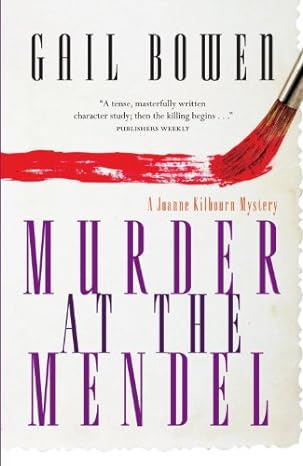
MURDER at the MENDEL(Joanne Kilbourn #2) (audiobook) by Gail Bowen


Published in 2012 by Post Hypnotic Press
Originally published in 1991
Read by Lisa Bunting
Duration: 6 hours, 33 minutes
Unabridged

Gail Bowen's Joanne Kilbourn character carries on into her second book, Murder at the Mendel. Life has changed for her - she has moved her family to Saskatoon in Saskatchewan to be close to her daughter in college and to teach at the same university. 

The local art center was called the Mendel (I say was because it has since been slated to close and move to a new location with a new name) and a childhood friend of Joanne Kilbourne who has since become a controversial artist has an exhibit at the Mendel. The artist, named Sally Love, and Kilbourn used to be very close but after the suicide of Love's father when they were 13 years old, Sally Love moved away.

Kilbourn and Love renew their friendship. Sally Love's exhibition has brought a number of protesters out because of her art. She has a lot of art with overt sexual themes, including a 200 square foot fresco on the wall over 100 penises (and a few vaginas) - paintings of the genitalia of all of her lovers over her lifetime permanently painted to the wall.

As a Kilbourn and Love navigate the protesters and her fans, Love decides to sell a private all-women's art gallery that an emotionally ultra-needy friend has managed for her for years. This unhinges the friend.

Suddenly everything starts to unravel as arson, multiple murders and more ruin Saskatoon's Christmas and New Years...


The Saskatoon skyline. Photo by Thomas Kelley
I did not enjoy this audiobook. It was not the fault of the reader, Lisa Bunting, who did a fantastic job with a variety of people's voices. She exhibited tremendous emotional range with her reading.

The text itself is the problem. Sally Love came off as an arrogant self-absorbed character and Kilbourn seems the same as she accepts Love without criticism, even as she makes cruel comments about other characters, makes plans to remove her daughter from her ex-husband (the only home she's ever known) and even sits and talks about masturbation at the breakfast table in front of Kilbourn's school-aged son before he heads off to school. In fact, Kilbourn's own internal compass is so messed up that I despaired of using her opinions as any kind of barometer to judge any other character and try to figure out who did what to whom.

To make matters worse, the pacing in this book is terrible. The "murder an the Mendel" that the title proclaims does not happen until halfway through the book. Bowen excels at long, rich descriptions of scenes but not at moving a plot along.

This is my third review of a Gail Bowen book or short story and this is my last. In the end, I was just glad to be done with it and I was sort of hoping that more of them had died along the way.

I rate this audiobook 2 stars out of 5.

This audiobook can be found on Amazon here: Murder at the Mendel: A Joanne Kilbourne Mystery, Book 2.

Note:  I received a copy of this audiobook free from the publisher in exchange for an honest review.

FREE FIRE (Joe Picket #7) by C.J. Box


Published in May of 2008

In the previous book in the Joe Pickett series, In Plain Sight, Joe lost his job as a Wyoming game warden. In Free Fire, Joe gets his job back, sort of. Governor Rulon, a man who delights in doing things that irritate bureaucracies, has offered him a chance to work as a Game Warden "without portfolio" (as they might say in diplomatic circles). Joe is an independent agent, working for the Governor but the Governor wants plausible deniability for everything Joe does.

The Governor offers this to Joe because of a situation that developed in Yellowstone National Park. A local attorney went into a part of the park that is in Idaho, shot four campers and then turned himself in. The campers all worked for Zephyr, a private contractor that runs the hotels, the gift shops and does the maintenance around the park. But, due to a loophole in the law described in detail here he was not able to be tried for anything. Due to federal law and his right to a trial by jury the attorney was simply not able to be brought to trial and he walked away.

The Governor sends Joe in to see if the Park Rangers and the FBI have done a thorough job of investigating. Specifically, he wants to know why the attorney killed the campers - his claim that they made fun of him and he took their guns away from them and shot them just does not sound plausible.


The Governor makes it clear that he is not sending Joe because Joe is some sort of genius investigator. Instead, he knows that Joe has a way of blundering around a case until something shakes loose. 

So, armed with a new badge, a new truck and unofficially accompanied by his fugitive friend Nate Romanowski, Joe heads off to Yellowstone and discovers that there is way more to this case than anyone has told the press...

****

Free Fire is much more gritty and brutal than most of the books in the series. There are lots of descriptions of the beauty and wonder of Yellowstone and I would imagine if you have not been you would find yourself a little overwhelmed by the descriptions. If anything, C.J. Box has restrained himself in his descriptions of one of the most amazing places on the planet. The sheer size of the park becomes an issue. It reminded me of the Chee/Leaphorn books where long rides in the truck become a routine part of the story.

For fear of spoilers I will not describe any more of the mystery, but I will say that the science of the park and the strange community that has developed around it make this a unique and fascinating book.

I rate this book 5 stars out of 5.

This book can be found on Amazon here: Free Fire: A Joe Pickett Novel

THE BATTLE of EZRA CHURCH and the STRUGGLE for ATLANTA (audiobook) by Earl J. Hess


Published in May of 2015 by Blackstone Audio
Read by Joe Barrett
Duration: 8 hours, 29 minutes
Unabridged

During the Atlanta campaign in the Summer of 1864 Confederate President Jefferson Davis changed the nature of the campaign with the simple stroke of a pen.

Up to that point, Union General William Tecumseh Sherman was slowly forcing his way southward towards Atlanta by way of a series of flanking maneuvers. His opponent, Confederate General Joseph E. Johnston, was slowly retreating, hoping to find an opening for a fatal strike against his opponent. Unfortunately for him, Sherman's mistakes were too small to be exploited and eventually Johnston found himself backed up against Atlanta itself.

Oliver O. Howard (1830-1909).
Photo by Matthew Brady.
At this point, President Davis intervened and removed Johnston on July 17, replacing him with John Bell Hood. While Johnston was cautious, Hood was by nature an aggressive general. Also, given the circumstances of Johnston's removal, Hood knew that his president expected offensive action to drive the Union army away from Atlanta.  So, Hood complied. On July 20, 22 and 28 there were attacks to stop the Union advance. All of them were costly to the Confederate army since they were running low on everything, including soldiers. 

The Battle of Ezra Church started out as yet another flanking maneuver by the Union army under newly promoted General O.O. Howard. The goal was to reach the railroad line and further cut off Atlanta. Hood knew that the Union army would try for this railroad line and he sent men out stop them. Interestingly, they were also under the command of a new general, Stephen D. Lee. 

One of the more interesting story lines of The Battle of Ezra Church and the Struggle for Atlanta is how these two experienced armies dealt with the transplanted officers brought in to lead them (Howard easily gets the nod here). But, there is more than that. It is also a story of Hood vs. Sherman and Hood's style vs. Johnston's style.

Stephen Dill Lee (1833-1908)
The actual details of the battle are well-researched but not presented in a a particularly interesting manner. I think that is mostly due to the nature of the battle. General Stephen Lee sent his men in successive waves. The story of the battle is repetitive as the Confederates make a foolhardy charge against hastily assembled union defenses, retreat and gather themselves up and charge again. Meanwhile, the Union forces are reinforced just in time and make another defensive stand. 

This is not to say that were are interesting tales inside of the larger tale, but this was an audiobook and the repetitive nature of the battle made me wonder more than once if I was re-listening to part of the story. 

Who won? Well, that is actually a matter of some debate. The Union objective (the railroad) was not reached so the Confederates can claim that as a victory. But, the cost in men was so high, perhaps as many as 5 Confederates killed for every 1 Union soldier, that the Union can claim that as a victory. Also, the nature of the battle is odd - the Union soldiers were technically on offense but they hid behind hastily constructed defensive positions while the Confederates, who were technically on defense, charged those positions repeatedly and eventually withdrew.

The last three chapters of the book were quite excellent. They dealt with the immediate aftermath of the battle and how they dealt with all of the wounded and the dead. It also included some of the internal bickering in Hood's army as Lee tried to deflect blame to everyone else and still claim a victory. In the Union army, Howard was accepted as a tried and true leader by most of his army even though he was forced to fight on his second day as its general. The last chapter dealt with the last few days of the campaign for Atlanta. 

Joe Barrett read this audiobook. I have heard him read other audiobooks and I am not usually very fond of his "folksy" voice. But, his unique style worked well with the extensive quotes from letters and reports read throughout this audiobook. 

I rate this audiobook 4 stars out of 5.

This audiobook can be found on Amazon.com here: The Battle of Ezra Church and the Struggle for Atlanta.


Note: I was sent a copy of this audiobook by the publisher in exchange for an honest review.

Featured Post

<b><i>BAN THIS BOOK (audiobook)</i></b> by Alan Gratz

Published in 2017 by Blackstone Audio, Inc. Read by Bahni Turpin. Duration: 5 hours, 17 minutes. Unabridged. My Synopsis Ban This Book is t...

Popular posts over the last 7 days