I'D LIKE to APOLOGIZE to EVERY TEACHER I EVER HAD: MY YEAR as a ROOKIE TEACHER at NORTHEAST HIGH by Tony Danza


Published in 2012 by Random House LLC


Before we go any further, I must tell you that I am a public school teacher that teaches in a school that is pretty similar to the one featured in I'd Like to Apologize to Every Teacher I Have Ever Had. I have been teaching for 25 years.

What looks like a publicity stunt by an out-of-work actor trying to jump start a career is really a sincere attempt to get a taste of what being a real teacher is all about. Danza starts the book explaining that he was at a low point in his career, having just had his TV talk show cancelled, but he had seriously considered being a teacher when he was younger and had used his platform on his TV talk show to promote teachers and provide "School Room Makeovers" and that had re-kindled his interest.

So, he was talking about this idea he had of becoming a teacher and someone told him that it would be a good idea for a reality show. Personally, I never heard of the show until I had heard of the book. I still have not watched the show, although I plan on it. I wanted to get Danza's unfiltered perspective first.

After a little haggling, they finally find a school willing to let Danza teach one class every day under the supervision of a seasoned teacher. I assume that the kids were similarly vetted but the way it plays out it seems like he's got a pretty average group of kids in his class.

Danza is only permitted to teach one class a day. To his credit, he arrives on time and stays throughout the day just like every other teacher. He helps coach, he helps with a talent show, he helps with crowd control in the morning and to catch the stragglers who wander into school at all sorts of times.

Danza is very sincere at his efforts to be a good teacher. As a teacher, I can tell you that having just one class would be great (less papers to grade, more time to lesson plan, you won't be as tired at the end of the day), but it is a disadvantage as well. I once heard another teacher describe teaching as "performance art" and I think that he is right. When you only teach one class it is liking having to film a scene with just one take and no practice and no warm-up. Last year, I taught 4 sections of Spanish 3. The first one was always the worst, by far. He had no chance to revise what he did, even if it is revision "on the fly".

Sometimes, Danza's celebrity status opens doors for him, like when he takes the class on a field trip to New York City, but, in the end, if Danza only used his celebrity to get him somewhere in class he would not get far - the kids are too young to have seen his movies and TV shows and after a while he just stops being a celebrity and has to be a teacher. His celebrity-sized wallet is a help from time-to-time (I hate to be crass, but sometimes lack of money for the classroom is an issue).

When the show suddenly quits filming halfway through the school year Danza has a decision to make - does he finish the year or does he just go on to the next gig? He finishes the year and it sounds like that second semester is the one that turns him from a true rookie to a teacher.

If you have never been inside a large public school as an adult, this book gives you some flavor of what it is like. Danza also intelligently discusses issues like charter schools, teachers unions and the like in the book - not from the perspective of a politician or a commentator but from the perspective of someone who has been in the classroom and knows that there is no silver bullet. Being a teacher is different than you think, even if you think you know what it is since you sat in the classroom and watched a lot of teachers teach. 

Danza does hit on the parent angle a lot and, as a parent and a teacher, I cannot disagree. On page 175 he notes: "One reason it's hard for both teachers and students is that there's so little parental backup. Which is not to say that the parents are always missing in action. Sometimes they're present to a fault." Absentee parents and helicopter parents are equally the bane to a successful student. 

I rate this book 5 stars out of 5.

This book can be found on Amazon here: 
I'd Like to Apologize to Every Teacher I Ever Had: My Year as a Rookie Teacher at Northeast High

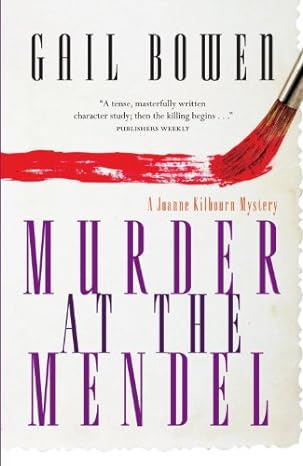
MURDER at the MENDEL(Joanne Kilbourn #2) (audiobook) by Gail Bowen


Published in 2012 by Post Hypnotic Press
Originally published in 1991
Read by Lisa Bunting
Duration: 6 hours, 33 minutes
Unabridged

Gail Bowen's Joanne Kilbourn character carries on into her second book, Murder at the Mendel. Life has changed for her - she has moved her family to Saskatoon in Saskatchewan to be close to her daughter in college and to teach at the same university. 

The local art center was called the Mendel (I say was because it has since been slated to close and move to a new location with a new name) and a childhood friend of Joanne Kilbourne who has since become a controversial artist has an exhibit at the Mendel. The artist, named Sally Love, and Kilbourn used to be very close but after the suicide of Love's father when they were 13 years old, Sally Love moved away.

Kilbourn and Love renew their friendship. Sally Love's exhibition has brought a number of protesters out because of her art. She has a lot of art with overt sexual themes, including a 200 square foot fresco on the wall over 100 penises (and a few vaginas) - paintings of the genitalia of all of her lovers over her lifetime permanently painted to the wall.

As a Kilbourn and Love navigate the protesters and her fans, Love decides to sell a private all-women's art gallery that an emotionally ultra-needy friend has managed for her for years. This unhinges the friend.

Suddenly everything starts to unravel as arson, multiple murders and more ruin Saskatoon's Christmas and New Years...


The Saskatoon skyline. Photo by Thomas Kelley
I did not enjoy this audiobook. It was not the fault of the reader, Lisa Bunting, who did a fantastic job with a variety of people's voices. She exhibited tremendous emotional range with her reading.

The text itself is the problem. Sally Love came off as an arrogant self-absorbed character and Kilbourn seems the same as she accepts Love without criticism, even as she makes cruel comments about other characters, makes plans to remove her daughter from her ex-husband (the only home she's ever known) and even sits and talks about masturbation at the breakfast table in front of Kilbourn's school-aged son before he heads off to school. In fact, Kilbourn's own internal compass is so messed up that I despaired of using her opinions as any kind of barometer to judge any other character and try to figure out who did what to whom.

To make matters worse, the pacing in this book is terrible. The "murder an the Mendel" that the title proclaims does not happen until halfway through the book. Bowen excels at long, rich descriptions of scenes but not at moving a plot along.

This is my third review of a Gail Bowen book or short story and this is my last. In the end, I was just glad to be done with it and I was sort of hoping that more of them had died along the way.

I rate this audiobook 2 stars out of 5.

This audiobook can be found on Amazon here: Murder at the Mendel: A Joanne Kilbourne Mystery, Book 2.

Note:  I received a copy of this audiobook free from the publisher in exchange for an honest review.

FREE FIRE (Joe Picket #7) by C.J. Box


Published in May of 2008

In the previous book in the Joe Pickett series, In Plain Sight, Joe lost his job as a Wyoming game warden. In Free Fire, Joe gets his job back, sort of. Governor Rulon, a man who delights in doing things that irritate bureaucracies, has offered him a chance to work as a Game Warden "without portfolio" (as they might say in diplomatic circles). Joe is an independent agent, working for the Governor but the Governor wants plausible deniability for everything Joe does.

The Governor offers this to Joe because of a situation that developed in Yellowstone National Park. A local attorney went into a part of the park that is in Idaho, shot four campers and then turned himself in. The campers all worked for Zephyr, a private contractor that runs the hotels, the gift shops and does the maintenance around the park. But, due to a loophole in the law described in detail here he was not able to be tried for anything. Due to federal law and his right to a trial by jury the attorney was simply not able to be brought to trial and he walked away.

The Governor sends Joe in to see if the Park Rangers and the FBI have done a thorough job of investigating. Specifically, he wants to know why the attorney killed the campers - his claim that they made fun of him and he took their guns away from them and shot them just does not sound plausible.


The Governor makes it clear that he is not sending Joe because Joe is some sort of genius investigator. Instead, he knows that Joe has a way of blundering around a case until something shakes loose. 

So, armed with a new badge, a new truck and unofficially accompanied by his fugitive friend Nate Romanowski, Joe heads off to Yellowstone and discovers that there is way more to this case than anyone has told the press...

****

Free Fire is much more gritty and brutal than most of the books in the series. There are lots of descriptions of the beauty and wonder of Yellowstone and I would imagine if you have not been you would find yourself a little overwhelmed by the descriptions. If anything, C.J. Box has restrained himself in his descriptions of one of the most amazing places on the planet. The sheer size of the park becomes an issue. It reminded me of the Chee/Leaphorn books where long rides in the truck become a routine part of the story.

For fear of spoilers I will not describe any more of the mystery, but I will say that the science of the park and the strange community that has developed around it make this a unique and fascinating book.

I rate this book 5 stars out of 5.

This book can be found on Amazon here: Free Fire: A Joe Pickett Novel

THE BATTLE of EZRA CHURCH and the STRUGGLE for ATLANTA (audiobook) by Earl J. Hess


Published in May of 2015 by Blackstone Audio
Read by Joe Barrett
Duration: 8 hours, 29 minutes
Unabridged

During the Atlanta campaign in the Summer of 1864 Confederate President Jefferson Davis changed the nature of the campaign with the simple stroke of a pen.

Up to that point, Union General William Tecumseh Sherman was slowly forcing his way southward towards Atlanta by way of a series of flanking maneuvers. His opponent, Confederate General Joseph E. Johnston, was slowly retreating, hoping to find an opening for a fatal strike against his opponent. Unfortunately for him, Sherman's mistakes were too small to be exploited and eventually Johnston found himself backed up against Atlanta itself.

Oliver O. Howard (1830-1909).
Photo by Matthew Brady.
At this point, President Davis intervened and removed Johnston on July 17, replacing him with John Bell Hood. While Johnston was cautious, Hood was by nature an aggressive general. Also, given the circumstances of Johnston's removal, Hood knew that his president expected offensive action to drive the Union army away from Atlanta.  So, Hood complied. On July 20, 22 and 28 there were attacks to stop the Union advance. All of them were costly to the Confederate army since they were running low on everything, including soldiers. 

The Battle of Ezra Church started out as yet another flanking maneuver by the Union army under newly promoted General O.O. Howard. The goal was to reach the railroad line and further cut off Atlanta. Hood knew that the Union army would try for this railroad line and he sent men out stop them. Interestingly, they were also under the command of a new general, Stephen D. Lee. 

One of the more interesting story lines of The Battle of Ezra Church and the Struggle for Atlanta is how these two experienced armies dealt with the transplanted officers brought in to lead them (Howard easily gets the nod here). But, there is more than that. It is also a story of Hood vs. Sherman and Hood's style vs. Johnston's style.

Stephen Dill Lee (1833-1908)
The actual details of the battle are well-researched but not presented in a a particularly interesting manner. I think that is mostly due to the nature of the battle. General Stephen Lee sent his men in successive waves. The story of the battle is repetitive as the Confederates make a foolhardy charge against hastily assembled union defenses, retreat and gather themselves up and charge again. Meanwhile, the Union forces are reinforced just in time and make another defensive stand. 

This is not to say that were are interesting tales inside of the larger tale, but this was an audiobook and the repetitive nature of the battle made me wonder more than once if I was re-listening to part of the story. 

Who won? Well, that is actually a matter of some debate. The Union objective (the railroad) was not reached so the Confederates can claim that as a victory. But, the cost in men was so high, perhaps as many as 5 Confederates killed for every 1 Union soldier, that the Union can claim that as a victory. Also, the nature of the battle is odd - the Union soldiers were technically on offense but they hid behind hastily constructed defensive positions while the Confederates, who were technically on defense, charged those positions repeatedly and eventually withdrew.

The last three chapters of the book were quite excellent. They dealt with the immediate aftermath of the battle and how they dealt with all of the wounded and the dead. It also included some of the internal bickering in Hood's army as Lee tried to deflect blame to everyone else and still claim a victory. In the Union army, Howard was accepted as a tried and true leader by most of his army even though he was forced to fight on his second day as its general. The last chapter dealt with the last few days of the campaign for Atlanta. 

Joe Barrett read this audiobook. I have heard him read other audiobooks and I am not usually very fond of his "folksy" voice. But, his unique style worked well with the extensive quotes from letters and reports read throughout this audiobook. 

I rate this audiobook 4 stars out of 5.

This audiobook can be found on Amazon.com here: The Battle of Ezra Church and the Struggle for Atlanta.


Note: I was sent a copy of this audiobook by the publisher in exchange for an honest review.

HARMLESS: AN UNCONVENTIONAL LOVE STORY (audiobook) by Ernie Lindsey


Published in 2013 by Ernie Lindsey
Read by DJ Holte
Duration: 10 hours, 34 minutes
Unabridged


First things first - Harmless: An Unconventional Love Story is a weird book. It was written to be that way. The author, Ernie Lindsey, set out to write a book in which the main character is totally unlikable but by the end of the book the reader will be rooting for this unlikable fellow.

Did he succeed?

Well, Steve Pendragon is certainly unlikable. It's not like he is an evil man. Rather, he is a clueless, thoughtless man. He keeps on flirting with his neighbor long after he should have gotten the clue that she did not want him to flirt with her any longer (in an office environment it would have careened into sexual harassment territory long before). It's not like he backs her up in the corner and puts his hands on her. He just does creepy things like have her mail delivered to his house so he has to walk it to her door every day. He stares at her from his window as she sunbathes. He gets into her car to roll her windows up when it is starting to rain and also uses the opportunity to dig through her mail.

Plus, he is clueless about all of his relationships. He is Herb from WKRP in Cincinnati. He knows he is awesome but everyone else knows he is at best average and certainly annoying. He talks non-stop about stuff that nobody cares about and he never listens. 

Photo by Niels Noordhoek
One evening Steve's world is turned upside down. His neighbor is shot and thrown from her upstairs window. Steve tries to catch the murderer before he escapes from her house but he is knocked out. He digs through her belongings before he calls the police (why? Because he's an idiot, as noted above) and when the police rule that it is a suicide he knows that he has to solve her murder himself. Once he heads off on this quest, Steve is going to learn as much about himself as he will about his murdered beautiful neighbor...

It was sort of entertaining just listening to narrator DJ Holte introduce the listener to Steve Pendragon. His cluelessness and creepiness should remind everyone of someone that they have known in their life. The first half of the book moves pretty well. But, the second half of the book, when Steve goes "on the lam" (there's a long discussion about that phrase) the book just bogs down with incessant observations, and a long extended scene in an abandoned post office. It just goes nowhere for too long.

The narration by DJ Holte was excellent. He captures Steve's undeserved arrogance and creates unique voices for every character. So unique that you can tell who is talking just by their individual voices if you are caught up in one of Steve's long meandering conversations. 

Despite the excellent voice work, I have to give the story 3 stars out of 5. Through the first half of the book I would have given it 4.5 stars. But, the second half just moved too slowly for me.

This audiobook can be found on Amazon.com here: 

Note: I was given a copy of this audiobook for review purposes.


IN PLAIN SIGHT (Joe Pickett #6) by C.J. Box


Published in 2006.


I have been reading C.J. Box's series about Wyoming Game Warden Joe Pickett for the last five years now after having someone recommend him to me on Amazon. The problem is, I have made absolutely no effort to read them in order - I just read them as I find them. So, I have read #1 and #9-13 plus several of Box's standalone novels. In Plain Sight is the first one that I felt a little lost in it as I jumped in but I got things figured out after 50 or 60 pages and still enjoyed another adventure with Joe Pickett.

In this book, Joe is dealing with a new boss at the state level who is much more bureaucrat than he is game warden. While they butt heads, the town of Saddlestring is being torn apart by an internal family feud with the Scarlett family. The Scarletts are one of the original white families to move into the area and they have been stunningly successful over the generations. They have the biggest ranch with the best land. They are on all of the boards, in the state legislature and employ lots of people. This family civil war splits the town apart and has gotten to the point where it looks like there will be an old-fashioned range war. And Joe is in the middle of it because his daughter is best friends with a daughter of one of the rivals.

Throw in a mysterious new ranch hand with an explosive temper who has a grudge against Joe Pickett and several brutal animal mutilations designed to taunt the game warden and terrify his family and you have a situation that Joe just can't ignore, even if his boss wants him to for political considerations...

For me, this story took a little while to get going partially because of my initial confusion (see the first paragraph). That being said, I give it an entirely respectable 4 stars out of 5 because once it got going it grabbed my attention.

In Plain Sight can be found on Amazon here: In Plain Sight (A Joe Pickett Novel)

LETTER from BIRMINGHAM JAIL (audiobook) by Martin Luther King, Jr.


A Brilliant Essay

Published by Mission Audio in April of 2013.
Originally published in 1963 in various newspapers and magazines
Read by Dion Graham
Duration: 51 minutes

This letter was written in response to a group of African American preachers who were calling for an end to the nonviolent resistance to the racist order in Birmingham, Alabama. This included sit-ins, marches and violating a court order to end all such demonstrations. King was arrested for violating this order (yes, he was arrested for speaking his mind and being involved in a peaceful assembly - a double violation of his First Amendment rights) and kept is squalid conditions in the overcrowded Birmingham jail.

Recreation of the Birmingham Jail cell where this letter was
written at the National Civil Rights Museum in Memphis,
Tennessee. Photo by Adam Jones, Ph.D.
 
Letter from Birmingham Jail was written, at first, on scrap bits of paper and smuggled out by way of his lawyers and re-assembled by his supporters on the outside. The last parts were written on a note pad. The fact that it was written in such a herky-jerky fashion and yet is so cohesive and consistent throughout is simply amazing to me considering how much I go back and revise as I write and discard entire paragraphs as I go along. 

The document itself is more than just a civil rights letter. It is one of those basic expressions of what it is to be an American and why it is so important to guard those rights. As I listened, I was struck by the irony that his arguments were so much like those of the Founding Fathers. In fact, they work so well because King was intentionally using their arguments as his arguments. He was intentionally using the language of those that would oppose his demands for equal rights against them. The letter abounds with Biblical references, references to the Ancient Greeks, the Founders and even to his namesake, Martin Luther. It uses the philosophical underpinnings of Western Culture to demand that Western Culture live up to its own ideals. 

And, it is brilliant.

King's mugshot from his arrest.
I am a history teacher and I would feel completely comfortable placing this document right next to Jefferson's Preamble to the Declaration of Independence, Thomas Payne's Common Sense and Lincoln's Gettysburg Address and Second Inaugural Address in a list of required readings for an American history class. 

Although this was written as a letter, it reads remarkably well as a speech. Dion Graham's performance is excellent. Of course, it helps when your source material is so good. But, do not take this at a swipe at Graham's abilities. He did not choose to mimic King. Instead, he read it in his own voice and he nailed all of the points perfectly. I do not think anyone could read it any better.

I rate this audiobook 5 stars out of 5. 

This audiobook can be found on Amazon.com here: Letter from Birmingham Jail.

This book was added to a "book ban" list in Florida in 2022. Ugh.

Featured Post

<b><i>BAN THIS BOOK (audiobook)</i></b> by Alan Gratz

Published in 2017 by Blackstone Audio, Inc. Read by Bahni Turpin. Duration: 5 hours, 17 minutes. Unabridged. My Synopsis Ban This Book is t...

Popular posts over the last 7 days