THE EASTERN STARS: HOW BASEBALL CHANGED the DOMINICAN TOWN of SAN PEDRO de MACORIS by Mark Kurlansky


Published in 2010 by Riverhead Books

The Eastern Stars is more a history of the Dominican Republic than a baseball book, but as author Mark Kurlansky clearly demonstrates, for the last 40 years or so the history of the Dominican Republic has clearly been molded and in some ways defined by its love of baseball. It is also a clear sign of the unhealthy state of economic affairs in a country when so many young people see no hope in moving up in the world except for playing professional baseball in America.

Kurlansky takes his readers through a meandering history of the Dominican Republic, moving backwards and forwards through time detailing a number of interesting stories about this Caribbean country but always coming back to the present to touch base and remind the readers that this is a baseball book, too. 

The Dominican Republic has had a long love affair with baseball thanks to American economic and military excursions into the country. It also has been so poorly managed by it various governments that for decades many young men have sacrificed everything in order to make it on to an American Major League Baseball team roster. Who can blame them - in 2006 ten percent of all major leaguers were from the Dominican Republic (p. 75). So many young men hope to win a contract, play for a few years and then return to the Dominican Republic and live like kings in their gated communities back in their hometowns.

Scouts prowl dusty sandlots looking for some spark of talent, even of the players are using balls made out socks and gloves made out of cardboard, the talent shines through. Or, at least they hope that it does.  Top prospects are enrolled in one of many "schools" that teach a lot of baseball and English and some math and science. In return, these schools get a cut of their contracts for helping to develop their talent. Even the Japanese teams have started sending scouts to the Dominican Republic.

As the title states, the real focus is the small fishing town of San Pedro de Macoris. It is unremarkable in every way except that it keeps producing major league baseball players. 

Why?

Kurlansky never comes out and says it, but after reading so many pages about the Dominican Republic and its sad history the reader just knows that it is because there really isn't anything else. It's either fishing in ever-more-depleted waters for less and less fish for more and more work or its baseball. Meanwhile, you can watch the SUVs of retired major leaguers pick their way around the potholes of roads that haven't been repaired in years and probably won't be anytime soon and know that the only rational choice is to put all of your effort into baseball and only baseball. Everything else is a sucker bet.

Note: many other reviewers have been critical of Kurlansky's detailing of some of the facts about the careers of some of the Dominican players the he describes, getting batting averages wrong and some of the dates wrong. No sport generates factoids like baseball and it is disappointing that Kurlansky has so many errors. But, read the book for what it was intended to be - a history of the Dominican Republic detailing how it became a sort of incubator for major league baseball players.

This book can be found on Amazon here: The Eastern Stars: How Baseball Changed the Dominican Town of San Pedro de Macoris.

I rate this book 4 stars out of 5.

NPR FAVORITE DRIVEWAY MOMENTS: RADIO STORIES that WON'T LET YOU GO by NPR


Published in 2012 by HighBridge Audio
Multicast performance
Duration: 2 hours, 16 minutes

This collection was inspired by listeners who wrote NPR and commented on why these stories from their vast treasure trove of stories have stuck with them for so long. Some are funny, some are sad and some are thought-provoking. They are also a mixed bag. Some are great, some are so-so and some had me wondering why they were included at all.

Pretty typical of the collection is a skit called "Complexities of Modern Love in the Digital Age". It features the two voice actors that you most typically hear when you call a big corporation for customer service and they lead you through the phone tree. In this case, they have the two voices talk to one another and date. The idea is sort of cute but the actual skit was not as funny as the idea of the skit.

A Kathy Griffin interview. Eh. 

The Cookie Monster interview was fun.

I loved the story about a stray cat that wandered into a prison yard and was adopted by the prisoners. They feed it, take turns with it and the amount of discord in the yard has dropped because of this one cat.

I also liked the story of the former KKK member who went from harassing his Jewish neighbors to converting to Judaism thanks to a little human kindness.

The story about pets in the Sarajevo during the war among what used to be Yugoslavia was very interesting.

The story of a young couple in China digging through the rubble after an earthquake looking for their only son and his grandparents who were babysitting was gripping and heartbreaking. Easily the best in the collection.

The story that will stick with me was "Growing Up, Aging Out: The End of Foster Care". It was told from a very sympathetic point of view, wondering what a girl was going to do when she turned 21 and was no longer eligible to be part of the foster care system. But, I found it to be very irritating and the longer I listened the angrier I got. This girl was not physically disabled. She still had not finished high school and she was nearly 21 years old. She was making no moves to get a job or even finish high school. Instead, had been conditioned to accept handouts her whole life and to not work. How would she live without a government check? What would she do? What she was doing was sleeping with her drug dealer boyfriend and trying to get pregnant. I listened to it with my high school-aged daughter and I turned it into a cautionary tale.

So, lots of forgettable stories, some so-so stuff, a couple of really good ones and one really disturbing one.


I rate this collection 3 stars out of 5. It can be found on Amazon.com here: NPR FAVORITE DRIVEWAY MOMENTS: RADIO STORIES that WON'T LET YOU GO.

INSURGENT: BOOK 2 of AMERICA'S FUTURE by Charles Sheehan-Miles


Published in 2012 by Cincinnatus Press 

Insurgent is a worthy successor to the original book in this series, Republic: A Novel of America's Future. Book One details how a fictional confrontation between the state of West Virginia and the federal government over the proper role of the Department of Homeland Security eventually leads to a very short war in which West Virginia is quickly defeated. 

Book Two deals with post-war relations between the occupying federal government, its troops and the people of West Virginia and the closely monitored civilian government of West Virginia.

The flag of West Virginia
The parallels between this fictional war and the Iraq War and the multi-year struggle to create a stable environment in Iraq once Sadaam Hussein was removed from power are striking and, I am sure, quite intentional. And, since this is a book about Americans in a situation similar to that experienced by the people of Iraq, the Iraqi reactions are made all the more understandable to an American reader. 

Sheehan-Miles switches from the point of view of a small military unit helping to keep a crucial road clear to the civilians who interact with that unit to the officials in the limited civilian government and keeps multiple story lines going, including the origins of a nascent insurgent group with powerful weapons and even stronger religious beliefs who starts taking on the occupying troops with bombs, assassination attempts and threats against those who collaborate. 

It is a compelling read and, like I said about the last book, it is guaranteed to make you think.

It can be purchased here on Amazon.com: Insurgent: Book 2 of America's Future

I rate this book 5 stars out of 5.

NOWHERE to RUN (Joe Pickett #10) by C.J. Box


Published in 2010 by G.P. Putnam's Sons

Wyoming Game Warden Joe Pickett is in the last week of his exile to a lonely post - Baggs, Wyoming in Nowhere to Run. Most men would take this last week to fill out the last bits of paper work, say goodbye to new acquaintances and maybe just take it easy. Not Joe Pickett. Joe loves the mountains of Wyoming and he looks at this as one last chance to take a pass through some wild and rugged territory that he may never get to see again. So, he heads off to check into a complaint about butchered elk (a hunter wounded an elk and before he could catch up to it to finish it off someone had already finished it, butchered it and carted off the best pieces) and several comments from long-time locals that the area just felt like something was wrong.

So, Joe heads off with a couple of horses, his nearly useless pistol (Joe is a great guy but a terrible shot with a pistol),his trusty shotgun, and all sorts of camping gear to investigate. He also has his satellite phone that he uses to check in with his wife and family every night.

Sure enough, everything feels wrong and soon Joe comes across Caleb Grim, a giant of a man. Caleb and his twin brother Camish are living illegally in this protected area. Joe stops to cite them. He should have ran when Caleb looked him in the eye and said, "You coulda just rode away." But, Joe is not that kind of guy. 

And, his family knows something is wrong when he doesn't call home that night...

Nowhere to Run is much more action-packed than most of the Joe Pickett novels and C.J. Box does a great job of describing action. It is inspired by a true story of a game warden encountering twin mountain men but it still felt a little forced. It was good, sometimes it was impossible to put down but there were times when it just didn't feel like the story really should have fit together the way that it was being told.  The whole book rates a very respectable 4 stars out of 5. 

I strongly recommend this series.

This book can be found on Amazon.com here: NOWHERE to RUN (Joe Pickett #10) by C.J. Box.

NPR CLASSIC DRIVEWAY MOMENTS: RADIO STORIES THAT WON'T LET YOU GO (audiobook)


Published in March of 2010 by HighBridge Audio

Multicast Performance
Duration: 2 hours

NPR Classic Driveway Moments is a collection comprised of 13 stories (and one intro track) culled from 31 years of NPR radio stories (1979-2010). Most of these stories have depth but not all are equal. 

I was profoundly moved by a story called "My So-Called Lungs" featuring a young woman starting college while struggling with cystic fibrosis. It was engrossing on multiple levels and my high school-aged daughter and I were captivated by the woman's honesty, grace and humor in the face of inevitable death. 

On the other hand, the story "Death of a Child: Losing Adam", featuring a child who was dying from a terminal illness just felt intrusive and maudlin. 

The interview with George Foreman was interesting and quite enjoyable, although NPR being NPR, they found a way to bring a downer note to it by tying the George Foreman grill into it and interviewing homeless people who used it as a cooking appliance of last resort.

The collection ends with a great story, undoubtedly exaggerated, about 2 friends hitch hiking across Nebraska in the 1970s. "Hitching a Ride with Junior McGee" is a great short story told well and is a good way to finish the collection.

Note: this collection is up and down, but the strong stories are very, very strong and are worth listening to.

I rate this collection 4 stars out of 5.

This audiobook can be found on Amazon here: NPR Classic Driveway Moments: Radio Stories That Won't Let You Go

THE ISLANDS of the BLESSED (Sea of Trolls trilogy #3) (audiobook) by Nancy Farmer


Published by Simon and Schuster Audio in 2009.

Duration: 13 hours, 30 minutes
Read by Gerard Doyle

Jack, the apprentice Bard from late 8th century Saxon England and his difficult friend Thorgil, the Viking girl, continue their adventures in The Islands of the Blessed, the conclusion to their trilogy (although there is an opening for the series to continue...). 

As with the other books in this series, Jack and Thorgil come into contact with a host of fairy tale creatures such as Mermen and Mermaids, Hogboons, Half-trolls and even a Viking god as Nancy Farmer demonstrates the depth of her research into European mythology. Jack and Thorgil join the bard on a quest to correct a horrible wrong done by Father Severus on a Mermaid  years ago (the Merpeople are called Fin Folk in this book) that has caused her to become a fearsome ghostly creature that kills and spreads disease and destruction. 
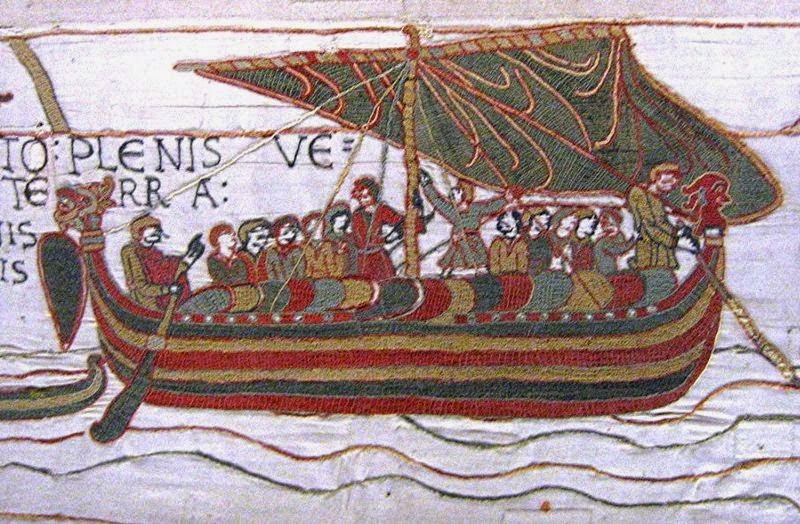
A Viking Longship in the Bayeux Tapestry.
Photo by Urban.

In this book, the adventure returns to the form of the first book and heads out to the open sea in Viking long boats. But, sadly, this book is much more like the second book of the series than the first. The book quickly deteriorates into a series of rather pointless confrontations with random monsters that are the unfortunate by-product of Nancy Farmer's meticulous research. Rather than develop a creature and flesh it out as a character (which the first book did so well with the Trolls and their world) this book just throws the out as a series of obstacles that Jack must overcome in his quest. It reminded me of the worst of the adventures that I helped create when I played Dungeons and Dragons in Junior High and High School.

The best parts of the book are when Jack struggles with the immense changes his world is undergoing. Christianity is a new arrival and Jack struggles with blending his Christian worldview and his pagan worldview.  He struggles with a Christianity that allows Father Severus to be so cruel. But, he has the example of Father Aidan who exudes a much more subtler style of Christianity and who comes so much closer to living up to the ideals of Christianity. Jack respects those ideals and espouses them at a critical moment that I cannot detail here because of spoilers. But, he is also a practitioner of magic that Christianity condemns (or at least discourages, depending on the location).  He also struggles with his friends the Vikings - fantastic friends, loyal to a fault who will gladly slit your throat and sell your sister into slavery and the Viking brand of paganism that glorifies death above all. 

As I listened, I was struck by the idea that the best parts of the book were constantly being subverted by yet another mythical beast's arrival making the book much longer and all the poorer.

Gerald Doyle's narration was extraordinary, as it was in the other two books of this trilogy.

It can be found on Amazon here: The Islands of the Blessed (Sea of Trolls Trilogy)

Click on the Nancy Farmer label below to see the other reviews of the books in this trilogy.

I rate this book 3 stars out of 5. 

CHINESE TURKESTAN: A PHOTOGRAPHIC JOURNEY THROUGH an ANCIENT CIVILIZATION by Ryan Pyle


Published by Ryan Pyle Productions in 2014

Photographer Ryan Pyle has traveled extensively throughout China and India, Luckily, he brings his camera along and takes plenty of pictures. 

His book Chinese Turkestan focuses on the Xinjiang Uyghur Autonomous Region, the most trackless part of the old Silk Road that has connected Europe and China off and on for well more than 2,000 years. The Uyghur are Muslim and their large but sparsely populated homeland lie at the crossroads of Islam and secular Communist China. Their territory touches Tibet, Pakistan, Kyrgyzstan, Kazakhstan and Mongolia.

What Pyle calls Chinese Turkestan is often at odds with the rest of China. The Uyghur are Muslim while China actively promotes secularism. China seems bent on modernizing as quickly as possible but the Uyghur sometimes seemed locked in the past. As Pyle notes in his introduction, "There were many occasions when I stood in a crowded marketplace, enveloped in the early morning haze of coal smoke amidst the cacophony of livestock traders, noodle, bread, and dumpling makers, blacksmiths, knife and carpet sellers, feeling like a time-traveler transported to some bygone era."

Pyle does note the modern world's encroachment with many of his pictures. The first picture in the main body of the book is that of a family playing in one of those grotesque plazas with statues extolling some virtue of an idealized and devoted citizen who is all-too-happy to live for the state that Communist countries excel at creating. 

But, most of the pictures have a National Geographic-type feel to them. They show regular people doing regular jobs pretty much they way that they have been done as long as anybody can remember. Pyle has chosen to shoot all of his pictures in black and white. Black and white can be powerful and it often is in this collection. But, I found myself wishing for just one color photo of the landscape so that I could get a better feel for their environment.

The book can be found here on Amazon.com:  
Chinese Turkestan: A Photographic Journey Through an Ancient Civilization

I rate this book 4 stars out of 5.

Note: I received a copy of this book for free in exchange for an honest review.

Featured Post

<b><i>BAN THIS BOOK (audiobook)</i></b> by Alan Gratz

Published in 2017 by Blackstone Audio, Inc. Read by Bahni Turpin. Duration: 5 hours, 17 minutes. Unabridged. My Synopsis Ban This Book is t...

Popular posts over the last 7 days