THE ISLANDS of the BLESSED (Sea of Trolls trilogy #3) (audiobook) by Nancy Farmer


Published by Simon and Schuster Audio in 2009.

Duration: 13 hours, 30 minutes
Read by Gerard Doyle

Jack, the apprentice Bard from late 8th century Saxon England and his difficult friend Thorgil, the Viking girl, continue their adventures in The Islands of the Blessed, the conclusion to their trilogy (although there is an opening for the series to continue...). 

As with the other books in this series, Jack and Thorgil come into contact with a host of fairy tale creatures such as Mermen and Mermaids, Hogboons, Half-trolls and even a Viking god as Nancy Farmer demonstrates the depth of her research into European mythology. Jack and Thorgil join the bard on a quest to correct a horrible wrong done by Father Severus on a Mermaid  years ago (the Merpeople are called Fin Folk in this book) that has caused her to become a fearsome ghostly creature that kills and spreads disease and destruction. 
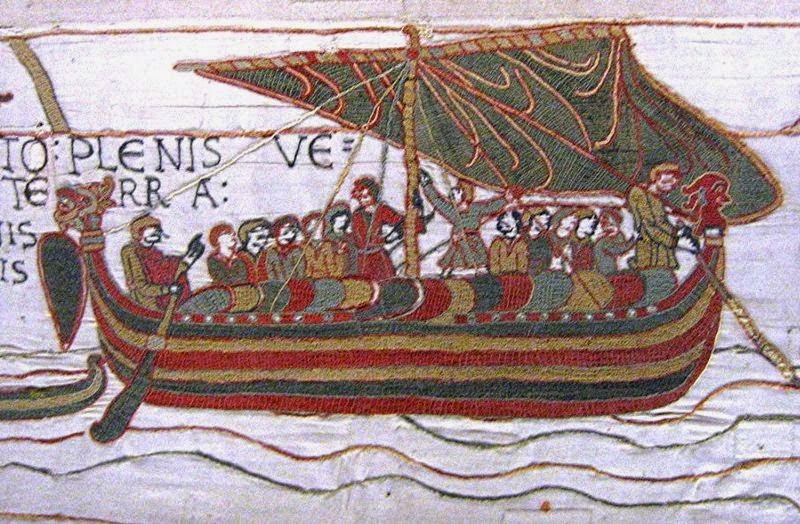
A Viking Longship in the Bayeux Tapestry.
Photo by Urban.

In this book, the adventure returns to the form of the first book and heads out to the open sea in Viking long boats. But, sadly, this book is much more like the second book of the series than the first. The book quickly deteriorates into a series of rather pointless confrontations with random monsters that are the unfortunate by-product of Nancy Farmer's meticulous research. Rather than develop a creature and flesh it out as a character (which the first book did so well with the Trolls and their world) this book just throws the out as a series of obstacles that Jack must overcome in his quest. It reminded me of the worst of the adventures that I helped create when I played Dungeons and Dragons in Junior High and High School.

The best parts of the book are when Jack struggles with the immense changes his world is undergoing. Christianity is a new arrival and Jack struggles with blending his Christian worldview and his pagan worldview.  He struggles with a Christianity that allows Father Severus to be so cruel. But, he has the example of Father Aidan who exudes a much more subtler style of Christianity and who comes so much closer to living up to the ideals of Christianity. Jack respects those ideals and espouses them at a critical moment that I cannot detail here because of spoilers. But, he is also a practitioner of magic that Christianity condemns (or at least discourages, depending on the location).  He also struggles with his friends the Vikings - fantastic friends, loyal to a fault who will gladly slit your throat and sell your sister into slavery and the Viking brand of paganism that glorifies death above all. 

As I listened, I was struck by the idea that the best parts of the book were constantly being subverted by yet another mythical beast's arrival making the book much longer and all the poorer.

Gerald Doyle's narration was extraordinary, as it was in the other two books of this trilogy.

It can be found on Amazon here: The Islands of the Blessed (Sea of Trolls Trilogy)

Click on the Nancy Farmer label below to see the other reviews of the books in this trilogy.

I rate this book 3 stars out of 5. 

CHINESE TURKESTAN: A PHOTOGRAPHIC JOURNEY THROUGH an ANCIENT CIVILIZATION by Ryan Pyle


Published by Ryan Pyle Productions in 2014

Photographer Ryan Pyle has traveled extensively throughout China and India, Luckily, he brings his camera along and takes plenty of pictures. 

His book Chinese Turkestan focuses on the Xinjiang Uyghur Autonomous Region, the most trackless part of the old Silk Road that has connected Europe and China off and on for well more than 2,000 years. The Uyghur are Muslim and their large but sparsely populated homeland lie at the crossroads of Islam and secular Communist China. Their territory touches Tibet, Pakistan, Kyrgyzstan, Kazakhstan and Mongolia.

What Pyle calls Chinese Turkestan is often at odds with the rest of China. The Uyghur are Muslim while China actively promotes secularism. China seems bent on modernizing as quickly as possible but the Uyghur sometimes seemed locked in the past. As Pyle notes in his introduction, "There were many occasions when I stood in a crowded marketplace, enveloped in the early morning haze of coal smoke amidst the cacophony of livestock traders, noodle, bread, and dumpling makers, blacksmiths, knife and carpet sellers, feeling like a time-traveler transported to some bygone era."

Pyle does note the modern world's encroachment with many of his pictures. The first picture in the main body of the book is that of a family playing in one of those grotesque plazas with statues extolling some virtue of an idealized and devoted citizen who is all-too-happy to live for the state that Communist countries excel at creating. 

But, most of the pictures have a National Geographic-type feel to them. They show regular people doing regular jobs pretty much they way that they have been done as long as anybody can remember. Pyle has chosen to shoot all of his pictures in black and white. Black and white can be powerful and it often is in this collection. But, I found myself wishing for just one color photo of the landscape so that I could get a better feel for their environment.

The book can be found here on Amazon.com:  
Chinese Turkestan: A Photographic Journey Through an Ancient Civilization

I rate this book 4 stars out of 5.

Note: I received a copy of this book for free in exchange for an honest review.

NPR DRIVEWAY MOMENTS: DOG TALES: RADIO STORIES that WON'T LET YOU GO by NPR


Published by HighBridge Audio in 2011.
Multicast Performance
Duration: 2 hours, 7 minutes

NPR's Driveway Moments collection are called "Driveway Moments" because the idea is supposed that the stories are so good that the listener sits in the driveway and listens to the end of the story when he/she gets home rather than just turning off the car and going on into the house.

In this collection, the emphasis is on dogs and this collection covers all sort of dogs. From homeless chihuahuas in Los Angeles  to massive sheep dogs in Turkey. There are celebrity dogs, blind dogs, war hero dogs and dogs that go to church. We also hear from two different dog trainers, learn about DNA testing for dogs and learn about a mother dog that adopted a nursing tiger Cub. 

The collection is up-and-down but the strong stories are good enough for me to rate this collection 4 stars out of 5.

This audiobook can be found on Amazon.com here: NPR Driveway Moments: Dog Tales: Radio Stories that Wont Let You Go.

Reviewed on March 7, 2015

NPR MORE FUNNIEST DRIVEWAY MOMENTS: RADIO STORIES that WON'T LET YOU GO


Should be called "Funny People in Rather Boring Interviews" 

Published by HighBridge Audio in 2010
Multicast Performance
Duration: 2 hours, 12 minutes

This collection of performances from NPR's vast radio library is the second volume of "Funniest Driveway Moments." They are called Driveway Moments because the idea is supposed that the stories are so good that the listener sits in the driveway and listens to the end of the story when he/she gets home rather than just turning off the car and going on into the house.

But, most of this 2 CD set should be called "Funny People in Rather Boring Interviews." 

The collection starts out with a run-of-the-mill interview with Joan Rivers (Sorry NPR but discussing her husband's suicide is just not funny) and the most boring interview with Harry Shearer that I have ever heard. There was an interview with Harold Ramis about how to write comedy that was vaguely humorous and I was really beginning to wonder if this would ever pick up.

Thankfully, a clip from "Wait Wait...Don't Tell Me" came on featuring Brian Williams. Despite the recent controversy concerning Williams, this is the best segment of the first CD.

Carol Burnett and Tim Conway come through at the beginning of the second CD and after several slow cuts, another "Wait Wait...Don't Tell Me" cut comes in and picks things up. An interview with Jane Lynch is not terrifically funny but at this point I was glad to settle for interesting and a couple of chuckles. The second CD just sort of eases its way out and I was glad to see it go.

I am a huge fan of NPR's Driveway Moments series but this set is just not all that funny. If you want an NPR-based laugh, find any of the "Wait Wait...Don't Tell Me" CD sets (The Brian Williams track is on one of them) and have a laugh. This was a disappointment.

I rate this audiobook 2 stars out of 5. It can be found on Amazon.com here: NPR More Funniest Driveway Moments: Radio Stories that Won't Let You Go.

Reviewed on March 6, 2015

GETTYSBURG: THE FINAL FURY by Bruce Catton


Published by Berkley Windhover in 1974


Bruce Catton was the most famous Civil War historian of his era and mastered the art of writing narrative history for the masses. I freely admit that I am an unabashed fan of Catton. I am quite sure that he kick-started my interest in the Civil War that has caused me to fill my shelves with over 100 Civil War books.

Catton tells the story of Gettysburg in slightly more than 100 pages His approachable style is in full display here. For example, his description of Confederate General A.P. Hill: "...a heads-down slugger always willing to take a blow in order to land one." (p. 20)   No one is better at telling a Civil War story than Catton and Gettysburg is the single biggest story of the war. He knows how to keep the story moving but to add just enough detail to make it feel like a special re-telling.

The book is full of great maps, illustrations and photographs and is well worth the time of a student of the Civil War or someone who is simply interested in learning more about Gettysburg.

I rate this history 5 stars out of 5. It can be found on Amazon.com here: Gettysburg: The Final Fury by Bruce Catton.

Reviewed on March 5, 2015

NPR ROAD TRIPS: ROADSIDE ATTRACTIONS (audiobook)


Published in 2009 by HighBridge Audio

Multicast Performance

Duration: about 1 hour.

National Public Radio has combed through its broadcast archives and found 13 different stories about the great American institution - the road trip. But, these aren't just any stories. These are stories that feature another great American institution - the roadside attraction. 

The stories cover a variety of quirky attractions including the Elvis Is Alive Museum, The Velveteria (featuring black velvet paintings of Elvis and lots more!), the world's 2nd biggest ball of twine, a series of backyard folk art exhibits in Michigan and even a couple of more famous attractions like Florida's Cypress Gardens and Seattle's Space Needle. A slightly off topic, but very interesting, story about the famed Burma Shave signs is also included. The stories wind up with the story of an epic musical piece written in the classical style about the trials and tribulations of the family car-based vacation.

The stories are all told with a sense of good-natured fun and some, like the story about the Velveteria and the musical tribute to the family road trip have moments where they are laugh-out-loud funny. The first story was fairly weak. But, taken as a whole, these stories are well worth your time.

I rate this audiobook 4 stars out of 5. It can be found on Amazon.com here: NPR ROAD TRIPS: ROADSIDE ATTRACTIONS

Reviewed on February 21, 2015.

WHAT CAUSED the CIVIL WAR: REFLECTIONS on the SOUTH and SOUTHERN HISTORY by Edward L. Ayers


Published in 2005 by W.W. Norton and Company

This wonderful set of nine essays is just about as complete of a discussion of the South, the Civil War, Reconstruction, family, home, historical research and some practical applications of the lessons of the Civil War for us today as I have read.

It seems to me that most of these essays have been published somewhere else first. That being said, Ayers has arranged the essays in What Caused the Civil War in a rough chronological order based not on the historical topic of the essay but on Ayers's own life. He starts with his own childhood in Eastern Tennessee and Western North Carolina and his own growing understand of what it means to be a Southerner. As the essays go along, Ayers goes to college, travels the world a bit and eventually returns to the South to do research and eventually teach at the University of Virginia. 

As Ayers moves through his education and his career he develops a perspective on the Civil War and that perspective changes as he grows in his research.

The best essay was the title essay. Ayers has a surprisingly simple yet nuanced tale of the causes of the war. I have read plenty of books on the war (easily 100 non-fiction books and at least 20 fiction books) and Ayers provided a thoughtful look at this topic. 

In short, he argues that it was slavery, of course, and a complete failure of the politics of the day to deal with changing public attitudes. The Whigs, one of the two major political parties, died by fracturing over slavery in 1840s and 1850s. The reactionary anti-immigrant Know-Nothings and the Republicans replaced the Whigs. The Know-Nothings caused a lot of noise and chaos but had no staying power. The Republicans adopted a mild anti-slavery platform (basically, no new slave states) and this caused the Democrats to fracture into multiple parties. 

Basically, slavery went from being an unhappy but back-burner issue to being
The Issue - the one that could not be compromised on, either way in just a few short years. The fact of the Civil War and its consequences, such as the destruction of the Southern political system and  Emancipation happened in such a short time that the political system simply could not figure out how to respond fast enough.

In our modern culture, gay rights has had a similar evolution and it might serve as a useful comparison. In the 1990's it was considered to be a giant leap forward to let gay soldiers serve under the Clinton's "Don't Ask, Don't Tell" policy. Now, Gay Marriage, a topic that wasn't even on anyone's radar in the 1990's, is a reality in most states and one political party is struggling to deal with this new reality. Churches are split and ugly insults go back and forth across social media as people try to re-work things in their own minds.


I enjoyed the essay on Reconstruction a lot as well. "Exporting Reconstruction" pointed out something obvious that I had never noticed before. Reconstruction was America's first attempt at nation-building- and it was not very successful. The parallels with our experiences in Iraq and Afghanistan are striking. 

I did not enjoy "A Digital Civil War". This essay spoke of Ayers's attempt to coordinate a massive amount of data in the early days of personal computing and how he helped pioneer some new techniques. At first it was kind of fun to remember those "good old days" of small memory and primitive software but it grew wearisome soon enough.

I rate this book 5 stars out of 5. It can be found on Amazon.com here: WHAT CAUSED the CIVIL WAR: REFLECTIONS on the SOUTH and SOUTHERN HISTORY by Edward L. Ayers.

Reviewed on February 13, 2015.

Featured Post

<b><i>BAN THIS BOOK (audiobook)</i></b> by Alan Gratz

Published in 2017 by Blackstone Audio, Inc. Read by Bahni Turpin. Duration: 5 hours, 17 minutes. Unabridged. My Synopsis Ban This Book is t...

Popular posts over the last 7 days