CHINESE TURKESTAN: A PHOTOGRAPHIC JOURNEY THROUGH an ANCIENT CIVILIZATION by Ryan Pyle


Published by Ryan Pyle Productions in 2014
Photographer Ryan Pyle has traveled extensively throughout China and India, Luckily, he brings his camera along and takes plenty of pictures. 

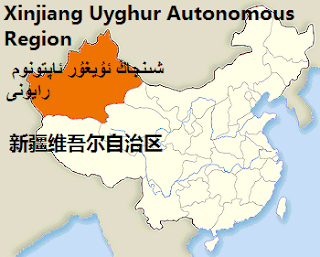
His book Chinese Turkestan focuses on the Xinjiang Uyghur Autonomous Region, the most trackless part of the old Silk Road that has connected Europe and China off and on for well more than 2,000 years. The Uyghur are Muslim and their large but sparsely populated homeland lie at the crossroads of Islam and secular Communist China. Their territory touches Tibet, Pakistan, Kyrgyzstan, Kazakhstan and Mongolia.

What Pyle calls Chinese Turkestan is often at odds with the rest of China. The Uyghur are Muslim while China actively promotes secularism. China seems bent on modernizing as quickly as possible but the Uyghur sometimes seemed locked in the past. As Pyle notes in his introduction, "There were many occasions when I stood in a crowded marketplace, enveloped in the early morning haze of coal smoke amidst the cacophony of livestock traders, noodle, bread, and dumpling makers, blacksmiths, knife and carpet sellers, feeling like a time-traveler transported to some bygone era."

Pyle does note the modern world's encroachment with many of his pictures. The first picture in the main body of the book is that of a family playing in one of those grotesque plazas with statues extolling some virtue of an idealized and devoted citizen who is all-too-happy to live for the state that Communist countries excel at creating. 

But, most of the pictures have a National Geographic-type feel to them. They show regular people doing regular jobs pretty much they way that they have been done as long as anybody can remember. Pyle has chosen to shoot all of his pictures in black and white. Black and white can be powerful and it often is in this collection. But, I found myself wishing for just one color photo of the landscape so that I could get a better feel for their environment.

The book can be found here on Amazon.com:  
Chinese Turkestan: A Photographic Journey Through an Ancient Civilization

I rate this book 4 stars out of 5.

Note: I received a copy of this book for free in exchange for an honest review.

NPR DRIVEWAY MOMENTS: DOG TALES: RADIO STORIES that WON'T LET YOU GO by NPR


Published by HighBridge Audio in 2011.
Multicast Performance
Duration: 2 hours, 7 minutes

NPR's Driveway Moments collection are called "Driveway Moments" because the idea is supposed that the stories are so good that the listener sits in the driveway and listens to the end of the story when he/she gets home rather than just turning off the car and going on into the house.

In this collection, the emphasis is on dogs and this collection covers all sort of dogs. From homeless chihuahuas in Los Angeles  to massive sheep dogs in Turkey. There are celebrity dogs, blind dogs, war hero dogs and dogs that go to church. We also hear from two different dog trainers, learn about DNA testing for dogs and learn about a mother dog that adopted a nursing tiger Cub. 

The collection is up-and-down but the strong stories are good enough for me to rate this collection 4 stars out of 5.

This audiobook can be found on Amazon.com here: NPR Driveway Moments: Dog Tales: Radio Stories that Wont Let You Go.

Reviewed on March 7, 2015

NPR MORE FUNNIEST DRIVEWAY MOMENTS: RADIO STORIES that WON'T LET YOU GO


Should be called "Funny People in Rather Boring Interviews" 

Published by HighBridge Audio in 2010
Multicast Performance
Duration: 2 hours, 12 minutes

This collection of performances from NPR's vast radio library is the second volume of "Funniest Driveway Moments." They are called Driveway Moments because the idea is supposed that the stories are so good that the listener sits in the driveway and listens to the end of the story when he/she gets home rather than just turning off the car and going on into the house.

But, most of this 2 CD set should be called "Funny People in Rather Boring Interviews." 

The collection starts out with a run-of-the-mill interview with Joan Rivers (Sorry NPR but discussing her husband's suicide is just not funny) and the most boring interview with Harry Shearer that I have ever heard. There was an interview with Harold Ramis about how to write comedy that was vaguely humorous and I was really beginning to wonder if this would ever pick up.

Thankfully, a clip from "Wait Wait...Don't Tell Me" came on featuring Brian Williams. Despite the recent controversy concerning Williams, this is the best segment of the first CD.

Carol Burnett and Tim Conway come through at the beginning of the second CD and after several slow cuts, another "Wait Wait...Don't Tell Me" cut comes in and picks things up. An interview with Jane Lynch is not terrifically funny but at this point I was glad to settle for interesting and a couple of chuckles. The second CD just sort of eases its way out and I was glad to see it go.

I am a huge fan of NPR's Driveway Moments series but this set is just not all that funny. If you want an NPR-based laugh, find any of the "Wait Wait...Don't Tell Me" CD sets (The Brian Williams track is on one of them) and have a laugh. This was a disappointment.

I rate this audiobook 2 stars out of 5. It can be found on Amazon.com here: NPR More Funniest Driveway Moments: Radio Stories that Won't Let You Go.

Reviewed on March 6, 2015

GETTYSBURG: THE FINAL FURY by Bruce Catton


Published by Berkley Windhover in 1974


Bruce Catton was the most famous Civil War historian of his era and mastered the art of writing narrative history for the masses. I freely admit that I am an unabashed fan of Catton. I am quite sure that he kick-started my interest in the Civil War that has caused me to fill my shelves with over 100 Civil War books.

Catton tells the story of Gettysburg in slightly more than 100 pages His approachable style is in full display here. For example, his description of Confederate General A.P. Hill: "...a heads-down slugger always willing to take a blow in order to land one." (p. 20)   No one is better at telling a Civil War story than Catton and Gettysburg is the single biggest story of the war. He knows how to keep the story moving but to add just enough detail to make it feel like a special re-telling.

The book is full of great maps, illustrations and photographs and is well worth the time of a student of the Civil War or someone who is simply interested in learning more about Gettysburg.

I rate this history 5 stars out of 5. It can be found on Amazon.com here: Gettysburg: The Final Fury by Bruce Catton.

Reviewed on March 5, 2015

NPR ROAD TRIPS: ROADSIDE ATTRACTIONS (audiobook)


Published in 2009 by HighBridge Audio

Multicast Performance

Duration: about 1 hour.

National Public Radio has combed through its broadcast archives and found 13 different stories about the great American institution - the road trip. But, these aren't just any stories. These are stories that feature another great American institution - the roadside attraction. 

The stories cover a variety of quirky attractions including the Elvis Is Alive Museum, The Velveteria (featuring black velvet paintings of Elvis and lots more!), the world's 2nd biggest ball of twine, a series of backyard folk art exhibits in Michigan and even a couple of more famous attractions like Florida's Cypress Gardens and Seattle's Space Needle. A slightly off topic, but very interesting, story about the famed Burma Shave signs is also included. The stories wind up with the story of an epic musical piece written in the classical style about the trials and tribulations of the family car-based vacation.

The stories are all told with a sense of good-natured fun and some, like the story about the Velveteria and the musical tribute to the family road trip have moments where they are laugh-out-loud funny. The first story was fairly weak. But, taken as a whole, these stories are well worth your time.

I rate this audiobook 4 stars out of 5. It can be found on Amazon.com here: NPR ROAD TRIPS: ROADSIDE ATTRACTIONS

Reviewed on February 21, 2015.

WHAT CAUSED the CIVIL WAR: REFLECTIONS on the SOUTH and SOUTHERN HISTORY by Edward L. Ayers


Published in 2005 by W.W. Norton and Company

This wonderful set of nine essays is just about as complete of a discussion of the South, the Civil War, Reconstruction, family, home, historical research and some practical applications of the lessons of the Civil War for us today as I have read.

It seems to me that most of these essays have been published somewhere else first. That being said, Ayers has arranged the essays in What Caused the Civil War in a rough chronological order based not on the historical topic of the essay but on Ayers's own life. He starts with his own childhood in Eastern Tennessee and Western North Carolina and his own growing understand of what it means to be a Southerner. As the essays go along, Ayers goes to college, travels the world a bit and eventually returns to the South to do research and eventually teach at the University of Virginia. 

As Ayers moves through his education and his career he develops a perspective on the Civil War and that perspective changes as he grows in his research.

The best essay was the title essay. Ayers has a surprisingly simple yet nuanced tale of the causes of the war. I have read plenty of books on the war (easily 100 non-fiction books and at least 20 fiction books) and Ayers provided a thoughtful look at this topic. 

In short, he argues that it was slavery, of course, and a complete failure of the politics of the day to deal with changing public attitudes. The Whigs, one of the two major political parties, died by fracturing over slavery in 1840s and 1850s. The reactionary anti-immigrant Know-Nothings and the Republicans replaced the Whigs. The Know-Nothings caused a lot of noise and chaos but had no staying power. The Republicans adopted a mild anti-slavery platform (basically, no new slave states) and this caused the Democrats to fracture into multiple parties. 

Basically, slavery went from being an unhappy but back-burner issue to being
The Issue - the one that could not be compromised on, either way in just a few short years. The fact of the Civil War and its consequences, such as the destruction of the Southern political system and  Emancipation happened in such a short time that the political system simply could not figure out how to respond fast enough.

In our modern culture, gay rights has had a similar evolution and it might serve as a useful comparison. In the 1990's it was considered to be a giant leap forward to let gay soldiers serve under the Clinton's "Don't Ask, Don't Tell" policy. Now, Gay Marriage, a topic that wasn't even on anyone's radar in the 1990's, is a reality in most states and one political party is struggling to deal with this new reality. Churches are split and ugly insults go back and forth across social media as people try to re-work things in their own minds.


I enjoyed the essay on Reconstruction a lot as well. "Exporting Reconstruction" pointed out something obvious that I had never noticed before. Reconstruction was America's first attempt at nation-building- and it was not very successful. The parallels with our experiences in Iraq and Afghanistan are striking. 

I did not enjoy "A Digital Civil War". This essay spoke of Ayers's attempt to coordinate a massive amount of data in the early days of personal computing and how he helped pioneer some new techniques. At first it was kind of fun to remember those "good old days" of small memory and primitive software but it grew wearisome soon enough.

I rate this book 5 stars out of 5. It can be found on Amazon.com here: WHAT CAUSED the CIVIL WAR: REFLECTIONS on the SOUTH and SOUTHERN HISTORY by Edward L. Ayers.

Reviewed on February 13, 2015.

THE SAVIOR GENERALS: HOW FIVE GREAT COMMANDERS SAVED WARS THAT WERE LOST - FROM ANCIENT GREECE to IRAQ by Victor Davis Hanson


Published in 2013 by Bloomsbury Press

Victor Davis Hanson, best known for his works on Ancient Greece, looks at five different generals from five different time periods and discusses how these generals became what he calls "Savior Generals". This book is very similar in structure to his 2003 book Ripples of Battle.

Hanson picked five generals to discuss in The Savior Generals: How Five Great Commanders Saved Wars That Were Lost - From Ancient Greece to Iraq.  All are from the West and he notes that this is not an all-inclusive list. They are not even particularly spread out well over history. One is from Ancient Greece, one from the early Byzantine Empire and three of them are American generals. In my opinion, not all of them fit the mold perfectly. In fact, I think only two of them do.

To be a Savior General you have to have been on the outs with the establishment and then, when everything has fallen apart and the situation is about as dire as possible, the establishment command structure looks to you to come in with your unorthodox ways and save the day. You also have to have an odd sense of how people work - a sense that makes you approach the crisis at hand in a different way than everyone else. Once the victory is won, the "Savior General" is removed in some way.

Themistocles (524-459 B.C.)

Hanson starts out with Themistocles, the general turned admiral who almost single-handedly created the Athenian navy in order to prepare for a repeat Persian invasion after the Athenians defeated the Persians at the Battle of Marathon. While most Athenians assumed that the Persians were not going to return after their defeat at Marathon, Themistocles understood the true size and scope of the Persian military and knew that the military losses at Marathon were a drop in the bucket compared to their true potential. When the Persians returned it was with "the largest amphibious invasion of Europe until the 1944 Normandy landing more than 2,400 years later." (p.23)


While the Sparta's famed 300 soldiers and their king slowed the Persian advance  for a few days at Thermopylae, the Athenians fled their city state using the navy that Themistocles had pushed for so hard between invasions. Hanson goes into detail about how Themistocles argued, cajoled, harangued and demagogued this fleet into existence and then repeated his performance all over again with the Greek allied leaders as they tried to figure out if they should even engage the Persians or if they should simply surrender. Luck, skill, sleight of hand, superior knowledge of the waters around Athens all contributed to a victory when defeat seemed so sure.

No general in this book was so far behind the 8 ball as Themistocles. His country (the Athenian city-state) was lost. It had been looted and burned and occupied. Thousands of foot soldiers were lost. For all practical purposes all that was left was the navy. but, Themistocles had prepared his country for exactly this moment and, even they they were heavily outnumbered (366 Greek ships against more than 600 Persian ships), the plan worked. Despite the great victory, Themistocles died in exile.

Belisarius (500-565 A.D.)

By comparison to Themistocles, Belisarius's story is not nearly so dramatic. He mostly fought on the Byzantine frontier - only once was the Empire itself at stake and even then, it probably could have been recovered easily enough if some troops had been recalled. He was a soldier always, rarely dabbling in court politics, unlike Themistocles who was a gifted politician for far longer than he was in actual combat.

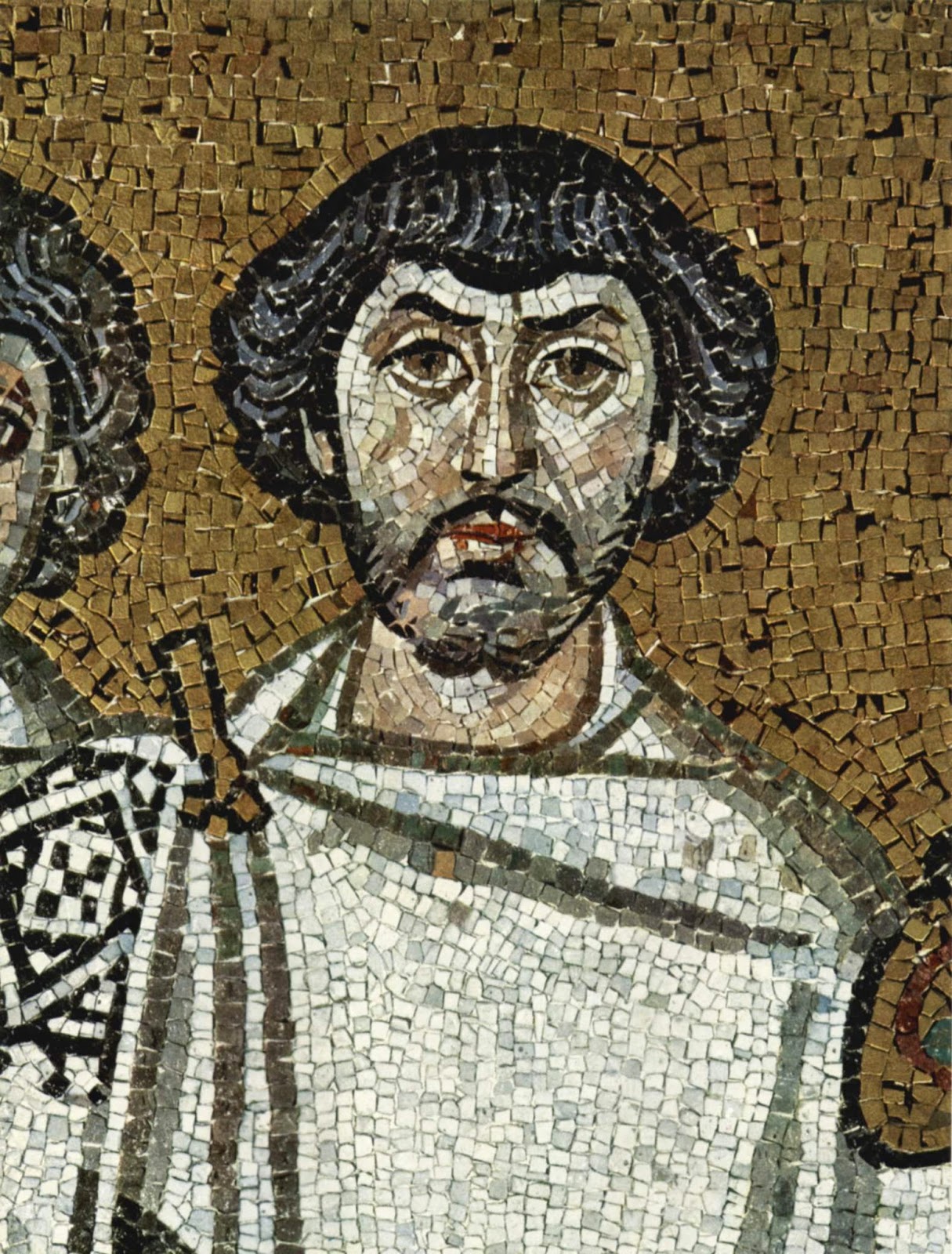
The only known portrait
of Belisarius. 
But, the career of Belisarius is remarkable in that he went from one lost cause to another and made the Byzantine Empire (really the Eastern Roman Empire) grow to the point where it nearly re-captured most of the combined Eastern and Western Roman Empires. His Emperor, the famed Justinian, never quite trusted Belisarius and deprived him of resources, men or clear orders necessary to finish the jobs properly. As I was reading, I found myself wondering if Justinian was a genius in his own right who was depriving a potential rival of the resources he needed to overthrown him, or a twit that was depriving a talented general of the resources he needed to complete his mission. Was he a brazen leader who was expanding his empire with a minimum of resources because that's all that was available or was he timid and just refused to completely commit to a military course of action. I decided that the answer to all of these questions was YES. Yes, he knew Belisarius was a potential rival and he was a twit for depriving him. He wanted to grow the Empire while the opportunity was there but he was all too aware of the risks of sending too many soldiers abroad. 

Despite his years of loyal service and saving the Emperor from a revolt and an attempted invasion of his capital, Belisarius was forcibly retired and brought back to the capital so the Emperor and his spies could keep an eye on him. 

William Tecumseh Sherman (1820-1891)

In a way, the story of Sherman is the story of two Savior Generals. Sherman fought in the first major battle of the American Civil War and even earned an important command and then had a nervous breakdown. Up-and-coming general Ulysses S. Grant discovered Sherman and brought him along with him. When Grant earned promotions, Sherman did, too. 

When Grant was promoted to be the head of the Union Army and headed to Washington, D.C. to confront Robert E. Lee, Sherman took over Grant's forces in the West and began to move on Atlanta.This is where Sherman does the atypical thing. Rather than seeking battle or blindly making a dash for the city, Sherman tries to outmaneuver his opponent in order to take the city with a minimum of losses.

Grant struggled with Lee and offered a demoralizing series of battles with massive casualties as Grant and Lee's armies grappled all over northern Virginia, rarely separating more than a few days before re-engaging and generating thousands of more Union casualties. 

Most historians believe that Lincoln's re-election was far from assured in 1864 and that Sherman's taking of Atlanta right before the election certainly helped. This is the crux of Hanson's argument for Sherman being a Savior General. Sherman helped ensure the re-election of Lincoln and Lincoln's re-election helped ensure the defeat of the Confederacy. 
1864 Portrait of Sherman
by Matthew Brady
.

On top of that, Hanson argues that Sherman's infamous March to the Sea was a revolution in warfare - a war on the property used to wage war rather than on the people that were fighting in the war. He argues that this revolution was more merciful than what was typical in most Civil War campaigns because it mostly avoided casualties with the focus on property.

Hanson has an amazing grasp of the Civil War for an historian that focuses on Ancient Greece. I enjoyed his analysis of Sherman but was frustrated with his dismissal of Grant as a Savior General as well. Before Grant arrived in the East the call was always, "On to Richmond!" with little concern about the Confederate army in the field except the degree that it kept the Union Army out of the Confederate capital. However, Grant re-focused the army on Lee, knowing that eventually Lee would simply run out of men and supplies. Grant's relentless effort ensured that Sherman would never have to face reinforcing units detached from Lee's army.

Sherman deviates from the mold of Savior General in his post-war career. Unlike most of the generals he profiled, Sherman had a successful post-war career.

Matthew Ridgway (1895-1993)

When Ridgway arrived in what remained of South Korea in December of 1950 the war in Korea had already been lost, won and lost again - in just six months.

Ridgway with his characteristic grenade
on his right strap and a first aid kit on
the left.
Ridgway was unpopular with the brass because he had plenty of opinions and never failed to share them. But, in just 100 days he moved the United Nations forces from a defensive (if not outright retreating) posture to an offensive footing and began pushing the North Korean and Chinese forces back across the pre-war border. 

His style of being with the fighting men and seeing what was really going on rather than being told through intermediaries re-invigorated a largely defeated army. He brought enthusiasm, proper supplies for the winter and an argument as to why this war in this place was important and he shared them all freely with his men. He also recognized the American advantages in this war (superior air power, having occupied Japan nearby as a source of men and supplies among other). He also limited the war aims to simply restoring the pre-war border rather than conquering North Korea. By doing that, he helped make the current truce that has largely held for 60+ years possible. 

Sadly, the Korean War is often referred to as "the forgotten war" and Ridgway's amazing success is often forgotten.

David Patraeus (born 1952)

Perhaps the most controversial Savior General to be added to Hanson's list is David Patraeus. 

This book was written before his disgrace over his mistress/biographer and her access to sensitive documents and information.

No matter his personal failings and his failure in Afghanistan, Patreus had success in Iraq with George W. Bush's unpopular "Surge" from January of 2007 to May of 2008. Hanson details how Patreus had been removed from the Iraq theater earlier and then brought in to implement the Surge strategy that he had been advocating to calm the fighting in the unpopular Iraq War.

This strategy seemed almost counter-intuitive. Embrace the very communities that are attacking the American army. Move among them, become a part of those communities. And, once trust is earned, convince those communities that they should turn on Al-Qaeda and embrace the new government. It cost more lives lost at first because the trust had not yet been earned and the American soldiers were more exposed. 

Reading about the real progress made with the Surge was bittersweet considering the current problems in Iraq with ISIS and all of the beheadings, murder, mayhem and chaos as well as Patreus's fall from grace. 

I rate this collection 4 stars out of 5. 

More information on this book can be found here: The Savior Generals

Reviewed on January 20, 2104.

Featured Post

<b><i>BAN THIS BOOK (audiobook)</i></b> by Alan Gratz

Published in 2017 by Blackstone Audio, Inc. Read by Bahni Turpin. Duration: 5 hours, 17 minutes. Unabridged. My Synopsis Ban This Book is t...

Popular posts over the last 7 days