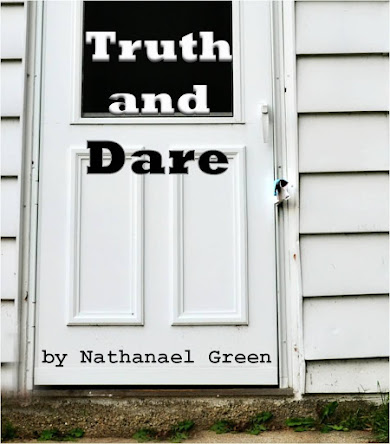
TRUTH and DARE (short story) by Nathanael Green


Published in December of 2013 as an e-book

Simon is the second least popular kid in his summer camp.  Sadly, the least popular kid in camp, Charlie Fergle, is going home and Simon knows he will be be the target of the nightly rounds of "truth or dare."  But, Simon does not want to leave his summer camp because he has met the girl of his dreams, Opal Finley.

Well, he hasn't really met her properly. He has admired her from afar, he has tried to speak to her and he has failed in spectacular fashion every time.


So far, this makes TRUTH and DARE sound like a horrible short story, but it is actually very funny and very sweet. 


This is my first short story by Nathanael Green, but I can guarantee it won't be my last.


I rate this short story 5 stars out of 5.


This story can be found on Amazon.com here: Truth and Dare by Nathanael Green.

Reviewed on January 25, 2014

BONES in HER POCKET (Temperance Brennan #15.5) (audiobook) (short story) by Kathy Reichs


Published by Simon and Schuster Audio in December of 2013.
Read by Linda Emond
Duration: 1 hour, 56 minutes.
Unabridged.

This short story is designed to go between books 15 & 16 in the series and is the audiobook version of a kindle e-book that was released in the summer of 2013.

In Bones In Her Pocket forensic anthropologist Temperance Brennan is called out to a remote location called Mountain Island Lake. It is the site of an artist colony and a raptor rescue center (they help deal with injured hawks, eagles and owls as well as advocate for policies that will help those animals).

A body was found floating in a canvas bag that floated up in the aftermath of a serious flood. As Brennan figures out whose body was found she soon discovers that there is no shortage of suspects...

This is my first Kathy Reichs book of any sort. To her credit, Reichs did not lose this newbie to her series despite the short length of the audiobook. The story moves along quickly and is easy to follow.

The reader, Linda Emond did a fabulous jobs with the reading, particularly the  accents. 

Note: This audiobook was sent to me by the publisher through Audiobook Jukebox's Solid Gold Reviewer program in exchange for an honest review.

I rate this audiobook 4 stars out of 5.

This book can be found on Amazon.com here: Bones in Her Pocket.

Reviewed on January 25, 2014

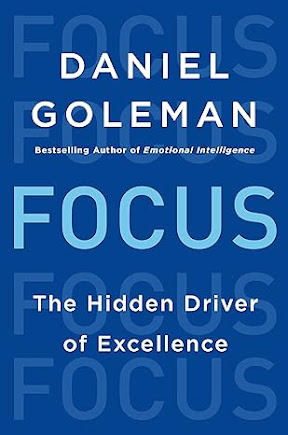
FOCUS: THE HIDDEN DRIVER of EXCELLENCE (audiobook) by Daniel Goleman


"Focus" lacks focus


Published in 2013 by HarperCollins.
Read by the author, Daniel Goleman.
Duration: 8 hours, 8 minutes.
Unabridged

Dr. Daniel Goleman is best known as the author of Emotional Intelligence. In many ways this book is less of a book about the importance of focus and more of a sequel to Emotional Intelligence. It is also a anti-global warming manifesto, an education reform book, a self-help book for business leaders who want to be the real leaders in their offices and there is a little bit about how people are able to focus their attentions a bit more and get better results.

That, of course, is the problem with the book called Focus. The primary topic should be the ability of people to focus and some hints to help you focus better. The book starts out with exactly this...well, focus. We learn how a store detective is able to focus on a crowded room full of bustling and sort out the normal shopping behaviors from the actions of a shoplifter. Goleman discusses how the give-it-to-me-now world of Tweets, Instagram, instant video makes our attention span short (I knew this already - I teach high school and my kids are on their phones all day long and I see the results).


But, then Goleman leaves this area of personal focus largely unexplored and veers into the focus of whole groups of people and uses global warming as his "focus" for this section. I listened to this as an audiobook on CDs and this lasted for more than a CD - well more than an hour of discussion about a topic that is basically off topic. He throws in a suggestion that schools adopt a global warming science project that probably would not hit most state's standards, goes on about carbon footprints, promotes websites that track your carbon footprint, tells how various companies have shrunk their carbon footprints. None of this, not one bit, not one iota, not one word is described in the blurb on the back of the audiobook. I got bored and started skipping whole chunks of text. To his credit, Goleman does point out that the concept of a zero-emission car is a misnomer since electric cars are charged up by an electric grid that is powered largely by coal and coal plants do have emissions (and if you get your electric car charged by a solar panel, there are emissions associated with the manufacture of those panels).  


Then we veer into the world of corporate leadership and the book becomes an extended discussion of what makes a good leader. Turn out it is mostly paying attention the the feelings and needs of those that are following you - this is where the book becomes a sequel to his book Emotional Intelligence with a special focus on CEOs. I felt like I was not the intended reader (or listener, in my case).


Speaking of being a listener, the audio portion of this experience needs to be discussed. The author, Daniel Goleman, read his own book. I am always leery of this because sometimes the author may have a perfectly fine speaking voice but just should not read an audiobook. It is more than a reading, it has to be a performance. Goleman does a lot of public speaking (his website has a place to contact his agent to schedule Dr. Goleman to speak to our corporate gig about leadership, emotional intelligence or maybe even global warming) but public speaking is not the same as reading an audiobook. I cannot hear gestures or hear the fact that the speaker moved across the stage or stood up to put more emphasis on a point in an audiobook. It all has to be done with your voice. Goleman's voice is okay, but not great. He does not quite drone, but it is not really lively either. It definitely took on a nagging tone during the extended global warming discussion. Even worse, there was a bass reverb echo while he spoke that I could not get rid of no matter how much I fiddled with the bass in my car. It sounded like that echo sound you hear when someone is speaking to you on the phone in a small, enclosed room. A professional audiobook should not have this problem. 


Note: This book was sent to me by the publisher in exchange for an honest review.


I rate this audiobook 1 star out of 5. I was so relieved to finish this thing and it took me forever to listen to it.


If you want to give this audiobook a try for yourself you can find it on Amazon.com here: Focus: The Hidden Driver of Excellence.

Reviewed on January 25, 2014.

THE BACKUP MEN (Mac McCorkle #3) (audiobook) by Ross Thomas


Originally published in 1971.


Audiobook edition published by HighBridge Audio in 2013.
Read by Brian Holsopple 
Duration: 6 hours, 1 minute.
Unabridged.

Ross Thomas (1926-1995) is a multiple Edgar Award winner. HighBridge Audio is going back and re-releasing a number of his books as audiobooks. 

The Backup Men is #3 in the four part Mac McCorkle series. I had not read or listened to any books by Ross Thomas before this one and, to his credit, Thomas did an extraordinary job of getting this newbie listener up to speed rather quickly.

Mac McCorkle is a part owner of a rather fancy restaurant in Washington, D.C. that he calls a "saloon." His partner is Mike Padillo who used to work for the CIA or a similar government entity (he is never quite clear about this) and is well-known in the professional hitman/bodyguard/spy community. 

Padillo is approached by a couple of well-known members of his professional community, a set of nearly identical male and female twins, the Gothars, to be their backup man in an operation. They are guarding the new king of a country next door to Kuwait. Remember that this is still 1971 so the massive oil fields in the Middle East were still being explored and developed. In this case, this little country was just being opened up to Western oil exploration, assuming that the new king lives long enough to sign the contracts, that is.
Photo by  Niels Noordhoek

It turns out a pair of equally well-known spies/thugs/hit men are out to kill this new king. When the male twin is found dead in McCorkle's apartment Padillo agrees to help the surviving twin escort the new king. McCorkle insists on coming along as a "talented amateur" and the chase begins.

Although this is a shorter-than-average audiobook, it just felt like the first half of the book was going nowhere. There was lots of posturing, discussion about what makes a good saloon (on a separate point, it really irritated me that McCorkle insisted on calling his fancy high-end restaurant a saloon. Simple rule: if you have a maitre d' you are not a saloon), a discussion about restoring old cars and their relative worth and lots of talk about Padillo's past that revealed not much about Padillo's past.

Once the story finally gets moving (about 60% of the way into the book) the action drives the story but the ending is just so-so. 

Brian Holsopple's reading of the book was quite good. He handled a number of different accents quite well. His performance of McCorkle's nearly non-stop stream of smart aleck comments and internal observations was one of the bright spots of this audiobook.

My short take on this story: McCorkle's quirky point of view on the world of international spying and his smart aleck comments make the story more palatable but it was just not enough to make an okay story a great story.

Note: I was given a copy of this audiobook by the publisher in exchange for an honest review.

I rate this audiobook 3 stars out of 5 and it can be purchased at Amazon.com here: The Backup Men by Ross Thomas.  

Reviewed on January 24, 2014.

THE BLACK BOX (Harry Bosch #18) by Michael Connelly


First published in November of 2012.

To celebrate the 20th anniversary of the first Harry Bosch book, Michael Connelly has Harry re-visit a case from twenty years ago in The Black Box. The book starts with a flashback to the Rodney King Riots in 1992. There were so many questionable deaths during the riots (more than 50) that LAPD put out rolling homicide teams that documented scenes as well as possible until they were called out to yet another death. Harry Bosch and this then-partner Jerry Edgar were one of those teams. 

Most of the victims they dealt with were people local to the neighborhoods where they were found so Anneke Jespersen, a foreign press photographer from Denmark stuck out and Harry Bosch always remembered her and felt guilty because he knew that he did not do a good job of starting the investigation into her murder due to the chaos of the riot - the investigation was barely started when they were called to another scene and by the time a true formal investigation was started the trail was long cold. The same could be said for almost all of the murders they looked into during the riots.
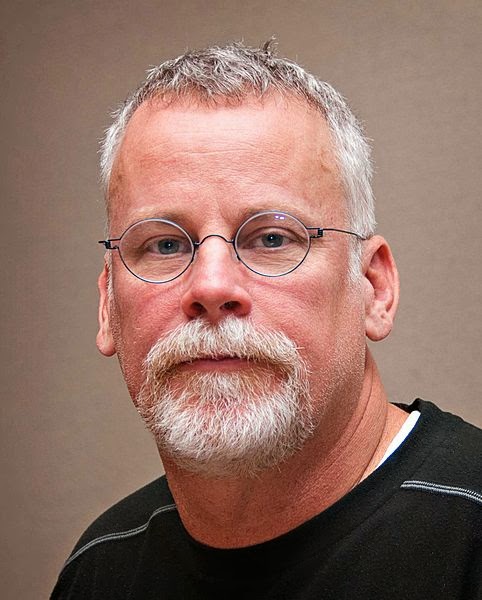
Michael Connelly.
Photo by Mark Coggins

Harry Bosch is still working in the Open-Unsolved Unit (the cold case squad) and Anneka Jespersen's case has been referred to them because of a ballistics match with other murders. So, Harry Bosch does his thing which is mostly starting to dig and irritating everyone else around him. The most important feature to the story is Bosch's sense that the end is near - his career has a definite ending date now and Bosch's investigation have picked up a sense of desperation - he will never be able to solve them all.

Connelly works in a nice literary allusion while Bosch is discussing one of his daughter's assignments. She is reading The Catcher in the Rye and they discuss if briefly. Bosch knows almost nothing of the book, but I was struck by the similarity between Bosch and his deep almost unrecognized need to solve as many murders as he can before he is forced to retire and this famous passage, perhaps the best-known passage, from The Catcher in the Rye: 

"You know that song 'If a body catch a body comin' through the rye'? I'd like – "

"It's 'If a body meet a body coming through the rye'!" old Phoebe said. "It's a poem. By Robert Burns."

"I know it's a poem by Robert Burns."

She was right, though. It is "If a body meet a body coming through the rye." I didn't know it then, though.

"I thought it was 'If a body catch a body,'" I said. "Anyway, I keep picturing all these little kids playing some game in this big field of rye and all. Thousands of little kids, and nobody's around – nobody big, I mean – except me. And I'm standing on the edge of some crazy cliff. What I have to do, I have to catch everybody if they start to go over the cliff – I mean if they're running and they don't look where they're going I have to come out from somewhere and catch them. That's all I'd do all day. I'd just be the catcher in the rye and all. I know it's crazy, but that's the only thing I'd really like to be. I know it's crazy."

Holden Caulfield wants to save all of the kids in his misunderstanding of the words of the poem - it's the only thing he'd really like to be. Harry Bosch has to solve all of the murders. He has to be the man who finds justice for these victims. It's the only thing he really wants to be.

At one point Bosch is describing the work of his favorite jazz musician, Art Pepper, but the description fits Bosch perfectly as well: "Powerful and relentless, and sometimes sad." (p. 199) This relentless nature earns him the ire of his new boss, Lieutenant O'Toole, and the chief who knows that Harry could very well solve this case on the eve of the 20th anniversary of the riots and it would look bad politically for one of the few solved murders to be that of one of the few white victims. He wants Harry to postpone his investigation for a few months, but Harry just can't do that and continue to be Harry Bosch. 

Despite the improbable dramatic ending I found this book to be a most satisfying Harry Bosch story, full of Bosch's disdain for bureaucracy and his willingness to go with an educated hunch no matter the cost. The ongoing story line describing Harry and his daughter is interesting, especially with her possible interest in becoming a police detective after she completes her education. Bosch's love life is giving the short shrift in this story. Bosch and his partner Chu continue to float along - they are partners in only the loosest sense of the world.

On an interesting note, one of Michael Connelly's real-life technical advisers about the workings of the Open-Unsolved Unit, Rick Jackson, makes a couple of extended appearances and works with Bosch.

I rate this book 5 stars out of 5. It can be found on Amazon.com here: THE BLACK BOX (Harry Bosch #18) by Michael Connelly.

Reviewed on January 19, 2014.

Reading Bingo: A fun reading game for 2014

I thought this was cute. It comes from Random House in Canada.


IN the WAKE of the PLAGUE: THE BLACK DEATH and the WORLD IT MADE by Norman F. Cantor


I Was So Primed to Like This Book...


Published in 2002 by Perennial (HarperCollins)

But...I should have read the back cover of In the Wake of the Plague a little better. Right at the top is the Ring around the rosies children's nonsense song:

Ring-a-round the rosie,
A pocket full of posies,
Ashes! Ashes!
We all fall down.

This is followed by the assertion: "a children's rhyme about the Black Death."

Sadly, this is not true and I have known this since the late 1980s when I was doing my undergraduate studies at Indiana University. Why sadly? Because this would have been such a cool fact! I am a high school history teacher and it would be great to able to say, "Look! Here's a children's rhyme we all know and it has this collection to the Black Plague - see how this historical event reverberates through time and even touches our lives now?"

Yeah. That would have been cool. And it is a fact that Norman F. Cantor (1929-2004), a leading medievalist should have known, especially if he is writing a book about the Black Plague. Instead, he doesn't just reference this little song, he embraces it and uses it as the way to introduce the entire concept, even going so far as to assert that this is the way little kids used to deal with the fear of the plague and deal with the frightening concept of sudden death (pages 5-6).

If this were the only problem, I could forgive Mr. Cantor.

Historians should never judge the people of history by the values of their own modern time and they should always check for their own biases. For example, he goes after the English nobility like a dog goes after a chew toy. He goes after their sexual preferences, their private religious chapels, their political posturing, their wars and more and criticizes them: "Fourteenth-century people lacked the moral categories that could transcend political and social roles. They lacked a critical value system that judged rulers by consequences and not the formal categories in which their behavior was structured." (page 39) In other words, everyone had a part to play and no one ever questioned it.  In fact, he goes even farther on pages 58-59 to assert that these folks showed an astonishing lack of self-awareness, unlike today's modern well-educated elites, of course.

Yes, he does actually assert that modern elites are very reflective. Now, if I say to you name 5 vacuous elites in 15 seconds, could you do it? Can you name 5 people that you know that have a college degree but are still dumber than a box of rocks? Of course, because people nowadays are really about the same as they were then. But, he compares rulers of the past to modern rulers and sincerely sees a difference in the way modern elites act, believe and think about things. On page 39 he attacks Edward III as "a kind of destructive and merciless force." The fact that Edward III's contemporaries believed him to be "a constitutional king and the very model of chivalry and aristocratic honor" merely "illuminates a gap between our world and fourteenth-century Europe." 

Really? President Obama won the Nobel Peace Prize and yet he bragged that he was "really good at killing people" with the drone program (and he is, too - according to UK's The Guardian drones killed more than 500 people in 2012).  My point is not to disparage President Obama but to point out that we (even our leaders) are all able to live with a great deal of dichotomy in our lives - not just back then, but now. It is a part of the human condition and an experienced historian should have known that.

There are also lots of snarky comments, including a really cheap shot at former Prime Minister Margaret Thatcher (1925-2013) on page 93. He is discussing how servant girls who were fired for theft would be expelled from their village to become beggars and/or prostitutes and most likely die on the streets. He notes that this is the kind of welfare program that Thatcher would approve of ("Margaret Thatcher would have loved late fourteenth-century and fifteenth-century England.") Whatever Thatcher thought about the welfare state, I hardly think she was for having young ladies become prostitutes or die of exposure rather than be on the public dole. Over the top, off topic and inaccurate. 

Most of the book reads like it was cobbled together from a combination of
Illustration of people suffering from the
bubonic plague (note the buboes,
or raised bumps)
already printed articles with an obsessive focus on England and a few members of the royal family and which parts of France produced wine and how much that wine was worth and who drank the wine and how much of the wine they imported and ...well, you get the idea.
 

There is just no focus on what the book is supposed to be about - how the Black Plague changed Europe and through Europe changed the world. There is an excellent explanation of the English legal system in the area of real estate and how that legal system helped to consolidate the holdings of some families. But, there is not much explaining how English society was before and after the Black Plague. And, speaking of England, why does Cantor just focus on England for so much of this book? 

The last third of the book is much less snarky and actually deals with the topic that is detailed in the title. The chapter on how many in Europe blamed the Jews for the plague was by far the best written, confirming that blaming European Jews for Europe's troubles has a long, documented history. And, for a change, he actually moved the focus away from England and got out as far as Poland. The chapter on the origins of the plague at the end of the book seemed misplaced (shouldn't it be in the beginning?) and included a serious discussion of the extraterrestrial origin of the Black Plague (yes, he actually discusses and gives credence to a panspermia-type origin to the epidemic). 

The last chapter, "Aftermath" is the outline that should have been fleshed out into the entire book. There is an interesting mention of the fact that the Church had to fill hundreds of open positions and the average age of becoming an ordained priest dropped from age 25 to age 20. "It was a younger, much younger Church that came suddenly into being, and now one staffed heavily with under-educated and inexperienced people." (page 206) Rather than just paragraph on the topic, it would have been worthwhile to explore how the Church changed and if these changes led to the conditions that caused the Protestant Reformation 140 years later.

I rate this book 1 star out of 5. The one good chapter out of ten does not redeem it.

This book can be found on Amazon.com here: IN the WAKE of the PLAGUE: THE BLACK DEATH and the WORLD IT MADE by Norman F. Cantor

Featured Post

<b><i>BAN THIS BOOK (audiobook)</i></b> by Alan Gratz

Published in 2017 by Blackstone Audio, Inc. Read by Bahni Turpin. Duration: 5 hours, 17 minutes. Unabridged. My Synopsis Ban This Book is t...

Popular posts over the last 7 days