NPR Road Trips: Fairs and Festivals (audiobook)


Lots of Fun

Published by HighBridge in 2012.
Multicast
Duration: about 1 hour.

My family and I are avid fans of fairs and festivals. We like to wander around and experience the hullabaloo of all of the people, the noises of the midway, the incessant sales pitches of the guys trying to sell replacement windows or guttering and, of course, the animals.

We just attended the Indiana State fair last weekend and spent an astounding 13 hours wandering around the giant circle of the fair (it is built around a one mile dirt track) seeing everything from Star Wars Stormtroopers to a petting zoo filled with week-old calves to a giant carving made of cheese (still being carved as we watched!). I learned about $261,000 John Deere Tractors, heard an acoustic blues band, bought a wallet, and saw a clown marching band performance - all before we hit the midway!

So, when I found this little audiobook of stories collected from NPR over the years about fairs and festivals I knew this was right up my alley. There are 18 little stories here that originally broadcast on the air from 1999 to 2011. Most are two to five minutes long, the longest being a little over ten minutes.

2012 Indiana State Fair Midway. Photo by DWD.
Fairs and festivals in Texas, Minnesota, Ohio, Iowa, Tennessee, New York, Alaska, West Virginia and more are discussed. Garrison Keillor leads off with a philosophic look at fairs and why we love them and why were are in such a hurry to get out of there when you have seen enough for one day. And, of course, he discusses the phenomenon of "food on a stick."

Other topics include the sounds of the fair, displays of various and odd collections, a "husband-calling" contest, a cornbread festival, a music festival, a butter carver and a wood chopping festival. There are stories about the other side of the fair as well. We learn about the freak show, how to make the perfect carnival pitch, how to get racing pigs to race and the story behind some the folks that make the glorious fair food.

As with all compilations, some entries are better than others, but even the weaker ones were strong in this collection.

I rate this audiobook 5 stars out of 5.

This audiobook can be found on Amazon.com here: NPR Road Trips: Fairs and Festivals.

Reviewed on July 8, 2012.

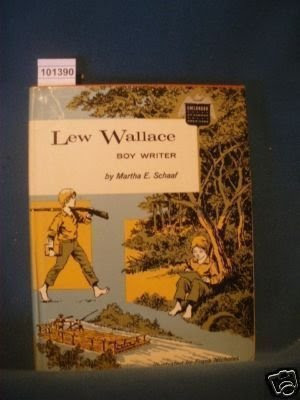
Lew Wallace: Boy Writer by Martha E. Schaaf


A Trip Down Memory Lane

Published in 1961 by The Bobbs-Merrill Company, Inc
Intended for upper elementary students.

Thirty-five years ago books like Lew Wallace: Boy Writer filled my library's book shelves in Hope, Indiana and I went through them like a hot knife through butter. I am sure they are a big reason why I enjoy history so much today. I remember enthusiastically reading about the adventures of young Daniel Boone, Abraham Lincoln and even about Martha Washington and other "yucky" girls as I worked my way down the shelf.

Union Major General Lew Wallace
(1827-1905)
I have next to my computer a 1961 hardback copy of Lew Wallace: Boy Writer, part of the Childhood of Famous Americans series

As suggested by the series title Lew Wallace: Boy Writer focuses on the childhood of future the Civil War general, territorial governor of New Mexico (during the days of Billy the Kid and the Lincoln County War) and author of Ben-Hur: A Tale of Christ. It features young Lew Wallace who hates school but loves to read and explore. His father was the sixth governor of Indiana.  Young Lew Wallace had access to the state's library and quickly fell in love with books.

The details of Wallace's adult life are not left out or just glossed over as an afterthought, but the main focus is on Wallace's childhood. This is a very simple read and for me, an enjoyable reminder of my own childhood.

Lew Wallace: Boy Writer can be found on Amazon.com here.

I rate this book 4 out of 5 stars.

Reviewed on August 2, 2012.

Superman Versus the Ku Klux Klan: The True Story of How the Iconic Superhero Battled the Men of Hate by Rick Bowers


A Dual Biography of Sorts


Published by National Geographic in 2012.

Note: This is a YA book aimed at 5th graders and above. This adult enjoyed the book also.

From time to time the dual biography comes back into vogue. Dual biographies are a great way to compare and contrast two people's lives and, in this case, this style is used to compare and contrast two different organizations: The Ku Klux Klan and Superman, Inc. and see how these two radically different groups interacted.

There is, of course, so such thing as Superman, Inc. - I made that up. Superman is owned by D.C. Comics, but there are people who make all sorts of decisions on how to present Superman. What will he stand for and stand against? What will the next comic be like? How about the next movie? Superman Versus the Ku Klux Klan tells the story of the creation of Superman (and the two young Jewish boys from Ohio who created him) and how Superman quickly caught on once a publisher finally took him on in 1938.

By 1946 Superman was an established fixture in American culture. His comics had been sent all over the  world courtesy of American soldiers in World War II, the character was in newspapers, comic books and even had a daily radio show. The producers of the radio show decided, in the aftermath of World War II and the Holocaust that Superman would take a stand against racism.

This was a risk because racism was still a very popular concept, as demonstrated by the other part of the book in which Bowers details the history of the Ku Klux Klan and describes its many manifestations over the years. The producers of the Superman  radio show decided to not have Superman take on the Klan directly. Instead, they create a new hate group called The Clan of the Fiery Cross. This fictional group is modeled on the Klan itself, helped by an double agent insider who was writing a series of articles on how the Klan is organized and makes money.


The trick in writing the radio show was not to make it too preachy. But, if you go too light on the message it may be missed altogether. Plus, this was a change in Superman's style. Everyone is against bank robbers, spies and organized criminals. Would this adventure with a message turn away young listeners?

The radio show aired sixteen 15-minute episodes in June of 1946 that were very well received, by its young audience, media sources and other groups across the country. Ratings actually increased during this storyline.  Bowers is quick to point out that this one little radio show did not end the Ku Klux Klan (although the Klan called for boycotts that just did not materialize), but it was important because it showed a superhero standing  with regular folks against a hate group and it was a financial and critical success. In a way, this was a stand that asked who was more American, Superman or the Ku Klux Klan?

I rate this book 4 stars out of 5.This book can be found on Amazon.com here: Superman Versus the Ku Klux Clan.

Reviewed on August 1, 2012.

The Cat Who Walks Through Walls (audiobook) (abridged) by Robert A. Heinlein


Easy to love and easy to hate


Published by Simon and Schuster Audioworks in 1987.
Performed by Robert Vaughn
Duration: 3 hours
Abridged

Note: The 2007 re-release of The Cat Who Walks Through Walls clocks in at just over 13.5 hours, so this  3-hour-long 1987 abridgment is undoubtedly heavily abridged, even considering that acclaimed actor Robert Vaughn is a relatively quick reader.

Books like The Cat Who Walks Through Walls are hard to describe and easy to love and hate. This is a soaring piece of fiction that takes the listener into a fully-developed world that has enough internal coherence and relationship to our current world that the reader can feel comfortable (there are Volvo vehicles, they stop at a Sears store, etc.) On the other hand, the action is frenetic to the point of chaos (this may be due to the abridgment, but upon reading an online summary, it may not) and the interaction of the characters is often witty but unrealistic to the point of being laughable. For example, when the main character finds out that his new wife (he has only known her for 3 days or so) wants him to marry her granddaughter as well in a group marriage he doesn't question the arrangement for more than about 3 seconds.

The premise of the story is that Colonel Colin Campbell and his new wife named Gwen Novak are on the run, framed for a murder they did not commit. The story is told from Campbell's point of view and he soon discovers that his new wife can travel through time, is much older than she says she is and is a member of a quasi-military unit called the Time Corps. She has been sent to recruit Campbell to help with a mission and has fallen in love with him.

Robert A. Heinlein (1907-1988)
Heinlein throws a great number of ideas around in this book, which is actually loosely tied into a number of his books. Heinlein continues his long string of books featuring women that are hyper-sexual, independent and yet often subservient to strong men. He explores time travel paradoxes and his idea of "World as Myth." World as Myth asserts that the multiverse is all fictional and that exceptionally good storytellers make their own universes and the rules of those universes. Members of the Time Corps have visited L. Frank Baum's Oz and Alice's Wonderland universes and John Carter of Mars makes a silent appearance in a dramatic scene towards the end.

Throw in talking space ships, smart-talking air traffic controllers and truly fun banter you have the making of a good book. Unfortunately, Heinlein's silly sexual politics, tendency to have long lecture scenes and his decision to keep the reader in the dark as long as possible hurt the book.

Robert Vaughn
A gigantic bright spot in this audiobook is Robert Vaughn. I have never heard Robert Vaughn read an audiobook before and I was uncertain as to what to expect. Vaughn has a very distinct speaking voice (he played Lee, the black-gloved gunman in The Magnificent Seven and Napoleon Solo in The Man from U.N.C.L.E.) and I was not sure how that would work. I am totally convinced that all of Heinlein's later books should have been read by Robert Vaughn (maybe they still could be, I am not sure how much Vaughn works nowadays). Vaughn's unique voice is able to pull off the pretentious and confident nature of Heinlein's prose and he is able to create any number of distinctive voices, both male and female. Truly a performance, not just a reading.

I rate this book 3 stars out of 5. It can be found on Amazon.com here: The Cat Who Walks Through Walls by Robert A. Heinlein.

Reviewed on July 28. 2012.

Fatal Dive: Solving the World War II Mystery of the USS Grunion by Peter F. Stevens


Three stories in one: A biography, a mystery and an adventure

Published in 2012 by Regnery History

The USS Grunion was a top of the line submarine for the U.S. Navy in 1942. Literally, the fastest submarine in the fleet and outfitted with the latest in torpedo technology (magnet activated designed to go off near ships) and led by the highly-respected Lieutenant Commander Jim Abele, the USS Grunion was sent to the Aleutian Islands in Alaska to harass Japanese supply ships (for those who did not know, Japanese forces held parts of the Aleutian Islands for a little more than in a year from 1942 to 1943).

The USS Grunion performed well, sinking two Japanese submarines and damaging a freighter despite problems with the torpedoes. What the crew of the USS Grunion did not know was that these advanced torpedoes did not work like they were supposed to. They did not track well towards their targets (although the magnetic trigger, called a magnetic pistol, was supposed to go off if it got near a ship, they often did not) and some of the torpedoes simply bounced off their targets when they hit (the freighter it attacked was damaged by two torpedoes that simply slammed into the hull with no explosions). In my mind, the fact that the Grunion did so well with an inferior torpedo is a testament to the ship and its crew.

But, the worst feature of these torpedoes was that some of them would miss their targets and go around in a broad circle back to the submarine that fired them, like a boomerang. It is one thing to use weapons that may misfire or miss. It is another to use weapons that have a tendency to miss and then circle back on the submarine that fired them!

The USS Grunion in March of 1942, before
she was commissioned
No one is quite sure how the Grunion was sunk, but it went down while in a fight with a Japanese freighter. The U.S. Navy has been silent about possible causes, but it seems likely that a torpedo circled back on the Grunion and collided with it, causing the Lt. Cmdr. Abele to assume that the Grunion was under fire from a Japanese plane and order it to dive. The dive plane (or hydroplane) controls the angle of the dive and it may have been damaged from the torpedo or other combat and got stuck so that the submarine was forced to keep going down until it finally was crushed by the intense pressure of the ocean itself.

The families of the 70 crew members of the Grunion were never told anything about faulty torpedoes or even where their loved ones were serving when they disappeared. Instead, a few family members used the connections and resources they had and shared what they knew with each other. They pieced together what they had and with a few very lucky breaks and help from Japanese historians were able to get a very good idea where the Grunion sank.

Fatal Dive is really three stories. It is the story of the Jim Abele and the USS Grunion , the story of the detective work that went into finding the possible location of the USS Grunion and the story of how it was finally found (no easy task in the very rough waters around the Aleutians). Stevens keeps a feeling of tension throughout his description of the search for the missing submarine despite the fact that the reader knows the mystery was solved when he reads the title and can see the pictures in the middle insert section, which is no mean feat.

Stevens includes a mini-biography and a picture of almost every member of the crew and does his best to make Fatal Dive a testament to the entire crew and their families, not just the story of the Abele family.

I rate this book 4 out of 5 stars.

This book can be found on Amazon.com here: Fatal Dive: Solving the World War II Mystery of the USS Grunion by Peter F. Stevens.

Reviewed on July 27, 2012.

Jackson: The Iron-Willed Commander (The Generals Series) by Paul Vickery


A Nifty Little Biography


Published by Thomas Nelson in 2012.

Jackson: The Iron-Willed Commander is a welcome addition to a larger series called The Generals that offers relatively short biographies (about 200 pages) of America's better-known generals. This book is by no means the definitive biography of Andrew Jackson, but it is great introduction to this controversial man.

Andrew Jackson lived most of his life on the American frontier. His most famous battle was, of course, the Battle of New Orleans in the last moments of the War of 1812 (technically, it took place after the treaty was signed) but by that time Jackson was a veteran of many battles. He had already fought the British in two wars, skirmished with the Spanish several times and was involved in multiple frontier wars with Native Americans. Throw in Jackson's willingness to duel and one quickly realizes that Jackson thrived on action and danger. A great deal of his life seems to be consumed by organizing for a campaign, going out on a military campaign, recovering from injury sustained in a battle or a duel or recovering from an illness he contracted while on a campaign. His wife, Rachel, must have been a very patient woman.

Rather than go into the details of Jackson's life, I will comment on the presentation of Jackson's more controversial decisions in the book. Jackson is reviled in many Native American communities for his policy of  forcing Native Americans out of their traditional land and making them settle across the Mississippi, including villages and communities that sided with him during the wars and including groups that decided to live like white society. Vickery is to be commended for doing what so many biographers would not do - he explains why Jackson did this. Many writers would scold Jackson, but Vickery explains Jackson's reasoning without excusing him. It makes for a better biography if one can understand the thinking of the time.

Andrew Jackson (1767-1845)
Since it is a part of a series about generals, most of the book focuses on Jackson's long and varied military career. Jackson's presidency merits a few pages as does his personal life. This is a nifty little biography and I recommend it as a great place to start a study of Andrew Jackson or the frontier times of the South.

I received this book as a part of Thomas Nelson's Booksneeze program in exchange for an honest review.

Reviewed on July 24, 2012.

This book can be found on Amazon.com here: Jackson: The Iron-Willed Commander

I rate this book 5 stars out of 5.

The Significance of the Frontier in American History by Frederick Jackson Turner


Four Classic Essays By a Noted Historian


Collection published by Penguin Classics in 2008.

The Significance of the Frontier in American History is a collection of four essays written by noted historian Frederick Jackson Turner from 1893 to 1910. Penguin Classics has re-issued these essays as part of its Great Ideas series.

Frederick Jackson Turner is featured in just about every U.S. History textbook for his essay The Significance of the Frontier in American History, written in 1893. I am embarrassed to note that I had never read this classic essay until I read this collection, although I was familiar with its basic thesis. In this essay Turner notes that the 1890 census determined that as of 1890 there was no longer a definable "frontier." He asserts that this is the beginning of something new for the United States as it has always been defined by its (usually) westward boundary.

Turner notes that the Western settlers came from all parts of the eastern seaboard but created a new culture, and in some ways the definitive American culture, when these diverse groups of settlers brought their old ways of doing and thinking and mingled them with one another to make something new. These settlers are known for their rugged individualism, a more egalitarian mindset (the frontier states were the first ones to lift property requirements to vote and, later, to let women vote) and a demand for government intervention in curtailing the power of corporations (at the time of the essay the Granger movement was quite active). Turner is quite clear that the presence of "free" land waiting for settlement was a major reason for the "self-made" man of the frontier and openly wondered about opportunities for economic advancement in a future with no frontier.

Frederick Jackson Turner
(1861-1932)
The second essay is The Problem of the West, written in 1896. It describes the dissonance between the original states on the east coast and the states that came were settled later. In many ways, this continues on to this day - just take a look at one of the political red state/blue state maps. He points to the Old Northwest territory states as being the linchpin that tie the Union together. States like Illinois, Michigan and Indiana are a little bit Western and also have strong ties to the east coast.

The Significance of the Mississippi Valley in American History, written in 1909 and 1910, discusses how the Mississippi River system, including the Ohio and Missouri Rivers, were the key to the exploration and settlement of a great chunk of the country. Not only did the settlers follow the rivers, but those rivers were their lifeline to the larger world of trade.

The last essay is the weakest, in my opinion. It was written in 1910 and is entitled Social Forces in American History. In many ways, it is the bookend for the title essay. Turner describes changes that he has seen in American society since the closing of the frontier, including the growth of corporations and those that get fabulously wealthy from industry and the beginnings of activist government.

I rate this collection of essays 5 stars out of 5.

This book can be found on Amazon.com here: The Significance of the Frontier in American History by Frederick Jackson Turner.

Reviewed on July 24, 2012.

Featured Post

<b><i>BAN THIS BOOK (audiobook)</i></b> by Alan Gratz

Published in 2017 by Blackstone Audio, Inc. Read by Bahni Turpin. Duration: 5 hours, 17 minutes. Unabridged. My Synopsis Ban This Book is t...

Popular posts over the last 7 days