Fatal Dive: Solving the World War II Mystery of the USS Grunion by Peter F. Stevens


Three stories in one: A biography, a mystery and an adventure

Published in 2012 by Regnery History

The USS Grunion was a top of the line submarine for the U.S. Navy in 1942. Literally, the fastest submarine in the fleet and outfitted with the latest in torpedo technology (magnet activated designed to go off near ships) and led by the highly-respected Lieutenant Commander Jim Abele, the USS Grunion was sent to the Aleutian Islands in Alaska to harass Japanese supply ships (for those who did not know, Japanese forces held parts of the Aleutian Islands for a little more than in a year from 1942 to 1943).

The USS Grunion performed well, sinking two Japanese submarines and damaging a freighter despite problems with the torpedoes. What the crew of the USS Grunion did not know was that these advanced torpedoes did not work like they were supposed to. They did not track well towards their targets (although the magnetic trigger, called a magnetic pistol, was supposed to go off if it got near a ship, they often did not) and some of the torpedoes simply bounced off their targets when they hit (the freighter it attacked was damaged by two torpedoes that simply slammed into the hull with no explosions). In my mind, the fact that the Grunion did so well with an inferior torpedo is a testament to the ship and its crew.

But, the worst feature of these torpedoes was that some of them would miss their targets and go around in a broad circle back to the submarine that fired them, like a boomerang. It is one thing to use weapons that may misfire or miss. It is another to use weapons that have a tendency to miss and then circle back on the submarine that fired them!

The USS Grunion in March of 1942, before
she was commissioned
No one is quite sure how the Grunion was sunk, but it went down while in a fight with a Japanese freighter. The U.S. Navy has been silent about possible causes, but it seems likely that a torpedo circled back on the Grunion and collided with it, causing the Lt. Cmdr. Abele to assume that the Grunion was under fire from a Japanese plane and order it to dive. The dive plane (or hydroplane) controls the angle of the dive and it may have been damaged from the torpedo or other combat and got stuck so that the submarine was forced to keep going down until it finally was crushed by the intense pressure of the ocean itself.

The families of the 70 crew members of the Grunion were never told anything about faulty torpedoes or even where their loved ones were serving when they disappeared. Instead, a few family members used the connections and resources they had and shared what they knew with each other. They pieced together what they had and with a few very lucky breaks and help from Japanese historians were able to get a very good idea where the Grunion sank.

Fatal Dive is really three stories. It is the story of the Jim Abele and the USS Grunion , the story of the detective work that went into finding the possible location of the USS Grunion and the story of how it was finally found (no easy task in the very rough waters around the Aleutians). Stevens keeps a feeling of tension throughout his description of the search for the missing submarine despite the fact that the reader knows the mystery was solved when he reads the title and can see the pictures in the middle insert section, which is no mean feat.

Stevens includes a mini-biography and a picture of almost every member of the crew and does his best to make Fatal Dive a testament to the entire crew and their families, not just the story of the Abele family.

I rate this book 4 out of 5 stars.

This book can be found on Amazon.com here: Fatal Dive: Solving the World War II Mystery of the USS Grunion by Peter F. Stevens.

Reviewed on July 27, 2012.

Jackson: The Iron-Willed Commander (The Generals Series) by Paul Vickery


A Nifty Little Biography


Published by Thomas Nelson in 2012.

Jackson: The Iron-Willed Commander is a welcome addition to a larger series called The Generals that offers relatively short biographies (about 200 pages) of America's better-known generals. This book is by no means the definitive biography of Andrew Jackson, but it is great introduction to this controversial man.

Andrew Jackson lived most of his life on the American frontier. His most famous battle was, of course, the Battle of New Orleans in the last moments of the War of 1812 (technically, it took place after the treaty was signed) but by that time Jackson was a veteran of many battles. He had already fought the British in two wars, skirmished with the Spanish several times and was involved in multiple frontier wars with Native Americans. Throw in Jackson's willingness to duel and one quickly realizes that Jackson thrived on action and danger. A great deal of his life seems to be consumed by organizing for a campaign, going out on a military campaign, recovering from injury sustained in a battle or a duel or recovering from an illness he contracted while on a campaign. His wife, Rachel, must have been a very patient woman.

Rather than go into the details of Jackson's life, I will comment on the presentation of Jackson's more controversial decisions in the book. Jackson is reviled in many Native American communities for his policy of  forcing Native Americans out of their traditional land and making them settle across the Mississippi, including villages and communities that sided with him during the wars and including groups that decided to live like white society. Vickery is to be commended for doing what so many biographers would not do - he explains why Jackson did this. Many writers would scold Jackson, but Vickery explains Jackson's reasoning without excusing him. It makes for a better biography if one can understand the thinking of the time.

Andrew Jackson (1767-1845)
Since it is a part of a series about generals, most of the book focuses on Jackson's long and varied military career. Jackson's presidency merits a few pages as does his personal life. This is a nifty little biography and I recommend it as a great place to start a study of Andrew Jackson or the frontier times of the South.

I received this book as a part of Thomas Nelson's Booksneeze program in exchange for an honest review.

Reviewed on July 24, 2012.

This book can be found on Amazon.com here: Jackson: The Iron-Willed Commander

I rate this book 5 stars out of 5.

The Significance of the Frontier in American History by Frederick Jackson Turner


Four Classic Essays By a Noted Historian


Collection published by Penguin Classics in 2008.

The Significance of the Frontier in American History is a collection of four essays written by noted historian Frederick Jackson Turner from 1893 to 1910. Penguin Classics has re-issued these essays as part of its Great Ideas series.

Frederick Jackson Turner is featured in just about every U.S. History textbook for his essay The Significance of the Frontier in American History, written in 1893. I am embarrassed to note that I had never read this classic essay until I read this collection, although I was familiar with its basic thesis. In this essay Turner notes that the 1890 census determined that as of 1890 there was no longer a definable "frontier." He asserts that this is the beginning of something new for the United States as it has always been defined by its (usually) westward boundary.

Turner notes that the Western settlers came from all parts of the eastern seaboard but created a new culture, and in some ways the definitive American culture, when these diverse groups of settlers brought their old ways of doing and thinking and mingled them with one another to make something new. These settlers are known for their rugged individualism, a more egalitarian mindset (the frontier states were the first ones to lift property requirements to vote and, later, to let women vote) and a demand for government intervention in curtailing the power of corporations (at the time of the essay the Granger movement was quite active). Turner is quite clear that the presence of "free" land waiting for settlement was a major reason for the "self-made" man of the frontier and openly wondered about opportunities for economic advancement in a future with no frontier.

Frederick Jackson Turner
(1861-1932)
The second essay is The Problem of the West, written in 1896. It describes the dissonance between the original states on the east coast and the states that came were settled later. In many ways, this continues on to this day - just take a look at one of the political red state/blue state maps. He points to the Old Northwest territory states as being the linchpin that tie the Union together. States like Illinois, Michigan and Indiana are a little bit Western and also have strong ties to the east coast.

The Significance of the Mississippi Valley in American History, written in 1909 and 1910, discusses how the Mississippi River system, including the Ohio and Missouri Rivers, were the key to the exploration and settlement of a great chunk of the country. Not only did the settlers follow the rivers, but those rivers were their lifeline to the larger world of trade.

The last essay is the weakest, in my opinion. It was written in 1910 and is entitled Social Forces in American History. In many ways, it is the bookend for the title essay. Turner describes changes that he has seen in American society since the closing of the frontier, including the growth of corporations and those that get fabulously wealthy from industry and the beginnings of activist government.

I rate this collection of essays 5 stars out of 5.

This book can be found on Amazon.com here: The Significance of the Frontier in American History by Frederick Jackson Turner.

Reviewed on July 24, 2012.

Capitol Murder (audiobook) by Phillip Margolin


Lots of plot threads that eventually tie together


Published by HarperAudio in 2012.
Performed by Jonathan Davis.
Duration: 9 hours, 38 minutes.
Unabridged.

I have been a Phillip Margolin fan since I read his book The Burning Man nearly 15 years ago. I worked at a used book store at the time and I remember turning a couple of people on to Margolin's stuff. I must admit that I have not read some of his more recent books, not out of lack of interest, but mostly due to the pressure of a massive To-Be-Read pile (do you REALLY need to add yet another book to the pile?).

Phillip Margolin
So, when I came across a Margolin audiobook, I knew that this was a good chance to catch up while not adding to the To-Be-Read pile, since I usually listen while doing things like driving.

So, what did I think of Capitol Murder?

First, this book is at least the third book in a series following the adventures of Brad Miller and Dana Cutler. This is not really a problem because Margolin sets up things early on with a dinner party scene that clues in the newbies to the series.

Second, Margolin has many, many plot threads going on at the same time. There is a terrorist plot from Pakistan, the ongoing saga of a serial killer named Clarence Little from an earlier book, an unfaithful Senator who opens himself to blackmail and the interactions of all of these threads in the lives of Dana Cutler and Brad Miller and Brad's wife. About halfway through this book I was pretty sure that Margolin had completely lost his touch and had thrown  bits and pieces of three or four book to fulfill a book contract. I just was not seeing how they all related.

Suddenly, they all come together and things get very, very busy very, very quickly. All of the threads tie together a little too neatly, although I did have a laugh out loud moment at the audacity of Dana Cutler in one of her last scenes. The Epilogue also has a nice twist that makes up for the quick ending of the main storyline.

So, does Margolin still have it? Yeah, he still delivers a very readable thriller. I won't wait so long to read my next one.

The audiobook was read by Jonathan Davis. The performance was often told in an emotionally flat tone of voice, like when reading a non-fiction text. This worked very effectively when describing the preparations of the terrorists or when the story is focusing on the actions of a serial killer. The methodical descriptions seem all  the more menacing when told in a flat matter-of-fact tone. But, when friends are sitting around having drinks and discussing what's been going on in their lives, there should be some punch to the conversation.

I rate this audiobook 4 stars out of 5.

This audiobook can be found on Amazon.com here: Capitol Murder.

Reviewed on July 23, 2012.

Nothing to Add to This Thought...


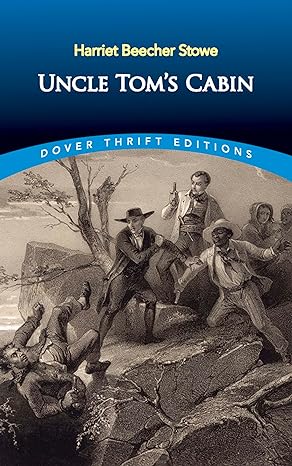
Uncle Tom's Cabin by Harriet Beecher Stowe


A Few Thoughts on Uncle Tom's Cabin

First Published in 1852.

Harriet Beecher Stowe sat down to write a book that would show the United States the evils of slavery. She wrote Uncle Tom's Cabin; or, Life Among the Lowly in response to the Fugitive Slave Act of 1850, at the urging of her sister-in-law. She succeeded in fueling the debate over slavery and she pointed a finger of shame at the slave owners and at America as a whole.

Harriett Beecher Stowe (1811-1896)
It created a national sensation. Within ten years, it sold two million copies, making it the best-selling novel of all time in the United States, in proportion to population, according to noted Civil War historian James M. McPherson. The book was so controversial and so powerful that there were attempts to ban it in some parts of the South. Pro-slavery authors attempted to counter the book with their own books with titles like Uncle Robin, in His Cabin in Virginia, and Tom Without One in Boston in an attempt to show that African Americans were better off in slavery. Abraham Lincoln reportedly acknowledged the impact of her novel when he meet Harriett Beecher Stowe in 1862 and quipped, "So, you're the little woman who wrote the book that made this great war."

Stowe uses two plot devices to successfully make her case about the evils of slavery. The first is the theme of the splitting apart of slave families and the slave-owning families throughout the course of the book. The second is Uncle Tom's unwavering adherence to Christian principles. The book was written to persuade Christians of the Second Great Awakening that slavery was a great evil that should be eliminated. The reader is continually assaulted with images and exhortations designed to shame the heart of a nineteenth century Christian into action.

Stowe chose to focus on the rending of slave families and the abuse heaped upon the devout Christian, Uncle Tom, for good reason. If she had focused on the hard, forced labor of slaves in the field there would have been little sympathy. This was an era in which nearly everyone worked long, hard hours and many people worked for others and felt that they were forced to work or starve. For example, historian Harry L. Watson noted that the famed "Lowell Girls" of New England were forced to live in company-owned boarding houses and worked an average of 73 hours per week.

If she had made a straight argument about the basic immorality of one human being owning another, she probably would not have swayed many hearts. Supreme Court Chief Justice Roger Taney summed up the feelings of many people in the Dred Scott decision when he said that African Americans were "of an inferior order...so far inferior, that they had no rights which a white man was bound to respect."

In some states, it was even against the law for African Americans to reside within the state. In Indiana, for example, the 1851 state constitution made it illegal for African Americans to move into the state and fined anyone who hired them or encouraged them to remain in the state. The proceeds of those fines were put into a fund to re-settle African Americans to colonies in Africa.

Rather than writing an essay or an editorial that lays out the antislavery argument, Stowe uses a much more effective method - she introduces her readers to the slaves themselves and inflicts the horrors of slavery upon these slaves. The reader is forced to get to know slaves as people (undoubtedly a rare occurrence for Northern whites) and then witness the rending of their families, their struggles for dignity, their flights for freedom and terrible physical abuse.

From the very beginning of her novel, Stowe shows the fearful prospect that faced all slave families - the selling away of family members. The reader is shown, through these fictional characters, the impact of the selling away of a family member. The reader is witness to a slave auction in which a worn-out old woman begs to be sold along with her only remaining child.

The fear of being sold away was not just restricted to cruel or greedy masters. Kindly masters could have financial troubles and be forced to break apart families. In what is probably the most famous scene in Uncle Tom's Cabin, the readers follows an escaping slave named Eliza as she flees a loving mistress in the middle of winter so that her only child will not be sold away to help cover family debts. Eliza is so desperate to escape the runaway slave hunters that she flees across ice flows of the Ohio River.

The majority of the book deals with the title character, Uncle Tom, a slave sold away from his family and friends (including the master's son) in order to pay a debt. Uncle Tom's desire to return to his home in Kentucky is a constant throughout the book. The reader also knows that he would not have suffered his awful death if he had not been sold away from his home and family. By making fully developed characters of the slaves, Stowe shows that the reality of slave life was not like the comments of the white woman at the slave auction. She is  asked,

"Suppose, ma'am, your two children, there, should be taken from you, and sold?"

and she answers:


"We can't reason from our feelings to those of this class of person."


Stowe attacks that attitude by showing how "this class of person" would respond to forced separation from a child, and it was no different than the response of any other class of person.


Stowe takes us on a tour of the South by way of the slave Uncle Tom. He sees good masters and bad ones. He lives in a mansion (as a slave, of course) and works in the most horrible conditions on a desolate plantation. Through it all, Uncle Tom is a perfect Christian. He is intended to be this way. He never deviates from the ideals of the Christian faith. He shares food while he is nearly starving. He rescues a drowning child while he is being shipped down the Mississippi to be auctioned and he does not complain when his hymn book is taken from him and his faith is ridiculed. Uncle Tom does not take freedom when it is offered by his master in New Orleans because he is concerned about the condition of his master's soul and wants to make sure he becomes a Christian. Tom even forgives the master who orders him beaten to death and the slaves who gladly comply with his commands. Stowe makes him an unbelievably perfect Christian, even a saint. She does this so that she can demonstrate the cruelty of slavery. If it can destroy this man who has done nothing wrong, how can anyone survive it? It screams at the consciences of the Christians who let this situation continue and questions the Christianity of the Slave-owning class.

Harriett Beecher Stowe's goal was to reach out to touch the heart of America and demonstrate the evils of slavery. Coming from a family of evangelists, she created the character of Uncle Tom to reach out to Christians of the Second Great Awakening. He may have been a slave, but he was also a fellow Christian who lived the Christian ideals. If the readers could not sympathize with a slave or a black man, they could identify with his religious ideals and his faith. Suddenly, people who felt nothing for the plight of the slaves could see the evils of slavery.

Truly an American classic.

I rate this book 5 stars out of 5.

This book can be found on Amazon.com here: Uncle Tom's Cabin.

Reviewed on July 19, 2012.

The Spiritual Singularity (The Day Eight Series, Book 3) by Ray Mazza


Published by CreateSpace in 2012.


The action continues in Book 3 of the Day Eight Series. In The Spiritual Singularity the tech company Day Eight is moving forward with their plans to use computerized simulated humans ("simulants") to affect events in the real world in a very dramatic way. Political assassinations, dramatic leap forwards in technology and a physical link between the computer simulant Ezra and the President of the United States make computer programmer Trevor Leighton very worried for the future of humanity itself. Leighton is working as best he can to save himself and possibly even the whole world even though he is running out of money, running out of time and running out of options.

The Spiritual Singularity is full of rich, meaty themes that have been discussed in science fiction and fantasy for decades. In the Lord of the Rings series,Tolkien looks into the idea of what unlimited power does to a human being. In the original Star Trek series, Captain Kirk defuses multiple computers that have taken humanity's choices away from them in order to protect them. Book 3 of this series approaches this theme from the side of the entity that is amassing unlimited power.

I really enjoyed the previous 2 books in The Day Eight Series ( The Reborn and Of Mice and Hitmen ) and gave them both 5 stars. I liked this one a little less, not for the action, which is solid, not for the chase and the mystery for what is going on. Instead, it gets a little too "talky" at times. It's hard not to with all of these big ideas flying around.

Still, this is a very solid book in a very strong series.

I rate this book 4 stars out of 5.

This book can be found on Amazon.com here: The Spiritual Singularity (The Day Eight Series, Book 3) by Ray Mazza.

Reviewed on July 17, 2012.

Featured Post

<b><i>BAN THIS BOOK (audiobook)</i></b> by Alan Gratz

Published in 2017 by Blackstone Audio, Inc. Read by Bahni Turpin. Duration: 5 hours, 17 minutes. Unabridged. My Synopsis Ban This Book is t...

Popular posts over the last 7 days