Capitol Murder (audiobook) by Phillip Margolin


Lots of plot threads that eventually tie together


Published by HarperAudio in 2012.
Performed by Jonathan Davis.
Duration: 9 hours, 38 minutes.
Unabridged.

I have been a Phillip Margolin fan since I read his book The Burning Man nearly 15 years ago. I worked at a used book store at the time and I remember turning a couple of people on to Margolin's stuff. I must admit that I have not read some of his more recent books, not out of lack of interest, but mostly due to the pressure of a massive To-Be-Read pile (do you REALLY need to add yet another book to the pile?).

Phillip Margolin
So, when I came across a Margolin audiobook, I knew that this was a good chance to catch up while not adding to the To-Be-Read pile, since I usually listen while doing things like driving.

So, what did I think of Capitol Murder?

First, this book is at least the third book in a series following the adventures of Brad Miller and Dana Cutler. This is not really a problem because Margolin sets up things early on with a dinner party scene that clues in the newbies to the series.

Second, Margolin has many, many plot threads going on at the same time. There is a terrorist plot from Pakistan, the ongoing saga of a serial killer named Clarence Little from an earlier book, an unfaithful Senator who opens himself to blackmail and the interactions of all of these threads in the lives of Dana Cutler and Brad Miller and Brad's wife. About halfway through this book I was pretty sure that Margolin had completely lost his touch and had thrown  bits and pieces of three or four book to fulfill a book contract. I just was not seeing how they all related.

Suddenly, they all come together and things get very, very busy very, very quickly. All of the threads tie together a little too neatly, although I did have a laugh out loud moment at the audacity of Dana Cutler in one of her last scenes. The Epilogue also has a nice twist that makes up for the quick ending of the main storyline.

So, does Margolin still have it? Yeah, he still delivers a very readable thriller. I won't wait so long to read my next one.

The audiobook was read by Jonathan Davis. The performance was often told in an emotionally flat tone of voice, like when reading a non-fiction text. This worked very effectively when describing the preparations of the terrorists or when the story is focusing on the actions of a serial killer. The methodical descriptions seem all  the more menacing when told in a flat matter-of-fact tone. But, when friends are sitting around having drinks and discussing what's been going on in their lives, there should be some punch to the conversation.

I rate this audiobook 4 stars out of 5.

This audiobook can be found on Amazon.com here: Capitol Murder.

Reviewed on July 23, 2012.

Nothing to Add to This Thought...


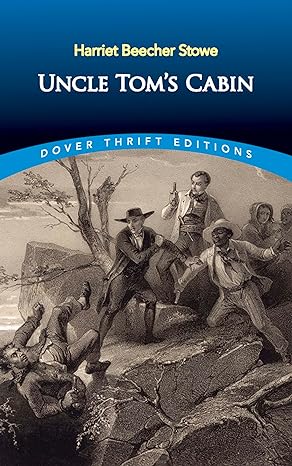
Uncle Tom's Cabin by Harriet Beecher Stowe


A Few Thoughts on Uncle Tom's Cabin

First Published in 1852.

Harriet Beecher Stowe sat down to write a book that would show the United States the evils of slavery. She wrote Uncle Tom's Cabin; or, Life Among the Lowly in response to the Fugitive Slave Act of 1850, at the urging of her sister-in-law. She succeeded in fueling the debate over slavery and she pointed a finger of shame at the slave owners and at America as a whole.

Harriett Beecher Stowe (1811-1896)
It created a national sensation. Within ten years, it sold two million copies, making it the best-selling novel of all time in the United States, in proportion to population, according to noted Civil War historian James M. McPherson. The book was so controversial and so powerful that there were attempts to ban it in some parts of the South. Pro-slavery authors attempted to counter the book with their own books with titles like Uncle Robin, in His Cabin in Virginia, and Tom Without One in Boston in an attempt to show that African Americans were better off in slavery. Abraham Lincoln reportedly acknowledged the impact of her novel when he meet Harriett Beecher Stowe in 1862 and quipped, "So, you're the little woman who wrote the book that made this great war."

Stowe uses two plot devices to successfully make her case about the evils of slavery. The first is the theme of the splitting apart of slave families and the slave-owning families throughout the course of the book. The second is Uncle Tom's unwavering adherence to Christian principles. The book was written to persuade Christians of the Second Great Awakening that slavery was a great evil that should be eliminated. The reader is continually assaulted with images and exhortations designed to shame the heart of a nineteenth century Christian into action.

Stowe chose to focus on the rending of slave families and the abuse heaped upon the devout Christian, Uncle Tom, for good reason. If she had focused on the hard, forced labor of slaves in the field there would have been little sympathy. This was an era in which nearly everyone worked long, hard hours and many people worked for others and felt that they were forced to work or starve. For example, historian Harry L. Watson noted that the famed "Lowell Girls" of New England were forced to live in company-owned boarding houses and worked an average of 73 hours per week.

If she had made a straight argument about the basic immorality of one human being owning another, she probably would not have swayed many hearts. Supreme Court Chief Justice Roger Taney summed up the feelings of many people in the Dred Scott decision when he said that African Americans were "of an inferior order...so far inferior, that they had no rights which a white man was bound to respect."

In some states, it was even against the law for African Americans to reside within the state. In Indiana, for example, the 1851 state constitution made it illegal for African Americans to move into the state and fined anyone who hired them or encouraged them to remain in the state. The proceeds of those fines were put into a fund to re-settle African Americans to colonies in Africa.

Rather than writing an essay or an editorial that lays out the antislavery argument, Stowe uses a much more effective method - she introduces her readers to the slaves themselves and inflicts the horrors of slavery upon these slaves. The reader is forced to get to know slaves as people (undoubtedly a rare occurrence for Northern whites) and then witness the rending of their families, their struggles for dignity, their flights for freedom and terrible physical abuse.

From the very beginning of her novel, Stowe shows the fearful prospect that faced all slave families - the selling away of family members. The reader is shown, through these fictional characters, the impact of the selling away of a family member. The reader is witness to a slave auction in which a worn-out old woman begs to be sold along with her only remaining child.

The fear of being sold away was not just restricted to cruel or greedy masters. Kindly masters could have financial troubles and be forced to break apart families. In what is probably the most famous scene in Uncle Tom's Cabin, the readers follows an escaping slave named Eliza as she flees a loving mistress in the middle of winter so that her only child will not be sold away to help cover family debts. Eliza is so desperate to escape the runaway slave hunters that she flees across ice flows of the Ohio River.

The majority of the book deals with the title character, Uncle Tom, a slave sold away from his family and friends (including the master's son) in order to pay a debt. Uncle Tom's desire to return to his home in Kentucky is a constant throughout the book. The reader also knows that he would not have suffered his awful death if he had not been sold away from his home and family. By making fully developed characters of the slaves, Stowe shows that the reality of slave life was not like the comments of the white woman at the slave auction. She is  asked,

"Suppose, ma'am, your two children, there, should be taken from you, and sold?"

and she answers:


"We can't reason from our feelings to those of this class of person."


Stowe attacks that attitude by showing how "this class of person" would respond to forced separation from a child, and it was no different than the response of any other class of person.


Stowe takes us on a tour of the South by way of the slave Uncle Tom. He sees good masters and bad ones. He lives in a mansion (as a slave, of course) and works in the most horrible conditions on a desolate plantation. Through it all, Uncle Tom is a perfect Christian. He is intended to be this way. He never deviates from the ideals of the Christian faith. He shares food while he is nearly starving. He rescues a drowning child while he is being shipped down the Mississippi to be auctioned and he does not complain when his hymn book is taken from him and his faith is ridiculed. Uncle Tom does not take freedom when it is offered by his master in New Orleans because he is concerned about the condition of his master's soul and wants to make sure he becomes a Christian. Tom even forgives the master who orders him beaten to death and the slaves who gladly comply with his commands. Stowe makes him an unbelievably perfect Christian, even a saint. She does this so that she can demonstrate the cruelty of slavery. If it can destroy this man who has done nothing wrong, how can anyone survive it? It screams at the consciences of the Christians who let this situation continue and questions the Christianity of the Slave-owning class.

Harriett Beecher Stowe's goal was to reach out to touch the heart of America and demonstrate the evils of slavery. Coming from a family of evangelists, she created the character of Uncle Tom to reach out to Christians of the Second Great Awakening. He may have been a slave, but he was also a fellow Christian who lived the Christian ideals. If the readers could not sympathize with a slave or a black man, they could identify with his religious ideals and his faith. Suddenly, people who felt nothing for the plight of the slaves could see the evils of slavery.

Truly an American classic.

I rate this book 5 stars out of 5.

This book can be found on Amazon.com here: Uncle Tom's Cabin.

Reviewed on July 19, 2012.

The Spiritual Singularity (The Day Eight Series, Book 3) by Ray Mazza


Published by CreateSpace in 2012.


The action continues in Book 3 of the Day Eight Series. In The Spiritual Singularity the tech company Day Eight is moving forward with their plans to use computerized simulated humans ("simulants") to affect events in the real world in a very dramatic way. Political assassinations, dramatic leap forwards in technology and a physical link between the computer simulant Ezra and the President of the United States make computer programmer Trevor Leighton very worried for the future of humanity itself. Leighton is working as best he can to save himself and possibly even the whole world even though he is running out of money, running out of time and running out of options.

The Spiritual Singularity is full of rich, meaty themes that have been discussed in science fiction and fantasy for decades. In the Lord of the Rings series,Tolkien looks into the idea of what unlimited power does to a human being. In the original Star Trek series, Captain Kirk defuses multiple computers that have taken humanity's choices away from them in order to protect them. Book 3 of this series approaches this theme from the side of the entity that is amassing unlimited power.

I really enjoyed the previous 2 books in The Day Eight Series ( The Reborn and Of Mice and Hitmen ) and gave them both 5 stars. I liked this one a little less, not for the action, which is solid, not for the chase and the mystery for what is going on. Instead, it gets a little too "talky" at times. It's hard not to with all of these big ideas flying around.

Still, this is a very solid book in a very strong series.

I rate this book 4 stars out of 5.

This book can be found on Amazon.com here: The Spiritual Singularity (The Day Eight Series, Book 3) by Ray Mazza.

Reviewed on July 17, 2012.

Of Mice and Hitmen (The Day Eight Series, Part 2) by Ray Mazza


Published in 2012 by CreateSpace

Yesterday, I posted a review of Book 1 of this series ( The Reborn ) and I wrote a lengthy rave review. I am not going to go into all of that here. Suffice it to say, I really liked Book 1.

Of Mice and Hitmen is where the series really hits its stride. In Book 1, programmer Trevor Leighton discovers that his employer, a tech firm called Day Eight, has created simulated human life in a computer. Not just Artificial Intelligence, but simulated life write down to the cellular level.  These computerized people are called simulants.

Trevor has already met one fairly simple version of the simulant program, a simulant 1.0 if you will. In Book 2 he meets Ezra, the most updated version of the simulant program. She lives in an accelerated world, programmed to go faster so that she can complete projects in the real world quicker. Her name is Ezra, which is an odd name for a female, but it means "helper" in Hebrew and she is being used to work on any number of projects for Day Eight - new computers, cures for illnesses, etc. She has lived for thousands of years in her simulated world and is far smarter than any human being has ever been in terms of raw knowledge.

But, there is another, darker purpose as well. Leighton senses this and narrowly escapes an attempt on his life. When a series of political assassinations change the results of elections, Leighton works to figure out how Day Eight, Ezra and the political chaos are all tied together while he is on the run.

I rate this book 5 stars out of 5.

This book can be found on Amazon.com here: Of Mice and Hitmen (The Day Eight Series, Part 2) by Ray Mazza.


Reviewed on July 17, 2012.

The Reborn (The Day Eight Series, Part 1) by Ray Mazza


Published in 2012 by CreateSpace

So, I have on the table next to me three books by Ray Mazza. These books make up The Day Eight Series. They are self-published and most experienced readers know that a great number of the self-published are fair to middling and I am usually tempted to grade them on a curve, the thought process being, " Well, it's pretty good considering it's a do-it-yourself job and she did it all herself." This is much the same thought process I have when I do handyman work around the house and I proudly show it off to my wife - it's pretty good but certainly not professional.

I let these three books sit on my to-be-read pile for about a month.

Why?

I was not in the mood for, "Well, it's pretty good, considering..."

So, I pick up book one, The Reborn, and about 15 pages in I am thinking, "Where is he going with this?" I read the back cover a couple of times and decided to give it a few more pages. Where are the human simulations running on computers? Where's the "catastrophic event" coming from?

By page 35 I decide I kind of like the main character, Trevor Leighton, and I'll ride it out a bit more.

On page 71, we hit pay dirt. My mind is blown. We are introduced to the simulations. Most importantly, we are introduced to how they are developed. Such a simple idea (and complex at the same time). Good sci-fi takes you to new places and shows you some new stuff. Great sci-fi takes what you already know and puts a little tilt to it, a twist that makes you see everything in a new way. It's all the same. It's all different.

Mazza's series is about human beings simulated on a computer. I figure he knows something about this since his bio shows that he has worked on several "Sims" projects. If you are not familiar with the Sims games, well they create a little world for you to interact in. In a way, they are very, very, very limited versions of Artificial Intelligence. They also show the glaring deficiencies of trying to develop it the way we have so far. This book shows a new path to achieving that effort and the series makes you question if you really want to.

So, in this book, Leighton, a talented programmer working for a tech company called Day Eight is screwing around with the firewall on his company's servers so he can download movies at work. That firewall breach starts a chain reaction that knocks out much of the internet and fries the computers in his office. On his flash drive, though, is a message from a dead girl that claims she is trapped. Since his office is closed for the time being, Trevor decides to do a little investigating and that is where the trouble starts.

These three books are not "pretty good, considering they're an indie effort." They are good. Period.

I rate book one in this series 5 stars out of 5.

This book can be found on Amazon.com here: The Reborn (The Day Eight Series, Part 1) by Ray Mazza.

Reviewed on July 16, 2012.

Bad Moon Rising (Sam McCain #1) (audiobook) by Ed Gorman


Published by AudioGo in 2012
Read by Joe Barrett 
Duration: 6 hours, 6 minutes.
Unabridged


This is the first book I have read (or for that matter even seen) in the Sam McCain series. Normally, I would not recommend jumping in on the tenth book in a series, but it is a testament to the skill of the author, Ed Gorman, that I was able listen to Bad Moon Rising and join right in and not feel lost at all. The titles in the series all come from music from the general time that the book is set in.

 It is late August 1968. It is hot in Black River Falls, Iowa. The book starts with Sam McCain at a party watching the violence of the Democratic National Convention. Hippies are on TV and hippies are in Black River Falls. They are a source of controversy as their free love lifestyle, long hair and drug usage rankle a lot of people in small town Iowa. They live on an old farm with a history of tragedy and that history continues as the daughter of the local millionaire is found dead in a barn on the commune. She was a frequent visitor on the farm and was known to date a resident so the finger of suspicion is immediately pointed at the hippies. Sam McCain is called out by the leader of the commune because he is the only attorney in town that will have anything to do with them. Tensions escalate as McCain tries to figure out what happened.

Ed Gorman
McCain is an interesting character. He sees why the hippies would want to "drop out" of society, but knows they aren't really going off the grid. He is irritated at the mindless anti-hippie reactions of many of his neighbors, but he is very aware that some of these folks cause serious trouble. He admires their talk about freedom, but notes that they live in a commune controlled by an iron-fisted dictator. What kind of guy is Sam McCain? He is the kind of guy that you like but your wife thinks is an asshole. And you know what, you'd  both be right. He is full of contradictions. He likes the hippies but he is a member of the National Guard. He likes to poke his finger in the eye of authority but he does a lot of investigative work for a judge.

I like this book for a lot of reasons. Number one, it's a good old-fashioned mystery. Number two, it's a bit of a history lesson, reminding readers of the upheaval of 1968. Number three, Ed Gorman reminds everyone that the Midwest is not all corn-fed country boys and girls riding on tractors. As a native of Indiana I can tell you that this is not "flyover country" - life happens here, too.

Reason number four for liking the book is the reader, Joe Barrett. Personally, I hate hearing audiobooks with "out of place" accents - British people that sound like people from California that sound like Kentuckians. Barrett hits "Midwest" over and over again perfectly. His sheriff actually sounds almost exactly like a guy I know. Excellent job.

I rate this book 5 stars out of 5. It can be found on Amazon.com here: Bad Moon Rising (Sam McCain #10) by Ed Gorman.

Reviewed on July 15, 2012.

Featured Post

<b><i>BAN THIS BOOK (audiobook)</i></b> by Alan Gratz

Published in 2017 by Blackstone Audio, Inc. Read by Bahni Turpin. Duration: 5 hours, 17 minutes. Unabridged. My Synopsis Ban This Book is t...

Popular posts over the last 7 days