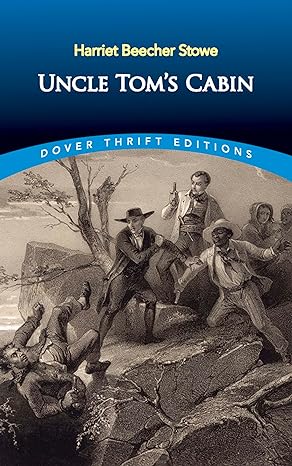
A Few Thoughts on Uncle Tom's Cabin
First Published in 1852.
Harriet Beecher Stowe sat down to write a book that would show the United States the evils of slavery. She wrote Uncle Tom's Cabin; or, Life Among the Lowly in response to the Fugitive Slave Act of 1850, at the urging of her sister-in-law. She succeeded in fueling the debate over slavery and she pointed a finger of shame at the slave owners and at America as a whole.
It created a national sensation. Within ten years, it sold two million copies, making it the best-selling novel of all time in the United States, in proportion to population, according to noted Civil War historian James M. McPherson. The book was so controversial and so powerful that there were attempts to ban it in some parts of the South. Pro-slavery authors attempted to counter the book with their own books with titles like Uncle Robin, in His Cabin in Virginia, and Tom Without One in Boston in an attempt to show that African Americans were better off in slavery. Abraham Lincoln reportedly acknowledged the impact of her novel when he meet Harriett Beecher Stowe in 1862 and quipped, "So, you're the little woman who wrote the book that made this great war."
Stowe uses two plot devices to successfully make her case about the evils of slavery. The first is the theme of the splitting apart of slave families and the slave-owning families throughout the course of the book. The second is Uncle Tom's unwavering adherence to Christian principles. The book was written to persuade Christians of the Second Great Awakening that slavery was a great evil that should be eliminated. The reader is continually assaulted with images and exhortations designed to shame the heart of a nineteenth century Christian into action.
Stowe chose to focus on the rending of slave families and the abuse heaped upon the devout Christian, Uncle Tom, for good reason. If she had focused on the hard, forced labor of slaves in the field there would have been little sympathy. This was an era in which nearly everyone worked long, hard hours and many people worked for others and felt that they were forced to work or starve. For example, historian Harry L. Watson noted that the famed "Lowell Girls" of New England were forced to live in company-owned boarding houses and worked an average of 73 hours per week.
If she had made a straight argument about the basic immorality of one human being owning another, she probably would not have swayed many hearts. Supreme Court Chief Justice Roger Taney summed up the feelings of many people in the Dred Scott decision when he said that African Americans were "of an inferior order...so far inferior, that they had no rights which a white man was bound to respect."
In some states, it was even against the law for African Americans to reside within the state. In Indiana, for example, the 1851 state constitution made it illegal for African Americans to move into the state and fined anyone who hired them or encouraged them to remain in the state. The proceeds of those fines were put into a fund to re-settle African Americans to colonies in Africa.
 Rather than writing an essay or an editorial that lays out the antislavery argument, Stowe uses a much more effective method - she introduces her readers to the slaves themselves and inflicts the horrors of slavery upon these slaves. The reader is forced to get to know slaves as people (undoubtedly a rare occurrence for Northern whites) and then witness the rending of their families, their struggles for dignity, their flights for freedom and terrible physical abuse.
From the very beginning of her novel, Stowe shows the fearful prospect that faced all slave families - the selling away of family members. The reader is shown, through these fictional characters, the impact of the selling away of a family member. The reader is witness to a slave auction in which a worn-out old woman begs to be sold along with her only remaining child.
The fear of being sold away was not just restricted to cruel or greedy masters. Kindly masters could have financial troubles and be forced to break apart families. In what is probably the most famous scene in Uncle Tom's Cabin, the readers follows an escaping slave named Eliza as she flees a loving mistress in the middle of winter so that her only child will not be sold away to help cover family debts. Eliza is so desperate to escape the runaway slave hunters that she flees across ice flows of the Ohio River.
The majority of the book deals with the title character, Uncle Tom, a slave sold away from his family and friends (including the master's son) in order to pay a debt. Uncle Tom's desire to return to his home in Kentucky is a constant throughout the book. The reader also knows that he would not have suffered his awful death if he had not been sold away from his home and family. By making fully developed characters of the slaves, Stowe shows that the reality of slave life was not like the comments of the white woman at the slave auction. She is asked,
"Suppose, ma'am, your two children, there, should be taken from you, and sold?"
and she answers:
"We can't reason from our feelings to those of this class of person."
Stowe attacks that attitude by showing how "this class of person" would respond to forced separation from a child, and it was no different than the response of any other class of person.
 Stowe takes us on a tour of the South by way of the slave Uncle Tom. He sees good masters and bad ones. He lives in a mansion (as a slave, of course) and works in the most horrible conditions on a desolate plantation. Through it all, Uncle Tom is a perfect Christian. He is intended to be this way. He never deviates from the ideals of the Christian faith. He shares food while he is nearly starving. He rescues a drowning child while he is being shipped down the Mississippi to be auctioned and he does not complain when his hymn book is taken from him and his faith is ridiculed. Uncle Tom does not take freedom when it is offered by his master in New Orleans because he is concerned about the condition of his master's soul and wants to make sure he becomes a Christian. Tom even forgives the master who orders him beaten to death and the slaves who gladly comply with his commands.
Stowe makes him an unbelievably perfect Christian, even a saint. She does this so that she can demonstrate the cruelty of slavery. If it can destroy this man who has done nothing wrong, how can anyone survive it? It screams at the consciences of the Christians who let this situation continue and questions the Christianity of the Slave-owning class.
Stowe takes us on a tour of the South by way of the slave Uncle Tom. He sees good masters and bad ones. He lives in a mansion (as a slave, of course) and works in the most horrible conditions on a desolate plantation. Through it all, Uncle Tom is a perfect Christian. He is intended to be this way. He never deviates from the ideals of the Christian faith. He shares food while he is nearly starving. He rescues a drowning child while he is being shipped down the Mississippi to be auctioned and he does not complain when his hymn book is taken from him and his faith is ridiculed. Uncle Tom does not take freedom when it is offered by his master in New Orleans because he is concerned about the condition of his master's soul and wants to make sure he becomes a Christian. Tom even forgives the master who orders him beaten to death and the slaves who gladly comply with his commands.
Stowe makes him an unbelievably perfect Christian, even a saint. She does this so that she can demonstrate the cruelty of slavery. If it can destroy this man who has done nothing wrong, how can anyone survive it? It screams at the consciences of the Christians who let this situation continue and questions the Christianity of the Slave-owning class.
Harriett Beecher Stowe's goal was to reach out to touch the heart of America and demonstrate the evils of slavery. Coming from a family of evangelists, she created the character of Uncle Tom to reach out to Christians of the Second Great Awakening. He may have been a slave, but he was also a fellow Christian who lived the Christian ideals. If the readers could not sympathize with a slave or a black man, they could identify with his religious ideals and his faith. Suddenly, people who felt nothing for the plight of the slaves could see the evils of slavery.
Truly an American classic.
I rate this book 5 stars out of 5.
This book can be found on Amazon.com here: Uncle Tom's Cabin.
Reviewed on July 19, 2012.
First Published in 1852.
Harriet Beecher Stowe sat down to write a book that would show the United States the evils of slavery. She wrote Uncle Tom's Cabin; or, Life Among the Lowly in response to the Fugitive Slave Act of 1850, at the urging of her sister-in-law. She succeeded in fueling the debate over slavery and she pointed a finger of shame at the slave owners and at America as a whole.
 |
| Harriett Beecher Stowe (1811-1896) |
in an attempt to show that African Americans were better off in slavery. Abraham Lincoln reportedly acknowledged the impact of her novel when he meet Harriett Beecher Stowe in 1862 and quipped, "So, you're the little woman who wrote the book that made this great war."Stowe uses two plot devices to successfully make her case about the evils of slavery. The first is the theme of the splitting apart of slave families and the slave-owning families throughout the course of the book. The second is Uncle Tom's unwavering adherence to Christian principles. The book was written to persuade Christians of the Second Great Awakening that slavery was a great evil that should be eliminated. The reader is continually assaulted with images and exhortations designed to shame the heart of a nineteenth century Christian into action.
Stowe chose to focus on the rending of slave families and the abuse heaped upon the devout Christian, Uncle Tom, for good reason. If she had focused on the hard, forced labor of slaves in the field there would have been little sympathy. This was an era in which nearly everyone worked long, hard hours and many people worked for others and felt that they were forced to work or starve. For example, historian Harry L. Watson noted that the famed "Lowell Girls" of New England were forced to live in company-owned boarding houses and worked an average of 73 hours per week.
If she had made a straight argument about the basic immorality of one human being owning another, she probably would not have swayed many hearts. Supreme Court Chief Justice Roger Taney summed up the feelings of many people in the Dred Scott decision when he said that African Americans were "of an inferior order...so far inferior, that they had no rights which a white man was bound to respect."
In some states, it was even against the law for African Americans to reside within the state. In Indiana, for example, the 1851 state constitution made it illegal for African Americans to move into the state and fined anyone who hired them or encouraged them to remain in the state. The proceeds of those fines were put into a fund to re-settle African Americans to colonies in Africa.
 Rather than writing an essay or an editorial that lays out the antislavery argument, Stowe uses a much more effective method - she introduces her readers to the slaves themselves and inflicts the horrors of slavery upon these slaves. The reader is forced to get to know slaves as people (undoubtedly a rare occurrence for Northern whites) and then witness the rending of their families, their struggles for dignity, their flights for freedom and terrible physical abuse.
From the very beginning of her novel, Stowe shows the fearful prospect that faced all slave families - the selling away of family members. The reader is shown, through these fictional characters, the impact of the selling away of a family member. The reader is witness to a slave auction in which a worn-out old woman begs to be sold along with her only remaining child.
The fear of being sold away was not just restricted to cruel or greedy masters. Kindly masters could have financial troubles and be forced to break apart families. In what is probably the most famous scene in Uncle Tom's Cabin, the readers follows an escaping slave named Eliza as she flees a loving mistress in the middle of winter so that her only child will not be sold away to help cover family debts. Eliza is so desperate to escape the runaway slave hunters that she flees across ice flows of the Ohio River.
The majority of the book deals with the title character, Uncle Tom, a slave sold away from his family and friends (including the master's son) in order to pay a debt. Uncle Tom's desire to return to his home in Kentucky is a constant throughout the book. The reader also knows that he would not have suffered his awful death if he had not been sold away from his home and family. By making fully developed characters of the slaves, Stowe shows that the reality of slave life was not like the comments of the white woman at the slave auction. She is asked,
"Suppose, ma'am, your two children, there, should be taken from you, and sold?"
and she answers:
"We can't reason from our feelings to those of this class of person."
Stowe attacks that attitude by showing how "this class of person" would respond to forced separation from a child, and it was no different than the response of any other class of person.
 Stowe takes us on a tour of the South by way of the slave Uncle Tom. He sees good masters and bad ones. He lives in a mansion (as a slave, of course) and works in the most horrible conditions on a desolate plantation. Through it all, Uncle Tom is a perfect Christian. He is intended to be this way. He never deviates from the ideals of the Christian faith. He shares food while he is nearly starving. He rescues a drowning child while he is being shipped down the Mississippi to be auctioned and he does not complain when his hymn book is taken from him and his faith is ridiculed. Uncle Tom does not take freedom when it is offered by his master in New Orleans because he is concerned about the condition of his master's soul and wants to make sure he becomes a Christian. Tom even forgives the master who orders him beaten to death and the slaves who gladly comply with his commands.
Stowe makes him an unbelievably perfect Christian, even a saint. She does this so that she can demonstrate the cruelty of slavery. If it can destroy this man who has done nothing wrong, how can anyone survive it? It screams at the consciences of the Christians who let this situation continue and questions the Christianity of the Slave-owning class.
Stowe takes us on a tour of the South by way of the slave Uncle Tom. He sees good masters and bad ones. He lives in a mansion (as a slave, of course) and works in the most horrible conditions on a desolate plantation. Through it all, Uncle Tom is a perfect Christian. He is intended to be this way. He never deviates from the ideals of the Christian faith. He shares food while he is nearly starving. He rescues a drowning child while he is being shipped down the Mississippi to be auctioned and he does not complain when his hymn book is taken from him and his faith is ridiculed. Uncle Tom does not take freedom when it is offered by his master in New Orleans because he is concerned about the condition of his master's soul and wants to make sure he becomes a Christian. Tom even forgives the master who orders him beaten to death and the slaves who gladly comply with his commands.
Stowe makes him an unbelievably perfect Christian, even a saint. She does this so that she can demonstrate the cruelty of slavery. If it can destroy this man who has done nothing wrong, how can anyone survive it? It screams at the consciences of the Christians who let this situation continue and questions the Christianity of the Slave-owning class.Harriett Beecher Stowe's goal was to reach out to touch the heart of America and demonstrate the evils of slavery. Coming from a family of evangelists, she created the character of Uncle Tom to reach out to Christians of the Second Great Awakening. He may have been a slave, but he was also a fellow Christian who lived the Christian ideals. If the readers could not sympathize with a slave or a black man, they could identify with his religious ideals and his faith. Suddenly, people who felt nothing for the plight of the slaves could see the evils of slavery.
Truly an American classic.
I rate this book 5 stars out of 5.
This book can be found on Amazon.com here: Uncle Tom's Cabin.
Reviewed on July 19, 2012.


