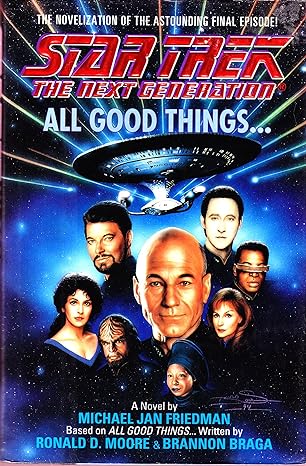
All Good Things... (Star Trek: The Next Generation) (audiobook) by Micheal Jan Friedman


Published by Simon & Schuster Audio in 1994
Read by Jonathan Frakes
Duration: 2 hours, 55 minutes.
Abridged
Based on a script by Ronald D. Moore and Brannon Braga

All Good Things... is an abridged audiobook presentation of the novelization of the two hour series finale of Star Trek: The Next Generation.  There is a lot of room there for errors to be made. Will the reader interpret the material well? Is the abridgment done well? Is the novelization of the script done well? That's a lot of steps between the original authors and the audiobook listener and any of them done poorly could result in a poor audiobook presentation.

Jonathan Frakes as
Commander Will Riker
This audiobook was done quite well. The novelist is a prolific author of Star Trek books so he knows his material. The abridgment was done well. The reader was Jonathan Frakes. Frakes played Commander Will Riker throughout the show's run (and directed several of them) so he knows how everyone is supposed to sound, how the show is paced, etc.  Frakes does an amazing impersonation of Patrick Stewart as Captain Jean-Luc Picard, captures the voice of Q and Data very well. His Lt. Worf voice is laughable, however. Happily, Worf's lines are few and far between while Picard speaks throughout.

In All Good Things... Picard is plagued by time travel. He is slipping backwards and forwards to three different moments in time. The earliest time is the time period covered by the first episode of the series. The second point is seven years later, the time period covered by the last episode of the series. The third point in time is in the far future when Picard is elderly and possibly suffering from a incurable dementia. The audiobook ties together the entire series (in a way) and let's the listener get a taste of the future lives of Worf, Crusher, Picard, LaForge, Riker and Data.

Picard keeps sliding between these times and as he goes along he is confronted by Q who lets him know that if he does not figure out what to do he will be responsible for the disappearance of all of humanity from the galaxy. Picard works to solve the problem from all three times, each with its own set of challenges.

I rate this audiobook 4 stars out of 5.

This audiobook is available through Amazon.com here: All Good Things...

Reviewed on July 8, 2012.

Resonance (audiobook) by AJ Scudiere


Audio version published by Skyboat Road Company in 2008.
Multicast Performance
Duration: 16 hours, 25 minutes
Unabridged.

The premise behind Resonance is simple - the magnetic poles are starting to switch and it is starting to cause frogs to be born deformed, messing up migration patterns and kill people who are in "hotspots" (areas where the reversal has already started).

Scudiere does a great job of creating believable characters and her five main characters are quite strong. We have two young doctors from the Centers for Disease Control and their boss (played by Arte Johnson of Laugh-In fame), a young narcissistic geologist and a young biologist who specializes in frogs.

These five race around the country documenting "hotspots" and trying to figure out why people exposed to them die. As they travel, we learn a lot more about the characters and a romance starts to bloom.

Well, it would start to bloom except for two things: 1) the entire world suddenly shifts causing half of the world's population to die and 2) the guy just somehow can't muster up the guts to tell her how he feels even though everyone knows it except for her for about 6 hours of the audiobook.

In fact, the book just goes into some sort of holding pattern about two-thirds of the way through. The explanation behind the mass deaths is discovered (because why would magnetic reversals kill people? If it so bad than an MRI would be fatality-inducing) and there is a Twilight Zone-esque ending that is fairly clever but takes too long to resolve.

What is not discussed is the concept of the world still running along like normal even though half of the population has died. No mass chaos. No nuclear power plants overloading. No rogue nations deciding "Hey! It's the end of the world so let's go ahead and nuke such-and-such country!" Deliveries are still made, the phones still work, bureaucrats are still filing forms and accountants are still watching the bottom line. Having never seen the end of the world, I can only assume that it would be less like a Midwestern blizzard and more like Hurricane Katrina when it hit New Orleans and the social fabric was torn to pieces.

This audiobook is billed as an "AudioMovie" because it has special effects and multiple actors reading the different parts, much like an old-fashioned radio show. Several audiobook producers are using this format and it can be a superior way to tell a story. The actors did a great job, especially Arte Johnson who stole every scene he was in with his role as the elderly brilliant but cranky CDC administrator.The special effects were relatively rare and did not intrude as can happen with some companies that have used this format.

This was a book in serious need of a thorough editing. Three or four hours could have been removed from this book without hurting it. Repeated conversations abound and the ending with a twist just lingered until it  eventually lost its punch.

I rate this book 3 out of 5 stars. This book can be found on Amazon.com here: Resonance by AJ Scudiere

Reviewed on July 6, 2012.

Top of the Rock: Inside the Rise and Fall of Must See TV by Warren Littlefield with T. R. Pearson


Published by Doubleday in 2012

If you remember the giant television shows of NBC's heyday in the 1980s and 1990s, Top of the Rock will be fascinating. Shows like Cheers, Cosby, Law & Order, ER, Will &  Grace, Friends, Frazier, 3rd Rock From the Sun, Mad About You and Seinfeld ruled the airwaves. Thursday nights were dominated by NBC and NBC usually made more money on that night than the other six nights combined - literally billions of dollars.

Warren Littlefield was directly involved in the creation of these shows or the in the decision to put them on the air. Littlefield tells the story of "Must See TV" through the voices of the participants themselves. The book is literally a series of quotes with very little in the way of narration from Littlefield himself. Littlefield calls it "oral history" format. If this book were a movie, it would be one of those "talking head" documentaries full of people talking.

But, what a documentary it would be!

I had my reservations about this book, especially when I saw its format. But, once I started it I blazed right through it. The stories behind the creation of these beloved television shows are interesting and told very well. Some stories are more interesting than others, of course, but the book zips along and is full of interesting tidbits like this one - Fred Dryer was the frontrunner for the part of Sam Malone of Cheers, instead of Ted Danson.

The inside story of what was going on in corporate NBC is interesting and, I suspect, a little self-serving on Littlefield's part. He is especially tough on Don Ohlmeyer (who does sound like a difficult person to work with) and makes it sound like NBC has not broadcast much in the way of quality programming since he left.

Nonetheless, this is an interesting book and I rate it 5 stars out of 5. This book can be found on Amazon.com here: Top of the Rock: Inside the Rise and Fall of Must See TV.

Reviewed on July 6, 2012.

Isard's Revenge (Star Wars: X-Wing #8) (audiobook) by Michael A. Stackpole


Published by Random House Audio in 1999

Read by Anthony Heald
Duration: 2 hours, 59 minutes.
Abridged

Probably no one, even George Lucas himself, knows more about the Star Wars universe than prolific author Michael A. Stackpole. He has authored comics and novels and helped to build the entire post-Return of the Jedi storyline.

Isard's Revenge is set several years after the last movie. The New Republic (the government that took over from the  Rebel Alliance in Episodes IV, V and VI) is mopping up the various bits and pieces of what is left of the Empire. Several warlords have set themselves up here and there and the New Republic is negotiating or fighting with them. 

In this storyline, a warlord named Ysanne Isard, the former Director of Imperial Intelligence, presumed defeated and dead, has returned. She has put together a rather complicated plot to draw Wedge Antilles (newly promoted to General by Admiral Ackbar) and his Rogue Squadron into a trap so she can wipe them out to get her revenge for her defeat at their hands that was detailed in Book #4 of this series.

Admiral Ackbar
Read by Anthony Heald who covers a wide variety of voices, accents and species with apparent ease, this book is long on speeches and action and very short on character development. I could blame the abridgement for that. It almost certainly cut out  too much of the interesting secondary story involving an attempt by an inter-species couple to deal with cultural prejudice as they try to adopt a baby to raise as their own. But, let's face it, the appeal of these books lies in the dogfights and the almost corny speeches the officers give to their pilots before the big fight.

While the audiobook version is abridged, it does two things the book will never have: 1) real Star Wars sound effects; 2) snippets from the original Star Wars soundtracks by John Williams. For old fans of the movies, it is awfully fun to hear the music and the blaster fire and the R2 units as the X-Wings roar into battle.

I rate this audiobook 3 out of 5 stars.

This audiobook can be found on Amazon.com here: Star Wars: The X-Wing Series, Volume 8: Isard's Revenge

Reviewed on June 29, 2012.

Lords of Creation by Tim Sullivan


Published in 1992 by AvoNova (Avon Books)

Tim Sullivan's Lords of Creation tries (and really tries hard) to pull together a whole lot of ideas and one really big one and put them all into a 242 page sci-fi paperback novel.

It is set in the year 1999. Instead of a successful first Gulf War,  America gets bogged in a protracted fight that saps its political vitals at home. The Republicans work with a growing Christian Milleniallist movement who believe that the end of the world as we know it is coming and America should be prepared. A Department of Morality is developed and led by a preacher who attacks all of paleontology as "the work of Satan." Entire university departments are shut down due to a lack of funding and only amateur paleontologists can continue to dig.

A fossil dig in Montana. Photo by SD Public Broadcasting
One group of such amateurs are digging at a remote site in Montana when they find a odd metal box buried deep in a fossil bed, with the fossils. They remove it and sneak into the lab of the local university , quickly have it confiscated by the Department of Morality and when it is opened five dinosaur eggs are discovered inside - they have been held in stasis by the box for millions of years. Soon enough, they are hatched and these dinosaurs are not anything that the paleontologists recognize. They have larger brains, grow incredibly fast and work together very well. Also, there are lots of grandstanding arguments between the leader of the paleontologists, David Albee and Flanagan, the head of the Department of Morality. Flanagan admits that he acts the way he does to impose morality upon America just to save America from itself - drinking, drugs, abuse, etc.

 ****Spoilers*****

Up to this point, the book seems to be a kind of screed against religion in general (they're all fanatics, they're stupid and they hate dinosaurs!). But, suddenly, the story switches. An alien spaceship comes, summoned from "sleep" in the asteroid belt by the opening of the egg box. The alien reveals that its species created the super smart dinosaurs that were just hatched and it froze them again because their reptilian brains lacked any sense of morality and all of that brainpower with no morality was a disaster. They destroyed rather than build.

So, the alien waited until primates evolved and made them super smart because they had morality. The innate sense of morality would "drive [the] species forward. It is absolutely correct in its moral imperatives, that these imperatives are larger than the individual and must be asserted. Those who stand against it are always incorrect, though their opponents believe that their version of morality is just as correct. This conflict is the process that culminates in a planetary civilization, and leads ultimately to the stars." (p. 236)

Now we have an interesting premise, the most important thought of the book and it is laid out and never touched again, despite all of the questions it begs such as:

-Is Flanagan bad  or good in light of this philosophy?

-Is the constant struggle really a good thing or not?

-Is the Department of Morality necessarily a bad thing - is it the realization of a planetary civilization thus stepping stone to the stars?

-If that is the cost, is it worth it?

Man, if there was ever topics to discuss, why aren't these being discussed? Instead, it wraps up in six pages and we are done.

One other issue. I know that authors have very little to do with the covers of their books, so these three comments are aimed at the person or persons that choose the art for the cover: 1) The book is set in Montana. There are no Saguaro cactus in Montana. 2) There is only one alien, not two. 3)  The alien looks nothing like the ones on the cover.

*****End Spoilers*****

So, a really huge idea is brought up to discuss and it lays there and dies. The rest of the book is an okay space alien story.

I have to give it 3 out of 5 stars for the rest of the book. Add 1 star for the really big idea. Total: 4 out of 5 stars.

Reviewed on June 28, 2012

This book can be found on Amazon.com here: Lords of Creation by Tim Sullivan.

The Blessing Way (Joe Leaphorn #1) (audiobook) by Tony Hillerman


Published by Borders/Recorded books in 1990.
Narrated by George Guidall.
Duration: Approximately 6 hours, 30 minutes.
Unabridged

The Blessing Way is the first of the Leaphorn books but, ironically, Leaphorn is a mere supporting character throughout most of the second half of the book. College professor/archaeologist Bergen McKee is the main character - the one who has the most growth and teaches the reader the most about Navajo society and culture.

Tony Hillerman (1925-2008)
Nevertheless, The Blessing Way is an enjoyable book. I have read all of Hillerman's books at one time or another so I am going back and listening to some of the older ones as a high-quality diversion from my boring work commute.

I intentionally picked this one, the oldest of the series, since I recently read and reviewed the newest of the series (The Shapeshifter), which, ironically enough, also prominently featured the Navajo Wolf/Witch/Shapeshifter. His descriptions of Navajo society in the two books would make an interesting comparison - a study in the ongoing process of diffusion of Belagana (white) culture throughout the reservation.

I figured out who did it with about an hour to an hour and a half of listening to go. However, that did not dim my enthusiasm for listening to an exciting escape, a chase through the desert and a great climax.

George Guidall did a strong job of reading the story - his pacing and ability to convey the appropriate emotion of the story were quite good.  I enjoy his readings of the Leaphorn/Chee series.

I rate this audiobook 5 stars out of 5.

This audiobook can be found on Amazon.com here: The Blessing Way by Tony Hillerman.


Reviewed on December 20, 2006.

Cold Mountain by Charles Frazier


An American Odyssey


-Slow start, but once you get past the first 50 pages or so you won't want to put it down.

Winner of the 1997 National Book Award

Originally Published in 1997 by Atlantic Monthly Press

Cold Mountain is really a set of very, very short stories all tied together into two main narrative lines. It can be very frustrating to some who just want to get the story moving, but that the main plotlines are not really the point. The wonder and randomness and beauty and brutishness of this thing we call life is the point.

This is no "Pilgrims Progress" in which the main characters struggle and eventually reach a higher consciousness and understanding. 

However, it is a Post-modernist American Odyssey. In the original Odyssey, Odysseus goes from one adventure to the next on his way home from war. In the telling it the reader (originally the listener since it was originally an oral story, not a written story) learns life lessons and Odysseus comes home a better man for all of his troubles.

Charles Frazier
Inman and Ada's adventures remind me of that but without the over-arching themes (thus, it is post-modernist), unless you consider the utter randomness and chaos, both good and bad, of life a theme. Are Ada and Inman better people as a result of their struggles? No, just different. Some characters become better people as a result of the war, some worse.

-Great book. Enjoyable read. I have not yet seen the movie, but I wonder how it can possibly do this book any justice.

I rate this book 5 stars out of 5. It can be found on Amazon.com here: Cold Mountain by Charles Frazier. 

In November of 2023 it was announced that the group Moms for Liberty had challenged more than 300 books in Florida. This is one of the books that the Moms challenged. Read more about the books here.

Featured Post

<b><i>BAN THIS BOOK (audiobook)</i></b> by Alan Gratz

Published in 2017 by Blackstone Audio, Inc. Read by Bahni Turpin. Duration: 5 hours, 17 minutes. Unabridged. My Synopsis Ban This Book is t...

Popular posts over the last 7 days