Great Tales from English History: Volume II. Chaucer to the Glorious Revolution (audiobook) by Robert Lacey


A Real Treat As An Audiobook


Published by Whole Story Audio Books
Read by the author, Robert Lacey
Duration: 5 hours, 50 minutes
Unabridged

Robert Lacey has done something that many writers have failed to do (unfortunately) - he has written history in a fun, accessible, easy to grasp manner. After all, as Lacey points out in his introduction to Volume 1, the "history" and "story" come from the same Latin root word. Essentially, history should be the simple story of how things happened, to the best of the teller's knowledge.

Geoffrey Chaucer (1343-1400)
Lacey's power as a storyteller is highlighted here in spades. He narrates his audiobook as well so there is the added bonus of hearing the author add nuance to the reading - essentially reading it the way he meant it to be heard.

The stories are short and entertaining. Only a couple of times in nearly six hours of listening did I find my attention wandering. This is a terrifically fun experience for any history lover. Full of interesting tidbits but not lacking in the larger themes or commentaries.

I am going to look for volume 3 and hopefully he has written or is writing his promised volumes on Scotland and Ireland as well.

Bravo!

I give this one an enthusiastic 5 stars out of 5.

This book can be found on Amazon.com here: Great Tales from English History. (Note: I was unable to find the audiobook on Amazon, but I did find multiple version and combinations of these stories. The link goes to a 3 volume book collection.)


Reviewed on April 18, 2007.

Michener's the Name by Robert Vavra


A chance to get to know a bit of Michener's personality


Published in 2007 by University Press of Colorado
208 pages.

I am a huge fan of Michener's sweeping epics. Some look at those gigantic books as drudgery, but that is only because they have not opened one up and read it. I've read all but two - I own them but I'm saving them back like a wine connoisseur would save back a couple of his favorites. I know these books will be great and I know that once I read them there will be no more new Micheners for me.

James Michener
(1907-1997)
Vavra's book focuses on their mutual interest in Spain and Spanish culture, especially bullfighting, Spanish dance and the Spanish countryside. Vavra met several famous authors, actors and personalities while in Spain in the 1960s. He mentions them, but it rarely acquires the character of a name-dropping book. Mostly, he uses those others as a point of comparison to Michener, and Michener comes off very well in the comparison. Never flashy, sometimes socially awkward, oftentimes astute, Michener is a friend to great and small alike. He seems to have been able to keep his head despite the fame and fortune. Perhaps that is because, unlike Hemingway, Michener never sought the limelight. He did not shrink from it, but he did not seek it.

Two-thirds of the book consists of Vavra's black and white photographs of Spain and/or Michener. This is appropriate considering that Vavra is an internationally famous photographer. The text is just as strong as the pictures, just surprisingly short. But, then again, maybe not. After all, this book is not intended to be a complete biography of Michener. Rather, it is the collected remembrances of one of his friends and the good times they had together.

I rate this book 4 stars out of 5.

This book can be found on Amazon.com here: Michener's the Name.

Reviewed on April 18, 2007.

Captured! A Boy Trapped in the Civil War by Mary Blair Immel


Published in 2005 by the Indiana Historical Society.
153 pages


Based on a true story, and full of relevant historical photographs, Captured! A Boy Trapped in the Civil War fails to deliver on action in many ways which will make it less attractive to the 10-14 year old (estimated) target audience..

Camp Morton in Indianapolis
It concerns a 14 year old boy named Johnny Ables who was captured by Confederate soldiers and pressed into service as a wood hauler. Ironically, those Confederate soldiers are themselves taken prisoner and Johnny is mistaken as a young Confederate soldier and is sent to prison camp (Camp Morton) in Indianapolis.

Although it will find a place on my classroom's bookshelf, I can only give this short volume 3 stars out of 5.


This book can be found on Amazon.com here: Captured! A Boy Trapped in the Civil War.

Reviewed on April 17, 2007


A Princess of Mars (Barsoom/John Carter of Mars #1) by Edgar Rice Burroughs


A Classic Sci-Fi Novel

Originally published 1912 in a magazine serial. (1917 in book form)

Since the movie John Carter is coming out in a couple of months I decided to go back and re-read the original of the 11 books that Burroughs wrote about Mars (or, as he calls it, Barsoom).

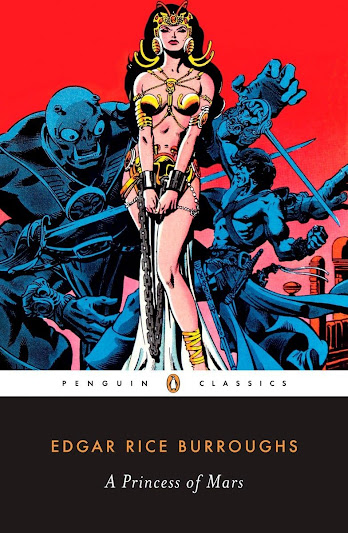
The Whelen cover.
I originally read the entire series, or at least most of it, nearly 30 years ago, when I was in high school. I must admit, I was struck by the art of Michael Whelen's cover more than anything else when I first picked it up and my circle of friends read at least some of them.

I remembered them fondly but found myself very vague on the specifics. I remembered the Princess was very beautiful and there were multiple races on Mars and that some had four arms and that Carter, a former Confederate soldier, traveled from Earth to Mars in some kind of psychic manner and that there was a lot of fighting.

Turns out, what I took as a poor memory was actually pretty accurate. The Princess is beautiful, there are multiple races of Martians and the green Martians have four arms and Carter does travel to Mars in some sort of psychic way. I had totally forgotten that it happens while he is being hunted by a group of Apache in Arizona at the time, but that really is not germane to the rest of the story.

Edgar Rice Burroughs (1875-1950)
The story is supposed to be the writings of John Carter himself (who is ageless and cannot remember his childhood). Carter told his nephew not to publish it until he had been dead for 21 years. The plot is mostly Carter's descriptions of his adventures told in first person with little conversation. There are lots and lots of battle scenes since Mars is a very violent place. Then again, Earth is not much better with Carter making a name for himself in the Civil War and in the first few pages being involved in a running battle with the Apache.

Short on character development and long on description and action, A Princess of Mars was not as good as I remembered it but I am very impressed with Burroughs and his imagination. In a time before science fiction was a normal part of the national psyche, he created an entirely new world, peopled it with aliens with new customs, languages and animals and made the world work in an interesting way. Some of his science is rather silly (the generator that creates the Martian atmosphere comes to mind), but it is a classic and a trendsetter.

This book can be found on Amazon.com here: A Princess of Mars by Edgar Rice Burroughs.

I rate this novel 4 stars out of 5.

Reviewed on January 8, 2012.


Why Men Hate Going to Church (Completely Revised and Updated) by David Murrow


Powerful and dead on.

Published 2011 by Thomas Nelson
237 pages, including end notes.

David Murrow has put a lot of thought into why men do not go to church. I am in my mid-40s and have gone to church all of my life, with the exception of 2 or 3 years right after college where my wife and I went every once in a while at best.  We have been at the same church for 18 years.

We have a great church but we do have wives that come to church without their husbands week in and week out - not many, but after reading this book and being made more aware of the issue I am sure I will notice more. Murrow has studied and interviewed and talked and listened about this topic for years and he has come up with 12 reasons that men do not come to church. Among them are:

-I'll hate church, like when I was a kid;

-I'll lose control;

-If I become a Christian, I'll become soft;

-Church is full of hypocrites;

-All they want is my money;

-I'm jealous (women who idolize the pastor or men resenting the time their wives spend at church);

-I'm being held to an impossible standard.

I've heard all of these excuses (and more) for not going to church and I've had those thoughts myself so I got it when Murrow discusses these topics. Sometimes he even brought up things that I hadn't even realized I was bothered by, such as songs and church language that emphasize "relationship and romance" (p. 99) Men, if you have not noticed, are notoriously clutzy, as a group, with relationships. Don't talk about being intimate with Jesus. Not a comfortable image for most guys. Instead, give men a mission (like the old Blues Brothers movie where Jake and Elwood tell everyone they "are on a mission from God.").

The problem is that church, like school, has gradually become an environment run by women, maintained by women and very female-centric. It is highly verbal, lots of talk about relatioships, full of songs that Murrow refers to as "Jesus is my boyfriend" songs (he fulfills your every emotional need and holds you in his arms). The largest Christian music radio network is K-Love. My wife loves it. I don't. She ought to love it - it is aimed at a mythical listener named "Kathy" - a thirty-something soccer mom with two kids, a minivan and a mortgage. 2/3 of K-Love listeners are women and a whole lot of their songs are soft rock "Jesus is my boyfriend" stuff. (pages 66-7) 

Men feel like they are not welcome by the decor, the songs, the style of service and the lack of things they can do to participate. Who wants to stay where they are not welcome?

I am a public school teacher. I can testify to the fact that boys and girls tend to learn differently. Church (and the sermon) is the weekly chance to teach men and women about the Christian faith. Do not make this experience all "girl friendly" and leave out many (but not all) men because the church favors one gender's way of doing things (Murrow actually presents statistics that show that women stay and enjoy church even if it really tilted towards a man's way of thinking).

Murrow provides lots of examples of what to do and what not to do, including success stories (including one from a church led by a female pastor - statistically the worst indicator of male involvement). I was excited by the chapter entitled "How Men Minister to Others" - lots of great ideas. It made me think about how two of our most active leaders were motivated to become more involved by mens' retreats. One really did not want to go, but he came back all fired up because he found out there were regular guys at church who drink beer while they study the Bible (yes, we do, but only on the mens' retreat) and he has organized and participated in any number of activities (as well as being an Elder). The second guy I was thinking about went on a weekend servant event (I went, too) - we helped a family re-do their home after a devestating flood (this event was organized by the first guy I was talking about) and had a couple of small Bible studies, played some cards, and had a real good time when we were not working. I enjoyed it but the second guy was inspired to really get involved and he has not slowed down a bit.

My wife is reading this book next (I talked about it while I was reading it) and we're passing it on to others in our church. Who knows what will happen?

The book has an accompanying discussion guide available at Murrow's website: http://www.churchformen.com/ .

I rate this book 5 stars out of 5.

This book can be found on Amazon.com here: Why Men Hate Going to Church.

Reviewed on January 6, 2011.

I received this book as part of Thomas Nelson's BookSneeze program in exchange for an honest review.

The Politically Incorrect Guide to the British Empire (P.I.G. Series) by H. W. Crocker III


A breezy look at a worthy topic


Published in 2011 by Regnery Publishing, Inc.
394 pages including extensive notes and an index.

Generally intended as an antidote to the slanted education that many of us have received, the Politically Incorrect Guide (P.I.G.) series is an entertaining series loosely based on the "Idiots Guide..." and the "Dummies..." books.

The Politically Incorrect Guide to the British Empire is an immensely readable look at the British Empire - it's origins, its ideals, its controversies and its rather abrupt ending after World War II. The format of the book is pretty simple. Crocker picks an area of the British Empire and than gives a brief (15-25 pages) history of the Empire in that part of the world, from beginning to end. Then, he focuses on several of the personalities mentioned in the brief history with biographies that go into greater detail.

Sir Francis Drake (1540-1596)
Those personalities are way more interesting than bland descriptions of policy edicts issued from the Lord such-and-such from the Ministry of This-and-that. The focus on the men that made the Empire makes this an interesting book from one end to the other. I especially enjoyed Sir Francis Drake, Sir Henry Morgan and General Charles George Gordon. Throw in sidebar articles with titles like "Nearly 1,000 Englishman against more than 55,000 soldiers of the nawab of Bengal = advantage England", "Kipling on the American War of Ingratitude - er, Independence" and "Films about British Africa That Anti-Colonialists Don't Want You to See" and you have the recipe for an entertaining, surprisingly breezy book that gives an interesting counter-argument to the crowd that argues that Western colonization ruined the world.

The question is, does the argument succeed? Was the British Empire a positive force for good? Is it like the front cover says: "Three cheers for colonialism!"

Well, yes and no. Did the British Empire spread the ideas of free speech, democracy, rights and responsible government around the world? Certainly. This book champions those notions and makes a series of strong arguments. But, rarely it is asked, "But, at what cost?" I can be certain that if I lived in Africa and if I were going to be colonized by a European power, I would want it to have been the British Empire. By far, they were the most humane, most generous and did their best to impart their ideals to their subjects. The proof is in the relative success of the former British colonies compared to the former colonies of other European powers. But, the caveat here is "If I were going to be colonized..." I would prefer not, thanks just the same.

But, this is a worthy counterpoint to the stuff that is dribbled out in most college classes (I took a few myself - "everything from the West is evil" , blah, blah, blah.) Read that stuff, read this book and you have a more realistic idea of what happened - everything was not evil, nor was it all wonderful. Like most things, Western colonization was a mixed bag. Colonization can be generally listed as a bad thing, but one can be certain that the British colonies, as a group, got a much better deal than the other colonies.

This book can be found on Amazon.com here: The Politically Incorrect Guide to the British Empire.

I rate this book 4 stars out of 5.

Reviewed on January 6, 2012

The Swamp Fox of the Revolution (Landmark Books) by Stewart Holbrook


A bit of nostalgia


Published 1959 by Random House
180 pages

Many, many years ago Random House published a series of more than 100 books called "Landmark Books". These were short histories of a little more than 150 pages that were long on action and short on historical analysis.

Nevertheless, these were this history teacher's first introduction to written history. The library in Hope, Indiana had a whole shelf of these books and I happily read about Daniel Boone and the Alamo and John Paul Jones. I happened across this one at a middle school library clearance.

The book delivers as I remember - lots of action and not much into the motivations of Francis Marion and the others who hid in the swamps of South Carolina with him and fought the British Army. That's okay, though. It's aimed at middle schoolers/upper elementary students and they don't care much for analysis anyway. Better to get them an appealing taste of history and let the whys and the wherefores fill themselves in later on.

I give this book 4 stars out of 5. It can be found on Amazon.com here: The Swamp Fox of the Revolution (Landmark Books) by Stewart Holbrook.

Reviewed on April 17, 2007.

Featured Post

<b><i>BAN THIS BOOK (audiobook)</i></b> by Alan Gratz

Published in 2017 by Blackstone Audio, Inc. Read by Bahni Turpin. Duration: 5 hours, 17 minutes. Unabridged. My Synopsis Ban This Book is t...

Popular posts over the last 7 days