Chicano Visions: American Painters on the Verge by Cheech Marin


A great collection, a terrific exhibition


Published in 2002 by Bullfinch.
160 pages

I caught this exhibition at the Indiana State Museum while it was on a nationwide tour. It was so interesting that I took full advantage of my museum membership and came back and saw it several times while it was here in Indianapolis. I picked up the book Chicano Visions as the exhibit was winding down but only recently read the well-written introductory essays that make up the first 35 pages or so of the book.

Cheech Marin has created a high-quality full color text of this travelling show which is mostly comprised of pieces from his own personal collection. Marin's taste tends to run towards political art, but there is plenty that speaks of life for artists who are both Chicano and American, as the exhibition title (also the book title) imply.

Artists that grabbed my attention include:

Carlos Almaraz - his car crash paintings were gigantic attention getters in the gallaries. His other works are great as well.

David Botello - his Monet-like style is fascinating.

One of the best paintings may well be "Janine at 39, Mother of Twins" by Margaret Garcia. Cheech Marin's comment on page 67 hits it on the head: "If there is a visual definition of the lushness, the strength, and the beauty of women, this painting is it."

Cesar Martinez's "Hombre que le Gustan las Mujeres (The Man who Loves Women)" is funny and a sadly realistic portrayal of the ways that men see women.

Patssi Valdez's "Room on the Verge"
Patssi Valdez was the painter that stole the show in Indianapolis, at least from the comments I heard. Her pictures are so bright and have the power to make the viewer feel as though he or she is being drawn in to the canvas, especially with works like "Room on the Verge." Another painting of hers graces the cover of the book.

I did not care for the works of a couple of established artists: Gronk and Mel Casas. The Casas pieces in this show seemed less like a work of art and more like very large, not very clever political cartoons. That being said, it was entirely appropriate to include their works considering their standing in the Chicano art movement.

I rate this book 5 stars out of 5.

This book can be found on Amazon.com here: Chicano Visions: American Painters on the Verge.

Reviewed on February 17, 2008

Stranger in Paradise by Robert B. Parker


I think I've read this one before...


Published in 2008 by Putnam
304 pages

I am a gigantic fan of Robert B. Parker. I've read all of the Spenser books, the Stone books and the Randall books. And I'm slowly "re-reading" the Spenser books as audiobooks.

It is not lightly that I give Stranger in Paradise two stars.

The Stone novels were always different than the Spenser / Sunny Randall novels. Spenser and Sunny always have that buddy network to fall back on (especially Hawk and Spike, respectively) Jesse has always been alone, except for his on-again off-again ex-wife, who actually makes his sense of being alone even stronger.

The whole formula for Jesse Stone is thrown out. Instead, we have a re-make of Spenser's April Kyle and Paul Giacomin stories told under Jesse Stone this time around with a girl named Amber.

Stone is not a lone, principled character this time. Instead, Parker reverts back to a mainstay of the formula he uses in the Spenser novels - the amazing sidekick. Rather than Spenser's Hawk (a mysterious, unstoppable African-American who operates on the wrong side of the law that the ladies find irresistible and shares witty racial banter with Spenser) we now have Stone's Crow (a mysterious, unstoppable Native American who operates on the wrong side of the law that the ladies find irresistible and shares witty racial banter with Stone). Hawk. Crow. C'mon!
Robert B. Parker 
(1932-2010)


Parker often recycles previous plots (how can he not - he's written so many books!) but this was just too much for me. The story is easy to read, interesting and enjoyable, but it has too many recycled features for my taste.

I rate this book 2 stars out of 5.

This book can be found on Amazon.com here: Stranger in Paradise.

Reviewed on February 20, 2008.

The Invention of Hugo Cabret by Brian Selznick


The book that turned into a phenomenon.

Published 2007 by Scholastic.
533 pages.
Text and illustrations by Brian Selznick

The Invention of Hugo Cabret was a gift to my daughter by her great aunt way back when she was in 3rd grade. She was at a critical time when some of her friends were losing interest in books (how sad to throw away such a powerful thing as reading for pleasure) and her great aunt stepped in in a big way with this book. The sheer magnitude of the thing made her eyes open wide and she looked at her great aunt dubiously as if to say, "Can I read anything this big?" Of course, she read it - that night. And, she got up again and read it again at 4 o'clock in the morning. She was so thrilled that she could read something with this much heft that she has never shrunk from another book again. And, she has read it at least once a year (if not more) since then.


So, because of my daughter I loved this book even before I read it. But, what did I think about it?

I enjoyed it. The pictures are great and they tell the story well. The writing is also good. It is simply told but not a simple story. I very much enjoyed both parts of the story. I appreciated the respect paid to old movies, to history in general and the honor given to people who are very talented with their hands. It does a great job of creating a whole new world and putting the reader right into it.

Very loosely inspired by real events, the plot involves an orphan named Hugo who lives in the Paris train depot and works as the keeper of the clocks. All of the clocks are powered by springs and have to be turned to keep running on time. Hugo is an orphan and his uncle was the keeper of the clocks and gets a room to stay in at the depot as a part of his pay. However, his uncle has now passed away and Hugo keeps the clocks running as though he is still alive just so he can have a place to live. Hugo is also afraid that he will lose an automatos (robot-like machines that look like people powered by gears) that his father was restoring at the time of his death. He has been stealing gears from a toymaker/seller in the depot to work on his automaton and at the beginning of the story he gets caught and everything looks like it will fall apart for Hugo...

I rate this book 4 stars out of 5.

This book can be found on Amazon.com here: The Invention of Hugo Cabret.


Reviewed on December 30, 2011.


Blaze by Richard Bachman (Stephen King)


Blaze is Stephen King's twist on Steinbeck's "Of Mice and Men."

Hardcover edition - published June 2007 by Scribner.
285 pages.

Stephen King and DWD's Reviews have had an "on again off again" relationship. 25 years ago I read everything the man wrote and very much enjoyed it. It is one of my favorite books. But somewhere around Insomnia I got very tired of the Stephen King train and I got off for about 15 years. I picked up Cell at the library and I enjoyed it. Since then, I've done a little more Stephen King reading (and audiobooks) but not a lot. I've missed a lot of his books and will slowly work my way through many of them. I always enjoyed his Bachman books - Thinner and The Running Man have stayed with me for decades (especially The Running Man - King predicted reality television even better than he would have imagined way back when) so I picked this one up at a local bookstore and decided to give King another whirl.

Stephen King
Blaze can be summed up in just one phrase: "What if George and Lennie from Of Mice and Men moved from the Steinbeck novel to a Stephen King novel?" Of course, this world will be even darker than Steinbeck's world (which was dark enough) and our two main characters are not goodhearted day laborers, one worldly and one mentally retarded, trying to make their way through the world, they are con men and car thieves trying to make that one big score.

Bachman/King's book is much more detailed that Steinbeck's tiny classic, but it is every bit as interesting. This is an enjoyable, yet sad book that goes into the detail of Blaze's life (Blaze is the nickname for the Lennie character) and his attempt to follow through with a rather complicated kidnapping of a baby even though George died several months earlier. Blaze hears the voice of George in what I would assume is a personification of Blaze's own thoughts. Or, since this is Stephen King, it could be a ghost of George. It is never made clear.

It is an engrossing book that has the reader ironically pulling for a kidnapper. It is also a story of multiple "What ifs...?" at several points in Blaze's life. King is at his character-creating best in Blaze (I think that he gets overlooked for his ability to create rich and full characters) and when the book ends by a river in an homage to the ending of Steinbeck's Of Mice and Men. King acknowledges the inspiration in an entertaining introduction ("...kinda of hard to miss," he notes on page 4) and he also includes a short story first published in 2006 called Memory at the end of Blaze.

I rate this novel 5 stars out of 5.

This book can be found on Amazon.com here: Blaze by Richard Bachman (Stephen King).

Reviewed on December 30, 2011.

Note: This book was banned by a school district in Florida in the 2023-2024 school year. Here is a link to the extensive list of books that were banned in Florida that year.

If You Want To Walk On Water, You've Got to Get Out of the Boat by John Ortberg


A Great Bible Study

Published 2001 by Zondervan
220 pages.
10 chapters with a Preface.

John Ortberg does not specialize in deep, seminary-level Bible studies. He is perfectly able to operate at that level, I am sure, but that is not the way to reach the common man or woman and this is a Bible study aimed at the regular church-going Christian that feels like he or she should be doing more (whatever that may be) and trusting in God or help in doing whatever that "more" is. The inspiration for the book comes from the story of Jesus walking on water and Peter being so inspired by the sight of it that he leaps out of the boat to join Jesus...for a few steps, anyway.

Jesus walking on water from the 
Codex Egberti (10th century)
For those that are concerned about this being a book about works-righteousness, Ortberg is not teaching that. He is teaching that God has called you to work in his Kingdom and Christians need to take a risk and step out in faith to do whatever it is they are called to do. Ortberg's strength is solid, interesting, often funny writing with a point. He does not waste many words - he gets to his point without bludgeoning or badgering his readers. Each chapter includes review and discussion questions. There is also a workbook and a DVD - both are designed for small group studies and are helpful to create meaningful discussions (I did participate in just such a study).
I rate this book 4 stars out of 5.

This book can be found on Amazon.com here: If You Want to Walk on Water, You've Got to Get Out of the Boat

Reviewed on December 29, 2011.


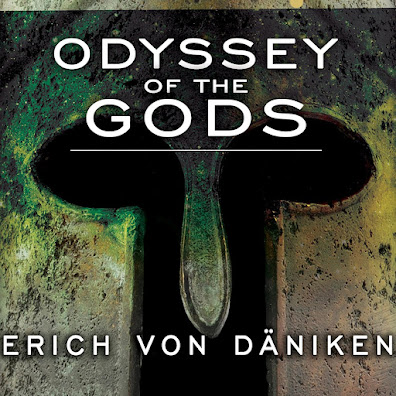
Odyssey of the Gods: The History of Extraterrestrial Contact in Ancient Greece (audiobook) by Erich Von Däniken


More of the same from Von Däniken, but it is still interesting and entertaining.


Read by William Dufris
Duration: 7.5 hours
Published in October of 2011 by Tantor Audio
Unabridged.

Erich Von Däniken’s bestselling 1968 book Chariots of the Gods? helped to popularize what is now known as the “ancient astronaut” theory. This theory was featured in the 1970s NBC documentary In Search Of Ancient Astronauts and has even made it to Hollywood with the X-Files and the latest installment of the Indiana Jones movies. In short, the theory is that humanity, thousands of years ago, was visited by aliens who built gigantic structures such as the pyramids and Stonehenge and were mistaken for gods by our ancestors. They are the inspiration behind much of the ancient mythology around the world and the fantastic beasts included in many of those myths are actually the result of genetic experimentation.

In Odyssey of the Gods Von Däniken looks at three tales of ancient Greece and applies his broader ideas to those tales. The three tales are: 1) Jason and the Argonauts; 2) The Iliad/The Odyssey; 3) Atlantis. A great of deal of time in this audiobook is spent simply reciting these stories (easily one-third of the audiobook) and then stopping from time to time to offer insight based on his theories and fitting them back into his larger theory by noting how some aspects of the stories are similar to other tales from other ancient cultures, such as the Assyrians, ancient India, ancient Israel and even the Mayans, Aztecs and Incas.

As one can imagine, Von Däniken offers an interesting perspective on these stories. All of the creatures and heroes are the result of alien/human crossbreeding or genetic manipulation. Von Däniken allows no room for exaggeration – every tale is taken at face value, especially if it has great detail. He asserts that unnecessary detail in a story makes it less likely to be fiction (because no one would waste their time in creating it), which prompted me to wonder if he had ever read anything about the immense amount of unpublished extra details that J.R.R. Tolkien created just to lay down the backstory for his tales of Middle Earth.

Nonetheless, I did not listen to Von Däniken’s Odyssey of the Gods to look for a fight. As a history teacher, I truly enjoy a multitude of perspectives on history. I really do not take his entire theory seriously but he does, up to a certain point, have a valid question: how did our ancestors build giant pyramids and cities and create entire mythologies when they were literally just a few generations from being unorganized farming villages? It is a giant leap to go from simple farmers to highly organized priesthoods, advanced mathematics and the ability to build with multi-ton stones hauled from far away quarries and right now history has only the vaguest of answers as to how this happened. Throw in historical quirks like the Piri Reis map and the geometric web pattern that he claims covers all of the holy sites of ancient Greece and you have some good reasons to at least give Von Däniken a chance to lay out his theory.

Von Däniken is featured in an audiobook-exclusive interview after the book. His rather strong Swiss-German accent does nothing to hide his enthusiasm and infectious nature  – you just have to like him no matter what you think of his ideas. It is also obvious that the reader, William Dufris, strived to catch that aspect of his voice while reading the book. He did a remarkable job of reading the book and making it seem less like a textbook and more like an exceptionally well-presented seminar.

I rate this audiobook 4 stars out of 5.

This audiobook can be found on Amazon.com here: Odyssey of the Gods.

Reviewed on November 22, 2011.

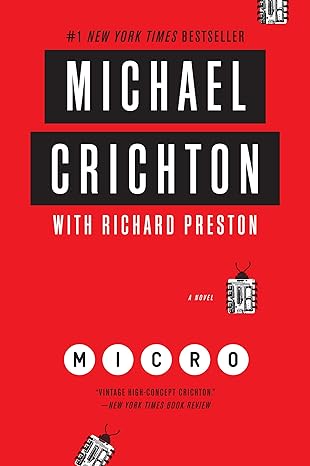
Micro: A Novel (audiobook) by Michael Crichton and Richard Preston


Although it is a collaboration, it reads remarkably like a typical Crichton novel

Published 2011 by Harper Audio
Read by John Bedford Lloyd
Duration: 14 hours
Unabridged.

Michael Crichton died in 2008 and left Micro as an unfinished manuscript. I have no idea how much of this book is actually Crichton's and how much belongs to Richard Preston. To me it felt like a typical Crichton novel.

A typical Crichton novel for me is a mixed bag. It has grand themes - truly big, big ideas with foundations in real science. Grand themes about the dangers of too much innovation without enough ethical considerations, lots of Gee Whiz stuff (think of the movie Jurassic Park where the paleontologists are mesmerized when they first see the dinosaurs) and laughable plot lines with sketch characters (the worst for me was State of Fear in which the big menacing bad guys were wedging themselves into Toyota Priuses as they stalked their opponents - yes, the Prius, the ultimate pursuit car!).

This book has all of that in spades.

The plot revolves around NanoGen, a Hawaiian start up company that has figured out (or stolen) how to shrink full-sized objects down to a very, very small size. People are about one half of an inch tall when they are shrunk. NanoGen claims to be using the technology to thoroughly search the Hawaiian rain forest for biological discoveries that  could be used to help create medicines. Their plan is to search the micro-world bit by bit (literally square foot by square foot) in tiny detail so that even creatures that cannot be seen with the naked eye can be harvested and investigated for possible uses in a bio-technology laboratory.
Micheal Crichton (1942-2008)


But, the bad guy in charge of the project also wants to use these tiny robots as weapons and has made plans to corrupt the original vision of NanoGen's founders. So, murder and mayhem result and soon enough we are following a group of college graduate students who have been shrunken and dumped into the rain forest in an attempt to get rid of even more witnesses (why weren't they immediately squished and flushed down the toilet? The bad guy is so over-the-top in his sadism that he wants to prolong their punishment, which of course eventually backfires.).

So, when our seven college graduate students are dumped in the rain forest (in the micro world as Crichton/Preston usually refer to it) we have several scenes that are reminiscent of Jurassic Park, except we don't have T. Rex and Velociraptors. Rather, we have centipedes, spiders, wasps and ants - all armored and all very dangerous to very tiny people. This part of the book is by far the best - the descriptions of the bugs, their habits, their defenses and their weapons are all fascinating. If it weren't for these details I would have to rate this novel poorly, but the descriptions are entertaining in and of themselves.

John Bedford Lloyd's narration of the book was solid but really did little to enhance or detract from the book.  His voices were solid. To be fair, most of the plot was inane, so it was not like he was working with a literary classic. His deep voice did add a lot to the menacing descriptions of the bugs.

I rate this audiobook 3 stars out of 5.

This book can be found on Amazon.com here: Micro: A Novel.

Reviewed on December 27, 2011.


Featured Post

<b><i>BAN THIS BOOK (audiobook)</i></b> by Alan Gratz

Published in 2017 by Blackstone Audio, Inc. Read by Bahni Turpin. Duration: 5 hours, 17 minutes. Unabridged. My Synopsis Ban This Book is t...

Popular posts over the last 7 days