J.R.R. Tolkien (Christian Encounters series) by Mark Horne


A nifty little biography


Published in 2011 by Thomas Nelson

Mark Horne's J.R.R. Tolkien is an enjoyable biography of the famed writer of The Hobbit and The Lord of the Rings trilogy. It is not a large biography (130 pages) but, if you are like me and knew just a little about Tolkien and wanted to know a bit more, this biography fits the bill perfectly.

Horne begins with quite a bit of detail about Tolkien's early life, especially the difficulties caused by the loss of his father when 
he was very young and the death of his mother when he was 12 years old. His mother's faith and the difficulties she endured when she converted to Catholicism are very important foundations of Tolkien's young life.

Tolkien's relationship with his wife Edith (both before and after they were married) are covered quite well. Horne skimps a bit on his children and we almost completely lose track of Tolkien's brother, who endured the same difficulties but chose a different path through life.

Tolkien had no inheritance or lofty standing in society to help him prosper in pre-World War I England. But, he did have a first class mind and despite the distraction of his budding romance with Edith, he was able to procure an academic scholarship to Oxford. Tolkien and academia were a great fit and he continued to teach throughout most of his life. He seems to have been an excellent teachers as his academic programs grew even though he was very much an advocate of letting students have more choices and less rigid programming in their education (this is in line with the general freedoms he promoted throughout his works).
J.R.R. Tolkien (1892-1973)


Academic male companionship was important to Tolkien and he almost always had a group of students and/or professors that he met with regularly. They discussed the news of the day, literature, various academic disciplines and they served as willing foils for each one another's new projects. This seems to have been the great joy of Tolkien's life. C.S. Lewis was one of these companions, being a fellow member of group that called themselves the Inklings.

This little biography's strength is how it tells the tale of the creation of Tolkien's beloved books and their enormous influence on literature and culture even today and how truly surprised Tolkien was at his success. Tolkien was prone to multiple re-writes, self-doubt and what might be referred to as attention deficit disorder when it came to finishing projects - he was constantly adding this or that and re-working sections of books, even while the presses were waiting, as was the case for The Return of the King. Thrown in is Tolkien's omnipresent and ultimately quixotic desire to publish the never-quite-done The Silmarillion, his background source for the world of Middle Earth (it was published after his death after careful editing by his son, Christopher).

I received my copy of this book without charge from Thomas Nelson Publisher's BookSneeze program. There was no expectation of a positive review in exchange for the book, nor would I simply "give" a positive review since that would be unethical.

I rate this biography 5 stars out of 5.

This book can be found on Amazon.com here: J.R.R. Tolkien by Mark Horne.

Reviewed on August 1, 2011.

Indigo Slam (Elvis Cole #7) (audiobook) by Robert Crais


Published in 2008 by Brilliance Audio.
Read by David Stuart.
Duration: 8 hours, 27 minutes.
Unabridged.

While not as action-packed as The Last Detective (which follows Indigo Slam in the series, but I've not read a single one of them in order so why start now?), this is a strong book. Lots of smart comments, action and twists and turns, although the very last twist was so obvious that only the clinically brain dead couldn't see it coming. But, that didn't lessen the overall value of the book for me.

Elvis is hired by a group of children who have been living on their own for a while to find their missing father. As the investigation progresses, Cole and his enigmatic partner Joe Pike get caught up in the Witness Protection Program, a counterfeiting ring, a crime syndicate and all sorts of other incidents of violence and mayhem. Cole's deep down soft heart and his smart mouth are, of course, an enjoyable part of the story.

The audiobook is read by David Stuart who captures the voice of Elvis Cole perfectly.

I rate this audiobook 5 stars out of 5.

This audiobook can be found on Amazon.com here: Indigo Slam (Elvis Cole/Joe Pike Series).

Reviewed on April 24, 2008.

Jack Arute's Tales from Indy 500 by Jack Arute with Jenna Fryer


Published in 2006 by Sports Publishing

Jack Arute's first Indy 500 was in 1969 as an 18-year-old spectator. His family owns a track in the Northeast and racing is in his blood. His dad passed down a love for the Indy 500 in particular. Arute turned that love into a long career covering racing. 


In Jack Arute's Tales from Indy 500, Arute only tells stories from 1969 to the present (2004 in the hardback version, 2005 in the paperback version). Nothing too complicated and a real fun read, especially if you want to re-live some of the more exciting, interesting and sad moments from the last 35 years or so.

Jack Arute (center) 
joking with Tony Kanaan
I'd recommend the paperback version over the hardback since it has been expanded to include the 2005 race - the race where Danica Patrick became a household name.


This is a quick read - I finished it in just one evening, but to be fair, I did read into the wee hours of the morning because the stories were that much fun.

I rate this book 4 stars out of 5.

This book can be found on Amazon.com here: Jack Arute's Tales from the Indy 500

Reviewed on May 2, 2008.

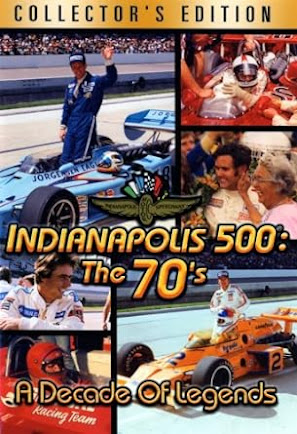
Indianapolis 500: The 70's A decade Of Legends (Collectors Edition) DVD


A must for Indy 500 fans

Part of a series of DVDs produced by the Indianapolis Motor Speedway, this collection reviews all of the races from 1970-1979, including A.J. Foyt's famed and unprecedented fourth win.

The collection features original TV & radio commentary, sound and video and lots of interviews with the drivers. Some of the interviews are from the 1970s and some are from nowadays looking back.
Janet Guthrie


Indianapolis 500: (The 70's A decade Of Legends) Collectors Edition is more than mindless promotion of the race - the lowlights (1973) are exposed along with the controversy associated with the arrival of Janet Guthrie, the first female participant in the 500. Changes with racing technology is highlighted throughout.

DVD features include collecting all of the bits and pieces of interviews with several drivers and some owners and adding a few bonus bits. Rick Mears and Roger Penske are especially strong interviews.

Well done.

5 stars out of 5.

This DVD can be found on Amazon.com here: Indianapolis 500: the 70's.

Reviewed on May 2, 2008.

Liberal Fascism: The Secret History of the American Left, From Mussolini to the Politics of Meaning by Jonah Goldberg


An Impressive Amount of Research


Published in 2208.

According to Goldberg, the traditional left-right concept of political beliefs is incorrect. Understanding this is key to understanding Goldberg's thesis that modern liberalism is the intellectual heir to Rousseau's ideas, the French Revolution and is, at the very least, the intellectual cousin to both fascism (especially Italian Fascism) and Soviet Communism.

To fully understand this you have to understand that measuring political philosophy with a one-dimensional left-right line lack the depth to measure both social and economic political philosophies. A quadrant map used to measure political beliefs will more accurately show depth of support for government involvement in economic issues, political rights and social issues. Anarchists lie at the edge of one quadrant, Libertarians a little more toward the center of that same quadrant but totalitarians lie in the opposite corner. Search the web to discover more about the grid concept for yourself.

Knowing this and actually knowing the stated goals of the fascist states (not including the racial discrimination of the Nazis), one can easily see that those goals are more in line with those of modern liberals and not with those of the Right, despite the popular belief that Fascists are nothing more than extreme Conservatives.

On the political grid, one can see that Fascists and Communists are really nearly the same thing, or at the very least political cousins of one another. They are both Totalitarians. Totalitarianism it the opposite of the Enlightenment philosophies that America was founded upon (see John Locke) and they are the opposite of the views of Classical Liberals.

Goldberg's thesis in Liberal Fascism: The Secret History of the American Left, From Mussolini to the Politics of Meaning is that modern liberals are not Adolph Hitler death camp fascists. Rather, they are akin to Mussolini's pre-World War II vision of fascism. Goldberg likens Mussolini's fascism to being very masculine and he likens modern liberalism to being more of an "eat your vegetables" nanny-state style of fascism, a more feminine model, if you will. Not classic Totalitarianism, but with clear Totalitarian features. The government is getting more and more involved in your daily life. The government tells you cannot smoke in your own business (Indianapolis), the type of grease you can cook with (New York City) and what types of grocery bags you can use (San Francisco).

None of those things belongs in the realm of government in the view of Classical Liberalism, which is more concerned about protecting you from government intervention, not in protecting you from yourself. While a nanny state is clearly not a Totalitarian state, it also is clearly closer to fascism on the quadrant grid than it is to classical liberalism.

Goldberg uses an impressive array of quotes and sources to back up his arguments. Goldberg is not afraid to go after Republicans as well. He's not happy with Karl Rove or George W. Bush for their own fascist tendencies. Mind you, his complaints are not those that the hyperbolic bloggers on the Left obsess over. He is bothered by the faith-based initiatives and the tremendous reach of No Child Left Behind into areas that were once left to local and state government.

Liberal Fascism is often dense reading, more like a political science textbook than the typical political stuff put out by partisans like Michael Moore, Ann Coulter and Sean Hannity. A strong working knowledge of political philosophy and political science vocabulary is a must with this book.

Goldberg provided tons of endnotes to document his work which is a strength and indicative of the quality of work that he has created. It was also quite annoying. Not the notes themselves, but the fact that they were endnotes with commentary requiring the reader to constantly flip back and forth to the end of the book and to keep two sets of bookmarks- one for the text and one for the endnotes. If a writer plans to write additional commentary in his or her notes common decency would suggest that footnotes are better for the reader. The continuity and flow of the main text is not broken by constant flipping to the back of the book. Shelby Foote did this to great effect in his gigantic 3 volume Civil War series. Tom Holland uses both in his book "Rubicon" - notes at the end, additional commentary at the bottom of the text.

I rate this book 5 stars out of 5.

This book can be found on Amazon.com here: Liberal Fascism.

Reviewed on May 2, 2008.

America Alone: The End of the World as We Know It by Mark Steyn


Important information but not well-presented


Published in 2006

I am a genuine fan of Mark Steyn. I am a frequent reader of National Review and his "Happy Warrior" column is what I read first. I picked this book up as a result of listening to a half-hour interview with him on my local radio station. I picked it up less than 4 hours after hearing him.

The information in America Alone The End of the World as We Know It is important, but the presentation is lacking. Steyn repeats himself so often that, if properly edited, this book would only have about 50 pages. Steyn writes brilliant columns. This book reads like a series of columns that overlap information, commentary and theme and was not up to the standards that I expected.

Steyn has done a lot of research, includes dozens and dozens of quotes and paraphrasing. However, he includes absolutely no endnotes, no footnotes, heck, he doesn't even include a bibliography! C'mon, Mark, I expect my tenth grade students to show their sources. You should do the same.

An interesting side note: A Canadian court tried to ban this book, Mark Steyn and the magazine that printed excerpts from this book due to some sort of 30 year old politically correct hate crimes law (can't write items critical of ethnic groups, etc.). While I'm not fond of the way this book is written, I can't stand the idea of banning a book for PC reasons. Steyn's book describing the trial is Lights Out: Islam, Free Speech and the Twilight of the West. Click here for my review of that book.

This book can be found on Amazon.com here: America Alone: The End of the World As We Know It

I rate this book 3 stars out of 5.

Reviewed on May 2, 2008.

Talking God (audiobook) by Tony Hillerman


Originally published in 1989.
Read by John MacDonald
Duration: 6 hours, 35 minutes
Unabridged

Talking God is good, but not the typical Tony Hillerman book. Rather than being based in the Four Corners area, this one mostly takes place in Washington, D.C.

Navajo Tribal Police Lt. Joe Leaphorn and Jim Chee investigate a body found in Gallup, New Mex
Tony Hillerman
(1925-2008)
ico. Some digging into the case discovers a trail that leads to the Smithsonian in Washington, D.C. and Navajo artifacts that are on display there.

It is interesting to see D.C. through Navajo eyes, but we do spend a lot of time in the mind of the bad guy as well, which is to the detriment of the story in my mind.

Chee's personal life features prominently as he re-connects with his on again-off again love interest Janet Pete, who is now an attorney in D.C. Leaphorn's painful loneliness and a general feeling of loss pervades throughout the book.

I would have rated the book as four stars, but I am reviewing the audiobook. My audiobook was read by John MacDonald and I cannot think of a worse pairing than MacDonald's voice and Hillerman's writing. It's not that MacDonald isn't clear - he's easy to understand. But, his voice sounds like Eastern establishment, not Western. This audiobook lasted about 6 hours and 35 minutes.

I rate this audiobook 3 stars out of 5.

Reviewed on May 2, 2008.

Note:  a new audiobook version of Talking God has been released with a different reader. I have not listened to the new version, but this book deserved another chance. This link leads to the new audiobook on Amazon.com because I cannot find a link to the edition that I listened to. 

Featured Post

<b><i>BAN THIS BOOK (audiobook)</i></b> by Alan Gratz

Published in 2017 by Blackstone Audio, Inc. Read by Bahni Turpin. Duration: 5 hours, 17 minutes. Unabridged. My Synopsis Ban This Book is t...

Popular posts over the last 7 days