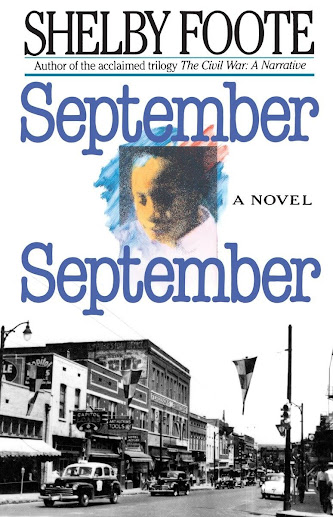
September September by Shelby Foote


Sex and kidnapping in 1957 Memphis

Originally published in 1978.

Shelby Foote is most famous for his massive history of the Civil War (The Civil War: A Narrative), but he was also an author of fiction. I have read several of them and they mostly qualify as Southern gothic - moody, dark and full of tragedy. September September fits that description perfectly, although it takes place later than his other novels.

Set against the backdrop of the racial integration of Little Rock Central High School in September of 1957, the novel features two white men and a white woman who kidnap the grandson of a wealthy black Memphis businessman. They use the Little Rock incident as their cover to blame the kidnapping on racial strife when it is really a brazen attempt to get $60,000 from a man who will not expect much cooperation from the police.

Shelby Foote (1916-2005)
The problem is summed up in a line from one of the kidnappers: "Truth is, we're not very smart, those of us who go in for crime." A sexual triangle forms between the three kidnappers. Anger and jealousy start to take precedence over "the plan" with tragic results.

Foote does a great job of creating characters with a past that feels real and his dialogue is first rate. The most interesting character to me was Theo, the grandfather who pays the ransom. His story would have been worthy of another book.

A surprising part of the book was the frequent and open discussion of sex. Racial tension is the topic of the book - racial strife in Little Rock, as the purported excuse for the kidnapping, as the source of anger in Eben's (the kidnap victim's father) burgeoning racial consciousness - but that is really a veneer. The real topic is sex and how it can strengthen, confuse and even weaken the bonds between men and women. There are quite a few graphic scenes, much more than I remember in his other novels.

I rate this book 4 stars out of 5.

Reviewed on July 15, 2011.

This book can be found on Amazon.com here: September September by Shelby Foote.

A Time for Patriots (Patrick McLanahan #13) (audiobook) by Dale Brown


Up and Down


Published by HarperAudio
Read by William Dufris
Duration: 12 hours, 27 minutes
Unabridged

Dale Brown knows how to write action very well. He certainly knows all about airplanes (sometimes he talks about them so much that it's quite easy to drift off for a while and then come back), he has created enough new technological gizmos to outfit an entire fleet and he does a solid job of creating dialogue that sounds good to the ear - from old men to teenage boys. But, the promised confrontation with militias in A Time for Patriots just sort of fizzles rather than pops.

Lt.-General Patrick McLanahan is retired and living in Battle Mountain, Nevada on a remote air base safeguarding the last of America's space planes in the hopes that the program will be re-developed in earnest when the economy picks up and the budget can allow for it. In the meantime, he and his son are flying missions for the Civil Air Patrol (CAP). Brown, who is also a member of CAP, spends a great deal of time describing its mission and even runs the reader (or in my case, listener) through an actual search and rescue operation which was interesting but not really germane to the storyline as described on the back of the book.

******Spoilers*******


Meanwhile, a militia group uses a dirty bomb on an airplane to attack the federal building in Reno. Brown uses all sorts of red herring leads to confuse multiple story lines and try to make it a surprise as to where the attacks were coming from. Although my original suspicions turned out to correct, I was fooled for a while.

But, in the end, Brown's fundamental misunderstanding of the militia movement as a whole - a misunderstanding he could have cleaned up in just a few seconds if he had did as little as researched on Wikipedia (I have linked the article here) hurt the book. I am not a militia member nor do I particularly sympathize with them, but I do follow politics and pay attention. He claims that the militias have formed due to a lack of federal government involvement in support of poor relief or job training. Instead, they are almost always a reaction to the perception of too much federal involvement in local issues. This is especially an issue in Nevada since 84.5% of Nevada is owned by the federal government.

When the big reveal happens and the bad guys are discovered and thwarted I was very disappointed to find out the real reasons that drove the entire movement. I thought to myself, "Really? Would anyone actually nuke downtown Reno for that reason?" I just didn't buy it.

So, to sum up - nice action scenes, I like the stuff on CAP, the technological toys are pretty cool but the main reason the book was written - the militia part, just landed flat on its face.

I rate this audiobook 3 stars out of 5. The education about CAP and the performance by William Dufris make up for the militia misfires.

This book can be found on Amazon.com here:  A Time for Patriots by Dale Brown.

Reviewed on July 15, 2011.

Ancient Trade Routes of the Arab World DVD


This made for school DVD highlights an important and oft-ignored facet of history


Published by Schlessinger Media.
Duration: 38 minutes.

Any teacher of world history knows that some subjects have plenty of supplemental resources available. For example, the Ancient Romans and Greeks have literally thousands of DVDs, books, workbooks, programs, units, games and activities available as supplements, including whole weeks of programming on the History Channel.

Equally influential eras, such as the Arab Trade Routes are often ignored or have scant materials available even though these trade routes were the source of medieval Islam's strength, wealth and intellectual flowering.

The DVD Ancient Trade Routes of the Arab World does address this topic, but only in a 3-star (ok, but not great) way. The DVD features three short films (12 minutes or so for a total of 38 minutes) about three trading hubs - Zanzibar in East Africa, Dhofar in the Arabian Peninsula and Ghadames in the Sahara. The movies show the modern-day versions of these cities and discuss their place in history. The Dhofar video does a great job of explaining the past value of frankincense and how it was made and traded in the ancient world.

There is a support website available (listed in the movie intro credits) but you'll probably have to make your own worksheet to make sure the your students' attentions don't wander too much.

I rate this DVD 3 stars out of 5.

This DVD can be found on Amazon.com here: Ancient Trade Routes of the Ancient World.

Reviewed on August 29, 2008.

The Long Hunters by Jason Manning


A solid bit of historical fiction

Published in 2002.

Jason Manning has written a series of novels about the Barlow family, starting with Lt. Timothy Barlow. The Long Hunters is set during the War of 1812 and the Seminole War and features Barlow, young Ensign Sam Houston, General Andrew Jackson and a Creek warrior/family man named Rook. The book covers the Battle of Horseshoe Bend and some of Jackson's Seminole Campaign in some detail, while we get a history book type overview of the Battle of New Orleans.

Manning's books are always well-researched and I am always a bit surprised that his stuff is always marketed with the pulp fiction westerns. Not that I dislike a good Western, mind you, but Manning's stuff is a cut above.

The next book in the series is The Fire-Eaters.

I rate this novel 4 stars out of 5 and it can be found on Amazon.com here: The Long Hunters

Reviewed on August 30, 2008.

First Daughter by Eric Van Lustbader


Good action marred by laughable political conspiracies and a not-so-hidden message

Published in 2008.

Eric Van Lustbader is better known as the author who has picked up the Bourne series since the death of Robert Ludlum. First Daughter has some similarities to that series in that we have vast government conspiracies, brainwashing and one man versus the system.

Positives:
The action in the book is strong.

Negatives:
The backstory Van Lustbader told to introduce us to the main character, Jack McClure, is much more interesting than the main plotline.

The politics in this book are laughable. The President is a thinly disguised clone of Bush43 (Iraq, 9/11, Patriot Act, Faith-based initiatives, etc.) except he has the paranoia and anger level of 3 or 4 Richard Nixons. The President makes new policy initiatives in his last week in office. With less than a month to go he has a major negotiation with the Russians, even though everyone knows that no one negotiates with a President with so little time left in office - his replacement will just countermand all of them in a matter of days!

Atheist terrorist groups abound even though there's no such things as atheist terrorist groups - there are terrorists that are atheists, but there are not terrorists FOR atheism. People will kill for their religious beliefs, but I can't imagine anyone killing over their lack of belief...

Even more annoying is Van Lustbader's insistence on ridiculing religion throughout the book. The President is a religious fanatic. The President-elect uses religion as a tool to get elected. The minister who is out to save the neighborhood sells out in a political alliance. A grieving mother finds comfort in the church of her youth - but she leaves it and now acts much more sane. A religious peer of McClure (the only one) ends up leaving the church and McClure congratulates him for it. The bad guy comes off as sort of a good guy in this anti-religious mindset.

It is one thing to decry religion in politics (I'm very religious and I don't like religion in bed with politics) but, it is entirely another thing to decry religion altogether. Maybe Van Lustbader thought he was being subtle, but he was about as subtle as a wrecking ball.

Recommendation: There are plenty of other action/political thrillers out there.

I rate this book 2 out of 5 stars.

This book can be found on Amazon.com here: First Daughter by Eric Van Lustbader.

Reviewed on September 1, 2008.

Forced Out: A Novel by Stephen W. Frey


This book had such potential and then...


Published in 2008.

I really liked the premise behind Forced Out: a young baseball player hides from the New York mob by playing single A ball in Florida but he is discovered by a former Yankees talent scout. Soon enough, the mob is on the hunt again.

But... (WARNING: Spoilers, sort of...)

The book gets increasingly complicated (which is fine, life is complicated) and the only way Frey resolves anything with any character in this book is by having someone killed off. I expected lots of people to die (it is about the mafia, after all) but this story gets ridiculous. The book ends up feeling like Frey was either: a) under a tight deadline; or b) unable to figure out how to end this complicated book in a reasonable way so he just started killing everyone off.

Either way, it was a very unsatisfying ending. In good conscience, I cannot recommend this book to all but the most ardent of Stephen Frey fans.


I rate this book 2 stars out of 5 and it can be found on Amazon.com here: Forced Out by Stephen W. Frey. 

Reviewed on September 5, 2008.

Samuel Adams: A Life by Ira Stoll


The "Forgotten" Founding Father

Published in 2008.

George Washington. Thomas Jefferson. Benjamin Franklin. John Adams. All there at the founding of our country. All recognized for their unique contributions to the revolution. Author Gary Wills noted that Adams was "the most influential man at the first two Congresses." He was on the committees of correspondence that tied the colonies together in the first place and no one was on more committees in the Continental Congress. It is easily argued that Samuel Adams had as great a role, if not greater than any other member of the Congress. He had such an integral part to play that a local newspaper noted in his obituary that "to give his history at full length, would be to to give an history of the American Revolution."

In Samuel Adams: A LifeIra Stoll tells the story of Samuel Adams. Called by some the Last of the Puritans for his strong religious faith and willingness to express it openly, Adams was certainly one of the strongest defenders of liberty from the outset. In fact, a general amnesty was offered to everyone in the Massachusetts colony by the British government, except for Samuel Adams and John Hancock. At other times, the British government approached him with clumsy attempts to bribe him with high office or favors, which he rejected with flair ("tell Governor Gage it is the advice of Samuel Adams to him no longer insult the feelings of an exasperated people.") Stoll correctly labels Adams a "religious revolutionary" - those two themes dominate his life until the very end.

Samuel Adams (1722-1803)
Politically, he was closer to Thomas Jefferson than his Federalist cousin John Adams. But, unlike Jefferson, he decried slavery and acted upon it (his wife received a slave as a gift and he freed her that day). He also advocated education for women. He wrote page after page for newspapers supporting the idea of independence and would not compromise on that point. He could whip up a crowd with his voice as well, and he often did during the years when Boston led the protests against taxes, leading up to the Boston Tea Party.


Stoll's prose is not necessarily the most exciting of reading, but Adams words and life are inspiring enough that I rate this book 4 stars out of 5.

This book can be found on Amazon.com here: Samuel Adams: A Life.


Reviewed on July 13, 2011.

Featured Post

<b><i>BAN THIS BOOK (audiobook)</i></b> by Alan Gratz

Published in 2017 by Blackstone Audio, Inc. Read by Bahni Turpin. Duration: 5 hours, 17 minutes. Unabridged. My Synopsis Ban This Book is t...

Popular posts over the last 7 days