Motherhood and Hollywood: How to Get a Job Like Mine by Patricia Heaton


A fun, breezy read about a normal girl who made it big

Published in 2002 by Villard

Motherhood and Hollywood: How to Get a Job Like Mine is not out to change anyone's life, but it is a funny, light look at one woman's meandering quest to be an actress. Also, it is quite reassuring to find out that there are people in Hollywood who are quite normal.

Patricia Heaton's book is irreverent, sometimes serious, frank, cute, and her tales of a time when kids could run the neighborhood in suburban Cleveland without fear reminded me of my own fun in small town Indiana. She pokes fun at her own silliness and naivete and reminded me of my own way back when.

The author, Patricia Heaton
This is a weekend read (it also has great potential as a read-out-loud-to-your-spouse-in-the-car book), but it will be one that you'll pass on to friends so they can have a fun weekend as well.


I give this one 4 stars out of 5.

This book can be found on Amazon.com here: Motherhood and Hollywood: How to Get a Job Like Mine.

Reviewed on June 20, 2006.

Keeping Black Boys Out of Special Education by Jawanza Kunjufu


Full of good advice about ALL boys and special education

Published in 2005.

While Jawanza Kunjufu, an author of nearly two dozen books, writes primarily for an African-American audience, Keeping Black Boys Out of Special Education is full of good observations about boys in special education in general.

There is a growing concern about the number of boys in special education as compared to girls. Kunjufu joins more established authors such as Christina Hoff Sommers ('The War Against Boys') and Michael Guiran ('Boys and Girls Learn Differently') in pointing out that there is something wrong out there in the world of education as far as boys are concerned.

Kunjufu gives wonderful advice about the questions parents should ask if they are brought in to the school to discuss placing their student into special education. His suggestions include signing nothing until you completely understand it, insisting on seeing what modifications have been done up to this point (unfortunately, some teachers have the reputation of referring every student who does not learn quickly from that teacher's ONE teaching style for special education services) and asking for a different assessment test (it is your right) - scores can vary widely from one test to the next.

His best advice comes in the area of the IEP, or Individualized Education Plan. All special education students must have one and most are vague. He insists on specificity and the book is worth the purchase price just for this chapter alone - both for the prospective special education parent and the special education teacher.
Jawanza Kunjufu


Kunjufu's target audience is African-American, as I've already said. I am not, so some passages were not really aimed at me. I was not comfortable with Kunjufu's seemingly equating inner-city poverty with African-American culture in general. As he points out in the beginning of the book, that this is a stereotype. However, he reinforces that stereotype over and over again. It could be that he is really targeting that segment of the African-American population... Like I said, I don't know.

Regardless of my comfort level with certain passages, this is a must read if your student is being referred for special education services. It is a quick and practical read with a clear table of contents to get you quickly to the IEP and Parent Empowerment sections and room for notes in the back.

I rate this book 5 stars out of 5.

This book can be found on Amazon.com here: Keeping Black Boys Out of Special Education by Jawanza Kunjufu.

Reviewed on June 20, 2006.

The Keeper by Meg O'Brien


This thriller does its job but misses the mark on being a great read.


Originally published in 1992.

In The Keeper Meg O'Brien produces a thriller that keeps the suspense up but still comes up short from being a truly satisfying read.
The plot concerns the kidnapping of Charly Hayes, the daughter of a Nathan and Brooke who are divorced. Accusations of parental kidnapping fly from both parties and eventually Brooke is secretly sent to John Creed, an ex-cop who is known as the Keeper (Keeper of the Flame, Keeper of the Faith, Keeper of the Files) who is unofficially attached to LAPD as a one-man department to find missing children. When things get rough, he has a team of volunteers to help him out - both inside and outside the department. Creed is an emotional train wreck who obsesses since his own son has been missing for 5 years.

Some of O'Brien's transitions from one character to the next are clunky and the relationship between Creed and Brooke is telegraphed from the first page that they meet. O'Brien has several discrepencies, such as having Brooke chamber a round in a revolver and using plain, untreated tap water to clean a fish tank. Those are annoying, but mostly I found myself wishing that this same premise for a plot were re-written by someone else who could make the characters come alive a bit better. The character of Brooke just did not work for me. Unfortunately, despite the name of the book, The Keeper and his team were not the focus of the book. If they had been, it probably would have been a better book.

Once again, it's not a bad book, but it certainly isn't a great one either.

This book can be found on Amazon.com here: The Keeper.

I rate this book 3 stars out of 5.

Reviewed on June 9, 2006.

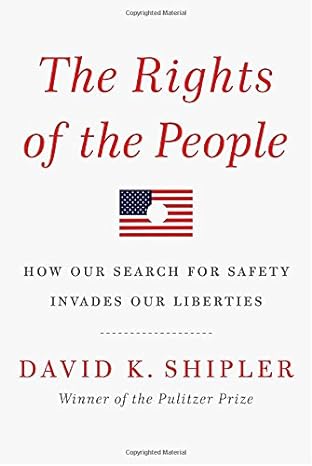
The Rights of the People: How Our Search for Safety Invades Our Liberties by David K. Shipler


An Important Book - for Liberals and Conservatives

Published by Alfred A. Knopf in 2011

Pulitzer Prize-winning author David K. Shipler takes a long hard look at the rights we have sacrificed in the era of the War on Drugs and the War on Terror, and lesser wars such as the War on Handgun Violence in The Rights of the People: How Our Search for Safety Invades Our Liberties. I picked this book up figuring that my Conservative sensibilities might get ruffled a bit by a New York Times reporter but I might learn a thing or two along the way.

I always tell people that the traditional left-right continuum used to describe someone's politics is so inaccurate as to be useless. Really, what is the difference between an aging hippie living on a hill somewhere raising some dope for personal use and telling the government to get out of his business and a Barry Goldwater-type conservative (like me) living by himself on a hill somewhere that tells the government to get its nose out of his business? Some dope. Otherwise, they are both determined advocates of civil liberties - keep out of my business if it is not hurting anyone else.

Mr. Shipler and I meet on that continuum at the spot I just described.

The Rights of the People starts with a history of civil rights in American history and there were a few things that surprised this American history addict (let's just say that the more I read about Woodrow Wilson, the less I like).  Shipler then moves into a chapter called "Another Country." This country is inner-city Washington, D.C., a place where the Fourth Ammendment (The right of the people to be secure in their persons, houses, papers, and effects, against unreasonable searches and seizures, shall not be violated, and no Warrants shall issue, but upon probable cause, supported by Oath or affirmation, and particularly describing the place to be searched, and the persons or things to be seized.) simply does not exist. Because Washington had very stringent anti-handgun laws, the police openly frisk people on the street, at family picnics, on their front steps, in their cars, in parked unlocked cars, just about anywhere - looking for guns. Temporary roadblocks are set up, drivers are pulled from their cars and frisked and their cars are searched without cause just to snag a pistol here or there (to be honest, I would not drive in some of those neighborhoods without a pistol, either.)


This is the kind of activity that I would not tolerate and I have lived next door to an armed drug dealer that I desperately wanted to have arrested. But, I did not want my entire neighborhood turned into a police state to achieve it. This section angered me, especially as I recognized a behavior described by Shipler that I have seen in some of my middle school students - young men pulling up their shirts to show that they are not carrying pistols in their waistbands. Some of my students do this when challenged by authority figures at school as well, which tells me they live in an America that does not have a Fourth Amendment.

Or, maybe the whole country is going that way. Shipler describes multiple cases of people's homes being searched with flimsy warrants, or none at all. Or, public school-based drug tests in order to participate in any extracurricular activities. At a school I used to work at I sponsored a Key Club (a volunteer organization). Every member of the club was subject to a urine test simply because they wanted to help out in a nursing home or collect the recycling during their study halls and be recognized for it during our meetings. How silly is that?

Shipler moves on to the Patriot Act and describes in histrionic-free language what it enables and what it has been used for. He describes in great detail how NSA data mining is used. To be honest, I was bothered by this as well, but not as much as I was by the first section, but only because the first section was much less abstract and more visceral, more real.

A chapter called "The Right to Be Let Alone" describes how all of the data we produce about ourselves every day can be used by private entities or employers. Some of his examples are a bit weak, including a police officer who was disciplined for using his department-issued pager to send personal sexual messages. He sent so many messages that he went over the contracted limit. Work tools are for work and the employer has a right to ensure that they are used for work, in my opinion.

He wraps up the book with a look at how counter-terrorism has eroded rights.

Of course, history continues to march along. Shipler released his book before the death of Osama Bin Laden and before the Supreme Court of Indiana ruled “In sum, we hold that [in] Indiana the right to reasonably resist an unlawful police entry into a home is no longer recognized under Indiana law.” Which means that, in Indiana, warrants are not technically not necessary at this time. Fun, huh?

Here is a link to Mr. Shipler's  second book called  Rights at Risk with other aspects of this topic.

I rate this book 5 stars out of 5. Highly recommended.

This book can be found on Amazon.com here: The Rights of the People.

Reviewed on July 12, 2011.

No Greater Courage: A Novel of the Battle of Fredericksburg by Richard Croker


A Fine Bit of Historical Fiction

Originally published in 2006 by William Morrow

No Greater Courage: A Novel of the Battle of Fredericksburg is Richard Croker's novelization of the events leading up to and including the Battle of Fredericksburg in December of 1862 and it is just about as good as it gets in the "cast of thousands" (lots and lots of characters) type of historical fiction.

Due to the nature of this sort of book, it is just about impossible to get too deeply involved in many of these characters. But, Croker does an admirable job of giving us something to know about each of them, reminding the reader who each character is when they re-join the narrative and then we get to watch them in what is arguably one of the Union Army of the Potomac's worst moments. Most of the characters are real and not all of them are big generals. Not only do we get to see the action in the battle itself, but there is plenty of focus on the behind-the-scenes political intrigue that demonstrates how truly talented Lincoln was as a politician and also the dangers of too much civilian interference in purely military matters.
Ambrose Burnside (1824-1881), the Union
commander at Fredericksburg


The only complaint I have concerns maps. There are not enough of them and the maps that are included are so stylized that I had difficulty reading them. Fortunately, the maps are not absolutely necessary for the book to be enjoyed and if you find yourself confused, historical maps of this battle abound on the internet.

I hope that Richard Croker is working on another book. Chancellorsville comes up next chronologically and he would do a great job with it.

Croker's previous novel of the Civil War, To Make Men Free: A Novel of the Battle of Antietam is not required pre-reading to enjoy this novel.

I rate this novel 5 stars out of 5. It can be found on Amazon.com here: No Greater Courage: A Novel of the Battle of Fredericksburg by Richard Croker.

Reviewed on September 15, 2008.

A Cure for Night: A Novel by Justin Peacock


A Very Solid First Novel

Published in 2009.

The last two novels I read before this one were from solid "name brand" authors. And...they were disappointing schlock. Justin Peacock is a new author and perhaps because he is new, he has put some care into his work and created a strong book that I can easily recommend.

The title A Cure for Night comes from this little exchange between two defense attorneys:

The author
"That's what the criminal law is: it's how the day tries to correct the night's mistakes. Most of my cases, people have done something they never would've dreamed of doing in broad daylight."
"What does that make us?" I said. "The night's janitors?"
"We're absolutely that," Myra said, sipping her cosmo. "What else do we do but clean up after it? That's why we'll never run out of work. Not unless someone invents a cure for night."


This gritty, dark book features a New York City Public Defense Attorney, Joel Deveraux, that has his own troubled past (with drugs) that has caused him to fall from the fast track in a big-time, big money law firm. Joel is working himself up through the system and he is tapped to be second-chair on a murder case that involves an inner-city drug dealer, a Jewish college student and a lot more.

On a real positive, Justin Peacock has gone out of his way to include correct-sounding dialects - the people from the projects sound authentic to my ear. Although I am not "in the life", I have taught in urban schools for  more than 10 years and Peacock's a lot more accurate than most of those that even bother to try to catch the dialect.

Fans of Robert K. Tanenbaum (Reckless Endangerment) will like this one.

I rate this book 4 stars out of 5.

This book can be found on Amazon.com here: A Cure for Night.

Reviewed on September 20, 2008.

The Last Stand: Custer, Sitting Bull, and the Battle of The Little Bighorn by Nathaniel Philbrick


Well-written, I learned quite a bit probably more than when I visited the battlefield

Published in 2010.

You just cannot talk about George Armstrong Custer without stirring controversy. Depending on the writer, Custer was a true American hero who was betrayed by his superiors and failed by his subordinates or he was a self-absorbed crazy racist imperialist that finally found someone that could fight back and taught him a lesson.

Our movies have shown this as well. Errol Flynn's They Died With Their Boots On (1941) made a hero of Custer while Little Big Man (1970) makes out to be a delusional nut.

Sample of how Little Big Man depicts Custer:


In The Last Stand: Custer, Sitting Bull, and the Battle of The Little Bighorn, Philbrick notes these views and takes more of a middle road. Custer comes off as a more nuanced man. Ambitious, impetuous and overly confident, but not a fool. Plus, he had reasons for that confidence - the audacious, unexpected move had always worked for him in the past.

Sitting Bull, his opponent at the Battle of The Little Big Horn is similarly portrayed without much nuance in the literature. He is a symbol of resistance and Sioux culture, but not really portrayed as a thinking, living, breathing man. Sitting Bull was one of many Sioux leaders. He advocated rejecting white culture as long as possible, but realized that this was only possible for a certain amount of time. In this respect, this icon of resistance was, in fact, a realist that understood that, in the end, such resistance was futile.
George A. Custer
(1839-1876)


Philbrick's title, The Last Stand, refers to two last stands - the famed last stand of Custer and, ironically, he notes that the same battle was really the last stand of the Sioux. Never again would they have so many warriors in one location - after the battle they scattered. Some went to the reservation, some left for Canada and some fought and died in smaller groups.

Sitting Bull
(c. 1831-1890)
In many ways, The Last Stand is a well-written dual biography of Custer and Sitting Bull, and that additional background information makes the telling of the tale of the battle all that much more interesting.The background on Major Reno and Captain Benteen also heightened the drama of the tale.

Like I said in the title, I've been to the battlefield and I left no more informed to the actual timeline of the battle and how it transpired over the space than I was when I arrived - it is just too vast and there were not enough maps (this was more than 20 years ago so maybe things have changed at their interpretive center). Of course, with the actual troopers involved in the Custer's Last Stand, as opposed to those who were with Reno and Benteen, their movements in the battle are bound to be speculative.

The real strength of this book is Philbrick's ability to make a history read like a novel. The story is told with drama, is well-researched and does a good job of tying in other things that were going on in American history at the time. The information about the steamboats that traveled the Missouri was fascinating - I had no idea that they were so cleverly designed.

I rate this book 5 stars out of 5. It can be found on Amazon.com here: The Last Stand: Custer, Sitting Bull, and the Battle of The Little Bighorn by Nathaniel Philbrick.

Reviewed on July 11, 2011.

Featured Post

BAN THIS BOOK (audiobook) by Alan Gratz

Published in 2017 by Blackstone Audio, Inc. Read by Bahni Turpin. Duration: 5 hours, 17 minutes. Unabridged. My Synopsis Ban This Book is t...

Popular posts over the last 7 days