An Important Book - for Liberals and Conservatives
Published by Alfred A. Knopf in 2011
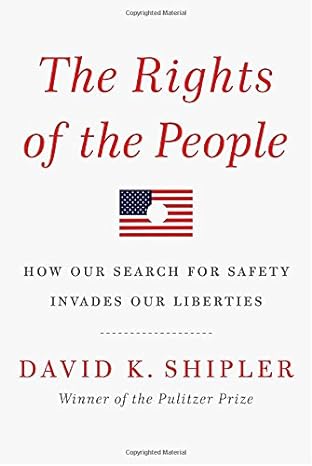
Pulitzer Prize-winning author David K. Shipler takes a long hard look at the rights we have sacrificed in the era of the War on Drugs and the War on Terror, and lesser wars such as the War on Handgun Violence in The Rights of the People: How Our Search for Safety Invades Our Liberties. I picked this book up figuring that my Conservative sensibilities might get ruffled a bit by a New York Times reporter but I might learn a thing or two along the way.
I always tell people that the traditional left-right continuum used to describe someone's politics is so inaccurate as to be useless. Really, what is the difference between an aging hippie living on a hill somewhere raising some dope for personal use and telling the government to get out of his business and a Barry Goldwater-type conservative (like me) living by himself on a hill somewhere that tells the government to get its nose out of his business? Some dope. Otherwise, they are both determined advocates of civil liberties - keep out of my business if it is not hurting anyone else.
Mr. Shipler and I meet on that continuum at the spot I just described.
The Rights of the People starts with a history of civil rights in American history and there were a few things that surprised this American history addict (let's just say that the more I read about Woodrow Wilson, the less I like). Shipler then moves into a chapter called "Another Country." This country is inner-city Washington, D.C., a place where the Fourth Ammendment (The right of the people to be secure in their persons, houses, papers, and effects, against unreasonable searches and seizures, shall not be violated, and no Warrants shall issue, but upon probable cause, supported by Oath or affirmation, and particularly describing the place to be searched, and the persons or things to be seized.) simply does not exist. Because Washington had very stringent anti-handgun laws, the police openly frisk people on the street, at family picnics, on their front steps, in their cars, in parked unlocked cars, just about anywhere - looking for guns. Temporary roadblocks are set up, drivers are pulled from their cars and frisked and their cars are searched without cause just to snag a pistol here or there (to be honest, I would not drive in some of those neighborhoods without a pistol, either.)
This is the kind of activity that I would not tolerate and I have lived next door to an armed drug dealer that I desperately wanted to have arrested. But, I did not want my entire neighborhood turned into a police state to achieve it. This section angered me, especially as I recognized a behavior described by Shipler that I have seen in some of my middle school students - young men pulling up their shirts to show that they are not carrying pistols in their waistbands. Some of my students do this when challenged by authority figures at school as well, which tells me they live in an America that does not have a Fourth Amendment.
Or, maybe the whole country is going that way. Shipler describes multiple cases of people's homes being searched with flimsy warrants, or none at all. Or, public school-based drug tests in order to participate in any extracurricular activities. At a school I used to work at I sponsored a Key Club (a volunteer organization). Every member of the club was subject to a urine test simply because they wanted to help out in a nursing home or collect the recycling during their study halls and be recognized for it during our meetings. How silly is that?
Shipler moves on to the Patriot Act and describes in histrionic-free language what it enables and what it has been used for. He describes in great detail how NSA data mining is used. To be honest, I was bothered by this as well, but not as much as I was by the first section, but only because the first section was much less abstract and more visceral, more real.
A chapter called "The Right to Be Let Alone" describes how all of the data we produce about ourselves every day can be used by private entities or employers. Some of his examples are a bit weak, including a police officer who was disciplined for using his department-issued pager to send personal sexual messages. He sent so many messages that he went over the contracted limit. Work tools are for work and the employer has a right to ensure that they are used for work, in my opinion.
He wraps up the book with a look at how counter-terrorism has eroded rights.
Of course, history continues to march along. Shipler released his book before the death of Osama Bin Laden and before the Supreme Court of Indiana ruled “In sum, we hold that [in] Indiana the right to reasonably resist an unlawful police entry into a home is no longer recognized under Indiana law.” Which means that, in Indiana, warrants are not technically not necessary at this time. Fun, huh?
Here is a link to Mr. Shipler's second book called Rights at Risk with other aspects of this topic.
I rate this book 5 stars out of 5. Highly recommended.
This book can be found on Amazon.com here: The Rights of the People.
Reviewed on July 12, 2011.
Published by Alfred A. Knopf in 2011
Pulitzer Prize-winning author David K. Shipler takes a long hard look at the rights we have sacrificed in the era of the War on Drugs and the War on Terror, and lesser wars such as the War on Handgun Violence in The Rights of the People: How Our Search for Safety Invades Our Liberties. I picked this book up figuring that my Conservative sensibilities might get ruffled a bit by a New York Times reporter but I might learn a thing or two along the way.
I always tell people that the traditional left-right continuum used to describe someone's politics is so inaccurate as to be useless. Really, what is the difference between an aging hippie living on a hill somewhere raising some dope for personal use and telling the government to get out of his business and a Barry Goldwater-type conservative (like me) living by himself on a hill somewhere that tells the government to get its nose out of his business? Some dope. Otherwise, they are both determined advocates of civil liberties - keep out of my business if it is not hurting anyone else.
Mr. Shipler and I meet on that continuum at the spot I just described.
The Rights of the People starts with a history of civil rights in American history and there were a few things that surprised this American history addict (let's just say that the more I read about Woodrow Wilson, the less I like). Shipler then moves into a chapter called "Another Country." This country is inner-city Washington, D.C., a place where the Fourth Ammendment (The right of the people to be secure in their persons, houses, papers, and effects, against unreasonable searches and seizures, shall not be violated, and no Warrants shall issue, but upon probable cause, supported by Oath or affirmation, and particularly describing the place to be searched, and the persons or things to be seized.) simply does not exist. Because Washington had very stringent anti-handgun laws, the police openly frisk people on the street, at family picnics, on their front steps, in their cars, in parked unlocked cars, just about anywhere - looking for guns. Temporary roadblocks are set up, drivers are pulled from their cars and frisked and their cars are searched without cause just to snag a pistol here or there (to be honest, I would not drive in some of those neighborhoods without a pistol, either.)
 |
This is the kind of activity that I would not tolerate and I have lived next door to an armed drug dealer that I desperately wanted to have arrested. But, I did not want my entire neighborhood turned into a police state to achieve it. This section angered me, especially as I recognized a behavior described by Shipler that I have seen in some of my middle school students - young men pulling up their shirts to show that they are not carrying pistols in their waistbands. Some of my students do this when challenged by authority figures at school as well, which tells me they live in an America that does not have a Fourth Amendment.
Or, maybe the whole country is going that way. Shipler describes multiple cases of people's homes being searched with flimsy warrants, or none at all. Or, public school-based drug tests in order to participate in any extracurricular activities. At a school I used to work at I sponsored a Key Club (a volunteer organization). Every member of the club was subject to a urine test simply because they wanted to help out in a nursing home or collect the recycling during their study halls and be recognized for it during our meetings. How silly is that?
Shipler moves on to the Patriot Act and describes in histrionic-free language what it enables and what it has been used for. He describes in great detail how NSA data mining is used. To be honest, I was bothered by this as well, but not as much as I was by the first section, but only because the first section was much less abstract and more visceral, more real.
A chapter called "The Right to Be Let Alone" describes how all of the data we produce about ourselves every day can be used by private entities or employers. Some of his examples are a bit weak, including a police officer who was disciplined for using his department-issued pager to send personal sexual messages. He sent so many messages that he went over the contracted limit. Work tools are for work and the employer has a right to ensure that they are used for work, in my opinion.
He wraps up the book with a look at how counter-terrorism has eroded rights.
Of course, history continues to march along. Shipler released his book before the death of Osama Bin Laden and before the Supreme Court of Indiana ruled “In sum, we hold that [in] Indiana the right to reasonably resist an unlawful police entry into a home is no longer recognized under Indiana law.” Which means that, in Indiana, warrants are not technically not necessary at this time. Fun, huh?
Here is a link to Mr. Shipler's second book called Rights at Risk
with other aspects of this topic.I rate this book 5 stars out of 5. Highly recommended.
This book can be found on Amazon.com here: The Rights of the People.
Reviewed on July 12, 2011.


 is not required pre-reading to enjoy this novel.

 ) will like this one.
 (1941) made a hero of Custer while
 (1970) makes out to be a delusional nut.


 is a double Academy Award winning documentary is narrated by Orson Welles. This movie is shown in by the Mexican government in embassies around the world and serves as a fantastic 18 minute introduction to the Ancient Indian Civilizations of Mexico. Orson Welles, dramatic photography and an equally dramatic soundtrack combine to make this a memorable movie. A must-see and must-have movie for all fans of Mayan and Aztec history.