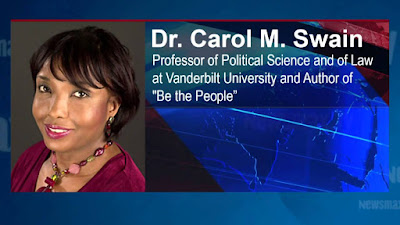
Be the People: A Call to Reclaim America's Faith and Promise by Carol M. Swain, PhD


Sometimes incredibly strong, sometimes deeply flawed.

Published in 2011 by Thomas Nelson, Inc.

Carol M. Swain's Be the People: A Call to Reclaim America's Faith and Promise is a look at several broad areas of concern in American policy, including the high divorce rate, abortion, gay marriage, illegal immigration, race relations in America, HIV, school prayer, and the high unemployment among those with lower levels of education.

First, the positives:

-Swain's personal story is inspirational and she shares it as she writes about these issues.
-Swain provides a humane 15 point plan to deal with illegal immigration.

-Her commentary on race and racism are quite interesting and well thought out. I teach in a multi-racial school with a near even mix of whites and blacks and a great number of Hispanics as well. It can be tricky and Swain accurately describes many of the issues that I have encountered.

-Swain's section on abortion is also rock solid. There are profound arguments for why it is immoral and should be illegal from a number of sources, including from babies that survived and grew up, mothers that regret the decision (Swain is one of those mothers), medical evidence for increased cancer rates and solid philosophical and legal arguments.

Weaknesses:

-There are times when the text is confusing, almost like it was not proofread, merely spell-checked. For example, on page 123 she paraphrases a CDC report "....estimated that as many as one-third of black men were HIV positive..." but two sentences later notes that Washington, D.C. has the "highest rate of infections in the country, with an estimated...7 percent of its black men infected." Which is it, 33% or 7%? 
Another example: on page 134 she is discussing the National Council of La Raza and claims that La Raza is Latin for "the race." It is Spanish, not Latin - a fact that she gets correct in her end notes on page 289. On page 42 she is upset that the Obama administration correctly followed American flag protocol by allowing the Chinese flag ("signaling to the world that China was on equal footing with the United States") to fly alongside the American flag at a state dinner. The American flag flies higher than state flags, but at the same level as those of other countries. This is not an insult to America, it is international flag protocol.

-Sometimes it seems as though she is mystified that people who move here do not completely abandon their religious beliefs and immediately become Christians upon entering the country. On page 168, she notes that the Sabbath rules in Israel apply to the whole country, not just to the Jews. She then laments that newcomers to America sue to have their customs respected. My first thought was that Islam's Sabbath day is Friday and every Muslim student I have had came to school on their Sabbath and only one has made a stink about wanting time out of class to pray at the proscribed time.

-She wants prayer returned to school  (pgs 34-35). I teach in a public school and I am a devout Christian - I only miss services 2 or 3 times per year. I have taught Sunday school, worked with the youth group, worked in more Vacation Bible Schools than I care to remember, have been a member of a small group Bible study for more than 15 years and I come from a line of Lutherans that probably knew Martin Luther (the man who started The Reformation) personally. I do not want prayers in public school. 

Why not? 

Whose prayers do we use? A generic multi-faith prayer that means nothing? A rotating prayer that includes some Hindu prayer, some Muslim prayers, some Christian prayers, some Wiccan prayers and so on? I have taught with Muslim, Hindu and Jewish teachers. Are they going to be forced to recite a Christian prayer? Would I want to be forced to recite a prayer from outside of my faith by my employer?

It is my understanding that Swain is a frequent guest on the Sean Hannity show. The parts of the book that I disliked were exactly the parts that appeal to the scream and yell "debate" with outrage gotcha type shows, like Hannity's. The other parts were well thought out - too bad the other stuff was not equally well considered and argued.

I received this book for free from Thomas Nelson's Booksneeze review program. They made no demands on the type of review I wrote, but I am forced to disclose this arrangement due to federal regulations.

I rate this book 2 stars out of 5.

This book can be found on Amazon.com here: Be the People: A Call to Reclaim America's Faith and Promise.

Reviewed on June 15, 2011.

Sign-Talker: The Adventure of George Drouillard on the Lewis and Clark Expedition by James Alexander Thom


An entertaining look at the Lewis and Clark adventure

Published in 2003.

Lewis and Clark's famous Voyage of Discovery lasted from 1803-1806. Besides Lewis and Clark there were a number of French trappers, Seaman (Lewis' dog) soldiers, frontier hunters, Clark's slave named York, Sacagawea and her son and George Drouillard, a half-French/half-Shawnee man brought along with the dual role of sign-language interpreter and hunter. Meriwether Lewis called Drouillard "One of the two or three most valuable members of the expedition..."

A memorial in Jefferson City, Mo. from left to right: 
York (sitting), Meriwether Lewis, Seaman the dog, 
William Clark, and George Drouillard (crouching)
In Sign-Talker, James Alexander Thom tells the story of Drouillard, focusing on his journey with Lewis and Clark. This book is James Alexander Thom at his descriptive best - the descriptions of camp life, hunting with Drouillard and the look into his presumed spiritual life gives the reader tremendous insight into what life may have been like 200 years ago.
However, this book is also infused with a streak of political correctness that will be sure to irritate most readers. Drouillard continually comments on the cultural insensitivity of Lewis and Clark - and to be sure, they brought more than their share of cultural bigotry to their dealings with the local native tribes as they traveled - but he never expects those local native tribes to be more open and tolerant of the ways of the white men in the Voyage of Discovery. Tolerance is not a one-way street.

Anyway, the PC streak did not detract much for me (although it is a sign of things to come with Thom's later books). The story is interesting, well told and I do recommend it.

I rate this book 4 stars out of 5.

This book can be found on Amazon.com here: Sign-Talker: The Adventure of George Drouillard on the Lewis and Clark Expedition.

Reviewed on June 24, 2011.

Narrative of the Life of Frederick Douglass, an American Slave (audiobook) by Frederick Douglas


An American Classic


4.5 hours
Narrated by Jonathan Reese
Published by Tantor Media

Frederick Douglass wrote three autobiographies during his life. Narrative of the life of Frederick Douglas, an American Slave, written in 1845, is, perhaps, the most famous. The others were My Bondage and My Freedom (1855) and Life and Times of Frederick Douglass (1881, revised 1892).

Written as a response to those that doubted that such an intelligent and well-spoken man could have ever been a slave, Narrative tells about the early life of Frederick Douglass (b. 1818 - d.1895), how he learned to read and write and how he acquired the skills necessary to escape and prosper in the North after he escaped.

Frederick Douglass (1818-1895) 
as a young man
Douglass was a young man when this book was published (aged 27) so there is not a lot of detail about his life as a free man (with the caveat of being an escaped slave living the constant fear of being kidnapped and returned to slavery).

Douglass spends considerable time detailing the degradations and brutalities of slave life - insufficient food, poor clothing, fear of being separated from family and friends. Random brutalities dumped upon the slaves fill the book and create an uncomfortable but necessary look at what was euphemistically called the peculiar institution.

Understandably, the more education Douglass acquires, the more miserable he becomes. Douglass is especially intolerant of Christians who twist Christianity into contortions to justify slavery. His arguments thunder like an Old Testament prophet as he uses Christianity's own arguments, often straight from scripture, to demolish their positions.

Narrative of the Life of Frederick Douglass is not only an American classic, but is informative and entertainingly told.

My copy of the audiobook came with an embedded e-book that contains the text of the book in PDF format.

I rate this audiobook 5 stars out of 5.

This audiobook can be found on Amazon.com here: Narrative of the Life of Frederick Douglass.

Note: in 2022 this book was part of a list of books that were banned or challenged in Oklahoma.

Reviewed on June 13, 2011.

Star Trek: The Return (abridged audiobook) by William Shatner, Judith Reeves-Stevens and Garfield Reeves-Stevens


It's Star Trek. It's William Shatner. What More Can You Ask For?


Published by Simon and Schuster Audio in 2001.
Read by William Shatner
Duration: 3 hours, 6 minutes
Abridged

The audiobook lasts about 3 hours and is read by William Shatner, who is also one of the authors.

I admit, I picked Star Trek: The Return on a whim - the fact that it was read by Shatner himself was a big plus. Shatner is nothing, if not interesting. His book is much like the man himself (at least his well-known public persona) - lots of action, bluster, bravado, noise and Shatner's well-known and unique speaking style.

This book takes place immediately after the events of the Star Trek: Generations movie. If you haven't seen the movie lately, don't fret. Shatner uses it as a launching point only and goes on his own way. 

William Shatner in
Star Trek: Generations
At the end of Star Trek: Generations, Kirk has been killed by sacrificing himself to save a planet and possibly the entire Federation. Jean-Luc Picard respectfully buries him under a pile of rocks. Star Trek : The Return has the Romulans and the Borg coming to find Kirk's body so that they can re-animate his brain and learn all of his secrets. Kirk cannot be contained by the Borg or the Romulans and soon enough he's off saving the galaxy again.

Of course, William Shatner's Kirk is featured prominently throughout, which helps to make it an entertaining listen. Any armchair psychologist can have a field day with William Shatner's apparent need to keep his hand in the Star Trek franchise, especially by bringing Kirk back (again...he was presumed dead and definitely gone at the beginning of the Star Trek: Generations as well). This is hardly great literature but I had fun.

Three of the movies are tied together in a neat little bundle (Star Trek: The Motion Picture, Star Trek: Generations and Star Trek: First Contact) I enjoyed this audiobook during my commute for a few days. An entertaining diversion.

I rate this audiobook 4 stars out of 5.

This audiobook can be found on Amazon.com here: Star Trek: The Return.


Reviewed on January 23, 2009.

America, 1908: The Dawn of Flight, the Race to the Pole, the Invention of the Model T and the Making of a Modern Nation by Jim Rasenberger


The strong points are very strong but there are flaws

Originally published in 2007 by Scribner.

America, 1908 covers some of the key cultural, political, manufacturing and just plain odd events that happened in 1908 in the United States in an easy-to-read, often fun format. These include the Race to the North Pole, the New York to Paris automobile race, the introduction of the Model T, the last time the Cubs won the World Series for more than a century, the Wright Brothers proving to the world that they really could fly (and do it for hours, not just seconds) and a series of horrible race-based lynchings.

While I enjoyed learning more about the Wright Brothers and the Model T, other parts seemed more than a bit skewed towards events in New York City (the Cubs win their last World Series and it's told from the point of view of the New York Giants?) and against rural areas and the South (the only references to the South are from newspapers mentioning events in NYC or about lynchings and attacks of corporate tobacco interests. Surely something happened that was not a lynching or some other violent act?)

The author seems to suffer from the same conceit that plagues a number of New York City-based authors - a failure to realize that the rest of the country not only matters but is just as interesting as NYC. For example, when describing the NYC-Paris race he mentions they drove through Indiana but fails to mention that they were in the process of planning the massive 2.5 mile Indianapolis Motor Speedway (it opened in 1909) - a facility designed to show off the capabilities of automobiles in competition without having to expose them to the vagaries of open road races like the NYC to Paris race.

So, to sum up, America, 1908 is a nifty piece of history, such as it is. It is hardly inclusive of America as a whole with a definite bias towards New York City-based events.
1908 Model T Ford


Personal note: Rasenberger's inclusion of a horrible anti-black race riot in Springfield, IL was especially thought-provoking as I watched the Obama inauguration this week. What a difference 100 years can bring in some attitudes! 

I rate this book 4 stars out of 5.

This book can be found on Amazon.com here: America, 1908: The Dawn of Flight, the Race to the Pole, the Invention of the Model T, and the Making of a Modern Nation.

Reviewed on January 23, 2009.


Of Mice and Men by John Steinbeck


I thought it was great before, even better when I re-read it 15 years later.

Originally published in 1937

John Steinbeck (1902-1968)
I used to have a considerable classroom library (I have since switched schools and there is no Silent Sustained Reading program at the new school so I donated my library) and I always would hand Of Mice and Men to any kid that said he or she hated reading and "there's nothing good to read." I had a hard time keeping this book on the shelves and since I had an "honor system" check out plan this book kept on disappearing on me since the students seemed to have felt it was worth keeping and I had to make runs to the local used book store to re-stock it.

But, I hadn't read it in a while so I decided to see if it was still one of my favorites.

If anything, this book is more powerful than it was before. The loss at the end is more powerful, both the loss with Lennie and with the loss of a dream. Themes abound, such as the loss of the American Dream, loneliness, friendship and the responsibilities of friendship. Perhaps, even some religious themes with all of the events starting on a Friday and ending on a Sunday.

But, all of that would be pointless if the story were not well-written and poignant. It's short length only serves to heighten the power of the story.

One of the best American novels. Period.

I rate this novel 5 stars out of 5.

This book can be found on Amazon.com here: Of Mice and Men by John Steinbeck.

Reviewed on January 31, 2009.

Note: In February of 2022 I tagged this book "MAGA Censorship List" because a group called Moms for Liberty created a list of 51 books that they wanted removed from their school library. This article is pretty good because it has a lot of details. It includes the whole list and one activist's assertion that the books may be part of an agenda on the part of George Soros or the United Nations or the American Library Association. (Seriously - it's a direct quote in the article. This is the kind of crazy that fills these groups.)

This book is also on lists of books that Progressives want to ban. Here is a link to a list maintained by a university that tracks book bans. In this case, it is for inclusion of the n-word.


The Invention of Air: A Story Of Science, Faith, Revolution, And The Birth Of America by Steven Johnson


Meandering book felt more like an expanded magazine article 


Published in 2008. 

I am a history teacher and thought The Invention of Air: A Story Of Science, Faith, Revolution, And The Birth Of America might be an interesting new perspective on the Enlightenment and the American Revolution from the perspective of English theologian, philosopher and scientist Joseph Priestley.

We get a hefty dose of scientific history which is appropriate but not my area of interest. We don't get a lot of detail on his theological writings that caused him to flee England for America and later made him unpopular with some politicians in America as well.

We also get a lot of off-topic meanderings such as his pages full of information on the Carboniferous era (millions of year ago) that form a rhetorical touchstone for the rest of the book but mostly seemed to fill the book with extra pages.

Joseph Priestley
(1733-1804)
In fact, the large-type print, off-topic musings and small number of pages (204 in the uncorrected manuscript that I read) left me more informed than I already was on Priestley but also feeling more like I'd been on a general tour of late 18th century Enlightenment science rather than having read a biography.


I rate this biography 3 stars out of 5.

This book can be found here on Amazon.com: The Invention of Air: A Story Of Science, Faith, Revolution, And The Birth Of America.


Reviewed on January 31, 2009.

Featured Post

<b><i>BAN THIS BOOK (audiobook)</i></b> by Alan Gratz

Published in 2017 by Blackstone Audio, Inc. Read by Bahni Turpin. Duration: 5 hours, 17 minutes. Unabridged. My Synopsis Ban This Book is t...

Popular posts over the last 7 days