The No. 1 Ladies' Detective Agency (audiobook) by Alexander McCall Smith


Thoroughly enjoyable


Originally published in 1998.
Read by Lisette Lecat.
Duration: 8 hours, 9 minutes.
Unabridged.

The No. 1 Ladies' Detective Agency started out pretty slowly and I nearly stopped listening about 45 minutes into it. Suddenly, the story "clicked" for me and I gladly listened to the whole 8 hours and 9 minutes.

Narrated wonderfully by Lisette Lecat, a native South African who injects a touch of authenticity with her lovely accent and voice rhythms, this book is much more than a series of detective stories. It is also the story of Botswana and its culture and the complex interactions between traditional and modern, male and female, rich and poor, and white, black and Indian.

A lovely book and a real joy to listen to. Sometimes laugh out loud funny, sometimes deeply moving.

Well done.

I rate this book 5 stars out of 5. It can be found on Amazon.com here: The No. 1 Ladies' Detective Agency.

Reviewed on February 13, 2009.

This Hallowed Ground: The Story of the Union Side of the Civil War by Bruce Catton


An Amazing One Volume History of the Civil War

Originally published in 1956.

When I was a freshman in college, way back in 1986, I happened upon a Bruce Catton (1899-1978) book in the bookstore while buying all of my textbooks for my first semester. I picked it up just because I was in a mood to be educated with something that looked more interesting and less daunting than my economics and math textbooks. My fascination with all things Civil War began with that book. I traded it in a fit of stupidity a couple of years later at a used book store near campus. I read his trilogy, re-printed articles in American Heritage and then I moved on to other talented authors, such as James McPherson.


Bruce Catton
(1899-1978)
I had forgotten how truly gifted Catton was as a writer and I just assumed that because Catton was the historian of my childhood, he was an inferior writer. Why? I don't know.

I picked up this older copy (see picture above) of This Hallowed Ground: The Story of the Union Side of the Civil War to read on a family vacation. I was reminded, once again, that this man could truly write and he belongs right there in the pantheon of truly gifted storytellers who can tell the story of America in an entertaining, factual and compelling way. For those that scoff at narrative history in favor of "serious history" I say that the purpose of a historian is to tell his society their own story and make it seem that it matters. Bruce Catton did just that.


John Brown (1800-1859)
Catton begins with a single week in May of 1856. We have the beating of abolitionist Senator Charles Sumner by a pro-slavery Congressman in the Senate Chamber, the sacking of Lawrence, Kansas by pro-slavery forces and John Brown's brutal attack at Pottawatomie Creek. All within a few days of each other - all portents of things to come. One thing seemed to unhinge everyone in America - slavery and the disagreement over a state's right to declare a man to be another man's property.

Catton does tell the story almost completely from the Union perspective and it is clear that he is sympathetic to the Union cause in this book. He is not the only author of Civil War histories to have favorites, but he is clearly not disrespectful of the Confederate soldiers or of their efforts. He is also leery of some of the liberties Lincoln took in his effort to maintain the Union, as is clear in the section on Clement Vallandigham.

Mostly, though, Catton's strength is just his storytelling. It moves along crisply with a penchant for telling the odd, humorous and tragic little stories that make up the overall big story. Along the way, Catton produces some profound little gems, like this paragraph about 1864 the slow, bloody demise of slavery and what that meant for the country that concluded a chapter:

"It would be that sort of year: year of Jubilo, year of overturn and disaster and ruin, year infinite bloodshed and suffering, with the foundations of the great deep broken up; hard tramp of marching military feet, endless shuffle of splay-footed refugees running from something they understood little better than they could understand what they were running toward; the significance of their march being that it led toward the unknown and that all America, like it or not, was going to follow."

To sum up, this is a lovely little history - beautifully written, skillfully told by a master storyteller. It is not the only history that someone should read of the Civil War, but it is a great place to start. Also, I am thrilled that I went back and re-discovered Bruce Catton and found that he is not only as good as I remembered - he is better.

I rate this book 5 stars out of 5. Highly recommended.

This book can be found on Amazon.com here: This Hallowed Ground: The Story of the Union Side of the Civil War by Bruce Catton.

Reviewed on June 3, 2011.

Black Alley: A Mike Hammer Novel (audiobook) by Mickey Spillane


Mike Hammer almost kicks the bucket


Published in 1996 by Penguin Audio.

...and he drives around a lot with a seeping gut wound, visits old friends, gets put in a coma, gets a marriage license and looks for $89 billion. Sounds like a lot of action, doesn't it? In reality, there's not too much going on here.

The series is not aging well. I find myself running the math figures on this 1997 book and most of Hammer's friends and contacts are in their 70s, 80s and 90s. One former Prohibition cop that he uses as an informant would be at least 93 years old - that is if he served as a division chief in the fight against booze brought in to get around the Prohibition laws at the tender age of 18! I conservatively estimated his age to be at least 103 - how many 103-year-olds are sources of current mafia information?

Also, has Spillane ever actually seen a backhoe? It is a heavy duty piece of construction equipment. Even the small ones are extremely heavy and must be towed with special trailers. He has Hammer towing one behind his car on a mountain on a regular trailer with no brakes - that must be a heckuva car!

Anyway, problems like this drug the book down for me.

I listened to Black Alley as an abridged audiobook read by, of course, Stacy Keach (who else?!), who played Mike Hammer on the TV series. Keach did a decent job despite being hampered by a poor story.

I rate this abridged audiobook 2 stars out of 5. It can be found on Amazon.com here: Black Alley: A Mike Hammer Novel by Mickey Spillane.

Reviewed on February 27, 2006.

The Hornet's Nest: A Novel of the Revolutionary War by Jimmy Carter


Published in 2003 by Simon and Schuster

Regardless of your views on Jimmy Carter the politician, he is also Jimmy Carter the author. A good reviewer should separate his opinions, be they pro or con, about the politician from a politician's works of fiction. I will endeavor to do so here.

Carter's interest in his native state of Georgia has led him to write, The Hornet's Nest: A Novel of the Revolutionary War, a historical novel about the Revolutionary War in Georgia, the Carolinas and Florida. Admittedly, this is an area that is often ignored in favor of Boston, Valley Forge and Philadelphia so there is room for quality fiction in this area.

The problem with Carter's work is not a lack of attention to historical detail - it is too much attention to historical detail to the detriment of an actual story about fictional characters. Carter's storyline shifts from being a piece of historical fiction to being a rather dry local history throughout the work.

Carter's passion for historical detail often drowns out the narrative. The reader is treated to dry facts about the intricacies of the British command in Florida ad nauseum. We are repeatedly told some of the some details over and over again - sometimes multiple times on the same page!

Jimmy Carter
What makes it worse is Carter's insistence on using the labels 'Tories' and 'Whigs', rather than the more common 'Patriots' and 'Loyalists'. True enough that most Loyalists were of one party and most Patriots were of the other, but it is often inaccurate as well. It would be akin to a Civil War writer labeling the Confederates 'Democrats' and the Northerners 'Republicans.'

At least once, Carter makes a major historical mistake. He states that Britain's African slave trade policy was very different than the America's policy during the Revolutionary War. Officially, Britain did not adopt a different stance until 1807, the year before America's Constitution outlawed the importation of new slaves.

Carter is an experienced author of non-fiction works, with at least a dozen works to his credit. He can be an interesting public speaker, especially when discussing history. If I had been his publisher, I would have recommended to Carter that he team up with a veteran fiction writer (like fellow Georgia politician Newt Gingrich has done with his Civil War books). Carter could have directed the story while the other author could have smoothed out the rough spots and made it flow. As it is, however, I can only recommend this book to the most hardcore enthusiasts of the Revolutionary War and/or the history of Georgia.

To be honest, I would not have finished it if it were not for the fact that I borrowed it from a relative who spoke highly of it. Read the Revolutionary War novels by Shaara instead.

I rate this book 2 stars out of 5.


This book can be found on Amazon.com here: The Hornet's Nest: A Novel of the Revolutionary War

Reviewed on February 23, 2006.

Let Us Prey (abridged audiobook) by Bill Brannon


Awful. I give it an 'F'


Published by HarperAudio in 1994
Abridged Audiobook.
Duration: About 3 hours.
Abridged.

Let Us Prey gets some pretty decent reviews on Amazon.com so...maybe it is pretty decent IF you are a fan of gratuitous, super-detailed rape scenes, splattering mists of blood and brains, barely fleshed-out government plots and revenge-driven soldiers who insanely act without cause.

Admittedly, I listened to it as an abridged book on tape, however, Brannon's book is in serious need of more detail explaining the connections between the characters, including what some of these characters are doing in this plot in the first place. I was irritated at the lack of detail, but yet even more irritated at the insane amount of detail devoted to these items: 1) a visit of a 'John' to a hooker in Las Vegas; 2) an unnecessary rape and genital mutilation scene and similar descriptions of violence.

In an abridgment, you should abridge the unnecessary parts, not the essential plot details!

I rate this audiobook 1 star out of 5 and it can be found on Amazon.com here: Let Us Prey.

Reviewed on February 16, 2006.

The Profession: A Thriller by Steven Pressfield


A cautionary tale buried inside some first-rate action.

Published in 2012 by Crown.

The Profession is a near-future sci-fi action-adventure tale with a great deal of political analysis and some history tossed in as well.

Set in the year 2032, the world has become a different place, but not at all unrecognizable. The chaos in the Middle East still reigns supreme on the international scene because oil is still king ($8/gallon gasoline is threatening to collapse America's economy). Iran and Iraq are still fighting, terrorism still exist, the oil states in the Middle East are, at the same time, both strong and unstable. The United States is in the middle of an election that seems to be addressing none of the real issues that the country faces and none of the candidates inspire anyone to anything but changing the channel of the television when they appear.

Steven Pressfield
America is still acting as the world's de facto policeman, although this role is enhanced by a new creation - the private, mercenary armies that have their roots in the current Iraq and Afghanistan wars with groups like Blackwater - former special forces soldiers recruited to join private armies with the promise of much more money and many less restrictions. These private armies are no longer just support for official armies. No, they are real and complete armies with contracted air support, ships, tanks and lots of high-talent soldiers to operate everything. While they still cannot stand toe-to-toe with a large country's military, they are much more nimble and able to react with greater speed.

The technology of the world of 2032 is recognizable as well - the high explosives are a bit more explosive but in the world of war it is still machine guns, helicopters, missiles and drones.

Suddenly, in the midst of this chaos comes the head of Force Insertion, the largest mercenary company in the world, James Salter.  Salter is a former MacArthur-like Marine General who was removed from office for overstepping his bounds. In a bold political move that is reminiscent of Alcibiades and Julius and August Caesar, he offers a solution to all of the world's problems - give him the legal authority to be dictator of the United States (a legal possibility thanks to a series of bad laws passed after another 9/11 type of attack) and he will dispense with all of the arguing and just do what needs to be done.

The story is told from the point of view of Gilbert "Gent" Gentilhomme, a mercenary who knew Salter from their days in the Marines - the man who Salter treats like a son, and also the man who has a few misgivings about the whole thing.

This book can be read on multiple levels - as a cautionary tale, as a shoot-em-up, as a political thriller, or as a primer on how history can repeat itself.

I rate this book 4 stars out of 5.

This book can be found on Amazon.com here: The Profession: A Thriller by Steven Pressfield.

Reviewed on May 28, 2011.

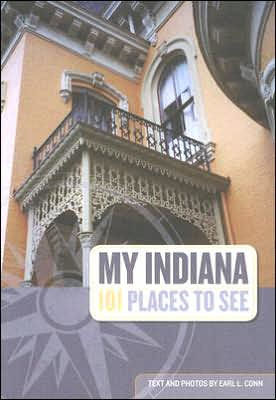
My Indiana: 101 Places to See by Earl L. Conn


Published in 2006 by the Indiana Historical Society.

The Indiana Historical Society's My Indiana: 101 Places to See is a colorful, informative guide to touring the state of Indiana. Every one of the 101 sites gets two pages, including at least two color photos (some have as many as four), a multi-paragraph, well-written description of the place and a section called "If You Go" that includes direction, phone numbers, websites, hours of operation and fees.


The choices are all solid and are spaced throughout the state. But, I could easily come up with 101 more places to go and see so hopefully the author is considering another volume. (Update: The author has created a book called My Indiana: 101 More Places to See)

Two notes of correction:

1) the entry for West Baden Springs (pp. 200-1) is out of date (thankfully). What was just an abandoned hulk of a ruined hotel (impressive even with pealing paint and no prospects for large-scale repair when this book was written) has become a 5 star resort and casino. I saw the atrium pictured on page 201 during the Christmas season and it is now a breathtaking spectacle that caused my 3 & 8 year old daughters to suck in their breaths and quietly say, "Wow!" They were inspired play princess in the castle for 20 minutes while my wife and I looked around and spoke with a very nice concierge about the building.

2) #29 is the Lincoln Museum in Fort Wayne, Indiana. What was once the largest privately held museum of Lincoln memorabilia is now closed. The entire collection is now in the hands of the Indiana State Museum in White River Park in downtown Indianapolis (see #39 for White River Park). You may ask, "Why Lincoln? Isn't he from Illinois?" Well, sort of. He grew up in Indiana. He lived in Indiana from age 7 to age 21 (see location #90 for his boyhood home).

I rate this book 5 stars out of 5

This book can be found on Amazon.com here: My Indiana: 101 Places to See.

Reviewed on February 15, 2009.

Featured Post

<b><i>BAN THIS BOOK (audiobook)</i></b> by Alan Gratz

Published in 2017 by Blackstone Audio, Inc. Read by Bahni Turpin. Duration: 5 hours, 17 minutes. Unabridged. My Synopsis Ban This Book is t...

Popular posts over the last 7 days