Icon by Frederick Forsyth


This is my first Forsyth novel and for the first 250 pages...


Originally published in 1996.

...I had determined that it would be my last.

Forsyth spends the first half of of the 500+ page Icon just setting the reader up for the real plot of the novel. Unfortunately, the setup consists of a series of disjointed flashbacks interspersed with seemingly unrelated tales of what is going on in the present of the novel (1999-2000 in the old USSR, now Russia).

Suddenly, once the flashbacks work their way up to the present time the real story starts and it is a great adventure story! The meandering story redeems itself. There is a lot of action, intrigue and a bunch of frustrated Nazis. Unfortunately, the ending is just too neat - it ends the book with everything too well resolved.

I rate this book 4 stars out of 5.

This book can be found on Amazon.com here: Icon by Frederick Forsyth.

Reviewed on October 9, 2005.

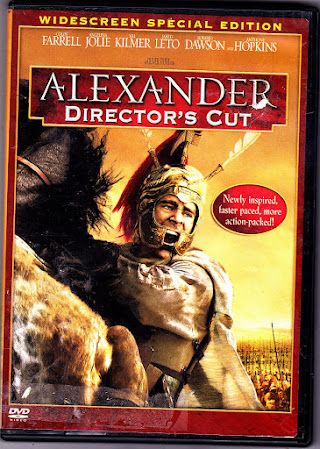
Alexander - Director's Cut DVD


YIKES!


Released in 2005.

NOTE: this is a review of the 1st re-cutting of this movie - the "director's cut." Stone has since re-cut it into a "final cut" and an "ultimate cut"

20 minutes into this movie I was thinking that it had real potential. We get to see the ugly details of Alexander's childhood. We get an understanding of his need to conquer, the need to achieve more than his father and his fascination for the non-Greek world (thanks to his mother).

An hour into the movie I was confused and disappointed. Confused because of the incessant flashbacks. I knew what was going only because I teach this stuff for a living.

How could the average movie-goer possibly understand why Alexander invaded the Persian Empire based on the feeble information supplied by Stone? Stone has an oblique reference to Phillip's murder, but the average movie-viewer does not know even know who Alexander the Great is, let alone that his father was murdered(he shows it in detail in a flashback - at the end of the movie - so the uninformed viewer will stay confused for nearly 2 more hours). A casual viewer might think that Alexander invaded Persia because he was following an eagle, since it was used so much in this battle scene (and mostly dropped for the rest of the movie).

On an historical note, I think it is disingenuous to blame the entire invasion on Alexander's need for revenge when the Greeks and the Persians had been fighting off and on again for nearly 2 centuries before Alexander's invasion finally put an end to it. Stone ignores all of that history and puts it all on Alexander (In my opinion, Stone is looking for conspiracies again -shades of 'JFK')

My disappointment stemmed from the casual skipping of most of Alexander's campaigns - from the destruction of the Persian navy to the conquering of the unconquerable Tyre to the Egyptians and their declaring him a god - all was covered in one paragraph from Ptolemy. One of the greatest military campaigns in all of history - possibly the greatest of all - dismissed like it was just so much garbage in the way of the true story.

***Note to Oliver Stone - the difference between Alexander the Great and every other mentally disturbed egomaniac with a Messiah complex, an abusive father and an over-protective mother with a snake fetish is those battles. They made him 'The Great!' Dismissing them with a wave of Ptolemy's hand over an ancient map is disrespectful to the story and to the viewer!

Stone's battle sequences are busy, noisy and confusing. Those are appropriate adjectives for any movie's battle scenes. However, they are also cold, distant and fail to convey the true genius that Alexander had as a battlefield commander. This is where it would have been useful to include those early campaigns - to show the viewer that Alexander was flexible, ruthless, personally brave and in many ways the ideal of a soldier and a general. He comes close when he shows Alexander speaking to the men before the Battle at Granicus. He alludes to a common history, but the viewer knows nothing of it and really cares very little for the people involved. Mostly, it's 10 minutes of Alexander riding his horse very fast.

Oliver Stone's re-creation of Babylon is very nice. He does a good job of showing Alexander's fascination with Asian culture and of demonstrating the tension between his desire for a united Greek-Asian empire and his men's desire to just take Asia's riches and return home to Macedon.

However, there's almost no development of the supporting cast of Macedonian characters. Alexander's male love interest has one main scene while they are in Asia and otherwise lurks in the shadows with sultry looks for Alexander. His men just become a part of the scenery so there is little emotional punch when Alexander starts to kill them off for mutiny.

The constant flashbacks were irritating. Some might think that they are sophisticated. I think they were insulting. Stone shows Phillip accusing his men of disloyalty in a flashback and then show Alexander doing the same. He shows Phillip bringing in a second wife in a flashback and then shows Alexander ignoring his wife in favor of his boyfriend. Phillip's second wife is dealt with as is the boyfriend. Phillip is assassinated as is Alexander (historically shaky...) Are we too stupid to make these connections without having them paired up for us in back-to-back scenes?!?

For those that blame the failure of this movie on Alexander's bisexuality and America's prudishness I would say that as a history teacher in America, not 1 American in 100 knows who Alexander the Great was, let alone knowing his sexual preferences. Rather, what everyone heard was that it was a long, bad movie.

Too bad that Oliver Stone took this topic that was so rich in potential for a great movie and ruined it for this generation of movie-goers. I suppose we'll have to wait for 20 more years before someone will be able to get the financing to try again and do it right.

I rate this DVD 1 star out of 5.

Reviewed on  October 8, 2005.

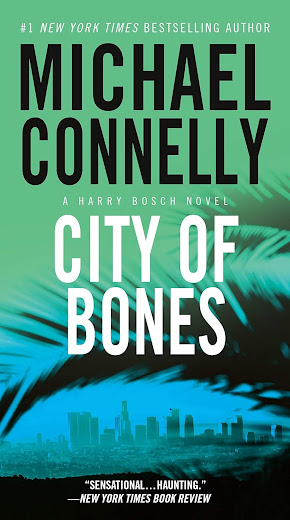
City of Bones (Harry Bosch #8) by Michael Connelly


Not the strongest of the series but very, very good


Winner of the 2003 Anthony Award.

Published in 2002 by Little, Brown. 

Michael Connelly is one of the two best living detective writers, in my opinion, the other being Robert Crais. Having noted in the title for this review that City of Bones is not the strongest in the series, I must also note that it makes this book receive a grade of merely an "A" rather than the normal "A+."

Michael Connelly
Bosch's books are gritty but not over the top. He is principled but not a boy scout. This particular Harry Bosch novel, City of Bones, deals with an old homicide uncovered in the hills surrounding Los Angeles. Bosch finds romance, has a major career shift and it has a surprise ending. No other plot details to avoid spoilers.

You can join the Bosch novels at any point but I'd recommend starting at the beginning.

I rate this book 5 stars out of 5.

This book can be found on Amazon.com here: City of Bones by Michael Connelly.


Reviewed on May 3, 2009.

The Dangerous Book of Heroes by Conn Iggulden and David Iggulden


Oh, how I wanted to be able to recommend this book!


Published in 2010 by William Morris

As a history teacher I often decry the politically and factually correct, but dreadfully dry and boring history textbooks. I was hoping that this book, The Dangerous Book of Heroes, could be a popular antidote and a return to the famous Landmark books series that I grew up reading. Mostly, The Dangerous Book of Heroes is just that - a collection of biographies - some just a few pages, some longer. They are illustrated with the same kind of line drawings that I remember from the Landmark books.

But, this book does have a danger to it, and not the tongue-in-cheek kind suggested by the title. The publisher markets this as a book for children with the phrase "here are amazing stories of heroism that parents can share with their children." 

Captain Sir Richard Francis Burton
(1821-1890)
One of the authors claims it is aimed at 14 year olds and above. That may be so, but the series is promoted for pre-teens and some of the topics discussed are just not appropriate for the great majority of elementary school students, especially in the story about "Captain Sir Richard Francis Burton."

Due to the Burton biography, I recommend the book for 14 years and older, like the author recommends. The Burton entry is full of references to drug experimentation, frequenting prostitutes, male and female brothels, spousal murder, the Kama Sutra - unnecessary references in a biography that was already so laden full of facts that it had bogged down and became an endless list, much like a bad PowerPoint presentation with an endless supply of bullet point entries.

Note, I am not squeamish when it comes to teaching kids history. When I teach world history, we discuss, among other things, facts like Alexander the Great's sexual orientation(s), how Nero kicked his wife to death, slave owners abusing their female slaves in America (and throughout time) and the slaughtering of thousands in the fall of Jerusalem and Constantinople. But, there is context in that presentation. In this book, it seems to glorify the negatives of Burton's personality - he's a hero so let's look at everything he did and celebrate all of it, the good and especially the bad.

Other issues that really are small compared to the issue of the Burton entry:

-These heroes are all part of Western Civilization, and heavily centered on Great Britain. Most of these choices are great choices, but it could use a bit of diversity.

-Multiple references to the "sneak attack" on the "small British garrisons at Lexington and Concord." The way it is worded seems to imply that the Colonial militia attacked 2 forts rather than noting that 700 British regulars secretly marched out of Boston to take the munitions depot of the Colonial militia in Concord and were turned back by militia who were informed by spies (like Paul Revere) that the British army was on the move.


-He incorrectly notes that the Indians remained Loyalist and neutral in the Revolutionary War. Loyalist is a questionable concept - they were not pro-British so much as they were in favor of the British policy of not developing the Ohio River valley. For the Igguldens to comment that Indians did not work in conjunction with the British in the George Washington entry is to disagree with their own article on Daniel Boone. For those that doubt that the British worked in concert with Indians in the Ohio River Valley, read about Henry Hamilton the "Hair Buyer" Lt. Governor of Detroit who was believed to have paid bounties for white scalps in an effort to destroy the settlements in Kentucky.

-The "Forks of the Ohio" near Louisville were actually the "Falls of the Ohio". They are no longer there due to flood control dams.

-The atomic bombing of Japan was actually done with atomic bombs, not hydrogen bombs. Hydrogen bombs are much bigger than the atomic bombs and, more importantly, hydrogen bombs were not even tested until 7 years after World War II ended.

I rate this book 2 stars out of 5 - too many factual errors, the entry about Francis Burton, and the decision to only include heroes from Western Civilization. 

Reviewed on February 26, 2011. Edited on January 25, 2025.

This book can be found on Amazon.com here: The Dangerous Book of Heroes by Conn Iggulden and David Iggulden.

Free To Choose: A Personal Statement (audiobook) by Milton and Rose Friedman


A prototype of the current crop of approachable books on economics


Originally published in 1980.
Duration:12 hours, 15 minutes

Read by James Adams
Unabridged.

Free To Choose: A Personal Statement is the manifesto on the power of capitalism and freedom (and how they go hand in hand) that was designed to be read, digested and discussed by the common man, not the economist. In fact, this is the book that was designed as a follow-up companion to a 10 part PBS mini-series that fleshed out the ideas in the series and addressed issues and further questions that came up in the making of the television program.

Milton Friedman won the Nobel Prize for economics in 1976 (he always credited his wife for helping develop his theories so I would imagine he considered it a shared prize).

The audiobook follows the lead of the mini-series and has 10 broad areas that it covers, including:

-The Power of the Market;
-The Anatomy of a Crisis (an in-depth study of the Great Depression);
-Created Equal;
-What's Wrong With Our Schools;
-Who Protects the Consumer;
-Who Protects the Worker;
-How to Stay Free

The Friedmans were very much an advocate of the free market. For example, in a topic not discussed in the book, Friedman is famous for advocating the all-volunteer army we have now. It uses incentives rather than the draft to get people to join and that seems to have worked out quite well.

Rose Friedman (1910/11-2009)
and
Milton Friedman (1912-2006)
I will comment in detail on the only topic that they discuss that I know intimately: Education. I have been a teacher for 21 years in tiny rural schools and large urban systems and now I am in a suburban system that is becoming more urban every day.

The Friedmans rightly decry the gigantic bureaucracy that sucks money right of the system, all of the way from the Secretary of Education to his 50 counterparts in the various states and all of their myriad ways of creating even more positions to look over the shoulder of school corporations, school boards, superintendents, assistant superintendents, principals, department heads and all of their office assistants. You would be amazed how many people it takes to make sure I have chalk and staples in my class. Actually, I have almost always had to buy them for myself.

So, just what do all of these non-teachers do anyway?

I take great issue with the Friedmans' assertion that bad schools create bad neighborhoods and crime rather than bad neighborhoods and crime creating bad schools.

The Friedmans also too quickly dismiss the costs of private schools and parochial schools. They claim that they are cheaper for any number of reasons than public schools. They blithely comment that they are cheaper because they have to compete and they move on.

But, are private and parochial schools really cheaper? My church has a new school. It was built at a cost of several million dollars, almost none of which is passed on to the consumer because this is looked upon as a mission for the church. We also provide absolutely no transportation in any way - not to and from school, not for field trips, not for sporting events. That is a cost borne by the parents and not typically figured into the bill (but public schools MUST provide transportation to and from school). My church's school has contracted with a caterer to provide meals, but the costs are not subsidized. Subsidized meals are part of the cost you always see when you hear how expensive public schools are. Private and parochial schools also rarely deal with severely mentally or physically handicapped students. That is an expensive part of any school and public schools are required to educate all students - even those who have little or no hope of ever learning how to write their names and require aides to help them do the simplest of tasks.


Anyway, I have done a lot of complaining about what was a pretty solid economics book. Some of it is dated, some is a little arcane and jargon-filled but most of it is presented in plain, easy to understand English. This is the grandfather of more recent and more accessible books like Naked Economics and Freakonomics, and for that it has to be respected.

I rate this audiobook 4 stars out of 5.

Reviewed on February 25, 2011.

This audiobook can be found on Amazon.com here: Free To Choose: A Personal Statement by Milton and Rose Friedman.

Aftermath (abridged audiobook) by LeVar Burton


Published in 1997
Read by LeVar Burton
Approximately 3 hours
Abridged.


Have you ever read a book in which the author takes a premise that would, at most, fill about 150 pages and yet he or she stretches it out to 400 pages? This is not one of those books.

Aftermath has the opposite problem - an awful future is described and peopled. The cure for cancer and brain disorders is discovered, stolen and recovered with lots of gunfights, chases, psionic warfare, attempted child rapes, attempted suicides, kidnappings galore, slavery and people being skinned alive. However, none of it is fleshed out - we are left with the skeleton of an epic story - a framework of what could have been. Think Stephen King's The Stand told in less than 300 pages. I just wish he'd added more.

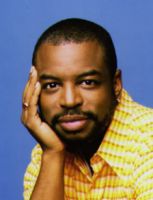
LeVar Burton
I am reviewing this as an abridged audiobook (no doubt the abridgment is part of the problem as well. Too often, too much is taken out). LeVar Burton, well-known television actor, read it, as would be expected - he has a fine voice and lots of experience due to his well known PBS show Reading Rainbow and, of course, Star Trek: The Next Generation

Sometimes, however, his tone of voice just isn't quite right. He uses the same tone and quality of voice that he uses when discussing a children's book of Reading Rainbow (earnest and happy) when reading about the plight of hundreds of African Americans who have been kidnapped, chained and drugged and are waiting to have their skins forcibly removed. It was more than a little too much dissonance.

So, in short, the relatively low score is a reflection of Burton's failure to follow through with the potential of the book.

I rate this audiobook 3 stars out of  5, mostly based on the strong premise rather than the anemic follow through. 

This audiobook can be found on Amazon.com here: Aftermath by LeVar Burton.

Reviewed September 30, 2005

Alternate Gettysburgs by various authors


Published in 2002 by Berkley

It's a collection, and like all collections Alternate Gettysburgs suffers from the fact that it was written by a dozen different authors. Some are very good, most are decent. Two are awful.

The gimmick in this alternative history is, of course, 'What if the Battle of Gettysburg had turned out differently?' It is inspired by this Faulkner quote:

Confederate Major General
George Pickett (1825-1875)
'For every Southern boy fourteen years old, not once but whenever he wants it, there is the instant when it's still not yet two o'clock on that July afternoon in 1863, the brigades are in position behind the rail fence, the guns are laid and ready in the woods and the furled flags are already loosened to break out and Pickett himself with his long oiled ringlets and his hat in one hand probably and his sword in the other looking up the hill waiting for Longstreet to give the word and it's all in the balance, it hasn't happened yet, it hasn't even begun yet, it not only hasn't begun yet but there is still time for it not to begin against that position and those circumstances which made more men than Garnett and Kemper and Armistead and Wilcox look grave yet it's going to begin, we all know that, we have come too far with too much at stake and that moment doesn't need even a fourteen-year-old boy to think This time. Maybe this time with all this much to lose and all this much to gain: Pennsylvania, Maryland, the world, the golden dome of Washington itself to crown with desperate and unbelievable victory the desperate gamble...'

Is it worth reading? If you're a Civil War buff and don't mind 'slumming' by reading an alternative history rather than a normal history book - yes it is worth your time. Personally, I don't think of it is as slumming - I think of it as nice little foray into what-may-have-been. However, alternative histories are often looked down on by more than a few serious readers of history.

I would recommend if you are not very familiar with the facts of the Civil War and general and the Battle of Gettysburg in particular that you read the Appendix (the last section) first - included are the 'Gettysburg Address', three good short histories of the war and the battle and one interesting essay (controversial, but also my favorite) that tells you why the Confederacy never could have won anyway, no matter the outcome of the battle.

I rate this collection 4 stars out of 5.

This book can be found on Amazon.com here: Alternate Gettysburgs.


Reviewed September 19, 2005.

Featured Post

<b><i>BAN THIS BOOK (audiobook)</i></b> by Alan Gratz

Published in 2017 by Blackstone Audio, Inc. Read by Bahni Turpin. Duration: 5 hours, 17 minutes. Unabridged. My Synopsis Ban This Book is t...

Popular posts over the last 7 days