Aftermath (abridged audiobook) by LeVar Burton


Published in 1997
Read by LeVar Burton
Approximately 3 hours
Abridged.


Have you ever read a book in which the author takes a premise that would, at most, fill about 150 pages and yet he or she stretches it out to 400 pages? This is not one of those books.

Aftermath has the opposite problem - an awful future is described and peopled. The cure for cancer and brain disorders is discovered, stolen and recovered with lots of gunfights, chases, psionic warfare, attempted child rapes, attempted suicides, kidnappings galore, slavery and people being skinned alive. However, none of it is fleshed out - we are left with the skeleton of an epic story - a framework of what could have been. Think Stephen King's The Stand told in less than 300 pages. I just wish he'd added more.
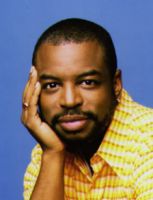
LeVar Burton
I am reviewing this as an abridged audiobook (no doubt the abridgment is part of the problem as well. Too often, too much is taken out). LeVar Burton, well-known television actor, read it, as would be expected - he has a fine voice and lots of experience due to his well known PBS show Reading Rainbow and, of course, Star Trek: The Next Generation

Sometimes, however, his tone of voice just isn't quite right. He uses the same tone and quality of voice that he uses when discussing a children's book of Reading Rainbow (earnest and happy) when reading about the plight of hundreds of African Americans who have been kidnapped, chained and drugged and are waiting to have their skins forcibly removed. It was more than a little too much dissonance.

So, in short, the relatively low score is a reflection of Burton's failure to follow through with the potential of the book.

I rate this audiobook 3 stars out of  5, mostly based on the strong premise rather than the anemic follow through. 

This audiobook can be found on Amazon.com here: Aftermath by LeVar Burton.

Reviewed September 30, 2005

Alternate Gettysburgs by various authors


Published in 2002 by Berkley

It's a collection, and like all collections Alternate Gettysburgs suffers from the fact that it was written by a dozen different authors. Some are very good, most are decent. Two are awful.

The gimmick in this alternative history is, of course, 'What if the Battle of Gettysburg had turned out differently?' It is inspired by this Faulkner quote:

Confederate Major General
George Pickett (1825-1875)
'For every Southern boy fourteen years old, not once but whenever he wants it, there is the instant when it's still not yet two o'clock on that July afternoon in 1863, the brigades are in position behind the rail fence, the guns are laid and ready in the woods and the furled flags are already loosened to break out and Pickett himself with his long oiled ringlets and his hat in one hand probably and his sword in the other looking up the hill waiting for Longstreet to give the word and it's all in the balance, it hasn't happened yet, it hasn't even begun yet, it not only hasn't begun yet but there is still time for it not to begin against that position and those circumstances which made more men than Garnett and Kemper and Armistead and Wilcox look grave yet it's going to begin, we all know that, we have come too far with too much at stake and that moment doesn't need even a fourteen-year-old boy to think This time. Maybe this time with all this much to lose and all this much to gain: Pennsylvania, Maryland, the world, the golden dome of Washington itself to crown with desperate and unbelievable victory the desperate gamble...'

Is it worth reading? If you're a Civil War buff and don't mind 'slumming' by reading an alternative history rather than a normal history book - yes it is worth your time. Personally, I don't think of it is as slumming - I think of it as nice little foray into what-may-have-been. However, alternative histories are often looked down on by more than a few serious readers of history.

I would recommend if you are not very familiar with the facts of the Civil War and general and the Battle of Gettysburg in particular that you read the Appendix (the last section) first - included are the 'Gettysburg Address', three good short histories of the war and the battle and one interesting essay (controversial, but also my favorite) that tells you why the Confederacy never could have won anyway, no matter the outcome of the battle.

I rate this collection 4 stars out of 5.

This book can be found on Amazon.com here: Alternate Gettysburgs.


Reviewed September 19, 2005.

Ring of Truth by Nancy Pickard


This Edgar Award nominee does it again!


Originally published in 2002.

I've regularly read Nancy Pickard's 'Jenny Cain' series and have been heartened by the growth I've seen in her work. Pickard's detective stories have slowly been growing in power and complexity. This novel, however, may very well mark Pickard's arrival as a true master of the detective story.

I admit that I have not read another of this series, but I was struck by the simple cleverness of Ring of Truth. The writer of a 'true crime' novel becomes unnerved by doubts concerning the outcome of the trials and criminals that she has recently written about. Her own private investigation, interspersed with chapters from her recently completed 'true crime' book that fill the reader in on the backstory, causes a great deal of distress and irritation among both the police and the real criminals.

Very well done. Very clever. I'll be looking for more in the series.

I rate this book 5 stars out of 5 and it can be found on Amazon.com here: Ring of Truth by Nancy Pickard.

Reviewed on September 12, 2005.

An Essay on the American Contribution and the Democratic Idea (kindle edition) by Winston Churchill


An interesting piece of history


Note: this is not written by "THE" Winston Churchill. This one was written by an American novelist and essayist with almost the same name who lived from 1871-1947. Sir Winston Churchill signed his works Winston S. Churchill in order to differentiate between the two.

The essay is inspired by a 1917 visit to the battlefields of Europe during World War I.

Churchill's essay is an interesting bit of history in that it appeals to old ideals of the old Progressives of the late 19th and early 20th centuries. There are many comments that hold to all of the hallmarks and ideals of the movement, including an obsessive faith in science and psychology (line 200) and a belief that human nature is basically good but just needs to be re-educated (line 228).

He advocates a new political party based on the teachings of modern social science (line 290), a centralized economy in order to be more efficient (line 360) and he proposes that "incomes are to be taxed above the necessary cost of family maintenance (line 367) and the "progressive elimination of the private capitalist" (line 368).
Winston Churchill (1871-1947)


Interestingly, he argues that the solution to all of society's ills comes from centralized economic power in the form of a democratically elected central government that will be led by people who have been properly educated with our newly-discovered scientifically-based methods that will get rid of the dangers of greedy human nature. (lines 395 and 462)

I rate this essay 4 stars out of 5. It can be found on Amazon.com here: An Essay on the American Contribution and the Democratic Idea.

I rate this essay 4 stars out of 5.

The Human Blend: The Tipping Point Trilogy, Book One (audiobook) by Alan Dean Foster


Lackluster characters hurt a very interesting premise


Read by David Colacci
Published by Tantor Media, November 2010.
Duration: 9 hours, 56 minutes,
Unabridged.

Ultra-prolific author Alan Dean Foster introduces yet another series with The Human Blend, the first installment of a trilogy set in a relatively near-future Savannah, Georgia.

In this interesting new world the direst predictions about global warming have come true. America’s southern states have become near-tropical. Flooding ocean waters have buried coastal cities, forced them to move onto stilts or have caused cities to move inland. Much of Florida is underwater, the Everglades have swallowed the rest.

Political changes have swept the world as well. The United States is now part of a larger country called Namerica. Several countries in Asia are equal to, if not more important than Namerica. The moon, Mars and Jupiter’s moon Titan have been colonized as well.

Alan Dean Foster
But, the most important changes are the changes to the individual. In this future world, plastic surgery has become relatively cheap, easy and almost entirely safe. Called “melding”, new technologies have allowed millions upon millions of clients to “gengineer” themselves in an amazing number of ways. They can add animal tissue and literally grow feathers, gills, become amphibians, or fly. Clients can become exact duplicates of movie stars, athletes or anything else they can dream up. Do you want extra arms, eyes in the back of your head, or robotic hands with interchangeable parts? No problem. Want something a little more dangerous? Back alley gengineering clinics offer more dangerous options such as hidden weapons.

Alan Dean Foster introduces us to this strange new world through a meld named Whispr – a street thug who has had radical gengineering to make him hyperthin. Whispr and his accomplice Jiminy are working the streets of Savannah with a weapon that turns off pacemakers so that they may loot the dead bodies of their victims. They have just removed an exquisite hand from the body of their latest victim in hopes of selling it to a back alley clinic when they find an electronic storage device, a futuristic flash drive that is made of an unknown metal but is literally as thin and as flexible as a thread.

As Whispr and his various companions travel through the underworld trying to identify this thread and perhaps even download the information on it, they become the targets of police, hitmen and the bodies start to pile up in a hurry.

David Colacci, narrator
The narrator, David Colacci, does a fantastic job of creating a number of distinct character voices and accents ranging from Asian to Creole to Eastern European to southern redneck to South American Spanish. However, even the considerable talents of Colacci could not save the book from an inexplicable attack of wordiness for wordiness’ sake. Alan Dean Foster demonstrates in the book that he can be a master of the language with truly brilliant riffs of alliteration, simile and witty bits of conversation that make the listener smile at his cleverness. But, like a drum solo at a rock concert, a little bit of this goes a long way. Keep it up too long and the fans step out and look for popcorn. I found my attention wandering as a character named Wizzwang let loose with one cutesie, sex-crazed, pseudointellectual verbal barrage after another in the last hour or so of this audiobook. It seemed like Foster was trying to stretch the story out rather than cover new territory.

Another problem with the book is that there is really no one to root for. Whispr is not really likable – he kills people just to loot their bodies. His friends are no better. They are not lovable rogues, like Johnny Depp’s Captain Jack Sparrow. Rather, they are just criminals with bland but talkative personalities. There is the mystery of the threat data storage device, but this is not enough to compel the reader to carry on.

Fortunately, I found the world created by Alan Dean Foster to be quite interesting and I especially enjoyed the descriptions of the food dispensers, the new climates created by global warming and the effects of gengineering on society. As this installment ends, Whispr and his accomplice (a beautiful “natural” doctor who specializes in creating high-quality melds) are heading off to Africa to try to discover more about this “thread” and discover why everyone wants it so badly. I find myself wondering what new things I will learn about this distinctive vision of the future in the next installment.

I rate this book 4 stars out of 5.

This book can be found on Amazon.com here: The Human Blend.

Reviewed January 22, 2011.

First Blood by David Morrell


Decent, but not Morrell's best work


Originally published in 1972.

The copy I have of First Blood includes an interesting forward by the author in which he discusses the Rambo phenomenon that swept the world after the Stallone movies were made. That forward was written several years ago and the Rambo legacy continues today. Just last night I saw a commercial for a Nicholas Cage movie that mentions Rambo twice.

Anyway, this is Morrell's first novel and it is not bad. Morrell tries to work in several serious themes and tries to make it a piece of really violent literature rather than settle for just a bit of escapism. In fact, this novel was used for several college and high school classes as a novel to discuss until the Rambo movie phenomenon overwhelmed the books.

Even though this was regarded highly enough by some instructors to be used in the classroom, I think that it missed the mark a bit too much - the rivalry between Rambo and the sheriff was a bit too contrived and the Special Forces officer sent to help with Rambo never really worked well for me. He was too aloof, too uncommitted to his soldier (Rambo) or to the people he was sent to protect.
David Morrell


As an action thriller this book seemed overblown - it reminded me, ironically, of the Rambo II movie (Morrell discounts Rambo II and Rambo III because he had little say in the screenplays. He wrote the novelizations in an attempt to salvage a bit of the flavor of his original character) - too over the top. Just too much.

I rarely say this, but now I have said it in two of my last three reviews - the movie is better than the book. The motivations of the Rambo character are more defined (even though the sheriff and deputies are reduced to stereotypes of redneck country cops) and, ironically, the action in the blockbuster Hollywood action flick is more believable than in the book.

I rate this book 3 stars out of 5.

This book can be found on Amazon.com here: First Blood

The Princess Bride: S. Morgenstern's Classic Tale of True Love and High Adventure by William Goldman


Great book, great movie, great story no matter the format!

Originally published in 1973.

The author, 
William Goldman
I wasn't even aware that The Princess Bride: S. Morgenstern's Classic Tale of True Love and High Adventure was even a book until I was looking through the special features on my DVD and they were speaking of the difficulties they had bringing the book to the big screen. Once I found out about the book I just had to get it!

So, is it better than the movie?

While I certainly enjoyed the background information on Fezzik and Inigo, this is one of the first books that I can honestly say is better as a movie. Notice, that I have given this book 5 stars, so we are distinguishing between very good and very, very good here. Still, the movie is a further abridgment of S. Morgenstern's classic tale (wink, wink) that makes the story even stronger.


My edition had a wonderful new introduction the recounted some of the struggles and joys in making the movie and includes the first chapter of the long-lost 'sequel' entitled 'Buttercup's Baby.' Both are worth your time.

I rate this book 5 stars out of 5.

This book can be found on Amazon.com here: The Princess Bride: S. Morgenstern's Classic Tale of True Love and High Adventure by William Goldman.

Featured Post

<b><i>BAN THIS BOOK (audiobook)</i></b> by Alan Gratz

Published in 2017 by Blackstone Audio, Inc. Read by Bahni Turpin. Duration: 5 hours, 17 minutes. Unabridged. My Synopsis Ban This Book is t...

Popular posts over the last 7 days