1601 Conversation as it was by the Social Fireside in the Time of the Tudors (kindle) by Mark Twain


The commentary is actually more interesting than the story


Originally published anonymously in 1880.

Literary critic Edward Wagenknecht called 1601 "the most famous piece of pornography in American literature."


Just to be clear, it's not really pornography, at least not by modern standards. Rather, it's a short story featuring Queen Elizabeth I, Ben Jonson, Beaumont, Shakespeare, the Duchess of Bilgewater, Sir Walter Raleigh, and a few other people all in a closet talking about passing gas and sex.

Sound strange?

Well, it is. And - it's only so-so funny.

Mark Twain (1835-1910)
3/4 of my edition was a fairly interesting commentary on the history of the story and about the characters. We learn that Twain wrote this as a diversion after the publication of Tom Sawyer (while he was working on Huckleberry Finn) during a time of writer's block. Twain showed it to some friends who published a few copies and then it snowballed. Twain's 1601 went "viral" before there was an internet, apparently.


I rate this kindle short story 3 stars out of 5. It can be found on Amazon.com here: 1601 Conversation as it was by the Social Fireside in the Time of the Tudors.

Reviewed on May 20, 2009.

The House of the Scorpion (audiobook) by Nancy Farmer


Recommended for middle schoolers through adults 

 
National Book Award, Young People's Literature, 2002.

Published in 2002.

Limiting The House of the Scorpion to a young adult audience is a disservice to the book and to the themes it brings up. This would be a fantastic book for an adult discussion group - there are so many themes and controversial topics that a group could discuss for hours and hours.


That being said, I nearly quit listening to this audiobook after the first hour. It was sooooo slow to get started. On top of that, it was often dark and opressive. However, after the character Tam Lin comes in to the story the whole book changes and you would have had to fight me to get me to give the book up. By the time the end came around I felt like I had lived a life with Mateo and was thoroughly satisfied.

So, what kind of themes are there? Well, this book, in my opinion, points out the dangers that many of the more Conservative thinkers warn us about with our current policies towards bio-technology and, to a lesser extent, immigration.

Nancy Farmer
The future, as portrayed in The House of the Scorpion is often a dark place with clones created solely to provide body parts for their originals and "eejits" - people with computer chips inserted into their brains to make them completely docile and the perfect slaves who will literally do the task they're assigned to do until they are told to stop (or die). The United States is no longer the world's only superpower and there is a new country between Mexico (now called Aztlan) and the USA. It is called "Opium". Opium serves as a buffer between Aztlan and the U.S. that is run by a cartel of drug lords with drug plantations worked by eejits, most of whom are illegal aliens from the U.S. or Mexico who were captured and enslaved (the parallels with the American underground labor force comprised of illegal immigrants can be easily made).


Aztlan has become a country obsessed by economic success and the duty to the larger society as a whole. The goal there seems to be the bee hive - all workers know their place and sacrifice for the good of the society. The mantra is the "5 principles of Good Citizenship" and the "4 Attitudes Leading to Right-Mindfulness." The success of the state is paramount over the interests of any individual.

Grand themes run throughout the book such as:

-What does it mean to be human?

-Who is accorded human rights?

-What are the limits of cloning? Do we clone people just to use them for parts? Do we clone fetuses just to use their parts (as happens in the book)?

-The rights of the individual vs. the demands of the state? Where are the boundaries or should there be any? Is the individual entirely free? Can the state demand everything of the individual? Is there a difference between an eejit and an Aztlanian worker bee?

The audiobook lasts 12.5 hours and is read brilliantly by Robert Ramirez (NOTE: There are other audiobook versions out there with different readers). I'm glad I stuck through the initial slow parts - I was thoroughly rewarded.

I rate this book 5 stars out of 5.

This audiobook can be found on Amazon.com here: The House of the Scorpion

Reviewed May 21, 2009.

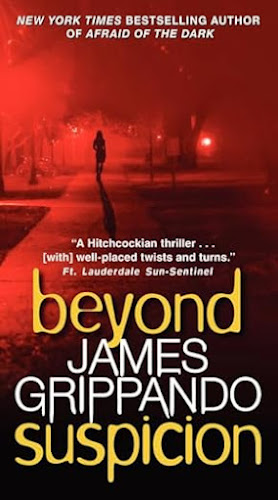
Beyond Suspicion (Jack Swyteck #2) by James Grippando


Published in 2002.

Beyond Suspicion is a quick-moving book and is a sequel to Grippando's first published novel 'The Pardon'. I read 'The Pardon' many years ago, but reading the first book is not a necessary requirement - Grippando sets the stage very well in this book so it can be a 'stand alone' novel.

I shot through this book very quickly - the plot drags you in pretty well and Grippando's writing style keeps the book moving along at a quick pace. The main character is fairly average and his world is suddenly turned upside down by one case and its connections to the underworld. Murder, mayhem and one family crisis after another keep it interesting. Grippando fills this novel with a multitude on interesting characters, any one of which would be strong enough to be the main character in a book.

A good solid read - a great summertime novel.

This book can be found on Amazon.com here: Beyond Suspicion.

I rate this book 4 stars out of 5.

Reviewed on July 25, 2005.

The Man Who Met the Train: A Carl Wilcox Mystery by Harold Adams


So, what is a 'rawboned' mystery?


Published in 1988 by Mysterious Press.

My copy of  The Man Who Met the Train had a snippet from a review from the Chicago Sun-Times in which they said it was a 'rawboned' mystery. I was intrigued by that characterization and can now report to you what that means.

It means that this mystery is sparsely written - no extravagant detail and most conversations aren't even fully fleshed out. It's a quick and dirty read about some quick and dirty crimes set in two small towns in Depression-era South Dakota. In style and setting it reminded me of a western. The hero, Carl Wilcox, comes upon a wrecked car. Inside are four dead adults and one survivor - a little girl.

Wilcox is eventually hired on by local bigwigs to investigate the circumstances of the crime, seeing as how he has previous experience as a police officer. Wilcox starts to pull at the loose threads of this crime and starts to discover that some very prominent local names are being implicated in these murders and other crimes.
Harold Adams

The most interesting aspect of the story is the budding personal life of Wilcox. One of the local ladies enjoys serious flirtation with him and the little girl he saved from the wreck who trusts no one but him. It is enjoyable to follow along with Wilcox's discomfort and awkwardness in dealing with this traumatized little girl. He has obviously been a loner for a while and suddenly he is looking at the prospect of a family and dealing with having to sing little kid sings in the car and telling stories before bed time.

This is a solid little read. Now I'll be on the lookout for other books labeled 'rawboned'.

I rate this book 4 stars out of 5.

This book can be found on Amazon.com here: Man Who Met the Train: A Carl Wilcox Mystery

Reviewed on July 21, 2005.

The Jury by Steve Martini


A great legal thriller

Published in 2001.

The oddly titled The Jury (it's not about the jury at all - they are barely mentioned) is a sharp, tight legal thriller that hums right along until the neat little twist at the end.

Paul Madriani and his law partner Harry Hinds have are defending a murder suspect, a genetic researcher named David Crone. The book joins the trial already in progress. Madriani and Hinds have one big problem, though. The unflappable Crone keeps so many secrets - trade secrets, research secrets and vital information that he just didn't think was important enough to mention to his attorneys that they don't really know where they stand in any of this.

Throw in a family friend with a genetic disorder that may be cured by Crone's research, you get a solid mixture of urgency, ambiguity and frustration that kept me glued until the end.

I rate this book 4 stars out of 5.

This book is found on Amazon.com here: The Jury by Steve Martini.

Reviewed on February 8, 2011.

A Place Called Freedom by Ken Follett


An informative historical adventure

Originally published in 1995.

Follett's A Place Called Freedom was one of the most requested books when I worked at a now-defunct used book store many many years ago. I finally got around to reading it and I can see why it was in such demand.

Follett introduces the reader to the turbulent politics on 1760s England, Scotland and America. He throws in a liberal dose of romance and the reader will be reminded of the Tom Cruise / Nicole Kidman epic movie Far and Away. There are plenty of similarities - both feature poor, rural heroes who fall in love with the landlord's spunky daughter. Nevertheless, it's a great read and unique enough to stand up in its own right.

I recommend it to anyone who is interested in a view of England's politics and turmoil on the eve of the American Revolution - it puts America's arguments for revolution in a clearer context - it even strengthens them. On top of that, the book is a great read.

I rate this book 5 stars out of 5.

This book can be found on Amazon.com here: A Place Called Freedom


Reviewed on July 16, 2005.

I Heard the Owl Call My Name by Margaret Craven


A wonderful book - it creates a world for the reader and at the end you are sad to leave it.

Originally published in 1967.

For me, when I read an absolutely excellent novel, I have a hard time getting into another one - you end up rejecting the new one because it's not as good as the last one. This is one of those novels for me. So, I guess I'll be cleansing the reading palate with a few magazines.

I first read I Heard the Owl Call My Name when I was 14 or 15 years old. I haven't thought about it for years until I came across it at a book sale and picked it up on a whim. I approached re-reading it with some trepidation - I was afraid that it would not be as good as I remembered and I would be disappointed.

Well, it wasn't as good as I remembered - it's much better! Age and experience make you appreciate some things more, I suppose.

I shot through I Heard the Owl Call My Name in less than 24 hours - a new record for this slow and steady reader. Granted, it's a short novel (my copy was 159 pages), but it pulls you in an you want to learn more about this native American village and the young vicar sent to minister to them. I teach high school and I have a small library of books in my classroom. From time to time, I am asked by students to recommend a book and this one will shoot up to the top of my list with Of Mice and Men.

I rate this book 5 stars out of 5.

This book can be found on Amazon.com here: I Heard the Owl Call My Name.

Reviewed on June 30, 2005.

Featured Post

<b><i>BAN THIS BOOK (audiobook)</i></b> by Alan Gratz

Published in 2017 by Blackstone Audio, Inc. Read by Bahni Turpin. Duration: 5 hours, 17 minutes. Unabridged. My Synopsis Ban This Book is t...

Popular posts over the last 7 days