Darwin's Plantation: Evolution's Racist Roots by Ken Ham and A. Charles Ware


Published in 2007.

Ken Ham is a lightning rod of a figure for outspoken atheists, especially for those who use evolutionary biology as the basis for their beliefs about religion. The internet is full of attacks and counterattacks on this topic. Ken Ham gets a lot of attention from people who have really not read his work. Whether you disagree with a person or not, it makes no difference to me, but at least be somewhat familiar with the person's work before you attack it.

Darwin's Plantation: Evolution's Racist Roots, in particular, has attracted some attention, mostly because of its provocative title. So, let me start this review with a general rundown about Ham's theses.

Ken Ham's point in the book is this (made in this quote by a quite famous evolutionary scientist):

"Biological arguments for racism may have been common before 1859, but they increased by orders of magnitude following the acceptance of evolutionary theory." - Stephen Jay Gould (Ontogeny and Phylogeny - 1977)(p. 15)

That's what Ham is saying.

At no point does he remotely excuse the "Christian" excuses for racism that were common in the 18th and 19th centuries.

At no point does he claim that Darwin invented racism.

Ken Ham
Ham correctly notes that scientists used any number of ways to measure human racial groupings and rank them (head size, brain weight, etc.) in the late 19th and early 20th centuries. Hitler used those biological arguments to justify his genocides against the Jews, gypsies and everyone else he hated.

In my master's in education program that I completed two summers ago I saw similar research done to explain low achievement rates by African-Americans in school. It was not being promoted by the school, but I found it doing research for a paper. Seriously. I think it's junk -  but this garbage is still out there.

Even the co-discoverer of DNA, Dr. James Watson weighs in with a bit of old-fashioned scientific racism: "There is no firm reason to anticipate that the intellectual capacities of peoples geographically separated in their evolution should prove to have evolved identically. Our wanting to reserve equal powers of reason as some universal heritage of humanity will not be enough to make it so." (October 2007) (p. 55) Search it - I typed in his name and got lots of articles about it.

Science-based racism does exist because of this old line: "Figures don't lie but liars figure." Science generates lots of facts and figures and they can be twisted to say just about anything.

Does that mean all scientists are racists? Certainly not! Ham never claims it.

So, why only the three stars?

Ken Ham and his co-author A. Charles Ware wrote the book in turns - each wrote different chapters. I give the part that Ham wrote 4 stars. It was interesting and I found it to be quite well-written - a lively style with numerous quotes.

Dr. A. Charles Ware
The part written by Ware was tedious to me. Ware is the president of Crossroads Bible College in Indianapolis and his focus was on mitigating the effects of racism in society. He wants the church to recognize and acknowledge racist attitudes that were commonly taught from the pulpit in the past and move beyond them with the grace of God in a spirit of forgiveness.

It was an important topic but full of cutesy lines like needing to move beyond " 'race' relations to the unity of grace relations". (p. 136) He also has lots of lists and constructions like D.R.E.A.M.S. to help you remember how to build a multicultural church. I found myself in the odd situation of absolutely of agreeing with an author wholeheartedly but the text was ... rather bland. Great information but delivered in a way that did not work for me. I give Dr. Ware's section 2 stars, which makes an average of 3 stars.

This book can be found on Amazon.com here: Darwin's Plantation: Evolution's Racist Roots.

Reviewed June 20, 2009.

Unbroken: A World War II Story of Survival. Resilience, and Redemption by Laura Hillenbrand


Believe the hype - this is a fantastic book!

Originally published in 2010.

Sometimes books, movies, or restaurants get a lot of hype and buzz but really are not what they are cracked up to be.  Unbroken is everywhere nowadays - bookstores, my local grocery store is selling it. I just saw online that there is a movie deal. 

Is it the real deal?


Laura Hillenbrand
Yes, Unbroken is an amazing biography, and it is most definitely the real deal. I plowed right through 450 pages of text in near-record time, devouring chunks of a story that continued to take new twists and turns and lead me to follow Louis Zamperini from the heights of athletic glory in the 1936 Berlin Olympics to the literal pits of despair in a digging out prison camp latrine with his bare hands in order to earn enough grains of rice to barely fuel his ravaged, starved body.

Louis Zamperini grew up as a juvenile delinquent in Torrance, California - a restless kid who, at the urging of his big brother, finally channeled his impressive running skills into something more acceptable than running away from the law. Louis used those skills to earn a spot on the 1936 U.S. Olympic team. He competed well, but expected to do better at the 1940 and 1944 games, which of course were later cancelled due to World War II.

 
Louis Zamperin looking through a
hole blasted through his B-24
on a mission.
Instead of running in the Olympics, Louis found himself training to be a bombardier on a B-24 and heading off to fight in the Pacific Theater.  On a search and rescue mission in 1943, his plane went down and only Louis and two crewmates survived. After floating at sea for 47 days (and losing a raftmate), Louis and his pilot Russell Phillips were picked up by Japanese soldiers and eventually transferred through a series of POW camps, each new one more horrific than the last until the end of the war, including one horrible guard nicknamed The Bird.

Hillenbrand 's descriptions of the terrible torture of floating at sea, the humiliations he suffered in the POW camps, the incredible kindness showed by a precious few guards are exquisite. Her descriptions of his post-traumatic stress disorder and his difficulties in adjusting to civilian life after the war are painful but it is a joy to see him turn his life around, discard the justifiable and understandable anger and move on to make his life count in the best ways he knows how.

This is a fantastic book. I rate it 5 stars out of 5. It can be found on Amazon.com here: Unbroken: A World War II Story of Survival. Resilience, and Redemption by Laura Hillenbrand.

Reviewed February 1, 2011.

The Darkest Evening of the Year by Dean Koontz


Not very complicated plot, lots of info about rescue dogs

Published in 2007.

I have not read a Koontz book for over five years, but a relative passed The Darkest Evening of the Year off to me in an informal family book exchange and it didn't sit in my to-be-read pile for very long

What did I think?

Having just added a rescue dog to our family the week I started reading this book I had some interest in one of the overarching theme of the book: the tragedy of wasting the lives that fills our world, especially those of our pets.

Koontz hits his other basic themes such as good vs. evil and the good cannot flee evil - they must confront it.

But, was it a good book?

Yes and no.

I read it quickly - Koontz's writing style remains breezy and easy to digest. But, the evil sociopaths were so over the top that I felt that they weren't even interesting. Their prisoner is so saintly that she is equally over the top.


Dean Koontz
The extended lecture on the need for adopting dogs gets old after a bit. Maybe it's a preaching to the choir thing, but I was already converted to this concept before I picked up the book.

The most interesting character by far is a post-modern hitman who names himself after a series of postmodern characters and writers (Billy Pilgrim, Tyrone Slothrop and others).

So, in sum, same old themes, one really interesting character and a lot of info on dog adoptions.

I rate this book 3 stars out of 5. It can be found on Amazon.com here: The Darkest Evening of the Year

Reviewed June 29, 2009.

Joker One: A Marine Platoon's Story of Courage, Leadership and Brotherhood by Donovan Campbell


An enthusiastic 5 stars! A fantastic book.

Published in 2009.

I was offered Joker One as part of the Amazon Vine program and I decided to take it because I am a history teacher and I decided I needed to read a book about the Iraq War just to have a greater sense of what was/is going on and to be able to speak more intelligently about it to my classes.

So, I picked Joker One and I let it sit on my pile of books. I let it sit and sit because I was afraid it would be preachy, depressing and difficult.

Finally, with classes over I picked up Joker One and I was hooked by page 2 with Lt. Campbell's description of an explosion that he had just avoided. It was filled with honest emotions, including a bit of honest, self-deprecating humor.

I shot through Joker One. I carried it everywhere I went. I read passages to my long-suffering wife. I told her shortened versions of the stories. Literally, I laughed (his account of their first night mission and the pack of dogs is hilarious!) and I teared up multiple times, especially at poignant moments like after their first serious day of all out fighting when Campbell is asked, "...do you think we fought well today, sir? I mean, that was our first big fight. Would the Marines who fought at Iwo Jima and Okinawa, you know, be proud of us?" (p. 178)

Donovan Campbell
I guess I identified with Campbell - a married college graduate who is likely to think too much, feel too much and questions himself. Campbell is a Christian and his faith is lightly woven into the text throughout.


Campbell offers no answers to what is going on in Iraq. He barely mentions Bush administration policy, except for his stated dislike of the Coalition Authority government. His concerns are the survival of his men, not winning the war by re-writing policies and strategies.

His descriptions of battles are gritty and can be bewildering - not due to poor writing but rather due to an accurate portrayal of the fighting as he lived it.

The book was mostly created as part of a veteran's writing project class at the Harvard Business School. To me the book has the feel of being crafted - being re-written many times and being thoroughly discussed. I think the writing pulls out the best out of Campbell's story. For example, his story of his battle-hardened Sargeants watching the DVD of The Notebook in the NCO room with tears streaming down their faces is priceless.

The day of reckoning is April 6. "Golf Company knew that something was wrong, because for the first time since our arrival we knew exactly what each mosque was saying during its call to prayer. From every minaret in the city, the same word rang out, over and over, in short, chanted blocks:  JIHAD, JIHAD, JIHAD...JIHAD, JIHAD, JIHAD...JIHAD, JIHAD, JIHAD...Every single muezzin in Ramadi was calling for a holy war against the Marines." (p. 156) Campbell effectively expresses how completely alone this little cluster of Marines were. I got chills up my spine as I read and re-read these pages.

Pages 299-302 are as beautiful a description about the nature of love - sacrificing love - as I have ever read. Those pages are an extended play on the faith, hope and love verse in the Bible (1 Corinthians 13:13) and are brilliantly written - masculine, yet tear-evoking. Good stuff. Makes you proud of those men and grateful that Campbell can bring their story to us.

The best book I read in 2009.

Highly recommended.


I rate this book 5 stars out of 5.

This book can be found on Amazon.com here: Joker One.

Reviewed June 30, 2009.

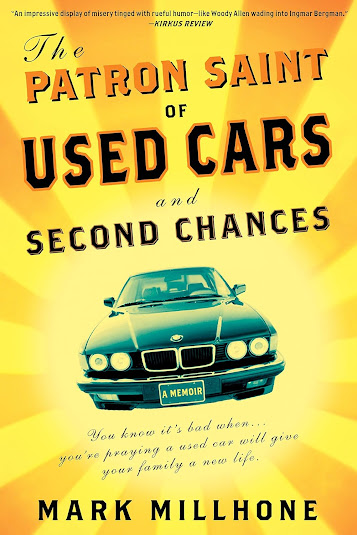
The Patron Saint of Used Cars And Second Chances: A Memoir by Mark Milhone


Fun story, but not completely resolved


Published in 2008 by Rodale Books.

Mark Milhone's memoir is about his self-described "Year from Hell," which included marriage troubles, a reconciliation with his dad and a road trip to pick up a used BMW he purchased on E-Bay (who does that?) is a fun, sad read.

Millhone tells his story about the death of his mother, the death of his first dog, the near-death of his newborn son, the dog bite his oldest son suffers and the deterioration of his marriage.

So, does he resolve these issues?

Not really.

He tells his story in an entertaining manner. His relationship with his father is strengthened (as a kid, his father sent his number one man from the office to take him to see The Empire Strikes Back because he has no time for his family) but the other issues are not fixed, there is just a renewed resolve to work on them.

Nonetheless, it's still a fun read - good for a summer trip. Lots of parts to read and discuss with others in the car.

I rate this book 4 stars out of 5.

This book can be found on Amazon.com here: The Patron Saint of Used Cars and Second Chances.

Reviewed on July 1, 2009

The Complete Idiot's Guide to World Religions (3rd edition) by Brandon Toropov & Luke Buckles


Fits the Bill Perfectly


Published in 2004

Some people have criticized this book for not having enough detail. Well, this book is just intended to be an introduction to a number of the world's great religions: Judaism, Christianity, Islam, Hinduism, Buddhism, Confucianism, Taoism and Shinto.

The descriptions are short (20-40 pages) and full of enough detail to give the reader a useful outline of the religion's teachings. For more detail on a particular religion, I would recommend the 'Complete Idiot's Guide to Islam (or Buddhism, or Judaism, etc.)

I was searching for a textbook to use for my school's new 9 weeks-long program on world religions. This book fits the bill perfectly - there is enough here to get us off to a very good start towards discussing any of these religions.

Less useful are the sections on similar ideas that span all world religions and the section on ancient and (basically) dead religions such as worship of the Ancient Egyptian and Greek gods.

I rate this book 5 stars out of 5.

This book can be found on Amazon.com here: The Complete Idiot's Guide to World Religions.

Reviewed on March 23, 2005

Melancholy Baby by Robert B. Parker


Sunny and Spenser's worlds come ever so closer together...


Published in 2004

Melancholy Baby is probably my 40th plus Parker book. While the Jesse Stone series was much improved by its last offering, I think this was the weakest of the Sunny Randall series.

The mystery part of Melancholy Baby was excellent, but Sunny spends forever in a day seeing Susan Silverman, expert psychologist and also Spenser's girlfriend. The book gets bogged down with too much detail about feelings, Oedipal complexes and the like.

Robert B. Parker
Don't get me wrong, I like Sunny and I'll read the next Sunny Randall book. I'm just hoping that this book was a bridge to Sunny going on to bigger and better things and moving away from this self-pitying/loathing over her strange relationship with her ex-husband.

One has to wonder, will Spenser and Randall bump into one another? Randall knows cops that Spenser knows, she's been to his girlfriend's house... Do I want to see that? yes and no. Sometimes it's best to leave the characters in their two different worlds, but it's also fun to mix and match, as 'Law and Order' likes to do on occasion.

I rate this book 3 stars out of 5.

This book can be found on Amazon.com here: Melancholy Baby.

Reviewed on March 23, 2005.

Featured Post

<b><i>BAN THIS BOOK (audiobook)</i></b> by Alan Gratz

Published in 2017 by Blackstone Audio, Inc. Read by Bahni Turpin. Duration: 5 hours, 17 minutes. Unabridged. My Synopsis Ban This Book is t...

Popular posts over the last 7 days