Finding Our Way Again: The Return of the Ancient Practices by Brian McLaren


Not What I Hoped It Was

Published in 2008 by Thomas Nelson Inc.


I hate to fault a book for what it isn't - you cannot condemn a recipe book for lack of character development or a romance novel for it's lack of discussion about thermodynamics. But, in the case of this book, I was really hoping for an in-depth discussion of ancient Christian practices that have fallen by the wayside but are deserving or a re-assessment.


The title and the blurb on the back cover led me to believe that Finding Our Way Again: The Return of the Ancient Practices is a thorough discussion of certain practices. Instead, this book is an introduction to an entire series of books about specific practices. This book frustrated me for three reasons:

#1) I'm starting out with a very petty reason, but it bothered me throughout. McLaren makes extensive use of charts to demonstrate his points, but his first chart (pg. 7) was so much like the one about rating the value of a poem in the Robin Williams movie Dead Poets Society that I almost laughed out loud. For those who are unfamiliar with the reference, or that have forgotten it, here is the quote from a book about poetry that the Robin Williams character later dismisses:

If the poem's score for perfection is plotted along the horizontal of a graph, and its importance is plotted on the vertical, then calculating the total area of the poem yields the measure of its greatness.  A sonnet by Byron may score high on the vertical, but only average on the horizontal. A Shakespearean sonnet, on the other hand, would score high both horizontally and vertically, yielding a massive total area, thereby revealing the poem to be truly great. As you proceed through the poetry in this book, practice this rating method. As your ability to evaluate poems in this matter grows, so will - so will your enjoyment and understanding of poetry.

To all of this nonsense Williams' character comments: "We're not laying pipe, we're talking about poetry."

"St. Francis of Assisi in Ecstasy"
by Caravaggio
McLaren's graph is not about poetry, but attempts to makes a point about "Faith as a System of Belief" and "Faith as a Way of Life."  However, his graphs and charts come no closer to making the point than the passage in the book from Dead Poets Society does about great poetry.  McLaren's prescription, when he finally gets around to it is that certain ancient practices may be helpful in making your system of belief grow stronger and make it more of a way of life. Nice idea but he fails to make the point by providing little more than personal anecdotes and several unrelated stories about St. Francis (if you don't know much about him before you read this book, this will be little changed).

#2) McLaren spends a long time talking about this concept in vague terms. He names the practices but does little more to tell us anything in any detail until the very end of the book and even then he comes up with this simple concept - in times of stress in our Christian walk these practices are solid routines and practices to fall back on (and you can learn about them in more detail in the other books in this series). Sure, I get this as a concept, but I was not impressed by McLaren's roundabout way of getting there. I felt like the book was all buildup and little payoff.

#3) McLaren makes the point over and over again about the inter-relatedness of Islam, Judaism and Christianity. This is not news, these 3 faiths are commonly called the Abrahamic faiths for that reason. At times, McLaren sounds like he is making an appeal to Islam and Judaism to rejuvenate themselves by following these practices as well - making this a book designed for three faiths, which just seemed odd to me in a book designed for Christians.

So, to sum up, I was mostly irritated because the book took a long time to get to its point and when it finally got there I am told that I need to get yet another book to find the information I was hoping was contained in this book.

I reviewed this book in conjunction with Thomas Nelson's BookSneeze program. I was provided with a physical copy of this book in exchange for an honest review. I was not compensated for this review. The opinions expressed are mine.

I rate this book 2 stars out of 5.

This book can be found on Amazon.com here: Finding Our Way Again: The Return of the Ancient Practices

Reviewed on January 9, 2011.

Perry Mason and the Case of the Velvet Claws: A Radio Dramatization

Perry Mason plays fast and loose with the law in a deadly case


Published in 2010 by The Colonial Radio Theatre on Brilliance Audio.
Voiced by the actors of The Colonial Radio Theatre on the Air.
Duration: 1 hour 31 minutes
Dramatized for audio by M.J. Elliot. Based on the book by Erle Stanley Gardner.

The Case of the Velvet Claws was the very first Perry Mason book, published in 1933. This radio dramatization is based on that book but, of course, it had to be adapted for the "radio play" format.

Perry Mason, Paul Drake and Della Street all figure large in this murder mystery that all began with an adulterous wife who wants to avoid political scandal. Eva Griffin, married to a powerful millionaire,  was discovered in a hotel with a married Congressman due to an unrelated crime at the hotel. Spicy Bits, a magazine that specializes in reporting scandal, is on the trail of this potential scandal and Griffin wants Perry Mason to act in her stead and offer the magazine a bribe to drop the story. Mason agrees to contact Spicy Bits and see what he can do but soon enough Griffin's husband is murdered and his client is, of course, a suspect. But, in a twist, Perry Mason is also a suspect!

Erle Stanley Gardner
 (1889-1970)
Perry Mason and the Case of the Velvet Claws is an entertaining audiobook (or radio play, if you prefer). Special effects are well-utilized and the characters all have distinctive voices and accents and work well together. I was struck, however, by Mason's willingness to tamper with evidence, create fake alibis and flat out lie in order to save his client. Nevertheless, it was still a solid bit of entertainment.


I rate this audiobook 4 stars out of 5.

This audiobook can be found on Amazon.com here: Perry Mason and the Case of the Velvet Claws: A Radio Dramatization

Reviewed on January 9, 2011.

The Sandy Knoll Murder: Legacy of the Sheepshooters by Melany Tupper


Could have been so much more


Published in 2010 by Central Oregon Books, LLC

The Sandy Knoll Murder brought a certain type of partnership you come across on those old TV lawyer shows. Perry Mason had Paul Drake. Ben Matlock had Tyler Hudson, Conrad McMasters and Cliff Lewis. What did they have? Tremendous investigators - researchers that covered the whole thing and then turned it over to someone else to make it sound nice for the judge and the jury.

Melany Tupper has thoroughly investigated (and thoroughly documented) the murder of John Creed Conn in 1904. She is a great investigator, especially considering that the murder happened more than 100 years ago.

Here are the basics:

Conn was a frontier businessman who disappeared, presumed to have committed suicide or accidentally drowned but than his body suddenly appeared on Sandy Knoll 7 weeks later.


At the same time, sheep were being slaughtered dozens and sometimes even hundreds at a time in yet another confrontation between cattle ranchers and sheepherders and there was a possible serial killer was living in and around the area.

All of this sounds like a great recipe for an exciting bit of history. This is where my reference to Perry Mason and Ben Matlock comes in. Tupper could easily be compared to one of his investigators.  Note that Paul Drake does the investigating for Perry Mason - but Perry Mason tells the story in the courtroom. Matlock did not do the difficult leg work - he had others do that while he weaved it together into an interesting, folksy, and convincing tale in order to save his clients. Tupper has dug and scraped at a history that was presumed to be "settled" and came up with a completely different conclusion than the settled upon facts of the case. This is a very good bit of investigative work.

Central Oregon Sheepherders
But, it is hard to read, especially the first few chapters. There is an assumption that the reader knows all about the Conn incident and the sheepshooters (I only know about this book and this particular incident because it was brought to my attention on an auto racing internet board). This is a critical mistake and makes the beginning of the book difficult at best. The commentary about Ray Jackson at the end of the book are quite good and quite convincing but too many times it was a hard slog to get to that point.

Working with another author to make the presentation more palatable and would have done this thorough and impressive piece of research a favor.

This book can be found on Amazon.com here: The Sandy Knoll Murder: Legacy of the Sheepshooters

I rate this book 2 stars out of 5.

Reviewed on January 2, 2011.

Wanda Hickey's Night of Golden Memories and Other Disasters by Jean Shepherd


Excellent. Absolutely Excellent.

Originally published in 1971

Wanda Hickey's Night of Golden Memories and Other Disasters is written by the man who co-wrote and narrates the classic movie A Christmas Story, Jean Shepherd (1921-1999). Shepherd's book  In God We Trust, All Others Pay Cash is the inspiration for that movie, although the infamous dogs in the kitchen scene comes from Wanda Hickey.

If you love the movie A Christmas Story, you will absolutely enjoy this book. Set in Hammond, Indiana (he fictionalizes it as Hohman, Indiana) in the 1930s, Wanda Hickey is actually a set of 8 semi-fictional short stories loosely based on actual people and events in Shepherd's life. Hohman is described as being "nestled picturesquely between the looming steel mills and the verminously aromatic oil refineries and encircled by a colorful conglomerate of city dumps and fetid rivers" which is an unkind, but not inaccurate description of Indiana's industrial northwest corner.

Jean Shepherd
These short stories cover Shepherd's youth from elementary school to his high school prom (his date is the Wanda Hickey from the title). Shepherd's genius in story-telling is his ability to take a fairly normal situation and somehow milk it for every bit of humor and add a bit of wisdom in the re-telling. All of the stories were originally published in Playboy magazine from 1966-1970.
The Bumpus Hounds from
A Christmas Story
He begins with The Grandstand Passion Play of Delbert and the Bumpus Hounds.
 
If you have ever had bad neighbors - neighbors with no concept of cleaning up after themselves or keeping their arguments and music inside the house - you will appreciate this story. As a bonus, this is the story that contains the infamous dogs in the kitchen scene from the movie A Christmas Story. However, in this story, it is an Easter ham, not a Christmas turkey.

Three other stories deal with Jean as a younger child. I enjoyed them all but particularly enjoyed County Fair! Three of the last four deal with Jean's forays into the world of dating and The Return of the Smiling Wimpy Doll is about the memories stirred up by a crate of childhood toys that are sent to an adult Jean Shepherd in New York City.

An absolute joy to read. 5 stars out of 5.

This book can be found on Amazon here: Wanda Hickey's Night of Golden Memories: And Other Disasters

Reviewed January 2, 2011.

Skin (X-files) (abridged audiobook) by Ben Mezrich


A competent, but not great audiobook

Published in 1999 by HarperAudio
Abridged audiobook
Format: Cassette
Duration: Approximately 3 hours
Read by Bruce Harwood

I heard Skin as an abridged audiobook. It was narrated by Bruce Harwood, who portrays the most 'normal' of the conspiracy-addicted threesome known as 'the Lone Gunmen' on the X-Files TV show. Harwood does a competent, but ultimately uninspiring job of narrating the story.

Bruce Harwood
In fact, this is also a decent description of the book as a whole. It is okay, but not great. The characters act like they are supposed to, but those wry comments from Fox are mostly non-existent and Scully is just not quite right throughout most of the book.

I am sure that the abridgment is at least partially to blame. The unabridged version is 8 and 1/2 hours. This one clocks in at three hours. Something had to give and it sounds like this one gave away its personality.

The plot itself was okay. The ending was a bit anti-climatic.

It's entertaining, but not great entertainment.

I rate this book 3 stars out of 5.

This audiobook can be found on Amazon.com here: Skin (The X Files)

Reviewed February 16, 2005.

Wizards (DVD) by Ralph Bakshi


My opinion is all over the place with this movie

Originally released in 1977.

Another reviewer described Wizards accurately when he said it was "a weird, horrible, funny, enthralling cartoon movie". That is dead on. The animation is both bad and wonderful. The plot is epic, wonderful and poorly thought out and petty.
Ralph Bakshi

So, here are some random thoughts: 

The animation:

I LOVE the fact that Bakshi used a variety of animation styles and techniques. It made the movie visually interesting and some of the animation is great enough to rival Disney animation at its very best.

Sometimes, however, the animation is of such poor quality that it distracts from the action. At times, the animation is worse than SeaLab 2021 on Adult Swim - and they intentionally make the animation bad! Money became an issue as the movie was being animated and it is, at times, quite obvious that they cut corners in some segments.

The characters and plot:

Avatar putting the moves on Elinore
Well, you clearly have good guys and bad guys. However, you have muddled motivation for the mutant bad guys (led by the evil wizard Blackwolf) to attack the good guys. At first, it seems like Blackwolf's mutants are attacking because they are envious of the prosperity of the good humans and their allies, the elves and fairies. Then, about halfway through, we find out the mutants are forced to live in irradiated territories that the good wizard (Avatar) never quite got around to cleaning up with his good magic even though he comments that he could easily do it. Why didn't he? Well, apparently, he's too concerned with drinking scotch and lusting over his young, lusty, busty apprentice.

Blackwolf showing his movies
This throws the whole plot into a twist - are the bad guys really evil mutants? Or, are they victims of repression on the part of the non-mutants. If that is the case, than what is Bakshi trying to say by having the mutants being whipped up by Nazi propaganda movies? Is he trying to excuse the Nazis by making a parallel with the Peace of Versailles and the terrible terms imposed on the Germans that led to the rise of the Nazis?

No, I think he's just got a really, really sloppy script, as evidenced by the fact that half of the lines of his lead elf character (soon to be king) are incoherent battle screams - even when they're not appropriate. He must be a hoot at the dinner table!

Blackwolf's mutants on the attack.
And I really must ask, why do Nazi propaganda movies turn on non-German-speaking mutants and inspire them to fight? They can't understand Hitler - they just get excited by the pictures, I guess. Was Bakshi trying to say that cinematic violence inspires more violence? That is an interesting sentiment, considering the amount of blood spilled in the movie.

Once again, I don't think he was trying to say anything, I think he was just sloppy.

One more thought: was it just me - or were some of the battle scenes from this movie spliced into Bakshi's version of "the Lord of the Rings?"

Mark Hamill has a voice role in Wizards. He plays Sean, the "King of the Mountain Fairies" - a tiny character with a tiny amount of screen time. Sean in introduced, says something important, and then gets killed after being in the movie for 1 minute and 5 seconds. The character does bear a passing resemblance to Hamill.

I rate this movie 2 stars out of 5.

This DVD can be found on Amazon.com here: Wizards

Reviewed in February of 2005.
 

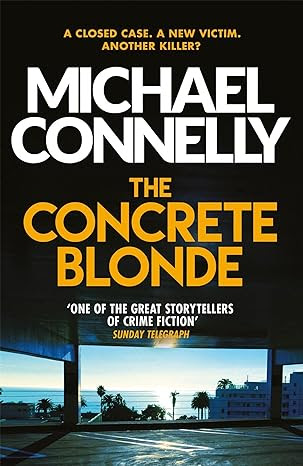
The Concrete Blonde (#3 in the Harry Bosch series) by Michael Connelly


A Great Read!

Originally published in 1994

Synopsis: Detective Harry Bosch of the LAPD shot and killed a suspected ritualistic serial killer in a controversial but "righteous shoot" several years before. Now, the killer's widow is suing the city for killing the wrong man and new victims of the serial killer are showing up - victims that definitely were killed after Bosch shot his man.

First - let's address the title. There are actually two concrete blondes in the book. One is the concrete statue of lady justice outside the courtroom. The other is one of the victims - a blond prostitute/porn actress who was found encased in the concrete floor of a self-storage unit.

Michael Connelly
Second - this is a great cop story. I won't go into much plot detail, but I will say that the story twists and turns in so many directions that it is hard to put down. Just when you think you have got it figured out, you find that Connelly has been waiting for you and your erroneous conclusions and he gleefully smashes them to pieces.

The Concrete Blonde almost caused me to be late to work two days in a row! I give this book an enthusiastic 5 stars out of 5.

This book can be found on Amazon.com here: The Concrete Blonde.

 
Reviewed in February of 2005.

Featured Post

<b><i>BAN THIS BOOK (audiobook)</i></b> by Alan Gratz

Published in 2017 by Blackstone Audio, Inc. Read by Bahni Turpin. Duration: 5 hours, 17 minutes. Unabridged. My Synopsis Ban This Book is t...

Popular posts over the last 7 days