Make Love the Bruce Campbell Way (audiobook) by Bruce Campbell


I laughed my way through this audiobook!

Published by Eastmoor Media in 2005.

Performed by Bruce Campbell and his actor friends.

Duration: 6 hours, 17 minutes.

Unabridged.


I picked up and looked at the book version of Make Love the Bruce Campbell Way several times and never quite decided to pick it up. But, I quickly snapped up the audiobook version because of this quote from the back cover from Bruce Campbell:

"...the prospects of doing a 'regular" audio adaptation weren't very appealing. But then a few things dawned on me:
1. I'm the lead character of the book.
2. As an actor by trade, I could play the part.
3. I'm knee deep in actor pals, why not record the book like a radio play?" 


At that point I was sold.

The story revolves around Bruce Campbell's attempt to move from being a B movie legend to a real A-list movie star. He gets his chance in "Let's Make Love", a Richard Gere/Rene Zelwegger romantic comedy directed by Mike Nichols. Of course, Bruce is hopelessly starstruck and out of his element as he messes the whole thing up - but that's where all the fun starts!

Bruce Campbell
This is a funny, offbeat story that goes off of the deep end but still drug me there laughing all the way. From Richard Gere learning how to fistfight (and absolutely loving it!) to Bruce Campbell holding off the FBI alongside two of his biggest fans in a running gun battle, I loved it!

Is it silly! Yes?!

Is it stupid! Of course!

It's offbeat, ridiculous, over the top and gloriously entertaining.

Highly recommended.

This audiobook can be found on Amazon.com here: Make Love the Bruce Campbell Way.

I rate this audiobook 5 stars out of 5

Reviewed December 26, 2009.

Misquoting Truth: A Guide to the Fallacies of Bart Ehrman's Misquoting Jesus by Timothy Paul Jones


An Enjoyable Counter-Argument

Published in 2007 by IVP Books.

Timothy Paul Jones' Misquoting Truth: A Guide to the Fallacies of Bart Ehrman's "Misquoting Jesus is a reasoned, polite yet firm response to Bart Ehrman's Misquoting Jesus: The Story Behind Who Changed the Bible and Why, a best-selling book that disputes the authenticity of the New Testament by noting that there have been numerous errors in translation and copying over the years, especially in the first 200-300 years of the Christian movement.

Jones starts by addressing Ehrman's criticisms directly. He acknowledges that there have indeed been a great number of errors, most in spelling, some in grammar and some were simple re-copying of lines of text or skipping a line of text. He notes that while there are a lot of them, most make no difference, such as my use of commas and other punctuation in this sentence - if I had left them out, the meaning of the text would not have changed. To use an example of my own from English, they might be as simple as using the word "house" rather than "home" in a sentence - a different word but not a different meaning.

This addresses more than 90% of Ehrman's citations of error, which makes me wonder why Ehrman brought them up to begin with...

Timothy Paul Jones
Ehrman asserts that the 4 gospels have had many different names over the centuries ("A wide variety of titles") as an argument against their authenticity. True enough, agrees Jones, but they've only had slightly different names, such as "The Gospel According to Mark" or "The Book of Mark." The authors' names have been attached to the same texts no matter where they've been discovered in the former Roman Empire. (pages 97-100)

Jones discusses how the early church determined which books were canon and which were not, addresses Ehrman's determination that none of the 4 Gospels could have been written by "illiterate" men such as Peter and John. Ehrman never considers that Peter and John would have had access to scribes, despite the fact that Paul refers to a scribe writing for him while he as in jail awaiting a hearing with Caesar and he ignores the fact that Matthew the tax collector turned disciple would have had to have been literate. Luke the physician would have probably been literate or he could have used the same scribes that Paul used since they were clearly companions.

I found this to be an enjoyable, polite response to Ehrman.

Highly recommended. 5 stars out of 5.

This book can be found on Amazon.com here: Misquoting Truth.

Reviewed on December 26, 2009

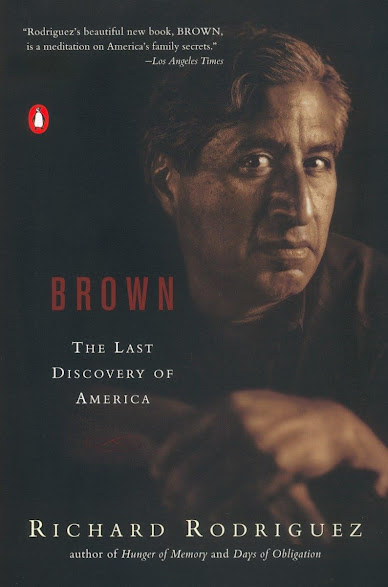
Brown: The Last Discovery of America by Richard Rodriguez


Great. Thought-provoking.

Originally Published in 2002.

Richard Rodriguez is a San Francisco-based writer who was asked to write a book about being Hispanic in America. I doubt Brown: The Last Discovery of America was the book that the publisher had in mind when they asked. Rodriguez is a true political maverick whose thesis is that America is becoming "Brown" - a mixture of Anglo, Hispanic, Black, Asian and whatever else you want to throw in. America can embrace this future (and probably will) or it can reject it and deny the reality that surrounds us all (and does it matter if you deny reality - it is still there).

I first heard of Rodriguez on C-Span. He was giving a speech at the Texas Book Fair created by Laura Bush. His speech was truly wonderful and I just had to find his book. I could go into detail on his observations, but you would much prefer if you would read it the way he put them in his book - his writing style is so fluid that he sneaks major concepts into your thoughts before you even realize that they are there.

I seriously enjoyed this book - at the risk of sounding like the back of a book cover - here are some thoughts that crossed my mind while reading it - important, poignant, personal and filled with insights.

I rate this book 5 stars out of 5 stars.

This book can be found on Amazon.com here: Brown: The Last Discovery of America.

Reviewed in 2004.

The Two Georges: The Novel of an Alternate America by Richard Dreyfuss and Harry Turtledove


So, what do you get when Oscar Award Winner and a Hugo Award Winner get together?


Published in 1996 by Tor Books

What you get is a pretty good book, actually.

The premise of The Two Georges is that the United States was never formed. The British government dealt fairly with the colonies in the 1760s and the independence movement was stillborn. Instead, what are now the USA and Canada is called the North American Union and are an integral part of the United Kingdom. The UK is a vast world-wide empire led by the King-Emperor. This union is symbolized by the painting "The Two Georges" which depicts colonial representative George Washington bowing before King George III before an assembly of British and American dignitaries. This moment encapsulates the agreements that kept the American colonies a part of the British Empire. At the beginning of the book the painting is stolen in 1996 by The Sons of Liberty, a North American pro-independence movement. The story follows two detectives and an art curator who are searching for the painting before the ransom deadline.

There were a lot of fascinating things about this book. I thoroughly enjoyed the historical premise and the maps of the world and North America that are at the front of the book. The authors conclude that if there were no USA, there would be few independent countries in Africa, Asia and the Americas, since there was no American example to inspire the dismantling of the vast world-wide European empires. Germany never coalesces since France never spawns a Napoleonic Empire (Napoleon was the first to unite most of Germany - before that it never really occurred to the Germans that they could create a powerful country if they untied themselves) since there was no French Revolution since there was no American Revolution to inspire it.

American history is different since the UK outlaws slavery in the 1830s - there was no Civil War. The American map has 2 mostly American Indian states - Iroquois and Cherokee, thanks to British restrictions on white incursions over the Appalachians (one of the reasons for rebellion mentioned in the Declaration of Independence).

Technology is far behind that of our world - American creativity is not challenged due to World Wars, Japan is practically a non-entity and Germany is a bunch of warring principalities.

Enjoyable book, decent mystery, good adventure.

I rate this book 4 stars out of 5.

This book can be found on Amazon.com here: The Two Georges: The Novel of an Alternate America by Richard Dreyfuss and Harry Turtledove.

Reviewed in 2004.

Presumption of Guilt by Herb Brown


More than your average crime book


Published in 1991.

A boy is found with bloody underwear. His babysitter, a male high school senior is immediately suspected of molestation. The little boy is very bright but is certainly very vague about what happened to him. Psychologists are brought in, with their own agendas. The prosecutors, parents, judge and the victim all have their own agendas. The reader is left to try to guess what really happened.

The point of view is usually that of the little boy who is trying to navigate his way through the adult court system while keeping his secrets secret, his family intact and do what is right, as far as he can tell. I really can't go into much more detail without spoiling the plot.

This is Brown's first book. He is a state supreme court justice from Ohio and I hope that this disturbing piece of fiction was not based on a true case. This book was well-written, compelling and, like I've already said, disturbing.

I rate this book 5 stars out of 5.

This book can be found on Amazon.com here: Presumption of Guilt.

Reviewed in 2004.

The Poet (Jack McEvoy #1) by Michael Connelly


Originally published in 1996.


Connelly is an Edgar Award winner (an award for great mysteries that is named after Edgar Allen Poe, the creator of they mystery genre) and, for me, that is usually a great recommendation as an author.

The Poet features Jack McEvoy, a reporter whose specialty is covering murders for his newspaper. This time, the story is about his twin brother, a cop and a presumed suicide who left a disturbing note consisting of a single line from Poe. McEvoy does a lot of digging and discovers that there have been a string of police suicides across the country with "Poe" suicide notes. Soon, he's on the case with an FBI task force and the chase is on to catch the killer they've nicknamed "The Poet."

This really is a well-written book. The first 100 pages are slow and wallowing in self-reflection and insecurity, as is appropriate for those left behind in the wake of a suicide. Once McEvoy finds the clues leading to a different conclusion, the book picks up in pace until it races along. The ending is full of cliffhangers and I was surprised.

I rate this book 5 stars out of 5 and it can be found on Amazon.com here: The Poet by Michael Connelly.

Reviewed in 2004.

Last Rights by Philip Shelby


Good action thriller book for political junkies

Originally published in 1997.

This political / action thriller revolves around the murder of a Colin Powell-type successful black general that was staged to look like a plane crash. Army Warrant Officer Rachel Collins discovers a clue to the actual cause of the general's death while investigating another crime and a nation-wide chase ensues while victims fall all over the place at the hand of the professional assassin "The Engineer."


It started out slow but the middle part of the book is really quite good. Shelby creates good tension and the main characters get banged up most thoroughly and realistically.

I rate this book 4 stars out of 5 and it can be found on Amazon.com here: Last Rights

Reviewed in 2004.

Featured Post

<b><i>BAN THIS BOOK (audiobook)</i></b> by Alan Gratz

Published in 2017 by Blackstone Audio, Inc. Read by Bahni Turpin. Duration: 5 hours, 17 minutes. Unabridged. My Synopsis Ban This Book is t...

Popular posts over the last 7 days