The Day After Tomorrow by Allan Folsom


Originally published in 1994.

Slow start - but then its a roller coaster!

I almost put this book down because it was going anywhere after the first 50 pages, but things picked up and for the next 675 pages it was one wild plot twist after another. It truly is a fun book to read, but I must warn you - don't get too attached to any of the characters because the author treats any and all of them as expendable.

It involves a man who sees his father's killer at a Paris cafe and his pursuit of the man brings him into contact with an Interpol investigation of an entirely set of unrelated crimes (or so it seems...)

Good pacing, after the first 50 pages. The end was a bit disappointing, but just about any ending would have been after all of this adventure.

I rate this book 5 stars out of 5.

Reviewed August 21, 2004.

This book can be found on Amazon.com here: The Day After Tomorrow by Alan Folsom.

The Year of Jubilo: A Novel of the Civil War by Howard Bahr


Published by Picador in 2001.

The Year of Jubilo is the second book by Bahr that I've read. In fact, I bought this one because I enjoyed his novel, The Black Flower: A Novel of the Civil War so much. This book is different than the The Black Flower: A Novel of the Civil War, which was heavy on texture and feel. This book is every bit the equal of the first, but much more focused on plot and theme.
So, what is the theme? It's in the title. The Year of Jubilo refers to the Old Testament Hebrew tradition called the Year of Jubilee. Every 7 years, all slaves were forever released from bondage. This novel explores freedom of all sorts in a (barely) post-Civil War Alabama town. There is, obviously, the newly-won freedom of the slaves, but that is barely brushed upon in favor of deeper themes. There is freedom (or not) from the past, guilt, the entanglements of family, family honor, regional honor, friendship, obligations of social position and even love.

All of this is mostly told through two characters, Gawain Harper, a former college professor who joined the Confederate army to prove he was worthy to the father of the woman he loves and Harry Stribling, a former newspaperman who served in the Confederate cavalry during the war and is now a self-proclaimed philosopher. Bahr is not limited to these two characters, though. He has created a whole community in this book. Characters range from the Union colonel in charge of the occupying force to a former slave chaser to a smuggler.

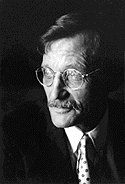
Howard Bahr
The smuggler, King Solomon Gault, is by far the most interesting character. He has avoided the real war all together and has made himself rich by smuggling during the war. He literally sees himself as a god unto himself and he callously uses and destroys a great number of people to pump up his own sense of grandeur and freedom. He is the antagonist and all of the advances in the plot move through him and the reactions to him.

This novel has rich characters and sometimes almost poetic scene setting. It is a joy to read. I laughed out loud at parts and was surprised at the brutality and abruptness of other parts. I even read parts out loud to my wife.

I rate this book 5 stars out of 5.

This book can be found on Amazon.com here: The Year of Jubilo: A Novel of the Civil War.

Reviewed on August 14, 2004.

Ship of the Line (Star Trek: The Next Generation) by Diane Carey


Pretty Decent Fun

Published in 1999

Yes, I hate to admit it, but I read a Star Trek novel. I haven't read one for years, but Ship of the Line was on sale at the dollar store so I picked it up. I also hate to admit it, but I liked it.

The plot focuses on the time between the 2 movies Generations and First Contact. It involves Captain Morgan Bateson, the captain played by Kelsey Grammer (a.k.a. Dr. Frasier Crane) in an episode of the fifth season of the Next Generation series. It deals with his forced time travel of 90 years into the future and Picard's angst over the loss of his ship. Kirk is also in it thanks to great holodeck programs. 

Kelsey Grammer as Capt. Bateson in ST:TNG.
Ship of the Line is way too cluttered and the ending is hackneyed, as many things Trek are. But, it was an entertaining read. A great novel would have dealt in-depth with the issues of a captain without a ship or a man living out of his own time, but who expects to find great literature at the dollar store?

I rate this book 4 stars out of 5. It can be found on Amazon.com here: Ship of the Line by Diane Carey.

Reviewed on August 14, 2004.

Too Long In The Wasteland by James McMurtry


One of the best albums I have ever heard for driving, listening and. 

Released in 1989.

I bought this album on the recommendation of a friend and boy am I glad I did! The lyrics are intentionally poignant and yet work without being cheesy. You can tell that he inherited his dad's (Lonesome Dove author Larry McMurtry) ability to mold and use the English language. But the great thing is that the music is just as good as the lyrics - you'd be singing along even if the words were meaningless.

This album was made with John Mellencamp's band - sort of on loan. The music is very solid, but the stories told by the lyrics steal the show.

I gave my only copy to a friend (and fellow fan who had worn his cassette out) that was called up to active duty after 9/11 - I knew that he could use the boost more than me.

Every McMurtry album has great songs but this one is strong all of the way through!

I rate this album 5 stars out of 5.

Reviewed on August 14, 2004.

This album can be found on Amazon.com here: Too Long In The Wasteland by James McMurtry.


Scarecrow by John Mellencamp


Awesome album

Released in 1985.

The first five songs on Scarecrow are as great together as any combination that I've ever run across on an album. They remind me of my rural Indiana roots - "Rain on the Scarecrow' starts us out at the farm, 'Grandma's Theme' reminds me of my own grandmother's voice, 'Small Town' and 'Minutes to Memories' link the urban and rural Indiana experience and 'Lonely Ol' Night' captures that restless, lonely spirit that we've all had. Perfectly put together.

This is not Mellencamp's best album overall (Uh-Huh is his best overall album, in my opinion) but it does have many of his absolute best, including 'Lonely ol' Night' and 'Small Town'. 

Truly a great album. 

Wonderful.

I rate this album 5 stars out of 5. It can be found on Amazon.com here: Scarecrow by John Mellencamp.

Reviewed on August 14, 2004.

Black Lies, White Lies: The Truth According to Tony Brown by Tony Brown


This book is up and down with an absolutely bizarre middle.


Originally published in 1995.


As you may know, I have taught for multiple years in urban schools. The issue of race in America has come up daily, and some days it is an ever-present feature. I am forced to think about it all of the time in the classroom and all I know is that I don't know enough to solve the issues and no one ever will. 

Tony Brown is a Black man (he prefers that term) who has hosted a PBS discussion show called "Tony Brown's Journal" for years. He also hosts a Saturday talk show on WLS 890 AM out of Chicago that can be heard throughout the Midwest thanks to their high wattage broadcast strength.

He is an interesting man and a good discussion leader on his shows. His views were fairly consistent with my own, although I think that his perceptions of white america are a little off, just as he would undoubtedly think that my views of black America are off. The first 1/3 and the last 1/3 of Black Lies, White Lies are full of pretty good thoughts, observations and ideas, except for their repetitiveness.

The middle 1/3 is a bit bizarre. It concerns AIDS and his denial that it even exists. He claims that AIDS is not real because there are 30+ diseases that are associated with it. He wonders how certain types of cancers and certain types of fungal infections and viruses can all be from the same disease. He misunderstands that these diseases are presumed to be symptoms of AIDS since they are rare and usually are only present to people with depressed immune systems - which happens to people with AIDS (thus its name). He also touts a theory that claims that AIDS was started accidentally by using viruses from Monkeys to create a Smallpox vaccine that was used in Africa in the 1970s. After doing a Google search I can tell you that he is not alone with this belief, but most others who share it assume that it was a racist plot by the US government in an effort to control population.

I was disappointed by "Black Lies, White Lies" because I like Brown's TV and radio shows - they seem to be full of commonsense discussion and straight talk, not conspiracy theories. I give this book '2 stars' for its repetitive nature and the bizarre middle of the book.

As an addendum, I thought I would add these conclusions that were gleaned from a poll and interviews by the "Washington Post" of black students and their beliefs concerning education that Brown quoted in the book. I thought the poll pretty much encapsulated the attitudes of black students (as a whole) that I had in the Indianapolis Public Schools:

*Black students are poor and stay poor because they are dumber than Whites.
*Black kids who do their homework and behave must want to be white. White kids who do poorly or dress cool want to be Black.
*Black people don't want to work hard.
*Blacks don't need to work hard because it won't matter in the end.
*Blacks have to be bad so they can fight and defend themselves from other Blacks.
*Blacks see their badness as natural.
*Black men make women pregnant and leave.
*Black boys expect to die unnaturally.
*White people are smart and have money.

In my experience, the poll-takers nailed these attitudes from black students about black people dead on. Not all of my students have expressed these attitudes, but a significant percentage have.

This book can be found on Amazon.com here: Black Lies, White Lies

I rate this book 2 out of 5 stars.

Reviewed on August 13, 2004.

Winter In The Heart by David Poyer


Great read - not really a courtroom thriller

Originally published in 1993.

Synopsis: The story of a small Pennsylvania oil town that has seen its better days and some of the unique characters that come together to expose a devious plan to dump toxic wastes into the surrounding countryside.

My review: This is a great read. It is advertised as a courtroom thriller but that is just as accurate as saying the movie The Princess Bride is a childhood bedtime story. True, it is, but it is so much more. In this case, the story is framed by about 10 pages of courtroom stuff just to give the story a bit of context, but it really is just a plain old novel - with all the foibles and follies that accompany good character creation.

I rate this book 5 stars out of 5.

This book can be found on Amazon.com here: Winter in the Heart.

Reviewed on August 10, 2004.

Featured Post

<b><i>BAN THIS BOOK (audiobook)</i></b> by Alan Gratz

Published in 2017 by Blackstone Audio, Inc. Read by Bahni Turpin. Duration: 5 hours, 17 minutes. Unabridged. My Synopsis Ban This Book is t...

Popular posts over the last 7 days