Understanding the Koran: A Quick Christian Guide to the Muslim Holy Book by Mateen Elass


Informative, fair and well-written

Published in 2004 by Zondervan

Short summary:

Mateen Elass is uniquely qualified to write a book like Understanding the Koran. His father was a Muslim. He was raised in Saudi Arabia. He is now a Presbyterian minister in the United States. His short, 10 chapter book introduces the reader to the Koran by telling its history and the common touchpoints that it shares with the Bible, Christian tradition and Jewish tradition. Elass also introduces the reader to the proper handling of the Koran and has a balanced discussion on the role of Jihad in Islam, as defined in the Koran. An optional Bible study is located at the back of the book with lots of questions designed for group discussion.

My review:

An absolutely excellent book! The reader is not required to be a Christian to understand the book - but a working knowledge of Christian tradition and the Bible would help. Mateen Elass has produced a wonderful introduction to Islam and the Koran. He is respectful of Islam throughout the book, but it is clear that he is writing from the Christian perspective.

I have but one complaint: he has excellent commentary in his endnotes that complement the text. Unfortunately, I discovered this about halfway through the book. I wish it had been footnotes instead.

I'll be on the lookout for another book by Elass. Might I suggest a book on Islam itself? Or, perhaps Muslim customs and holidays?

I rate this book 5 stars out of 5.

This book can be found on Amazon.com here: Understanding the Koran.

Reviewed on July 21, 2004.

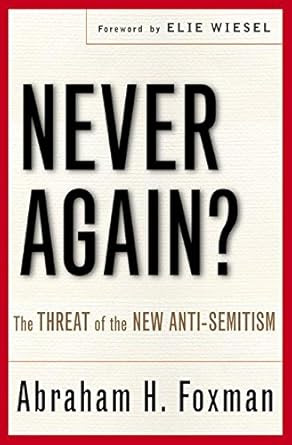
Never Again?:The Threat of the New Anti-Semitism by Abraham H. Foxman


Powerful, important but not perfect. Also - test yourself!


Published in 2003 by HarperOne.

Summary of the book:


In Never Again? Foxman uses the common comment that the world has learned its lesson during World War II and will "never again" let hate do what it did to the Jews in World War II. He uses a question mark because he points to some rather depressing trends in this well-researched book that mark a rise of anti-Semitism throughout the world, even in Japan. (reviewers note: How many Jews actually live in Japan? How many Japanese actually know what the Jewish religion is? I'm assuming this is just a nutball group that hates just about everybody and just threw the Jews in too).

Foxman is the head of the Anti-Defamation League, a group based in New York City that monitors Anti-Semitic activity throughout the world.

My review:

Foxman is a bit too sensitive (something that he admits he is trying to avoid), but he's right, there are terribly disturbing anti-Semitic trends, especially in his chapter 7 concerning very popular Muslim beliefs concerning Jews (he quotes opinion polls and continuing attacks that come from mainstream Muslim newspapers. Unfortunately, from an editing standpoint, he ends up with Chapter 8 - a chapter about anti-Semitism in Hollywood and popular entertainment. It is by far his weakest chapter, a point he virtually concedes because this is where he makes his comments about not wanting to appear too sensitive.

Foxman has an anti-Semitism quiz developed by the Anti-Defamation League. He says you qualify as "most" Anti-Semitic if you agree with six or more of the following:

1) Jews stick together more than other Americans.

2) Jews always like to be at the head of things.

3) Jews are more loyal to Israel than America.

4) Jews have too much power in the U.S. today.

5) Jews have too much control and influence on Wall Street.

6) Jews have too much power in the business world.

7) Jews have a lot of irritating faults.

8) Jews are more willing than others to use shady practices to get what they want.

9) Jewish businesspeople are so shrewd that others don't have a fair chance at competition.

10) Jews don't care what happens to anyone but their own kind.

11) Jews are not just as honest as other businesspeople.

I scored a zero out of 11 on this test. However, Foxman would still consider me an anti-Semite. He has 2 long chapters on Jewish-Christian relations (one for Catholics worldwide and one for American Protestants) and since I am a Christian that believes that Christ is the only way to heaven, I am an anti-Semite.

Oh, well. No matter Foxman's opinion, I will continue to consider myself not anti-Semitic, especially in light of some of the absolutely ignorant comments coming from some of my rural Indiana students. I do believe that I am the only one that has ever confronted some of them. Here's what they were doing: they were using the word Jew and Jewish as an insult term - meaning stupid. So, when someone would say something stupid some others would say, "That's so Jewish!" or "You're such a Jew!". So, anyway, I'd boot their asses out to the hall so fast that their heads would spin and we would have a lo-o-o-o-o-o-o-o-ong talk. I can tolerate a lot of ignorant things but racism is not one of them. I've had this conversation about 5 times in the last two years, but not for the last 5 or 6 months. Maybe it has stopped or maybe it has just stopped around me.

To sum up: This book receives a "4 stars". It would have received a higher grade except for the relatively weak chapter at the end that takes away a lot of its punch. Still, it is an important book.

I rate this book 4 stars out of 5.

This book can be found on Amazon.com here: Never Again?

Reviewed on July 18, 2004.

Stalking the Angel (Elvis Cole #2) (audiobook) by Robert Crais


Published by Brilliance Audio
Read by Patrick G. Lawlor
Duration: 6 hours, 52 minutes
Unabridged

Synopsis: 

Elvis Cole and his partner Joe Pike are hired by a Los Angeles businessman to find a missing ancient copy of the Hagakure, a book that details Bushido, or the way of the Samurai. Along the way, they discover hidden family secrets, connection to the Yakuza (Japan's ultra-violent mafia) and deal with a kidnapping and modern followers of the Bushido.

My review:

Written in 1989, Stalking the Angel is an early Elvis Cole book. Crais is still doing a bit of casting about to find his rhythm with the characters of Joe Pike, Elvis and even his irascible cat. The plot doesn't flow as well as later books but it still a very nice listen.

It is narrated by Patrick G. Lawlor who does a solid job of catching Cole's wisecracking side but overall does not catch on to Elvis as well as the narrators of his later books do.

I rate this book 4 stars out of 5.

This book can be found on Amazon.com here: Stalking the Angel.

Reviewed on March 16, 2010.

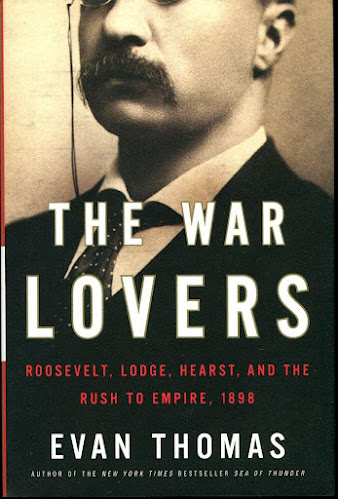
The War Lovers: Roosevelt, Lodge, Hearst, and the Rush to Empire, 1898 by Evan Thomas


Well done

Published in 2010 by Little, Brown, and Company.

Before this book, I had not had the pleasure of reading one of Evan Thomas' books. I picked The War Lovers up despite these fawning comments by Thomas in June 2009 ("I mean in a way Obama's standing above the country, above - above the world, he's sort of God.") My original thoughts were if this guy can't be any more unbiased in his observations than that, do I really want to read his stab at history?

Well, I am happy to say that I was pleasantly surprised. This is a solid history that is told well. The book flows along nicely and the reader is both entertained and informed.

Theodore Roosevelt (1858-1919) 
with his men in Cuba
The book's focus is the build-up of public support for the Spanish-American War (1898). As the title notes, Theodore Roosevelt, Henry Cabot Lodge and William Randolph Hearst are the main subjects in the book but other people round out the story, including Harvard professor and philosopher William James (Pragmatism and Other Writings ), his brother and fellow author Henry James (Henry James: Complete Stories, 1892-1898), Speaker of the House Thomas Brackett Read, various surviving family members of deceased Civil War hero Robert Gould Shaw (Glory) and great-grandson and grandson of presidents, Henry Adams (The Education of Henry Adams).

The War Lovers gives the reader a vivid portrait of life among the Eastern Elite in the late 19th century - a world so far removed from my experience that I may have well as been reading about a foreign country. But, in a way, the book was full of plenty of people that I have been reading about all of my life. Thomas takes those empty names and fleshes them out with personality, histories and makes them become much more real. On top of that, it is an entertaining read!

Highly recommended.

I rate this book 5 stars out of 5 stars and it can be found on Amazon.com here: The War Lovers: Roosevelt, Lodge, Hearst, and the Rush to Empire, 1898 by Evan Thomas.

Reviewed on March 18, 2010.

Ten Stupid Things That Keep Churches from Growing: How Leaders Can Overcome Costly Mistakes by Geoff Surratt


Published in 2009 by Zondervan

Geoff Surratt's Ten Stupid Things That Keep Churches From Growing is an entertaining and informative read. Like I noted in the title, I am not a pastor (but I have been an active church member nearly all of my life), but I still found the book quite enjoyable.


Surratt's 10 things are:

* Trying to do it all
* Establishing the Wrong Role for the Pastor's Family
* Providing a Second-Rate Worship Experience
* Settling for Low Quality Children's Ministry
* Promoting Talent over Integrity
* Clinging to a Bad Location
* Copying Another Successful Church
* Favoring Discipline over Reconciliation
* Mixing Ministry and Business
* Letting Committees Steer the Ship

Surratt does come at things from a non-denominational perspective so some of these items were not particularly applicable to my Missouri Synod Lutheran church, but most were. I was able to note that our church does most of these things well, including just moving out of a bad location (too small) and not letting the pastors do it all.

Surratt fills his chapter with real-life examples of what not to do, including lots of his own (self-described) stupid mistakes. At the end of every chapter he interviews another successful pastor about the issues he just wrote about and gets a slightly different perspective. Surratt's humor carries the book and saves this from being a drudge of a to-do list and makes it a joy. For example where he is commenting on his lack of ability to counsel parishioners with their personal problems: "My natural response when people tell me their personal problems is, 'Wow, what are you going to do about that?' You'd be surprised at how few people find solace or direction in that kind of advice."

It's not all fun and games though. Surratt has some especially profound thoughts on seeing church as a family (kind of choked me up as I was listening to it using the Kindle text-to-speech mode while walking the dog - enough so that I read it to my wife when I got back from the walk).

Good, informative read. Deceptively light-hearted - you'll laugh and you'll think at the same time.

This book can be found on Amazon here: 
Ten Stupid Things That Keep Churches from Growing: How Leaders Can Overcome Costly Mistakes

I rate this book 5 stars out of 5.

Reviewed on March 19, 2010.

Outliers: The Story of Success by Malcolm Gladwell


One of the most interesting and profound books I've read this year.


Published in 2008.

Please pardon a little bit of blogging tossed in with a little bit of book reviewing - it's not my normal style.

I am a high school teacher and we are, as a school, busily studying the racial achievement gap that exists on all (if not all, it is almost, almost, almost all) standardized tests across the country. Currently, I am bucking my school system by insisting it is not a racial gap but rather a failure of the culture of the school to attune itself to the culture of our African-American and Hispanic students. A cultural gap, as it were.

To me this is no simple issue of semantics - if the gaps are cultural they can be overcome by re-tooling and learning new strategies. If the gaps in achievement truly are racial - based on inherited characteristics from our genetic code, well, what's the point of trying, really? To be honest, I truly think they are using the word "race" as a simplistic code word for culture, but this is dangerous game to play, in my opinion. It is too easy for someone who is not clued into this simplistic code word game to misunderstand and take it as real that the racial achievement gap is truly based on the child's DNA.

Malcolm Gladwell
Anyway, in Outliers Malcolm Gladwell backs up my arguments in chapters 4, 5, 6, 7, 8 and 9 with interesting analyses that shed light on the importance of learned culture on success and behaviors. I recommended this book to a member of the leadership team that is leading these discussions and he was intrigued enough to pick up the book and start reading.

The other way that this book was meaningful was its emphasis on the role of practice in achieving success. 10,000 hours - the magic number when it takes to become a Mozart or The Beatles or Bill Gates or Michael Jordan. Note the emphasis on the individual here - you too can be a master of your chosen field with just enough practice! Sort of democratizing isn't it? This is blended together with cultural legacies in Chapter 9 to show how culture can encourage that sense of purpose in an individual.

Anyway, I have a student teacher who will be a very good teacher one day and I spoke with her about the value of practice and experience. She won't be a master teacher in her first year, but those hours in the classroom will add up and she will be one day. Well, it sounds less profound here, written down. Believe me, it was inspiring when I spoke about it (at least I hope it was!)

So, in short, this is a heckuva interesting book. I devoured it. It gave me a lot to ruminate about.

Highly recommended.

I rated this book 5 stars out of 5 and it can be found on Amazon.com here: Outliers: The Story of Success. 

Reviewed on March 19, 2010.

More Blood, More Sweat and Another Cup of Tea by Tom Reynolds


An interesting look at the experiences of a London paramedic

Published in 2009.

Tom Reynolds (a pseudonym) is the writer of a blog about his experiences as a paramedic in London. There are 212 entries that read like they were lifted from his blog, perhaps given a little editing and some re-arranging and then printed. If you like the television show Cops than this format may be of particular interest to you.

There are things to be gleaned from the book:

You learn that a blanket is the most important tool in an ambulance.

You learn that, like on the show COPS, alcohol creates a lot of trouble.

You learn that Britain's NHS is seriously overburdened. Reynolds discusses hospitals filled to capacity, ambulance services that make people wait for over an hour (not always but it does happen), hospitals without basic supplies like pillows and blankets, a boy with a history of collapsing waiting for weeks for an MRI scan (I have had two on an emergency basis in the last 3 years for one I had to wait 15 minutes and for the other I had to wait 45 minutes).

You also learn that some people are just nasty. Here's a quote from Reynolds. He is calling his dispatcher: 

"'Control, I need to return to station to clean out the back of our motor - we've just transported one of our 'local legends'. Is there any infection control policy for patients who are infested with insects?'

'Erm...'"

Gritty, disconnected, worth the read.

I rate this book 4 stars out of 5.

This book can be found on Amazon.com here: More Blood, More Sweat and Another Cup of Tea by Tom Reynolds.


Reviewed on March 22, 2010.

Featured Post

<b><i>BAN THIS BOOK (audiobook)</i></b> by Alan Gratz

Published in 2017 by Blackstone Audio, Inc. Read by Bahni Turpin. Duration: 5 hours, 17 minutes. Unabridged. My Synopsis Ban This Book is t...

Popular posts over the last 7 days