BAN THIS BOOK (audiobook) by Alan Gratz


Published in 2017 by Blackstone Audio, Inc.
Read by Bahni Turpin.
Duration: 5 hours, 17 minutes.
Unabridged.

My Synopsis

Ban This Book is the story of Amy Anne Ollinger, a fourth grade girl who is shocked when she gets to the library and finds out that her favorite book, From the Mixed-up Files of Mrs. Basil E. Frankweiler, has been removed from the shelves as part of a book ban. Amy Anne reads all sorts of books (except Captain Underpants books - they're kind of silly) but she loves this book and comes back to it often. She has read it 13 times and wanted to read it again. 

Amy Anne is told that a parent has complained to the school board about several books and they skipped the established plan to deal with these sorts of complaints and simply voted to remove them. 

Amy Anne's parents buy her a copy of the book and she takes it to school to read when she can during the day. Her friends find out about the book ban, see that she has a copy and ask to read it. In return, they offer her copies of banned books that they own. Other kids see their books and things start to get interesting...

My Review

This was a thoroughly enjoyable audiobook. As the plot gets more complicated, the arguments for and against school library book bans are laid out. Amy Anne is against them in general, but she is no absolutist (and neither are her parents.) She knows that she's just not ready for some topics.

To be completely honest, the kids seem pretty advanced for typical fourth graders, but what transpires is not entirely out of the skill set of kids that age.

What I really liked about this book is that Amy Anne epitomizes what John Lewis meant when he said that we should "get in good trouble, necessary trouble, and help redeem the soul of America."

And that brings us to the reason that I listened to this audiobook. In June of 2024 this book made headlines because a Florida school system banned it from its libraries. Yes, the school board rejected the established plan to deal with parent concerns about books, overruled the findings of the system they established and voted to ban Ban this Book. If that sounds familiar, that is because that is what happened in the book (see 5 paragraphs above.)

A school board member who is also a member of Moms for Liberty - a well-known source of book ban lists - asked to have this book banned. Yes, indeed. These moms are really into banning books in the name of Liberty. In fact, they've been successful at banning more than 140 books in this school system alone.

The author
The board looked at the very existence of the book as a challenge to their authority. A board member said, "The title itself and the theme challenges our authority. And it even goes so far as to not only mention books that are deemed inappropriate by school boards, including ours, it not only mentions them but it lists them."

I like this quote from the author about the book bans: "They banned the book because it talks about the books that they have banned and because it talks about book banning. It feels like they know exactly what they're doing and they're somewhat ashamed of what they're doing and they don't want a book on the shelves that calls them out."

I highly recommend this audiobook. I rate it 5 stars out of 5. Lots of fun.

This book can be found on Amazon.com here: Ban This Book by Alan Gratz.


KINGDOM of RAGE: THE RISE of CHRISTIAN EXTREMISM and the PATH BACK to PEACE (audiobook) by Elizabeth Neumann


Published by Worthy Books in 2024.
Read by Erin Bennett.
Duration: 8 hours, 38 minutes.
Unabridged.


Elizabeth Neumann worked for the Department of Homeland Security (DHS) in the George W. Bush and Trump administrations. 

During the Bush Administration, the work of the DHS centered around preventing attempts by foreign groups, usually Muslim-based, to commit acts of terrorism on the United States or on Americans abroad. She became an expert on why some Muslims were radicalizing (or self-radicalizing), the signs of what to look for, and things that can be done to prevent radicalization.

During the Trump Administration, she started seeing more and more reports about domestic terrorism, usually coming from self-radicalized ultra-conservatives who are encouraged by media. Two prime examples are the Pittsburgh synagogue shooter and the El Paso shooter. Both issued manifestos that quoted liberally from fringe MAGA Conservative theories, like the  Great Replacement theory pushed by politicians like Donald Trump and media figures like Tucker Carlson. Carlson mentioned the theory more than 400 times on his show.

At first, Neumann thought this was a ridiculous notion. But, as she noticed changes in rhetoric at her own church and with old friends from a former church that she reconnected with, she decided to take a serious look.

What she saw were the exact same trends in some parts of the American Christian community that she had found in the radicalized Muslim community 10-12 years earlier and it mortified her. This was not the faith she knew. She recognized that thought as well - she had heard it so many times when Muslim terrorists were her main worry during the Bush Administration.

Neumann does a thorough job of explaining the process of radicalization and the dangers of flirting with radicalizing comments for political gain. She also demonstrates that "self-radicalization" is much easier with the rise of social media. People prone to radicalization can easily find an online community. They can also watch videos and read texts without interacting with another human being. While this section is thorough, it is often dry and clinical as well. It felt more like a textbook reading or a briefing rather than an engaging text.

Her recommendations section have a similar feel, making the book as a whole highly informative but not particularly engaging.

I rate this audiobook 3 stars out of 5. It can be found on Amazon.com here: KINGDOM of RAGE: THE RISE of CHRISTIAN EXTREMISM and the PATH BACK to PEACE.

RUN: BOOK ONE (graphic novel) by John Lewis and Andrew Aydin


Illustrated by L. Fury and Nate Powell.
Published by Harry N. Abrams in 2021.


This spring I read the MARCH, the three volume graphic novel series about Congressman John Lewis (1940-2020) and the Civil Rights movement. When I finished the series, I thought to myself that it would be interesting to see how John Lewis ran for Congress and the struggles he encountered in an era where the KKK still openly marched.

My Synopsis:

The graphic novel RUN picks up right where MARCH trilogy left off. At the end of the MARCH trilogy, there was a celebration of the passage of the Civil Rights bills - a moment of success. There was also the murder of a volunteer who was helping with the celebration by anti-Civil Rights forces.

RUN explores what happened after the Student Non-Violent Coordinating Committee (SNCC) had it first taste of success. 
At the end of MARCH, there was a celebration of the passage of the Civil Rights bills. With that, a long-term goal achieved there was a lot of discussion about where to go next. there were a lot of things to consider, including the beginnings of the Vietnam War.

The discussions soon became arguments and those arguments led people to leave the SNCC and for the movement to fragment. Some pushed for more of the same strategies due to a belief in the power of non-violence and for the simple reason that they had been effective up to this point. 

Others, led by Stokely Carmichael, wanted to pursue separatist strategies. Eventually, this leads John Lewis to leave the SNCC and run for political office.

My Review:

As I look over what I wrote in my synopsis of the book, it sounds boring. It really was not. You normally don't hear much about the Civil Rights movement after the passage of the Voting Rights Act and the Civil Rights Act in 1964 and 1965, so I found it interesting.

Sadly, Lewis died before this book was finished and I doubt there will be more in this series. 

I rate this graphic novel 5 stars out of 5. It can be found on Amazon.com here: RUN by John Lewis and Andrew Aydin.

SLAUGHTERHOUSE-FIVE by Kurt Vonnegut

The first edition cover


Published with the alternate title "The Children's Crusade: A Duty Dance with Death."
Originally published in 1969.

Listed in Time Magazine's 100 Best Novels Since 1923.


Slaughterhouse-Five is the most famous, most celebrated, and most controversial novel of Kurt Vonnegut (1922-2007.) 

My synopsis:

The book serves as a memoir to Vonnegut's horrific experiences as a prisoner of war in World War II and as a sci-fi exploration of the concept of time travel. 

Vonnegut's very green unit was rotated to the front in December of 1944 in order to give experienced combat troops a break. The weather was bad, the terrain was bad, and the Germans had been retreating regularly. It was presumed that the Germans would be content to settle in to winter quarters, rest, refit, and pick up the fighting in 1945. 

Instead, the Germans launched a surprise offensive and what followed was the Battle of the Bulge. Lots of Americans were captured and taken back to Germany to be prisoners of war, including Kurt Vonnegut. Eventually, Vonnegut was taken to Dresden to work. The main character of this novel, Billy Pilgrim, was also captured and eventually taken to Dresden.

At Dresden, in February of 1945, Billy Pilgrim and Vonnegut were firebombed along with the rest of the city. The prisoners of war survived because they were being housed in partially underground slaughterhouse for hogs (the hogs had long ago been consumed.) They were in slaughterhouse number 5. 

Where Pilgrim and Vonnegut's stories separate is the sci-fi portion. At the beginning of the book we are told that "Billy Pilgrim has come unstuck in time." 

Pilgrim is sliding back in forth in time along his own timeline. He can do nothing to change events, he just keeps sliding back and forth. 

My review:

Vonnegut graded his own books in his book
Palm Sunday. I agree with his assessment of 
Slaughterhouse-Five.
This is the second time I've read this book. This time around I really paid attention to the non-science fiction parts of the book and looked for the connections to Vonnegut's own life. Chapter One practically screams for the reader to do so, but I did not the first time around.

This time, I could really see that Vonnegut was working through his wartime experiences through the story of Billy Pilgrim and his own story as the narrator. 

I was struck by the passage describing the condition of the American prisoners of war as their overloaded train car waited on the tracks for a turn on the tracks:

"Even though Billy's train wasn't moving, its boxcars were kept locked tight. Nobody was to get off until its final destination. To the guards who walked up and down outside, each car became a single organism which ate and drank and excreted through its ventilators. It talked or sometimes yelled through its ventilators, too. In went water and loaves of black-bread and sausage and cheese, and out came shit and piss and language.

Human beings in there were excreting into steel helmets which were passed to the people at the ventilators, who dumped them. Billy was a dumper. The human beings also passed canteens, which guards would fill with water. When food came in, the human beings were quiet and trusting and beautiful. They shared."

Vonnegut in 1965.
What struck me was that there in the middle of the most destructive war in human history, enemies were taking care of their enemies like decent people. Later in his career Vonnegut would make the same point with this comment in his book A Man Without a Country"A saint is a person who behaves decently in a shocking indecent country."

Vonnegut's trademark humor and clever new ways of saying the same old things abound in this book. Here is his commentary on a female character: "She was a dull person, but a sensational invitation to make babies. Men looked at her and wanted to fill her up with babies right away."

And there it is in a nutshell. This is Vonnegut's masterpiece. It is profoundly sad. It is funny. It is a memoir. It is sci-fi. And so it goes.

I rate this book 5 stars out of 5. It can be found on Amazon.com here: Slaughterhouse-Five by Kurt Vonnegut

Note: This book has been challenged multiple times over the last 50 years for sexual content, foul language and teaching principles contrary to the Bible. Amazingly, it has stayed on "banned books" lists for more than 50 years. At one point, it was referred to a prosecutor to see if the school was distributing pornography to students. The prosecutor said that it was "not in violation of criminal laws." See this site for more information.

Note: This book was put on book ban lists in Tennessee in multiple counties in 2025. The article has a searchable database because the list has more than 1,100 unique titles

To its credit, the Vonnegut Museum in Indianapolis has a history of sending free copies of Slaughterhouse-Five to students at schools where the book has been banned.

THE MOMENT: THOUGHTS on the RACE RECKONING THAT WASN'T and HOW WE CAN ALL MOVE FORWARD NOW (audiobook) by Bakari Sellers


Published in 2024 by HarperAudio.
Read by the author, Bakari Sellers.
Duration: 4 hours, 33 minutes.
Unabridged.


The Moment that Bakari Sellers refers to in his book is the so-called moment of racial reckoning that came with the murder of George Floyd and the protests all around the country that followed.

Sellers discusses a lot of relevant things that lead up to this moment including the murder of 9 African Americans by a young White supremacist in Charleston in 2015 and Covid-19. But, events like the Buffalo shooting of 2022, continued questionable acts of  and media and political-types discussing the Great Replacement Theory from 2017 until the present day have shown that moment of reckoning was not a big a moment that people supposed it was. Or, it demonstrates that the racist elements in America are pushing back hard.

I have run across Sellers as a guest on a couple of different podcasts that I follow and have always found him to be thoughtful and engaging. I have to admit, however, that I was a little disappointed in this book.

To me this book felt like two different books. I think there was too much time spent discussing the effects of Covid-19 on African American churches. Similarly, Sellers spent a lot of time discussing a police shooting case with an African American that he was involved in as an attorney. It is a sad commentary that I can say that I was only vaguely familiar with the case - and I'm not even sure if the case he referred to was the one I was thinking of because there are just so many.

The author
On the other hand, the other half of the book was compelling. He talked about the hope he had (and still has) after the George Floyd protests, his family, and some successes he has seen. 

Because of this wide variation, I am going to rate this audiobook 3 stars out of 5. This book can be found on Amazon.com here: THE MOMENT: THOUGHTS on the RACE RECKONING THAT WASN'T and HOW WE CAN ALL MOVE FORWARD NOW by Bakari Sellers

WHITE RURAL RAGE: THE THREAT to AMERICAN DEMOCRACY (audiobook) by Tom Schaller and Paul Waldman


Published in 2024 by Random House Audio.
Read by Ray Porter.
Duration: 11 hours, 2 minutes.
Unabridged.

White Rural Rage is a look at the rural/urban divide in the United States in politics as personified in the MAGA movement. 

The book is broken up into multiple chapters, each with a theme about how rural America is advantaged even though they claim they are put upon by urban elites. Sometimes, the authors have a point, sometimes they are just grinding their axes for no particular reason (like in the pickup truck chapter.)

The book has some excellent points, but it clearly written like an extended opinion hit piece rather than an extended informational piece and that did nothing but hurt the audiobook in my opinion. 

I rate this audiobook 3 stars out of 5. It can be found on Amazon.com here: WHITE RURAL RAGE: THE THREAT to AMERICAN DEMOCRACY by Tom Schaller and Paul Waldman.


ATTUCKS! OSCAR ROBERTSON and the BASKETBALL TEAM THAT AWAKENED A CITY by Phillip Hoose


Published in 2018 by Farrar, Straus and Giroux (BYR)

NOTE: Also published under the title UNBEATABLE!

Attucks! appears to be just a story about a 1950's era basketball team, but it is much more than that.

it is the story of Jim Crow style racism in a northern state. It is the story of an underdog school getting its chance to compete at the highest level. It is the story of one amazing player, a great coach, and Indiana's famous single class basketball system.

First - the single class basketball system. Back in the 1900's, Indiana had a single class basketball system. This means that every team was in the same playoff system together - no matter how big or how small. This was highlighted in the based-on-a-true-story movie Hoosiers. The true story had Milan High School (161 students) beating Muncie Central (1600+ students) in 1954. Usually, it wasn't that dramatic of a disparity, but small town schools did very well from 1911-1954. The biggest city in the state, Indianapolis, won zero championships during that time.

This is where the story of Crispus Attucks High School comes in. Attucks was an all African-American segregated high school smack dab in the middle of the city of Indianapolis. Indianapolis was a late arrival to the Jim Crow practice of segregated education (Attucks opened in 1927.) The school was named for the Crispus Attucks, an African-American and the first person to die in the Boston Massacre and possibly the American Revolution.

Attucks vs. Tech - a massive rivalry. Attucks is wearing the darker jerseys.

Attucks was prohibited from playing in the high school tournament until 1942 because...well, there really was no legal reason so we can just chalk that up to racism.

The book focuses on the development of the Attucks basketball program until it became a powerhouse in the 1950's. It's not just that though. This was the first really good team to come out of Indianapolis. It was all African-American in a highly segregated city. It had style, class, and pride in its underdog status. It had perhaps the best player to come out of Indianapolis ever - Oscar Robertson (no kidding - he was astoundingly good.) They won 45 games in a row and won back-to-back state championships in 1955 and 1956. 

How good was this team? The author tells the story of a game that Attucks won 123-59. A player on the losing team was crying after the embarrassing loss. His father told him, "You might as well stop that crying. Because can't nobody beat them. You ought to be glad you ever played against them." (p. 152)

I rate this book 5 stars out of 5. It is very readable and told the human side of the story very well. It can be found on Amazon.com here: ATTUCKS! OSCAR ROBERTSON and the BASKETBALL TEAM THAT AWAKENED A CITY by Phillip Hoose.


WINGS of MOURNING: THE FORGOTTEN FLEET, BOOK 2 (audiobook) by Craig Andrews


Book version originally published by My Story Productions in 2021.
Audiobook published by My Story Productions in 2024.
Read by Shamaan Casey.
Duration: 10 hours, 32 minutes.
Unabridged.


My Synopsis

Wings of Mourning
is the 2nd book in a trilogy about a future war between humanity and an insectoid species. While not a particularly original sci-fi concept, the first book was still entertaining and hinted at all sorts of possibilities. 

Humanity had been winning the war in space by using drone fighter based on carrier ships. The drones were so effective because the pilots would not die if the drone was shot down - they pilot could just switch to a new drone and rejoin the fight.

This was all well and good until the insectoid race (the Baranyk) developed an undetectable way to jam transmissions to the drone fighter ships, leaving the carriers vulnerable to attack. The tide of the war turned against humanity until a retired fighter pilot suggested pulling the old pre-drone fighter ships out of mothballs and put the drone pilots back into the real cockpits. 

The first book of the series, Wings of Honor, focused on the creation of the Forgotten Fleet - the revived air wing with actual pilots in the actual cockpits. 

The second book switches in tone and focus. Rather than focusing on the dynamics of the pilots of the Forgotten Fleet, it focuses on the war. The Forgotten Fleet has been fighting non-stop for six months. They may be young, but they are an experienced and dangerous unit - more than a match to any similar number of Baranyk ships.

The Forgotten Fleet has lost pilots due to death or injury and brand new replacement pilots have arrived to fill in the gaps.

Meanwhile, the Baranyk have changed their tactics and seem to be withdrawing. Are they retreating or are they pulling the fleet together for a big push? The Forgotten Fleet pushes forward to try to find out and suddenly discovers a new weapon in the war...

My Review

I liked the first book in the series quite a bit, but the second one surprised me in a good way. The book changed its tone and focus. Some prominent characters from the first book become minor characters and new characters are introduced. And, it was better than the first book.

The new threat to the fleet is hinted at towards the beginning of Book 2, but I was still very interested in what it all entails when it is finally revealed. The book takes some dramatic twists and turns, including one big twist that I was not expecting at all.

As is common in trilogies, the second act ends with a note of despair, like in the original Star Wars trilogy's The Empire Strikes Back. I am looking forward to seeing how it all works out in the end!

The reader of the audiobook was Shamaan Casey. He also read the first book in the series. He just nailed it.  

I rate this audiobook 5 stars out of 5. It can be found on Amazon.com here: Wings of Mourning: The Forgotten Fleet, Book 2 by Craig Andrews.

Note: a copy of this audiobook was sent to me by the publisher in exchange for an honest review.

FINISH WHAT WE STARTED: THE MAGA MOVEMENT'S GROUND WAR to END DEMOCRACY (audiobook) by Isaac Arnsdorf


Published in April of 2024 by Little, Brown, and Company.
Read by Will Damron.
Duration: 8 hours, 52 minutes.
Unabridged.

Finish What We Started is a look at the MAGA/Trump movement from a different perspective. There are lots of books about Trump, his children, Roger Stone, Stephen Miller, Bill Barr, Mike Pence, or any of the other big players in the Trump Administration. 

This book is different. It looks at regular people caught up in the movement in official positions and how they reacted. There is a guy who wrote a kindle e-book about the real power of political parties - the local precinct committee person in numbers. The theory is that if you get enough like-minded people in charge of the local precincts, you will control the party.

That author gets the attention of Steve Bannon and his popular podcast and people start buying the book and putting its principles in action. Bannon is the only famous person featured in the book. 

The book chronicles the transition from traditional Republicans to MAGA Republicans and the changes that means for basic retail politics (for example, motivating people to actually go to the polls to vote) and what it means for people who have been working for the Republican party for 20, 30, even 40 years. Some of the stories were compelling.

I rate this audiobook 4 stars out of 5. It can found on Amazon.com here: FINISH WHAT WE STARTED: THE MAGA MOVEMENT'S GROUND WAR to END DEMOCRACY by Isaac Arnsdorf.


THEY CALLED US ENEMY (graphic novel) by George Takei, Justin Eisinger, and Steven Scott


Published in 2019 by Top Shelf Productions.
Illustrated by Harmony Becker.

Winner of the 2020 Eisner Award for Best Reality-Based Work.

Winner of the 2020 American Book Award.


George Takei is most famous for his part in the the original Star Trek series and the subsequent movies. But, over the last 20 years or so, Takei has been on a personal crusade to make sure that the Japanese Internment Camps are not forgotten. 

President Franklin D. Roosevelt issued an executive order in February of 1942 to place all of the Japanese on the west coast of the United States into camps because they could not be trusted not to help the Empire of Japan. This order applied to all Japanese, even if there was absolutely no reason to suspect them of doing anything at all to help Japan. Takei's family was included in this round up and this graphic novel is that story.

The graphic novel format is ideal for the story of a young man caught up in a situation he cannot possibly understand. Takei does a good job of going back and forth from his childhood perspective to multiple adult perspectives (Takei at various points in his life) in order to explain things better.

I rate this graphic novel 5 stars out of 5. It can be found on Amazon.com here: THEY CALLED US ENEMY (graphic novel) by George Takei, Justin Eisinger, and Steven Scott.

Note: This book has been listed on multiple book ban lists - in Tennessee (use the searchable database because the list has more than 1,100 unique titles) in 2025 and in Pennsylvania right after it was published. I suppose that people are scared of learning America's history.

MAYA CIVILIZATION: A HISTORY from BEGINNING to END (MESOAMERICAN HISTORY) (kindle) by Henry Freeman (Hourly History)


Published in 2020 by Hourly History.

Hourly History specializes in e-book biographies and histories that take most readers about an hour to read. In some cases, an hour to cover a topic seems about right. For example, I really enjoyed their book on the Cuban Missile Crisis

Of course there is a massive difference in the time involved with the Cuban Missile Crisis and the Mayan Civilization - one lasted for weeks, the other for centuries. That makes a big difference with what can be dealt with the series' self-imposed one hour time constraint and that difference really hurt this e-book.

I have zero problems with the facts presented in this book, but I do have a problem with the way they were presented. 
I found this book to be oddly written. My pet theory as I was reading it was that it was an early experiment with an AI author program - but there is an actual name attached to my kindle e-book - Henry Freeman. Oddly, the Amazon website does not list Freeman as the author. 

I rate this e-book 2 stars out of 5. It can be found on Amazon.com here: 
Maya Civilization: A History from Begnning to End (Mesoamerican History.

I AM NOT YOUR YOUR PERFECT MEXICAN DAUGHTER (audiobook) by Erika L. Sánchez


Finalist for the National Book Award for Young People's Literature.
Named to Time Magazine's 100 Best YA Books of All Time.

Published by Listening Library in 2017.

Read by Kyla Garcia.
Duration: 9 hours, 41 minutes.
Unabridged.

Synopsis:

Julia is the daughter of Mexican immigrants to the United States. They live in pretty run down neighborhood in Chicago. She is in high school. Her family doesn't really understand her (basic YA fare) and she really loves writing. She is looking forward to moving on to college - like so many kids she wants nothing more than to get far, far away from where she grew up.

There is one presence that looms over everything - her dead sister Olga. Olga was older than Julia and has recently died in a bizarre accident - she stepped off of a city bus and was hit by a semi-truck. Her family is traumatized, of course. To make matters worse, Julia is constantly being compared to Olga - the perfect daughter who only gets more perfect in memory.

Julia digs around in her sister's bedroom (untouched since the day she died) and finds a few things that just seem out of character for Olga. Suddenly, there's a mystery and Julia just has to follow the clues...

My review:

At first, I found myself really liking this book. I was intrigued about the mystery element.

But, suddenly we are going from one YA (and Latino) stereotype to another. It got so ridiculous that I starting listing them. If only the author had just settled for 2 or 3 of them (instead of 15 or so.)

*****

This book is a frequent flyer on lists of books that MAGA parents turn in to be banned from local public libraries and school libraries. Here is a ban attempt from South Carolina and here is one from Texas, for example. It's not a book I would want to teach in my classroom (there are things that I would not particularly want to discuss in class) and I didn't particularly enjoy it, but I would be more than happy to have it in a classroom library.

I rate this book 2 stars out of 5. It can be found on Amazon.com here: I AM NOT YOUR YOUR PERFECT MEXICAN DAUGHTER (audiobook) by Erika L. Sánchez

TRAVELS with GEORGE: IN SEARCH of WASHINGTON and HIS LEGACY (audiobook) by Nathaniel Philbrick


Published in 2021 by Penguin Audio.
Read by the author, Nathaniel Philbrick.
Duration: 9 hours, 34 minutes.
Unabridged.


George Washington looked at the newly formed United States of America and saw what it had always been - 13 disunited states with nothing to bind them together. Washington may not have been the deepest-thinking founding father, but some things he just "knew" deep in his bones. What did he know in this case? He knew that they actually all did have something in common. They all had George Washington in common.

So, George went on a series of extended trips around the states until he had visited all 13 of them and he gave them a visible introduction/reminder (it depended on the state and the citizens) of what the new United States of America was all about. Travels with George is the story of those tours.

Each state had its own issues. For example, Rhode Island wasn't even a state when the started traveling - it was holding out. The Southern states, especially away from the ports, were always a little separate from the main political action between Virginia, Pennsylvania and Massachusetts. Washington was aware of this and mostly traveled over rutted, muddy, rough roads south of Virginia. This also meant he was traveling in areas that were barely mapped. That had to be tough on a man in his late fifties.

This is not just a whimsical fanboy look at this tour - it discusses the dangerous politics of the time (Rhode Island was one of the dangers) and it discusses the uncomfortable topic of slavery thoroughly and honestly in my opinion. 

This is a thoughtful and enjoyable book. I rate this audiobook 5 stars out of 5. It can be found on Amazon.com here: TRAVELS with GEORGE: IN SEARCH of WASHINGTON and HIS LEGACY by Nathaniel Philbrick.

BEARSKIN: A NOVEL (audiobook) by James A. McLaughlin


Published in 2018 by HarperAudio.
Read by MacLeod Andrews.
Duration: 9 hours, 49 minutes.
Unabridged.


Synopsis:

Bearskin features Rice Moore as the caretaker of a piece of Appalachian Virginia wilderness for a foundation. His job includes is walking the property, cataloging what he finds, remodeling the house on the property, and keeping poachers out. 


He's also hiding. A few years back he was caught smuggling drugs across the border from Mexico and ended up serving time in a Mexican prison. In the prison, Moore killed a man who was highly connected to a Mexican cartel and now he has taken on an assumed identity in the middle of nowhere in Virginia. 

When someone starts killing bears on the foundation property just to harvest organs to sell in Asia, Rice knows that he has to do something, even if it risks blowing his cover...

My Review:

This book sounds interesting and exciting. I found it underwhelming in so many ways. 

The book started out with tons of description. That's not unusual, especially early on. The book continued that way every time Moore entered a new scene - even if he has been in that setting a dozen times already. It just bogged things down to describe the same things over and over again in hyper-detail.

There were so many threads of a plot that started and were never acted upon. I understand that there are red herrings in stories, but these felt more like the author was exploring some ideas and then just walked away from them.  I don't want to provide spoilers, but at least half of the book is dedicated to plot lines that have no resolution.

The ending was just that - an ending. Three was no resolution to the main plot points. The book just ended with so many unresolved threads. A lot like real life, but not very satisfying in a novel. It's like the author just got tired of the whole thing and said, "Screw it!" and sent the manuscript off to the publisher. 

I rate this book 2 stars out of 5. It can be found on Amazon.com here: Bearskin: A Novel by James McLaughlin.

GOD BLESS YOU, MR. ROSEWATER by Kurt Vonnegut


Originally published in 1965.

After a steady stream of science fiction books, Kurt Vonnegut delivers a straight out social commentary with God Bless You, Mr. Rosewater

Synopsis:

Eliot Rosewater is the heir to a family fortune built on selling munitions in the Civil War and every war after that. The family fortune was built in Indiana but the family has moved to Providence, Rhode Island where it has a family mansion along with all of the others along the waterfront. His father is one of the senators from Rhode Island.

The Rosewater family avoids paying income taxes on this vast fortune by funding the Rosewater Foundation. Generally speaking, the foundation has been a legal way to not pay taxes and instead pay Eliot a whole lot of money to do nothing but supervise a foundation that does next to nothing.

A mural of Vonnegut in his
hometown - Indianapolis.
Photo by DWD
Eliot is suffering from PTSD (called "combat fatigue" in this book) from his experiences in World War II and drowns in troubles in bottle after bottle of alcohol. His only interests are science fiction and volunteer fire departments. He often gets black out drunk and comes back to his senses in a new town. He checks out the nearest volunteer fire department and sees if they have any new techniques or if they need any new equipment. Either way, he gives them something with foundation money.

Eliot is convinced to settle down in Rosewater County in southern Indiana. This is where his ancestors came from. He moves the foundation headquarters to Rosewater, Indiana and becomes the de facto caretaker of the people in this small town. People come to him with their problems and he listens. Sometimes, they need a little money to get over a rough patch or to help with a medical expense. It's all tedious, but the town needs him - even if it is to be someone to yell and scream at. 

The problem is, a lawyer at the law firm that handles the foundation business has found a different Rosewater from another branch of the family. The lawyer thinks he can remove Eliot as the head due to insanity. He will replace him with this other Rosewater and then make a fortune by representing him...

My review:

Vonnegut's report card
I am reading the Vonnegut novels in order of publication. This one is my favorite so far. Eliot is both a great man and a terrific loser. In a way, he is an imitation of Jesus and in a way he's a pathetic drunk that reads too much science fiction. This book is also the introduction to Vonnegut's literary alter-ego, Kilgore Trout.

Vonnegut famously graded his own books in the essay collection Palm Sunday. He gave God Bless You, Mr. Rosewater an A and I agree. 

I rate this book 5 stars out of 5. It can be found on Amazon.com here: God Bless You, Mr. Rosewater.

TIGER CHAIR: A SHORT STORY (kindle) by Max Brooks


Published in 2024 by Amazon Original Stories.

The premise of Tiger Chair is that it is a frank letter from a mid-level Chinese officer to a friend back home. World War III has been going on for a while. It started over the invasion of Taiwan and has now spread around the world. Chinese forces are active on many fronts, including India.

China has also attacked the United States in the mistaken belief that America's racial diversity and political animosities would cause American resolve to crumble and it would be a short war.

This has turned out to be wrong and the invasion has turned into occupation duty and occupation duty has always been terrible. 

I think Brooks has an actual agenda with this book and it is a warning. It is not a warning about China. It is a warning about over-dependence on technology and the foolishness of war. On top of that, it is so easy for one country to think that they have a realistic take on another country's internal politics and culture when they really have no idea at all.

Max Brooks
Brooks lectures in military circles about successful military organizations developing blind spots and becoming incapable of conceiving of strategies that will defeat them (or make it too costly to stay.)

It is an easy thing to observe in recent history. Americans have seen it in Iraq and Afghanistan. In both situations, their governments were deposed and it was assumed that new governments would be formed and the political differences would be worked out. Instead, the different rivalries fought one another with amazing ferocity. But, they also fought the Americans because there was one thing they all agreed on - they didn't want a bunch of outsiders telling them what to do.

It is the same in this story. I'd say that it's been this way forever.

I rate this short story 5 stars out of 5. It can be found on Amazon.com here: TIGER CHAIR: A SHORT STORY by Max Brooks.

MARCH: BOOK THREE (graphic novel) by by John Lewis and Andrew Aydin


Published in 2016 by Top Shelf Productions

Written by John Lewis and Andrew Aydin.

Illustrated by Nate Powell.

2016 National Book Award Winner for Young People's Literature

2017 Printz Award Winner

2017 Coretta Scott King Author Award Winner

2017 Sibert Medal Winner

2017 YALSA Award for Excellence in Nonfiction Winner

2017 Walter Award Winner

Congressman John Lewis (1940-2020) continues his life story in book three of the March series, focusing on his struggles in the Civil Rights Movement. The book starts with the 16th Street Birmingham Church Bombing in September of 1963 and ends with the signing of the Voting Rights Act in August of 1965.

These were, by any account, much like the famous Charles Dickens line from A Tale of Two Cities: "It was the best of times, it was the worst of times, it was the age of wisdom, it was the age of foolishness, it was the epoch of belief, it was the epoch of incredulity, it was the season of light, it was the season of darkness, it was the spring of hope, it was the winter of despair..."

It was the best of times in that the Civil Rights Act of 1964 and the Voting Rights Act of 1965 were passed. It was the worst of times because of these landmark laws were passed due to great sacrifices. As noted on page 91, in the state of Mississippi in the summer of 1964 during an attempt to mobilize and register black voters there were "more than 1,000 arrests, 80 beatings, 35 church burnings, and 30 bombings."

A theme that runs throughout the trilogy is that every success is soured by a violent response. I was particularly struck by an act of pointless violence at the end of the book. When the march from Selma, Alabama to Montgomery, Alabama finally happens (it had been turned back on other attempts by violence and by court order) there is a rally, there are speeches, and a concert given by an amazingly diverse crowd of artists - diverse in race and in musical styles. What should have been a beautiful moment is marred by the murder of a volunteer driver named Viola Luzzo from Detroit. She was shuttling people back to Selma. She was heading back to Montgomery to pick up more people when a car pulled alongside. A single shot was fired and she was killed (see picture.)

This is an excellent trilogy and an excellent way to tell this history. I rate this book and the entire trilogy 5 stars out of 5. 

This book can be found on Amazon.com here: MARCH: BOOK THREE (graphic novel) by by John Lewis and Andrew Aydin.

Click here for March: Book One.

Click here for March: Book Two.

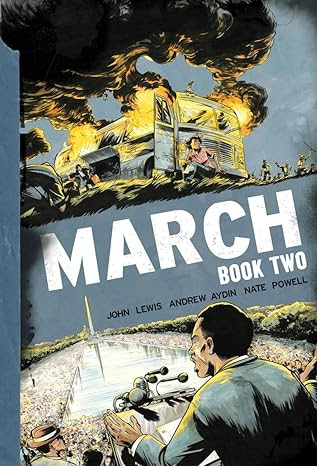
MARCH: BOOK TWO (graphic novel) by by John Lewis and Andrew Aydin


Published in 2013 by Top Shelf Productions.

Written by John Lewis and Andrew Aydin.

Illustrated by Nate Powell.

Congressman John Lewis (1940-2020) continues his life story in book two of the March series, focusing on his struggles in the Civil Rights Movement. The book starts in November of 1960 and ends with the 16th Street Birmingham Church Bombing in September of 1963.


The story includes some very harsh responses to attempts to integrate restaurants in Tennessee, the freedom riders (young African Americans were attempting to desegregate bus lines after a court ordered them to be desegregated), and the bus boycott campaign in Birmingham. 

The violent response is horrible and shocking

Infamous segregationist lawman Bull Connor of Birmingham figures prominently throughout the middle of the book. I am pretty well-versed in the major points of the Civil Rights Movement but I was still moved by the portrayal of the Children's Crusade.

The book includes all of the negotiations, concerns, and demands before the famed March on Washington. Lewis spoke at the march, followed by the world-famous "I Have a Dream" speech by Martin Luther King. 

And, as often happens in this history, a giant step forward is followed by tragedy. In this case, the book ends with the death of 4 girls in the terrorist bombing of a church in Birmingham. 

I rate this book 5 stars out of 5. It can be found at Amazon.com here: MARCH: BOOK TWO (graphic novel) by by John Lewis and Andrew Aydin.

Click here to see my review of March: Book One.

Click here to see my review of March: Book Three.

HOW the SOUTH WON the CIVIL WAR: OLIGARCHY, DEMOCRACY, and the CONTINUING FIGHT for the SOUL of AMERICA by Heather Cox Richardson


Originally Published in 2020.
Published by Oxford Press in 2022.


Historian Heather Cox Richardson has made herself into a name brand historian with her near-daily first drafts of history in which she writes up the day's political news and ties in similar historic themes or long-running trends. 

How the South Won the Civil War follows along those lines. 

The book looks at two long-standing trends in American points of view in American history that are in constant tension with one another.

This quote from page xv of the introduction gets the thesis of the book pretty well:

America began with a great paradox: the same men who came up with the radical idea of constructing a nation on the principle of equality also owned slaves, thought Indians were savages, and considered women inferior. This apparent contradiction was not a flaw, though; it was a key feature of the new democratic republic. For the Founders, the concept that "all men are created equal" depended on the idea that the ringing phrase "all men" did not actually include everyone."

She continues: "So long as these lesser people played no role in the body politic, everyone within it could be equal. In the Founders' minds, then, the principle of equality depended on inequality."

That is the heart of the thesis - some think that everyone should be able to participate, others think that only the best people should participate because some people cannot handle the responsibility (or just want to do all of the wrong things with the power.)

Richardson goes through history and shows how this has played out over the decades. A big theme is that, in general, the South has believed that not everyone should participate. The North has gone back and forth, but consistently more on the side on equality than the South. 

The Civil War was obviously a major flare up in this ongoing struggle and seemed to end the paradox once and for all. But, the same issues migrated west and the Western states generally joined the South as time went on, especially as the Democrats stopped being the conservative party when it came to race relations after the elections of 1964, 1968, and 1972. Movement Conservatives discovered that racists liked it when they said things like letting states keep their own rules about who gets to vote and being able to create special public schools so that they stay segregated.

Not every Republican followed this line of thought and the mainstream Republican Party denied that this line of thought even had a popular foothold. But, the Tea Party Movement followed by MAGA and Christian Nationalism has pushed the radicals (the old John Birch Society types) into the forefront. Trump didn't create it, but he found it and exploited it.

The MAGA movement and Christian Nationalism continues this cementing of the West and the South and the belief that some people should not have a say. Nowadays, it is not slavery or Jim Crow or forcing people to be IN the closet, but MAGA shows spend an inordinate amount of time on gay marriage, trans people, and the bogeyman of CRT. It's not the same old thing (well, it oftentimes is for the LGBTQ+ folks, especially for trans people) but it certainly rhymes.

The only complaint I have about the book is that the author fails to see that the same type of elitism exists in both parties.  Examples include FDR and his brain trust, a center-left media that laid out a certain world view for 40 years and still tries to (I mostly agree with that view, but I also acknowledge that it existed and still exists in a much weakened state.)

I rate this book 4 stars out of 5. It can be found on Amazon.com here: HOW the SOUTH WON the CIVIL WAR by Heather Cox Richardson.

Featured Post

<b><i>BAN THIS BOOK (audiobook)</i></b> by Alan Gratz

Published in 2017 by Blackstone Audio, Inc. Read by Bahni Turpin. Duration: 5 hours, 17 minutes. Unabridged. My Synopsis Ban This Book is t...

Popular posts over the last 7 days