A MAN WITH ONE of THOSE FACES (Dublin trilogy #1)(audiobook) by Caimh McDonnnell


Published by McFori Ink Ltd in 2018.
Read by Morgan C. Jones.
Duration: 11 hours, 11 minutes.
Unabridged.


Synopsis:

This comic romp features Paul Mulchrone - an unmotivated ne'er do well who is forced to volunteer 6 hours per week (and stay out of trouble) to maintain the weekly payments he receives as an inheritance from a hated aunt. He works those hours at a local hospital for older people in the memory care wing. He visits the patients and pretends to be relatives or friends that they want to talk to. Between failing eyesight, confusion and wishful thinking it works.

The author, Caimh McDonnell
It also works because Mulchrone is pretty good at improv and because he has "one of those faces" and looks a whole lot like just about everybody.

One day, he is asked to visit an old man in the hospice who is clearly dying. The old man gets confused, thinks he is the son of an old partner in crime and stabs Mulchrone with a knife he had stashed away.

Mulchrone gets treated and heads home - unhappy and confused. When another man tries to kill him, Mulchrone knows that he has stumbled onto something really dangerous...

My review:

The mystery in this book is pretty good, but the non-stop comic romp of the book got a little old after a while. Also, the ending was jarring compared to the rest of the book and was really quite creepy. It just didn't feel like it belonged. 

Not a bad book, but I don't think I will be continuing on with this trilogy.

I rate this book 3 stars out of 5. It can be found on Amazon.com here: A MAN WITH ONE of THOSE FACES (Dublin trilogy #1)_by Caimh McDonnnell.

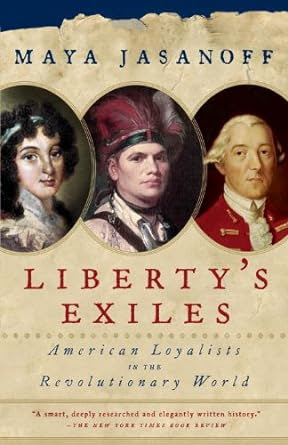
LIBERTY'S EXILES: AMERICAN LOYALISTS in the REVOLUTIONARY WORLD (audiobook) by Maya Jasanoff

Published by Recorded Books in 2012.
Read by L.J. Ganser.
Duration: 16 hours, 10 minutes.
Unabridged.


In 1783, at the end of the Revolutionary War, Loyalists (Americans who opposed the American Revolution and stayed loyal to Britain) had a choice to make - stay and ride out the anti-Loyalist bias in the United States or move somewhere else.

In the two years between the last major engagement (Yorktown) and the official end of the war and withdrawal of British troops the British decided to evacuate any Loyalists that wanted to go to other parts of the British Empire. One of the biggest advocates of this position was Guy Carleton, the British commander in America after Yorktown who later went on to become the Governor-in-Chief of Canada. He had more to do with what happened in this history than any other single person.

Guy Carleton (1724-1808)
The British government made an effort to make things right for these Loyalists. Not many Loyalists were completely reimbursed, but the fact that an effort was made was extraordinary for the day. In some cases, Loyalists were offered large grants of land, in other cases they were offered smaller grants of land and in other cases they were offered pensions and partial reimbursements for lost property. All of these offers were new innovations and a sign that the British government wished to honor the loyalty they had shown.

Some loyalists wanted nothing more than to start over, some looked to just work themselves up the British societal ladder, some wanted to get away from British society and some looked for a chance to get even with the Americans. 

There was a racial component to this as well. The British had offered freedom for any slaves that left their masters and joined their armed forces. The Americans pressured them to return the runaway slaves (including slaves from George Washington and Thomas Jefferson) but the British refused to go back on their deal with the former slaves as a point of honor. However, those former slaves oftentimes were given less money and less land than white Loyalists when they arrived at their new homes.

The British tried to honor the commitments shown by the Native American allies as well, but not nearly as much. 

Loyalists ended up going all over the empire but mostly to Canada. There were several families that went to Bermuda and Jamaica and back to England itself. Several families of African descent moved to Sierra Leone in Africa as part of an experimental colony. A few went even further to India. 

The section on the Canadian settlement was, at first, interesting but it soon got bogged down. It was all relevant detail, but just too much for me. In fact, that's pretty much my review of the entire book.

I rate this audiobook 3 stars out of 5. It can be found on Amazon.com here: LIBERTY'S EXILES: AMERICAN LOYALISTS in the REVOLUTIONARY WORLD (audiobook) by Maya Jasanoff.

CRIMEAN WAR: A HISTORY from BEGINNING to END (kindle) by Hourly History


E-book published by Hourly History in 2020.

Hourly History specializes in histories and biographies that take about an hour to read. In the case of the Crimean War (1853-1856), I think that's about right.

The war was the result of European alliance politics. Russia was looking to push into Ottoman territory. The Ottomans were considered to be pretty weak and certainly on the decline after centuries of being a major power. The Austrian Empire was a traditional ally to the Russians, but decided to stay neutral. The Prussians were just starting out so no one really cared what they did. Even though they had been traditional rivals for centuries, England and France decided that they had to intervene on behalf of the Ottoman Empire in order to stop Russia from becoming too powerful. 

The French and the English sent troops all of the way to the Ottoman Empire and then up into the Black Sea and landed troops on the Crimean Peninsula and the war was on.

The war itself is worthy of note for several reasons, including:

1) France and England worked together as allies. It was the beginning of what has mostly been the default position ever since;
2) Florence Nightingale's work as a nurse;
3) The Charge of the Light Brigade and the poem of the same name describing the futility of the attack and the by Alfred, Lord Tennyson featuring the line "Theirs not to reason why, Theirs but to do and die";
4) Exposed the weaknesses of Russia and the Ottoman Empire. Those weaknesses led to revolutions within 70 years;
5) It was demonstrated that rifled weapons were vastly superior to older style weapons;
6) Trench warfare was introduced. This pointed towards what would be the signature fighting style of World War I sixty years later;
7) The media of the day was able to relatively quickly send stories back from the front due to new technologies;
8) Photography brought realistic views of the war back to the English and French public.

This book does a good job of explaining the war, the causes, the military results and the short term and long term results. 

I rate this e-book 5 stars out of 5. It can be found on Amazon.com here: Crimean War: A History from Beginning to End

THE DRIFTER (Peter Ash #1)(audiobook) by Nick Petrie


Published in 2016 by Penguin Audio.
Read by Stephen Mendel.
Duration: 9 hours, 10 minutes.
Unabridged.


Synopsis:

Peter Ash is a veteran that has seen multiple tours of duty in Iraq and Afghanistan serving as a Lieutenant in the Marines. He is struggling with what he has seen and what he has done and is having a hard time integrating himself into the civilian world. It doesn't help that he has claustrophobia so intense that he has a hard time even walking into a building.

Peter gets word that his best friend, the sergeant that served with him every step of the way, has killed himself. Ash is torn up over his death and sees his failure to keep up with his best friend as a betrayal on his part. He decides to try to make amends by approaching his friend's widow and his two young sons by offering his services as a carpenter to try to fix things up a bit. He knows that she won't take any charity so he tells her he is from a (fake) government program that sends out retired Marines to work on the homes of widowed Marines.

While he is dismantling their decrepit front porch he discovers two things:

a) the biggest, smelliest dog he has ever seen;
b) a beat up old suitcase containing $400,000 in cash and 4 bricks of plastic explosive.

His friend's widow has no idea why the money is there and wants nothing to do with it - but there is a man with a disfigured face and a big SUV spying on the house...

My review:

I stumbled upon this book series and I couldn't be more pleased. I have read all of the Jack Reacher books written by the original author and it fills that niche pretty well. 

I very much appreciated the portrayal of PTSD and how the Great Recession really hurt a lot of regular people and seemed to benefit the "to big to fail" financial institutions that helped cause it because of their foolishness.

The audiobook reader, Stephen Mendel, did a fantastic job. 

I am looking forward to continuing on with this series!

I rate this audiobook 5 stars out of 5. It can be found on Amazon.com here: THE DRIFTER by Nick Petrie.

GERONIMO: A LIFE from BEGINNING to END (kindle) by Hourly History


Geronimo (1829-1909) is the Apache leader that is famous for having fought just about everybody that encroached on his people's land. Later on, when he had surrendered he was shipped all over the place to different reservations.

That was pretty much the facts that I knew about Geronimo and I thought that I really needed to add more to that. After all, he is one of the few Native Americans that everyone has heard of. 

Hourly History publishes histories and biographies that you can read in about an hour. That can be a tough job for big topics in history like "The Industrial Revolution" or "The Roman Empire" but it is just about right for a short biography. 

Geronimo may have fought with the United States and was eventually captured by the U.S. Army (many, many times) but he was really angry with Mexicans. Mexico was his primary enemy because Mexican soldiers killed his family and friends while he was on a trip to a Mexican town to get supplies. 

From that point on, as the United States and Mexico encroached on traditional Apache territories, Geronimo fought both groups - but he focused on Mexico whenever he could.

The book comes up short with his years in captivity, except to note that, depending on the time period, the security went from severe to very, very lax.

I rate this e-book 4 stars out of 5. It can be found on Amazon.com here:  GERONIMO: A LIFE from BEGINNING to END (kindle) by Hourly History.

TALKING BACK, TALKING BLACK: TRUTHS ABOUT AMERICA'S LINGUA FRANCA (audiobook) by John McWhorter


John McWhorter is, perhaps, the best known linguist in America (after Noam Chomsky). He has written about general rules of how languages over long periods of time, the evolution of English, the history behind English's biggest and baddest curse words, and more. Although he speaks in a formal tone, he has a knack for explaining fairly complicated things with everyday English and with lots of easy to follow examples.

The author and reader, John McWhorter
In this book, the topic is what is commonly known as Black English. 

Many people think of Black English as simply "bad" or "slang" English - English with less verb conjugations, double negatives and the endings left off of lots of words.

McWhorter demonstrates that Black English isn't just random mispronunciations and made up words. Instead, it is a coherent system that has its own distinct grammar and vocabulary. Some of it is based on the Southern dialect (most obviously is "y'all") but it would be a mistake to think it is a Southern dialect variation. 

He also shows that phenomena like Black English is a normal thing with several examples from around the world.

McWhorter reads the audiobook version of his book himself. This is appropriate since he is a rather gifted lecturer and has done several of his own audiobooks in the past (see ones that I have reviewed here.) 


I rate this audiobook 5 stars out of 5. It can be found on Amazon.com here: TALKING BACK, TALKING BLACK: TRUTHS ABOUT AMERICA'S LINGUA FRANCA by John McWhorter.

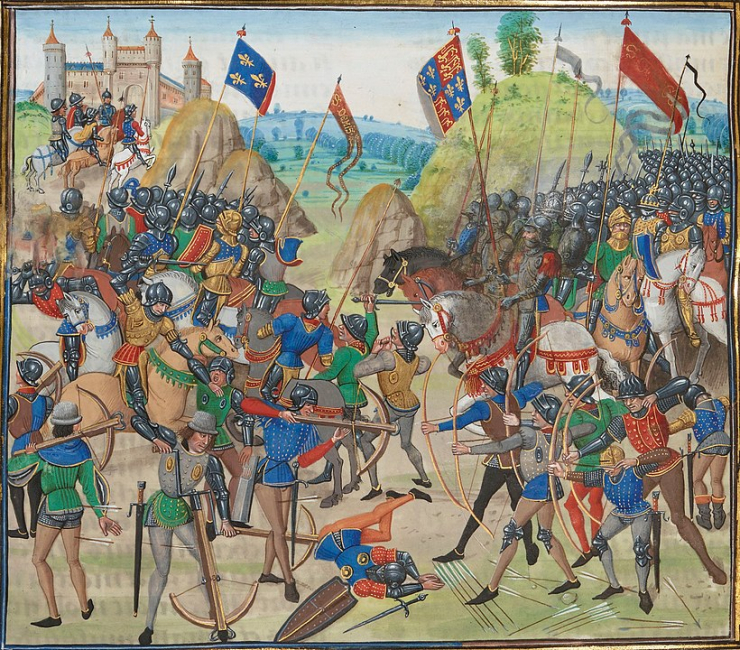
THE HUNDRED YEARS WAR: A HISTORY from BEGINNING to END (kindle) by Hourly History


E-book published in 2019 by Hourly History.

Hourly History is a series of histories and biographies that a reader can read in about an hour. Sometimes, that works out quite well. Sometimes, the topic is just too big to cover in an hour.

I think the Hundred Years War is one of those topics. 

Before I read this book I knew a few facts about the war: It was over dynastic struggles over the throne of France, the Battle of Agincourt, Joan of Arc.

Nothing in this book is incorrect, but I didn't really learn a lot more than I knew before. There is a parade of kings, royal family members and advisors - but there's rarely any detail that makes it interesting. For example, the book mentions an insane French king, but it does not mention that he believed that he was made out of glass and believed that he had to be careful that he would get bumped over and would smash to pieces. 


If you know literally nothing of the war, this is an adequate place to start.

I rate this audiobook 2 stars out of 5. It can be found on Amazon.com here:  
THE HUNDRED YEARS WAR: A HISTORY from BEGINNING to END (kindle) by Hourly History.

NO COMMON GROUND: CONFEDERATE MONUMENTS and the ONGOING FIGHT for RACIAL JUSTICE (audiobook) by Karen L. Cox


Published in 2021 by Tantor Audio.

At it's core, this book is a history of Confederate monuments and what they mean(t) to all of the people who live and work around them.

These monuments are tied in with the "Lost Cause" view of history that teaches that the Confederate cause was a just one, that the war had nothing to do with slavery and that the Confederate cause is only suppressed, but not dead.

These monuments are a vivid reminder about the "not dead" part. When the first big waves of monuments were out up (late 1800's) the Jim Crow laws were becoming standardized. During this time period, the Supreme Court decided in favor of racial segregation in the case Plessy v Ferguson (1896) and that project continued in earnest throughout the South. 

The monuments did honor the Confederate veterans, but they were also placed in symbolic areas like courthouses and town squares told African-Americans that they were not in charge and would never be in charge. The statue of the guy that fought to keep them enslaved in front of the halls of justice is a constant reminder. The author found multiple references to African Americans who stated they never entered the court house on the side where the statue was as a way of refusing to be intimidated. 

The book details some more current struggles over Confederate monuments, including monuments that some people are still trying to put up even today(!) The arguments for them are pretty much the same as they were 100 years ago and they were pretty weak and tone deaf arguments back then.  How were they tone deaf? People argue that the monument is to honor the region's culture and it is really just to honor a bunch of white guys from the region who fought to keep the region's black people in slavery. If you cannot imagine why the region's black people don't want to honor those soldiers...well, you are more than a little slow on the uptake (or racist - take your pick). 

I rate this audiobook 4 stars. It can be found on Amazon.com here: NO COMMON GROUND: CONFEDERATE MONUMENTS and the ONGOING FIGHT for RACIAL JUSTICE (audiobook) by Karen L. Cox.

This book is good, but not quite as good as a book that covered the same topic that I read about 18 months ago: 
DOWN ALONG with THAT DEVIL'S BONES: A RECKONING with MONUMENTS, MEMORY, and the LEGACY of WHITE SUPREMACY (audiobook) by Connor Towne O'Neill.


GOD BLESS YOU, DR. KEVORKIAN by Kurt Vonnegut


Originally published in 1999.
Version with Neil Gaiman foreword published in 2010 by Seven Stories Press.

Synopsis:

In the late 1990's Kurt Vonnegut made a series of 90 second recordings for WNYC, the local NPR station for New York City. The premise of each spot was simple enough - Vonnegut travels to the afterlife to conduct a very short interview with someone (some famous, some not) and then he brings word back to the land of the living to tell us the wisdom he has learned.

How does he get to afterlife? Dr. Jack Kevorkian, the creator of the assisted suicide machine works with Vonnegut to render him about 3/4 dead in the very room and on the very bed where the state of Texas administers the death penalty via lethal injection. One of the people he interviews is a murderer who had just been executed - Karla Faye Tucker, although Vonnegut misspells her first name as Carla.

The Vonnegut mural in his hometown
of Indianapolis. Photo by DWD.
Since he is 3/4 dead, Vonnegut is able to travel to the afterlife and is called back away when he is revived. Eventually, St. Peter gets tired of Vonnegut going back and forth and he is told he must wait just outside of the Pearly Gates. 

All of this going back and forth is cut short by the real life arrest of Kevorkian in Michigan in 1998, an event that Vonnegut refers to at the end of the book.

My review:

This short book is not Vonnegut's best work, but it is certainly packed with Vonnegut's famous biting sarcasm. It is an up and down book and it was clearly printed with an eye to making it seem to be a bigger book than it actually is - with extra wide margins, blank pages between chapters and the like. 

I rate this book 3 stars out of 5. It can be found on Amazon.com here: GOD BLESS YOU, DR. KEVORKIAN by Kurt Vonnegut.

BIG MOUTH & UGLY GIRL by Joyce Carol Oates


Published in 2003 by HarperTempest.

Synopsis:

This book features two high school juniors - Matt Donaghy (Big Mouth) and Ursula Riggs (Ugly Girl.)

Matt Donaghy's a popular guy, but not the most popular guy in school. He's got a reputation as a funny guy and his mouth gets the best of him sometimes. His world gets turned upside down when he makes a joke that is wrongheadedly "misinterpreted" as a serious threat. The police are called and Donaghy is taken into custody and suspended. His name is kept out of the papers, but schools are like small towns - everybody knows all of the details (or thinks they do) soon enough.

Ursula Riggs is a star athlete. 
Her mom clearly prefers her little sister who is a ballerina and her dad is always away on business. Ursula is big for a girl and feels like she is out of place. She adopts the persona of "Ugly Girl" as a way of coping. "Ugly Girl" is a heartless warrior on the basketball court and acts the same way in the hallways of the school (even though she really does care.)

The author, Joyce Carol Oates
Riggs overheard Donaghy's comments and knows that they were intentionally taken in the wrong way and she ignores everyone's advice and tells the principal that a horrible mistake has been made.

And that is when things change for Big Mouth and Ugly Girl.

My review:

I teach high school and these characters felt pretty real to me. After a slow start with Ursula Riggs, I found myself totally buying into this book. 

I rate this book 4 stars out of 5. It can be found on Amazon.com here: BIG MOUTH & UGLY GIRL by Joyce Carol Oates.

MY LIFE AMONG the UNDERDOGS: A MEMOIR by Tia Torres


Published by HarperAudio in 2019.
Read by the author, Tia Torres.
Duration: 5 hours, 50 minutes.
Unabridged.


Tia Torres is the director of the Villalobos Rescue Center, a dog rescue center featured on the Animal Planet TV show Pitbulls and Parolees. The rescue center used to be primarily for wolves and wolf hybrids but it morphed into pit bulls when police departments and city animal shelters would ask them to take in pit bulls on the theory that if you could handle a wolf you could handle a pit bull.

Turns out, they were right. Now she runs one of the largest pit bull rescue centers in the country.

This memoir talks about Torres' early life, her family and her early experiences with animals. But, the primary focus of the book are the special dogs that she and her family have had over the years. 

The author and one of her dogs
I have to confess to being a fan of the show. My wife started watching it and I was drawn in. Soon enough, we had marathoned through all 18 seasons of the show and you feel like you are invested in Tia, her family and, of course, the dogs.

If you are a fan of the show, this is a must read. If you have never heard of the show, this book will most likely be of limited interest.

I rate this audiobook 4 stars out of 5. It can be found on Amazon.com here: MY LIFE AMONG the UNDERDOGS: A MEMOIR by Tia Torres.

THIS REPUBLIC of SUFFERING: DEATH and the AMERICAN CIVIL WAR (audiobook) by Drew Gilpin Faust


Published by Blackstone Audio in 2008.
Read by Lorna Raver.
Duration: 10 hours, 54 minutes.
Unabridged.


This unique Civil War history isn't driven by the timeline of the Civil War, the strategies, or the personalities. Instead, it is a look at how the soldiers, the government, the families on the home front and post-war politics were affected by the massive amount of death that the war created as it ground on.

In all previous wars, the U.S. government did not worry too much about how to bury the dead because there just weren't that many when compared to the Civil War. Soldiers were properly buried, but there wasn't much thought given to keeping records about where they were buried, marking their graves or even keeping track of who had died.

The sheer quantity of death in the Civil War made the government change its approach. 
The book starts with a look at how dying a glorious death was all everyone wrote about. But, once the reality of the war was apparent, the talk shifted from glory to the value of sacrifice and that shift helped change the attitude of the government towards dead soldiers. More Union soldiers died in combat in the Battle of Shiloh than died in combat in the entire Mexican War and if mother's sons were being sacrificed that meant that the sacrifice needed to be respected. A sign of that respect would be a proper burial spot in a proper cemetery.

A series of proper cemeteries was out of the scope of federal power before the Civil War. The bureaucracy to track down every single improvised grave, disinter every soldier and rebury them in a federal cemetery had to be created. 

The bureaucracy had to be created to track every soldier that entered into service and keep track how they left (death, injury, end of their time in service, mustered out at the end of the war) and how to deal with the pensions for the widows and fatherless children. All of that paperwork needed a bureaucracy. The government had to grow in order to print, send out, sort through, file and store and access the paperwork. 
The national government had to become much more centralized to do things like that so that is what it did because the sacrifices had to be honored.

The book also delves into the racial component of death in the Civil War and into how literature changed by looking at several key authors. The literature section delved too much into interpretation and was, quite frankly, boring. Cutting it down by 2/3 would have only helped.

The last section looked at how the presence of Union cemeteries in the South helped Southern women contribute to the Lost Cause mythology. The theme of sacrifice existed in the South as well and Confederate widows didn't appreciate the way that Confederate war dead were sometimes left to rot in the fields while Union war dead were placed in special cemeteries with individual grave markers at public expense. This helped contribute to the monument culture we are dealing with now.

I read a lot of Civil War-related books (this is my 146th according to the tags on my blog) and this one showed me there was an angle I had never thought of before. It wasn't a perfect book - the language was often stilted and formal and the literature portion was tedious, but what else would you expect when the author was a former president of Harvard University?

I rate this audiobook 4 stars out of 5. A must-read for Civil War enthusiasts, people with a casual interest in the Civil War probably won't enjoy it much.

This book can be found on Amazon.com here: THIS REPUBLIC of SUFFERING: DEATH and the AMERICAN CIVIL WAR (audiobook) by Drew Gilpin Faust.

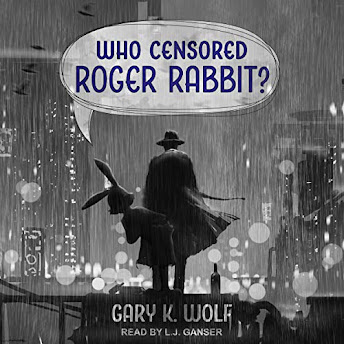
WHO CENSORED ROGER RABBIT (audiobook) by Gary K. Wolf


Book originally published in 1981.
Audiobook edition published in 2019 by Tantor Audio.
Read by L.J. Ganser.
Duration: 7 hours, 36 minutes.
Unabridged.


This book is the inspiration for the much-celebrated Disney movie Who Framed Roger Rabbit? but readers should know that it is not much like the movie.

Three of the main characters are the same - Private Investigator Eddie Valiant, Toon movie star Roger Rabbit and his Toon wife Jessica Rabbit.

But, the world they inhabit is different than the world in the movie. In the movie, Toons make cartoon movies. They are filmed like regular movies. In the book, Toons don't make movies, they make comic books and comic strips. Toons in the book have the little voice bubbles that appear over their heads just like you see in comic books and comic strips. The actors pose for the comic strip pictures and photographers take their pictures.

A quote from the book. Also, a very true statement.
In the book, Roger Rabbit is actually killed and Eddie Valiant is on the case looking for his murderer. There is not Toon World like there is in the movie - Toons just live and work among humans and are certainly second class citizens.

The Toons are a running commentary on the racial situation in the United States and that fact is essential to the book. They were living in North America when colonists from Europe displaced them. They were imported to work on the railroads in the late 1800's. Toons have their civil rights, but when a Toon moves into the neighborhood, people move away and the property values drop. Some Toons are lucky enough to "pass" for human. 

This book is a much darker story than the movie. That doesn't bother me any. But, this story has some unnecessary complicated powers of Toons that make the story line clunky. I think Disney made a lot of improvements when they adapted this story to make the movie. That being said, the book is pretty strong as its own independent work and was a very creative idea.

The audiobook was read by L.J. Ganser who did a great job with a lot of very different kinds of characters, including a lot of Toons who speak in, well, cartoonish voices. 

I rate this audiobook 4 stars out of 5. It can be found on Amazon.com here: WHO CENSORED ROGER RABBIT (audiobook) by Gary K. Wolf.

THE PARANOID STYLE in AMERICAN POLITICS and OTHER ESSAYS by Richard Hofstadter


-Originally published by Harper's Magazine in 1964 and in book form by Alfred A. Knopf in 1965.
-Audiobook published in 2018 by Tantor Audio.
-Read by Keith Sellon-Wright.
-Duration: 10 hours, 44 minutes.
-Unabridged.


Award-winning historian Richard Hofstadter (1916-1970) wrote these essays over a series of years and compiled them into a collection with a loose theme of how American politics is affected by paranoid conspiracies. 

Barry Goldwater (1909-1998)
He starts with the presidential candidacy of Barry Goldwater and the political commentary of groups like the John Birch Society. His descriptions of the Goldwater campaign sound so much like the Trump campaign of 2016 that a reader can almost replace the name Goldwater with the name Trump. The details are, of course, different, but the tone is practically the same. 

The ideological framework of the John Birch Society is replaced with QAnon, the fear of communism is replaced with the fear of immigrants but the tone is practically the same.

That is the main theme of the first half of the book - the near-constant presence of a paranoid fear that some group is trying to overthrow the American way of life. 

 
"The enemy is clearly delineated: a perfect model of malice, a kind of amoral superman -- sinister, ubiquitous, powerful, cruel, sensual, luxury-loving. Unlike the rest of us, the enemy is not caught in the toils of the vast mechanism of history, himself a victim of his past, his desires, his limitations. He wills, indeed, he manufactures, the mechanism of history, or tries to deflect the normal course of history in an evil way. He makes crises, starts runs on banks, causes depressions, manufactures disasters, and then enjoys and profits from the misery he has produced. The paranoid's interpretation of history is distinctly personal: decisive events are not taken as part of the stream of history, but as the consequences of someone's will. Very often, the enemy is held to possess some especially effective source of power: he controls the press; he has unlimited funds; he has a new secret for influencing the mind (brainwashing); he has a special technique for seduction (the Catholic confessional)..."

This paranoid strain is not unique to America, of course. For example, the fear of the Illuminati and English fears of a Catholic revolution. 

The fears of a Catholic revolution spread to America as well, but that was just a part of a whole series of paranoid conspiracies that Hofstadter points out. I decided to come up with my own list. Hofstadter passed away in 1970 so he never heard of the paranoid conspiracy theories that I remember being actively discussed (some quite seriously) in my lifetime.

Here is a list of all paranoid conspiracies that I remember (starting from the early 1980's):
 
-Satan worshipers were killing thousands of children in day cares across the country;
-back masked lyrics were brainwashing people that listened to rock music and making them kill themselves;
-Dungeons and Dragons was causing kids to go crazy (Tom Hanks made a movie about it!); 
-the New World Order was taking over America and flying black helicopters all over America and leaving secret messages for soldiers on the back of interstate road signs;
-FEMA camps. This is one of my personal favorites because the AMTRAK train yard in Beach Grove, Indiana was to be converted into a secret government concentration camp (Beach Grove is a neighborhood in Indianapolis, where I live);
-President Obama was a secret gay Muslim who was selling out America;
-QAnon with all of its weirdness (including a resurgence of the lizard people in some strains);
-crisis actors creating all of the school shootings (Alex Jones);
-Former President Trump's Stop the Steal movement with Italian satellites and Venezuelan vote tabulators conspiring to steal an election.

The rest of the book is not nearly as interesting. It has rather lengthy essays on the Spanish-American War, the Anti-Trust movement and the Free Silver movement. They made the point that the earlier essays did, but not nearly as directly and they weren't nearly as interesting.

The entire collection is written in an academic style that is not particularly welcoming to the reader. The author makes a point that the paranoid style of politics is not exclusively a feature of the Right, but he provides no examples of it from the Left, except maybe with the Free Silver movement. The politics of that movement are convoluted enough that you can't really get a good feel if it is a movement of the Left or the Right.

To sum up, the part of the book that discusses the 1950's and 1960's is great. The rest of rather tedious. The first part is worth listening to if for no other reason than to get the reference when you hear it in a political discussion.

I rate this book 3 stars out of 5. It can be found on Amazon.com here: 
THE PARANOID STYLE in AMERICAN POLITICS and OTHER ESSAYS by Richard Hofstadter.

DEEP SLEEP (Devin Gray Book 1) (audiobook) by Steven Konkoly


Published in February of 2022 by Brilliance Audio.
Read by Seth Podowitz.
Duration: 10 hours, 18 minutes.
Unabridged.


Synopsis:

Devin Gray is a retired military operator working for a high-end private security contractor. He is on assignment that goes a little sideways in the D.C. metro area and he is sent away to let things cool off.

While packing up to go, he is contacted about his mother. She is estranged from the rest of the family because she is always off researching a conspiracy theory, which is kind of ironic because she works in a government intelligence agency that looks for conspiracies. She is dead after some short of shoot out in Tennessee and everyone is keeping it quiet.

Gray discovers a note from his mother to him with instructions. It turns out to lead to her evidence that proves the conspiracy and he finds it to be plausible enough to reach out to others. Once they start digging, they find more than it is worse than they ever imagined...

My review: 

I was excited about this book. I really enjoyed the first two book of an his unfinished Rogue State series (link to review of the first book here: Fractured State.) That series is full of non-stop and, frankly, ridiculous action - but it is fun and demands your attention.

This book had a complicated conspiracy that you know in your head is simply too complicated to work, but your gut says, "Oh crap! This could really happen!" I had no problem with the premise of the book.

I had problems with the pacing of the book and the proliferation of characters. Konkoly decided to make characters out of some of the bad guys in an effort to confuse the reader at first. It worked and it was kind of a good choice except that he keeps on adding character after character after character and this audiobook reader got confused as to who exactly was who. I just decided to ignore character names and label them "good guy" and "bad guy" in my head. That totally defeated the purpose of creating a named character with lines and a personality, but I couldn't keep up. When one of them goes down in a gun fight, I didn't care a whole lot - I just kept a little running tally in my head to see if any of the good guys were going to survive.

For an action story, this book has an awful lot of sitting around and talking. Sitting around and talking in a restaurant, in a car, in a secret hideout, in another car, in an SUV, in a rented house, in another SUV, in a hotel, in a mansion, in a helicopter, in another hotel.

So many of these conversations were repeats of other conversations. The conspiracy is discovered and then explained to another person. That person explains it to a small group. That group explains and discusses with another group and by that point I felt like I could have stepped in and gave the explanation myself.

So, to sum up - too many characters makes the story hard to follow. Too much repeat conversations stretched the story out for no real reason.

On a pet peeve note: Konkoly is from Indianapolis and lives in Indianapolis. So do I. I was pleased to see part of the book took place in an Indianapolis suburb that he described perfectly (Carmel.) However, the audiobook reader mispronounced it. It is pronounced the way many people mispronounce the candy "caramel." He pronounced it like the California city "Carmel by the Sea." This was not important to the story and people who do not live in Indiana would have no idea but considering that the author lives here...

I rate this audiobook 2 stars out of 5. I will not be moving on to book two in this series. This book can be found on Amazon.com here:  DEEP SLEEP (Devin Gray Book 1) (audiobook) by Steven Konkoly.

9 DAYS (Dee Rommel Mystery #2) by Jule Selbo


Published September of 2022 by Pandamoon Publishing.

Synopsis:

Dee Rommel has decided to leave the Portland, Maine police force due to physical disability. She lost part of her leg and has to wear a prosthetic. She gets around very well but she just doesn't have it in her to go back on the police force.

Instead, she is working with a private detective and (very slowly) working on her own private investigator license. 

The mother of a wealthy local family with a generations-long history of being town benefactors and being more than a little quirky has confessed to murdering her gardener in her own backyard. The police think it is an open and shut case.

However, her youngest child, a twelve year old who is a genius by anyone's standards thinks otherwise. He has hired the detective agency Rommel works for and Rommel is assigned the case.

While the police seem to think it is a cut and dried case of murder, Rommel keeps finding evidence that things may not be as simple as they seem. It also is obvious that there are people who don't want Rommel to look beyond the simple and obvious explanation...

My review:

This is my second Dee Rommel mystery. She is a great character and the series has a solid feel to it. The author has created a world for her, it makes sense and this reader likes the people in it.

I rate this book 4 stars out of 5. It can be found on Amazon.com here: 9 Days (Dee Rommel Mystery #2) by Jule Selbo.

Note: I received a free copy of this book from the publisher in exchange for an honest review.  

SPENSER: A MYSTERIOUS PROFILE (Mysterious Profile Series) (Kindle) by Robert B. Parker


The Mysterious Profile series' title pretty much sums up what the series is all about. They are short profiles of famous lead characters in mystery series in the words of the authors themselves. Sometimes they are interviews in which the authors tell about the inspiration for the characters. Other times, they are scenes in which the characters explain themselves.

This profile is of the wisecracking detective Spenser created by Robert B. Parker. Parker (1933-2010) wrote 40 novels featuring wisecracking private detective Spenser and literally had a heart attack and died at his desk writing the 41st novel.

The Spenser books are the mold of any modern book series featuring a principled and competent investigator with a tough, mostly silent friend of dubious morality to back him up. This model is followed in the current-day book series of Elvis Cole by Robert Crais and Joe Pickett by C.J. Box

The problem of having Parker provide a profile of Spenser is that Parker has been dead for a dozen years. This profile is taken from another book, a collection of essays called In Pursuit of Spenser: Mystery Writers on Robert B. Parker and the Creation of an American Hero. Parker wrote a scene where Spenser is interviewed by a Harvard psychology professor (Spenser's love interest is a colleague of this professor) about manliness, love and what makes him tick.

The author, Robert P. Parker
(1933-2010)
If you have read a Spenser novel, you know that half of them have a scene very much like this. Parker was big on having Spenser express a great deal of self-awareness and openly discussing it with his girlfriend Susan Silverman while sitting around the dinner table. I usually found those scenes something to be skimmed over, especially when you've read something similar a dozen times or more.

When I found out about this book, I was hoping it was the type of profile that discussed the creation of the Spenser character. However, I was happy to indulge in a bit of nostalgia and read this "interview."

Note: the formatting in this e-book has issues. It makes the conversation hard to follow until you get the hang of it. 

I rate this e-book 3 stars out of 5. It can be found on Amazon.com here: SPENSER: A MYSTERIOUS PROFILE (Mysterious Profile Series) (Kindle) by Robert B. Parker.


DARK SKY (Joe Pickett #21) (audiobook) by C.J. Box


Published by Recorded Books in 2021.
Read by David Chandler.
Duration: 9 hours, 31 minutes.
Unabridged.


Winner of the Spur Award for Western Contemporary Novel (2022)


Synopsis:

Wyoming Game Warden Joe Pickett is good at his job and is known for dealing honestly with everyone. Usually, it's a good thing to have a great reputation. But, it can also mean that people dump the uncomfortable jobs on you because they know you will do them.

The new Governor of Wyoming has an idea that will pick up his slumping poll numbers - he will convince a tech mogul to build his latest server farm in Wyoming. He hopes that the prestige and, more importantly, new high-paying jobs will help the voting public overlook his scandals when it comes time for re-election.

The tech mogul is sort of a combination of Elon Musk and Mark Zuckerburg. He has new skills he wants to master and the current skill he wants to master is providing himself with all of his own food. He gardens and hunts everything and he is coming to Wyoming to go on an elk hunt in the mountains. Joe Pickett has been chosen to make sure he has a successful hunt and tell him all of the advantages of placing his server farm in Wyoming.

However, there is more awaiting this hunting party than a herd of elk...

My Review:

In my review of the 20th book in this series, Long Range, I wished that Joe Pickett would stop acting like a regular police officer and have cases that took him out into the mountains again. This book fits the bill perfectly! As a bonus, there was some discussion of the pluses and minuses of social media.

I rate this audiobook 5 stars out of 5. It can be found on Amazon.com here: Dark Sky (Joe Pickett #21) by C.J. Box.

ELEVATION (audiobook) by Stephen King


Published in 2018 by Simon and Schuster Audio.
Read by the author, Stephen King
Duration: 3 hours, 46 minutes.
Unabridged.


Stephen King has a long history of publishing collections of short stories. I am usually not a fan of short stories, but I have no problem with a Stephen King short story. I think King is so good at making characters that the reader can identify with in such a short amount of time.

This collection is pretty short - just two short stories. Both feature older men.

The author
In one, we have a man living in Maine with a supernatural problem and also a misunderstanding with his neighbors. This one really feels like two stories, but it was pretty touching.

In the second story, a desperately lonely widower living in the Florida Keys is brought a gift by his older sister to get him up and moving again - a puppy.

These are both good stories - very enjoyable and always with a twist. They were read by Stephen King. It was neither a good thing nor a bad thing - his accent was great with the characters in Maine, but he is a good reader, but not a great one. 

I rate this audiobook 4 stars out of 5. It can be found on Amazon.com here: ELEVATION (audiobook) by Stephen King.

Featured Post

<b><i>BAN THIS BOOK (audiobook)</i></b> by Alan Gratz

Published in 2017 by Blackstone Audio, Inc. Read by Bahni Turpin. Duration: 5 hours, 17 minutes. Unabridged. My Synopsis Ban This Book is t...

Popular posts over the last 7 days