SCHOOLED: A NOVEL (kindle) by Ted Fox


E-book published in October of 2022 by Lake Union.

Synopsis:

Jack Parker is a stay-at-home dad - but not really by choice. He used to be a big executive in a growing company, but a series of mishaps one Saturday morning led to him being fired and ending up in a humiliating viral video.

So, he is at home taking care of a toddler and a kindergartner while his wife is moving up the corporate ladder (different corporation, thank goodness.) He is nervous about his kindergartner starting school and is contemplating going back out in the job market because he can see that the need for a full time stay at home dad during the day is coming close to its end.

When he meets his high school bully and nemesis at a local park, he is dismayed. He is more upset to find out that his bully also has a student entering kindergarten at the the same school as his daughter. He decides he has to act when he finds out that the bully is running to be the president of the parent council and is proposing policies that will hurt the poorer families in the school, Jack decides he has to act.

All thoughts of returning to work go out the window because Jack is running for the board and confronting some old nagging ghosts...

My thoughts:

This was an engaging and oftentimes fun novel. Jack is a likable character and the story was interesting, if not always believable.

I did like how the book highlighted the importance of parent involvement in education and the importance of policies that make sure that all families can participate in the school's activities. 

When Ted Fox writes another book I would be interested in reading it.

I rate this e-book 4 stars out of 5. It can be found on Amazon.com here: SCHOOLED: A NOVEL (kindle) by Ted Fox.

Note: Ted Fox is a Hoosier author and this fellow Hoosier likes to recognize authors from the great state of Indiana.

BATMAN: NIGHTWALKER (D.C. ICONS, BOOK 2) (audiobook) by Marie Lu


Published by Listening Library in 2018.
Read by Will Damron.
Duration: 8 hours, 39 minutes.
Unabridged.


The books in the D.C. Icons series are a re-writing of the origin stories of D.C. Comics' iconic characters. To be fair, these YA stories are not complete re-writes. Instead, they are basically about the largely unexplored teen years of these characters (the exception being the 10 year run of the Smallville TV show featuring a teenaged Superman.) 

In this book we meet Bruce Wayne in the 12th grade and he is turning 18 - the age where he inherits the Wayne family fortune and the family business. He may be a legal adult, but he is still an impulsive teen. Bruce joins in on a police chase with a high-tech car created by Wayne Industries. He helps catch the bad guy but he gets arrested for getting in the middle of a police chase.

Wayne gets assigned community service in, of all places, Arkham Asylum. Can you imagine why anyone would assign anyone community service at Arkham Asylum? 

As expected, Bruce Wayne discovers something going on in Arkham that could mean the end of everything as he knows it...

This book requires a bit of suspension of disbelief (as noted above - who would put anyone assigned community service in Arkham?) but it was entertaining. We also meet a teenaged Harvey Dent, giving a bit of insight to his later incarnation as Two-Face. 

It does serve as a natural bridge to Bruce Wayne's eventual transformation to Batman and leaves the door open to more books. I know I would be up for reading more. 

I rate this audiobook 4 stars out of 5. It can be found on Amazon.com here: BATMAN: NIGHTWALKER (D.C. ICONS, BOOK 2) (audiobook) by Marie Lu.

THEY WANT to KILL AMERICANS: THE MILITIAS, TERRORISTS, and DERANGED IDEOLOGY of the TRUMP INSURGENCY (audiobook) by Malcolm Nance


Read by Ari Fliakos.
Duration: 10 hours, 30 minutes.
Unabridged.


Malcolm Nance served for 20 years in the U.S. Navy in cryptology. His work led him to work in intelligence and counter-terrorism. Since his retirement from the military he has worked an additional 20 years as a consultant to the military, as a college lecturer on the topic of counter-terrorism, and as the head of a think tank.

Nance applied what he knows about terrorism to the January 6 Riot and comes up with a series of disturbing conclusions.

Nance is concerned that the most extreme elements of the MAGA movement have gone beyond rhetoric and casual flirtation with militia movements and have actively engaged with them. This book was published in July of 2022 but yesterday (November 29, 2022) two leaders of the Oath Keepers militia were found guilty of seditious conspiracy for their actions at the U.S. Capitol on January 6, 2021.

Why was a fringe militia group in Washington, D.C. on that date? In the trial it was established that one of the reasons they were there was to provide security for speakers and VIPs at the Trump rally that immediately preceded the attack on the Capitol.

Nance's point would be that it should be a major point of concern when politicians move from official security to armed thugs who are not answerable to official authority. They become a private army.

Roger Stone in a golf cart with his Oathkeeper security forces.
Click on the picture to get a larger image and read the shoulder
patch of the man at the wheel of the cart. Do you want your
President's advisors to hang out with violent, organized gangs?
What does that mean for our political future?
Roger Stone has been a Republican campaign strategist since the days of Richard Nixon. He is an infamous dirty trickster. He was an advisor to former President Trump - close enough that he received an official Presidential pardon from Trump when Stone was convicted of lying to Congress. Roger Stone met with the Oathkeepers and the Proud Boys multiple times before the election. It is well-documented because Stone was participating in a documentary. He was quite open about using violence to overturn the results of the election and he was clearly hanging out taking selfies and posing for photos with two violent militia groups in the days before January 6.

This book provides a handy guide to the militia movement in the United States. He provides recent histories, ideologies, relative strengths, and connections to the GOP establishment. Some of them are shockingly well connected.  It is sobering and more than a little depressing to see how low the GOP has sunk. Can you imagine Ronald Reagan even acknowledging the existence of a group like the Proud Boys, let alone letting them speak with his advisors and telling them to, "Stand back and stand by" in a national televised debate. The Proud Boys were encouraged, not dissuaded

Some might argue that groups like the Proud Boys are really a response to Antifa. It is not an unreasonable argument. Antifa is a real thing and they can be violent street brawlers. The difference is that Antifa is not serving as bodyguards for Democrat politicians. They are not serving as Joe Biden's off-the-books muscle. 

This book is unlikely to change the mind of your hard-core MAGA uncle, but it does offer a sobering analysis of the situation the American republic finds itself in. It is good to have a long and hard look at this side of our political situation. This is a depressing and important work.

I rate this audiobook 5 stars out of 5. It can be found on Amazon.com here: THEY WANT to KILL AMERICANS: THE MILITIAS, TERRORISTS, and DERANGED IDEOLOGY of the TRUMP INSURGENCY (audiobook) by Malcolm Nance.

IF THIS ISN'T NICE, WHAT IS? (EVEN MORE) EXPANDED THIRD EDITION: THE GRADUATION SPEECHES and OTHER WORDS to LIVE BY by Kurt Vonnegut


Published in 2020 by Seven Stories Press.
Edited by Dan Wakefield.
Introduction by Dan Wakefield.


Many of the well-known quotes from Kurt Vonnegut (1922-2007) were not actually in his novels - they came from speeches he gave (mostly) in the latter half of his career. Vonnegut became quite a popular deliverer of graduation speeches. And why not? He was witty, irreverent and sometimes came up with a great quote like this one: "Another flaw in the human character is that everybody wants to build and nobody want to maintain it." (p. 230)

The title of this book comes from a story that Vonnegut has included in other essays. Vonnegut had two uncles who responded very differently to his World War II experiences. His Uncle Dan congratulated Vonnegut for having gone to war as a boy and come back as a man. 

His Uncle Alex was a different sort of man. The kind of man who encouraged everyone to notice the good things of life as they happen around us. "...when life was most agreeable - and it could be just a pitcher of lemonade in the shade - he would say, 'If this isn't nice, what is?'" He goes on to note, "If he hadn't said that so regularly, maybe five or six times a month we might not have paused to notice how rewarding life can be sometimes." (p. 135)

An illustration from the book
and the inspiration for the cover.
The book has several of Vonnegut's unique illustrations with their own distinctive Vonnegut style. The book is printed with multiple colors and is literally one of the most attractive looking paperback books I have held in my hands. 

The quality of speeches is all over the place. If you read a lot of Vonnegut, you are used to him rambling along in a seemingly pointless way with any number of weird observations and then he suddenly he drops a profound thought. Some of these are very much that way. Some are strong throughout and some are kind of weak. Having said that, this collection could serve as a fine introduction to a reader who is starting to read Vonnegut's essays. 

I rate this collection 4 stars out of 5. It can be found on Amazon.com here: IF THIS ISN'T NICE, WHAT IS? (EVEN MORE) EXPANDED THIRD EDITION: THE GRADUATION SPEECHES and OTHER WORDS to LIVE BY by Kurt Vonnegut.
 

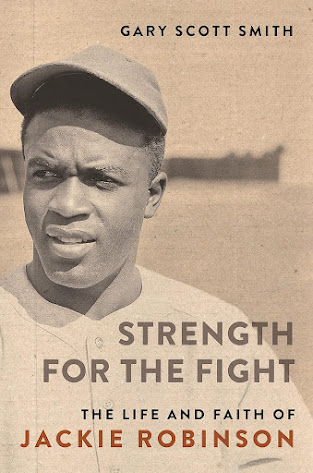
STRENGTH for the FIGHT: THE LIFE and FAITH of JACKIE ROBINSON (Library of Religious Biography) (audiobook) by Gary Scott Smith


Jackie Robinson. 

He is an icon of sports. And politics. And American history.

All fans of baseball know at least the broad strokes of the story of Jackie Robinson (1919-1972) and how he integrated baseball. This book offers a detailed re-telling of that story with a twist - a look at how Jackie Robinson's faith led him to this path and helped sustain him.

Robinson's early life, his time in service during World War II and his college sports career and his relationship with his wife are all covered. The biggest single part of the book is, appropriately, the story of how he and Branch Rickey (the head of the Brooklyn Dodgers) worked together to integrate Major League Baseball in 1947. The book also looks at how Rickey's faith led him to act to make the world a more just place by acting in such a symbolic manner.


Jackie Robinson stealing home.
I am not going to go through all of the details of Robinson's life - that's what the book is for. This book covers it all pretty thoroughly right up until his death in 1972. Sometimes, it was a little slow and repetitive about how Robinson demonstrated his faith. On the whole, though, it was a good listen.

The audiobook was read by Shamaan Casey. He had a perfect voice deep solemn voice for narrating this book. The only complaint I had was that he mispronounced several people's names, including singer/civil rights activist Harry Belafonte and baseball players Orel Hershiser and Derek Jeter. I don't look at this as necessarily the fault of the reader - if you don't know the name, you don't know the name. In my mind, the producer or director of the audiobook should have caught and corrected the mistakes. 

I rate this audiobook 4 stars out of 5. It can be found on Amazon.com here: STRENGTH for the FIGHT: THE LIFE and FAITH of JACKIE ROBINSON (Library of Religious Biography) (audiobook) by Gary Scott Smith.

THE FIRE NEXT TIME (audiobook) by James Baldwin


Read by Jesse L. Martin.
Duration: 2 hours, 45 minutes.
Unabridged.


James Baldwin (1924-1987) was an African-American essayist, playwright, poet and novelist. This book is a collection of two lengthy essays on race and religion in the United States. The book comes from a line from the song Mary Don't You Weep:

God gave Noah the rainbow sign
No more water, the fire next time.


The first essay is in the format of a letter to his nephew entitled "My Dungeon Shook: Letter to My Nephew on the One Hundredth Anniversary of the Emancipation."  As suggested by the title, it is about America's ugly racial history, including incidents from Baldwin's life.

The second, longer essay is "Down at the Cross: A Region in my Mind." This is a discussion of religion in America, including how Christianity had been warped into a tool to prop up a social structure that kept whites on top and blacks on the bottom waiting for their justice to come in the afterlife. It includes an interesting story of a dinner he had with the head of the Nation of Islam, Elijah Muhammad at Muhammad's home. 

The author in 1964.
This is a short audiobook, but it is an intense one. It clocks in at 2 hours and 45 minutes, but feels much longer because there is not an ounce of fluff anywhere to be found. The reader is the veteran Broadway, film and movie actor Jesse L. Martin and I think he hit the right tone throughout. 

While reading this audiobook I decided to do some research on James Baldwin because I was woefully ignorant except to recognize his photograph and the time period that he wrote in. I found this video of a debate between Baldwin and William F. Buckley, one of the founders of the modern Conservative movement. It is an excellent summary of what Baldwin says in this audiobook. Buckley is a renowned debater but he gets his clock cleaned in this debate because Baldwin is so good and Buckley has chosen to defend the indefensible. 

I rate this audibook 5 stars out of 5. It can be found on Amazon.com here: THE FIRE NEXT TIME (audiobook) by James Baldwin.

DESERT STAR (Renee Ballard /Harry Bosch mystery) (audiobook) by Michael Connelly


Published in November of 2022.
Read by Titus Welliver, Christine Lakin, and Peter Giles.
Duration: 9 hours, 37 minutes.
Unabridged.


Synopsis:

The latest Harry Bosch novel has Bosch returning to work with LAPD as a retired volunteer. Renee Ballard was offered a chance to "write her own ticket" because of her work (and very ugly internal politics) in the last novel.

With the help of a sponsor on the city council, she re-established the cold case unit. It has a shoestring of budget and she is the only full time officer in the unit. Everyone else is a volunteer with different skills - a former prosecutor who helps with search warrants, a former FBI field agent, an expert in making family connections with DNA results, an officer who retired early due to health reasons are part of the team. But, Ballard's biggest catch for the team is her sometime unofficial partner - retired LAPD homicide detective Harry Bosch.

Bosch may be old (70+) but he is up on the current technology and trends and he makes a big impact right away with some new ideas to apply to old case files. It's a good thing because that sponsor from the city council wants the unit to solve a cold case from his past...

My review:

One of the things I like best about this series is the fact that Michael Connelly has decided to let Harry Bosch age. Some characters, like James Bond, don't age. That has advantages in a thriller - the character can take a punch, he can run, he can romance the pretty girl.

But, over time it doesn't make sense.

More importantly, to me anyway, when the character doesn't age it is saying that old characters don't have much to offer if they can't run fast and beat up a room full of bad guys. Bosch has got a bum leg, an old Jeep and is a bit of a grump. But, he is full of drive, has no bigger ambitions than solving the next murder case and has lots and lots of spare time. 

The first 80% is a top notch police procedural. Some of the best Connelly has written. The last 20% of the book is good, too, but it is marred by a nonsensical plot point (see spoiler "note" down below) that makes it seem a bit more contrived.

It is clear that Connelly has put Bosch on a timer of sorts and this is one of the last Bosch books. I can respect that - Bosch books have been coming out for the last 30 years and Connelly is 66 years old. He still has time to end the series the way he wants to rather than have it go on in substitute author limbo like has happened to so many other authors like Robert B. Parker and his Spenser and Jesse Stone novels. 

Fans of Harry Bosch should not mourn yet. This book clearly is the first part of a two part series within the series. Bosch and his half brother Mickey Haller have a case to work on.

I rate this book 4 stars out of 5. It can be found on Amazon.com here: DESERT STAR (Renee Ballard /Harry Bosch mystery) (audiobook) by Michael Connelly.

*****Spoiler note*****

Harry heads off literally across the country from L.A. to Key West to confront a suspect without a cell phone. His cell phone is stuck in a car impound lot because his car was part of a crime scene. Throughout the whole book he has been texting, emailing, filming and recording with his phone. He is not a stereotypical old guy who has no idea how to use his phone and doesn't see a use for it. 

Connelly gives an explanation, but I think that the character Harry Bosch would have picked up a burner phone, got hold of Ballard and had her pass the phone number on to others while he was flying to Florida.

TREASURE STATE: A CASSIE DEWELL NOVEL (audiobook) by C.J. Box


Published in 2022 by Macmillan Audio.
Read by Christina Delaine.
Duration: 9 hours, 20 minutes.
Unabridged.


Montana private investigator Cassie Dewell's latest adventures are actually two overlapping cases. One involves a hidden treasure of gold coins. Clues to the treasure were written by an unknown poet who wrote them in a poem on a dry erase board (the "daily specials" board) in a small town restaurant. Dewell is ostensibly hired by the author to see if the treasure can be found by tracing the author's literary footprint. I was immediately struck by the thought that a treasure hunt inspired by a poem story line had already been explored in the TV show Longmire. I would imagine that a great proportion of C.J. Box readers are also Longmire viewers.

The second case involves a swindler who finds lonely wealthy widows, romances them and bilks them out of some of their money with fake investments. Another private investigator from Florida had come to Montana with a lead but disappeared. Dewell picks up the case and finds more than she bargains for...

****

This was a hit and miss book for me.

Cassie Dewell has always been C.J. Box's second series when compared to his work with Joe Pickett. There are fewer Dewell novels and they tend to have more extreme plot twists like deaths of main characters, career changes, moving to different states and more. This book at least offers some stability of keeping Dewell in the same career in the same state at the end of the book. I think the future health of the series is helped by the addition of a familiar character from the C.J. Box multiverse.

The story has some weird plot holes that don't stand up if the reader thinks about them very long afterwards. If the person who has hidden the treasure truly wants to stay hidden, why even tempt a trained investigator with a staff to help her who already has a proven track record of taking down a serial killer and a corrupt police department? He even provides a clue that leads straight to the author of the treasure poem. 

Personally, I think this was an excuse for Box to introduce a bunch of author characters that Dewell interviews throughout the book. They are a diverse bunch and most are not very flattering portrayals of authors. It makes me wonder if he was getting in some digs at some authors he knows. 

The bad guy's reasons for defrauding widows is so contrived that I cannot imagine it happening. Weirdly, it's not just about the money.

C.J. Box is clearly exploring some things. I follow him on a social media platform and he puts out some conflicting thoughts on modern life out there. This book does that as well, with commentary on mask mandates expressed by characters - Dewell's wonderful son is against wearing masks and a mentally ill author is obsessed with wearing them. Box also tosses in comments about pointless nature of a college degree but then has a character that makes a point of observing that he had made it out small town Montana and benefited from the expanded view of the world his education had given him.

Downtown Bozeman, Montana
This book had a definite rural/small town vs. urban vibe. True big city dwellers (NYC, Chicago, etc.) might be surprised that Montana has any urban scene in any sense in the whole state, but I am from small town Indiana and I can guarantee any reader that the rural vs. urban vibe is a thing all over the country.

In this case, the urban dwellers are predators on small town America, but small town America is depicted in a horrible light in this book.

There is also a strange argument between the values of "pull your own self up by your bootstraps" vs. strong unions and even praise for a socialist town government in Montana nearly 100 years ago to counter the power of rich urban elites.

The reader was Christina Delaine. She is not my favorite reader - her tone is simply too disinterested for me. However, she is excellent at reading the spoken parts characters with issues, such as a character with a speech impediment and the crazed ramblings of a woman suffering from a decades-long case of PTSD after a gang rape while she was in high school. It's a glossed over plot point - almost like she was supposed to do something more in the story, but it was dropped. Too bad.

I rate this audiobook 3 stars out of 5. This book can be found on Amazon.com here: TREASURE STATE: A CASSIE DEWELL NOVEL by C.J. Box.

KING RICHARD III: A LIFE from BEGINNING to END (BIOGRAPHIES of BRITISH ROYALTY) by Hourly History


Published in 2019 by Hourly History.


Hourly History is a series of histories and biographies that a reader can read in about an hour. Sometimes, that works out quite well. Sometimes, the topic is just too big to cover in an hour.

I am an avid reader of history, but I have areas of weakness that I am perfectly willing to shore up a bit, but I don't want to invest a ton of time. I want to know a bit more, not become an expert. The British Royal Family is just one of those areas for me. I know more than most people, but I can see the glaringly empty areas of my own ignorance.

I recently read Hourly History's biography of Henry VII (the king that defeated Richard III in battle and took his throne). Usually, I find the British Royal family to be a tedious topic, but I found the Henry VII biography to be quite interesting. I was hoping to have a similar experience with the biography of Richard III.

King Richard III (1452-1485)
Richard III took the throne towards the end of the slow motion civil war known as The War of the Roses. Richard started out as a loyal and devoted follower of his brother (Edward IV) who pretty much let him rule Northern England as a sort of mini-kingdom. Richard dealt with Scotland and border incursions and consolidated English royal control over some of the major noble families of the region.

When Edward IV died, Richard was supposed to step in and serve as Lord Protector for Edward V. Edward V was only twelve years old and Richard was to rule in his stead until Edward V came of age. 

This is where Richard III's story becomes complicated and very much like an episode of Game of Thrones...

This is an exciting story (Shakespeare wrote a play about it because it was so rich in drama) but this short biography just fails to convey that drama. 

I rate this biography 3 stars out of 5. It can be found on Amazon.com here: KING RICHARD III: A LIFE from BEGINNING to END (BIOGRAPHIES of BRITISH ROYALTY) by Hourly History.

GANGSTERS vs. NAZIS: HOW JEWISH MOBSTERS BATTLED NAZIS in WARTIME AMERICA (audiobook) by Michael Benson


Highly Recommended

Published in 2022 by Tantor Audio.
Read by Gabriel Vaughan.
Duration: 8 hours, 53 minutes.
Unabridged.


Flag of the German American Bund
In the United States in the 1930's there was a small, loud, enthusiastic, and growing group of Americans that were great fans of Hitler and the Nazi party. They were largely ethnic Germans and formed organizations that sported Nazi symbols and mimicked the big rallies that Hitler had in Germany. They also mimicked the overt antisemitic speech exhibited by the Nazis. The most successful of these was the German American Bund (German American Federation).

There were a lot of small groups but there were two larger organizations with a different take than the Bund. The Silver Legion of America (Silver Shirts) had a spiritualist take on hate. Father Coughlin was a literal Catholic priest who brought a "Catholic" view on antisemitic hate and anti-interventionism from Detroit. He had a massive radio audience that was so enthusiastic that his church superiors were afraid to muzzle him.

Officially, Nazi Germany did not support these groups, but there were plenty of unofficial connections.

The national government could officially do nothing to stop them quickly (although the age-old tactic of looking for things like tax violations did work to slow some of them down over time.)

There was also very little that local governments could do to stop these meetings. Some localities, like New York City, outlawed wearing some of their Nazi-style outfits (dubious legality). Others just buckled down and over-scrutinized all of their rental applications for meeting halls, applications for parades, and so on. If there was a misspelling, or any similar type of mistake it was denied. 

But, that kind of thing only lasts so long. Eventually these American Nazis learned to double check their paperwork and take advantage of America's wide open freedom of speech rules to advocate for actions that would kill those very same freedoms.

A judge from New York City named Nathan Perlman decided that if the American antisemites were going to have paramilitary organizations, American Jews needed one to literally punch back. Turns out he knew a whole bunch of tough Jewish guys that paraded through his court room on a regular basis - Jewish mafia gangsters. People like Mickey Cohen, Meyer Lansky, Davie "the Jew" Berman*, and Bugsy Siegel were talked to in an unofficial way. 

The deal was simple - no killing, lots of roughing up (but not too rough), try to disappear afterwards, no overt help from the judge, avoid the press. In return, there would be lots of backroom maneuvers to get them out of jail if needed. The judge appealed to their sense of ethnic loyalty and it worked. These men were not good Jews in any kind of moral way. Most had long since stopped going to temple. However, most had had enough of a connection to the larger Jewish community to have had a Bar Mitzvah and they all understood that if people were going after harmless rabbis and little old ladies that go to temple, they would certainly go after Jewish mobsters.

Mugshots of Meyer Lansky (1902-1983)
Meyer Lansky said this about their involvement: 
"The stage was decorated with a swastika and a picture of Adolf Hitler. The speakers started ranting. There were only fifteen of us, but we went into action. We threw some of them out the windows. Most of the Nazis panicked and ran out. We chased them and beat them up. We wanted to show them that Jews would not always sit back and accept insults"

This Nazi-Gangster fight did not go on for too long - a couple of years at longest. The German American Bund began to fizzle out during 1939 when everyone was starting to get a real sense of what Nazi Germany was all about. Pearl Harbor pretty much brought an end to the pro-fascist meetings thanks to Italy and Germany declaring war on the United States to express their solidarity with Imperial Japan. 

Are there thorny free speech issues in this scenario? Well, it looks bad when a judge is recruiting a crew of guys to beat people up for expressing their political thoughts. But, when you consider the record of Nazis before and during the war it's pretty hard not to enjoy hearing about the mobsters beating the crap out of a bunch of loud-mouthed racist bullies.

I recommend the audiobook version because of the reading of Gabriel Vaughan. The book is written is written in a lively and engaging manner and uses words or phrases from movies or newsreels from the time period, using slang like "heaters" (guns) and "whacked" (mafia ordered murder). Vaughan doubles down on this theme by reading with a mild accent reminiscent of newsreel narrators of the time.

I rate this audiobook 5 stars out of 5. It can be found on Amazon.com here: GANGSTERS vs. NAZIS: HOW JEWISH MOBSTERS BATTLED NAZIS in WARTIME AMERICA (audiobook) by Michael Benson

*Note on Davie "the Jew" Berman. Mobster nicknames are almost always colorful. Berman has to have the least imaginative nickname of all the mobsters of this era. That's most likely due to the fact that he was operating out of Minneapolis and Iowa City - places not known for large Jewish populations.

KING HENRY VII: A LIFE from BEGINNING to END (BIOGRAPHIES of BRITISH ROYALTY) by Hourly History


Hourly History is a series of histories and biographies that a reader can read in about an hour. Sometimes, that works out quite well. Sometimes, the topic is just too big to cover in an hour.

I am an avid reader of history, but I have areas of weakness that I am perfectly willing to shore up a bit, but I don't want to invest a ton of time. I want to know a bit more, not become an expert. The British Royal Family is just one of those areas for me. I know more than most people, but I can see the glaringly empty areas of my own ignorance.

King Henry VII of England (1457-1509)
Henry VII was the king that ended the a civil war between competing royal families - The War of the Roses. It was not a sure thing, though. It was a long shot for him to even survive, let alone make it to the throne. Normally, these complicated royal stories bore me, but this one had a lot of dramatic elements - murder of children, escapes, battles, betrayal, the death of a king on the battlefield, and more.

The length of this e-book was perfect. I rate this e-book 4 stars out of 5. It can be found on Amazon.com here: 
KING HENRY VII: A LIFE from BEGINNING to END (BIOGRAPHIES of BRITISH ROYALTY) by Hourly History.

REBEL with a CLAUSE: TALES and TIPS from a ROVING GRAMMARIAN (audiobook) by Ellen Jovin


Published by HarperAudio in 2022.
Read by the author, Ellen Jovin.
Duration: 7 hours, 38 minutes.
Unabridged.


Ellen Jovin had a fun idea. She sat up a table near a New York City subway entrance with a sign that said "Grammar Table" and within 30 seconds someone came to ask a question. She doesn't just take questions, though. She also takes complaints, comments, and observations as well. 

This worked out so well that she and her husband decided to take it on the road and visit all 50 states and make a documentary (he is the cameraman, she is the talent.) However, they only made it to 47 states due to the intervention of Covid-19.

Jovin has a great way of speaking with people about grammar and she has the training to back it up. Most people are defensive and/or nervous about their grammar skills. Jovin sets them at ease and gives them explanations that are easy to understand. I literally have no problem with that aspect. 

That being said, this audiobook was kind of a chore to finish. Jovin's reads her own book and does a good job, but the text was grammatically correct but not necessarily inviting for long-term listening. 

Each of these chapters would be a great weekly 3-5 minute segment on an NPR radio show but were not necessarily fun to listen to back to back to back they got to be be quite repetitive.  


The author at her table
A typical chapter would include the description of the people asking, the location of the table for this question (South Bend, Indiana or wherever) and a literal transcript of their conversation. This could take a while and rarely revealed anything particularly interesting and if properly edited could have knocked at least an hour off of the book. At first, this aspect to the book was charming - it felt sort of welcoming and homey. But, by the time we had worked our way up to the twentieth question, it was getting a bit old. If this were broken up into weekly segments on NPR I am sure I would have loved it.

A reader may be wondering at this point why I didn't do just that very thing and listen to this book in bits of pieces over a long period of time. The answer is simple: I checked this book out of the library as a digital download and only had it for a limited amount of time to listen to it before it went back to the library and on to the next person on the waiting list. So, I listened to it over the course of 10 days or so and it was a bit too...a bit too much.

I rate this audiobook 3 stars out of 5. It can be found on Amazon.com here: REBEL with a CLAUSE: TALES and TIPS from a ROVING GRAMMARIAN (audiobook) by Ellen Jovin.

ALL the WAY to the TIGERS: A MEMOIR by Mary Morris


Published by Recorded Books in 2020.
Read by Susan Bennett.
Duration: 6 hours, 32 minutes.
Unabridged.


Sometimes I fall asleep listening to the news on my local NPR station. One morning I woke up to PBS's Rick Steves (the guy who does all of the European travel shows) interviewing Mary Morris about this book. Turns out he has a travel-themed NPR radio show and they discussed her travels around the world. They discussed where she went in India and why she went (to see a tiger in the wild) and I immediately looked it up on my audiobook up and requested it.

But, I was unpleasantly surprised to find out that this book was not the book I heard described in the interview. I heard a great discussion about a travelogue book to India. I am always interested in hearing about India because it is an ancient society, it is a democracy and it is an up-and-coming economic power.

Also, I am a sucker for travelogue books.

I have read a book by a man who hiked across America following an oil pipeline, a man who hiked the Appalachian Trail with his semi-drunk friend, two guys who hiked from Mexico to Colombia, a guy who biked from the UK to India, a guy who rode a motorcycle around Afghanistan, a guy who hiked across Afghanistan when the Taliban collapsed in the early 2000's, and two ladies that rode bikes from Turkey all the way to India and China. I am sure there are more.

This book has some travelogue features to it, but about 1/3 of the book is flashbacks to her childhood and her parents. They are both weird. One could easily argue that they were abusive.  About 1/3 is flashbacks to the time she broke her ankle while ice skating and all of the reconstructive surgery she had to endure. The remaining 1/3 (maybe less) talks about her trip to India to look for tigers in the wild.

The travelogue portion was the best part. The flashbacks parts, at their best, were tolerable. I almost quit listening at multiple points. But, in the end, I just had to know if she saw a tiger or not (they are elusive, solitary creatures).

I rate this audiobook 2 stars out of 5. It can be found on Amazon.com here: All the Way to the Tigers: A Memoir by Mary Morris.

CULPER SPY RING: A HISTORY from BEGINNING to END by Hourly History


Published by Hourly History in 2022.

The Hourly History series features e-book histories and biographies that can be read in about an hour. They are great if you want to learn more about a topic, but you don't want to read a regular-sized book or biography. Plus, they offer a set of free books every weekend so you can explore without spending a dime.

The Culper Spy Ring has become a trendy topic in Revolutionary War history (if you can have such a thing). The spy ring grew out of the need of Continental Army to keep tabs of the British forces based in New York City. The spies were untrained but clever amateurs who, over time developed fairly sophisticated techniques to deliver information, including newspaper ads, letters with invisible ink and secret codes. They used the fact that they were private citizens to their advantage by taking advantage of their normal business routes and family visits to pass along knowledge.

I was intrigued by the fact that after the war the spy ring kept their secret spy ring a secret until they died. Their roles were pieced together by historians in the 20th century. 

Hercules Mulligan, 1740-1825
I was surprised find Hercules Mulligan in the book. I was only aware of him because of my daughter's love for the Broadway musical Hamilton. Mulligan is on the edges of the action in the production (he has less than a minute of solo singing parts - here is a link to all of them put together. Be aware that Mulligan uses foul language in the musical.)

It turns out that Hercules Mulligan may be worthy of his own musical. He was a member of the Sons of Liberty and he ran a high end tailor shop that was so good that the British officers used despite his political leanings. He must have been a great conversationalist because he pumped those officers for information even after Benedict Arnold had him briefly imprisoned for being a suspected spy. He started the war as a slave owner but freed his slave Cato in 1778. He also co-founded the New York Manumission Society, a group dedicated to gradually abolishing slavery and protecting free African Americans who were wrongfully accused of being runaway slaves. 

I enjoyed this e-book quite a bit. I rate it 5 stars out of 5. It can be found on Amazon.com here: 
CULPER SPY RING: A HISTORY from BEGINNING to END by Hourly History.

CORYDON: THE FORGOTTEN BATTLE of the CIVIL WAR by W. Fred Conway


Published in 1991 by FBH Publishers.


If you have ever traveled across Southern Indiana visiting historical sites like the Falls of the Ohio (a great fossil bed and a Lewis and Clark site), the Lincoln boyhood site and New Harmony then you have certainly seen a history written by W. Fred Conway.

I know that the top-rated, best-selling history authors depend a lot on writers like W. Fred Conway in order to get the more popular, wider-audience histories written. Why? Because Conway is a fan of Indiana history and he has done a lot of research that big name historians would never have time to do simply out of a love for his local area. This is one of the many books he has written about Indiana, Kentucky and/or Ohio and life along the Ohio River. Conway knows his stuff.

Unfortunately, there's not much of a story in the story of the Battle of Corydon. It was part of John Hunt Morgan's July 1863 into Union territory. The raid started June 11 in Tennessee and after more than 1,000 miles ended July 26 in Ohio along the Ohio River near West Virginia and Pennsylvania.

Along the way, Morgan fought one real battle, although he had lots of little skirmishes. On July 9 a little less than 400 members local home guard militia set up a battle line and fought more than 2,000 Confederate cavalry in the Battle of Corydon. They were quickly outflanked on both sides and captured. This was one of two Civil War battles fought on Union soil - the other one was Gettysburg a week earlier. 

To their credit, the militia gave better than they got. The militia killed 11 Confederate soldiers and wounded 40 and suffered 4 dead and 10-12 wounded. The captured militia was paroled (released on the promise that they would no longer fight in the war in any way) and Morgan's men moved on after some looting and taking more than $25,000 in Union money from local businessmen in exchange for not burning down their businesses. 

That's the basics of the battle. It didn't take very long and was tiny in comparison to the two massive battles that took place in July of 1863: Vicksburg, Mississippi and Gettysburg, Pennsylvania. It was interesting to note that Morgan learned about the results of those other two battles while he was in Corydon.

The book goes on to tell a "lite" version of the rest of the raid, including Morgan's capture and subsequent escape. However, there's still not a lot to this book. There are dozens of photos and drawings (always appreciated - but there were so many that it felt like filler). There is also an appendix about "Corydon Today" - a historical document in it's own right, considering it was printed 31 years ago. All of the pictures and the appendices made me wonder of the publisher had a minimum page requirement. 

I rate this book 3 stars out of 5. It can be found on Amazon.com here: 
CORYDON: THE FORGOTTEN BATTLE of the CIVIL WAR by W. Fred Conway.

THE BOMBER MAFIA: A DREAM, A TEMPTATION and the LONGEST NIGHT of the SECOND WORLD WAR (audiobook) by Malcolm Gladwell


Published in 2021 by Pushkin Industries.
Read by the author, Malcolm Gladwell.
Duration: 5 hours, 14 minutes.
Unabridged.


Before there was a U.S. Air Force, there was the U.S. Army Air Corps. Before the Army Air Corps (re-organized as the U.S. Army Air Forces in 1942) built the largest collection of flying fighting machines to relentlessly bomb the Axis Powers in World War II, they had a tiny budget and a few air bases. One of these was Maxwell Field, a training facility in Alabama. That facility became the intellectual home of a group of pilots who espoused the concept of precision bombing. They were known as The Bomber Mafia.

Precision bombing is the theory that teaches that you don't have to blow an enemy's entire military to pieces, you can just hit certain key industries and choke out their ability to produce more weapons/feed their people/move soldiers and so on. This was intended to be a more humane way to wage war - an antidote to the mass slaughter the world saw in World War I. Precision bombing could end wars before they got to that point by simply forcing an opponent to stand down. The invention of the Norden Bomb Sight convinced them that bombers could fly as high as they wanted over the enemy and could still drop bombs precisely where they wanted them

The other argument when it comes to bombing is strategic bombing. Strategic bombing, in simple terms, is brute force bombing. It is simply dropping bombs on enemy territory to inflict maximum mayhem and damage with the goal of breaking the morale of the enemy. Think of it as something like Sherman's infamous March to the Sea from the Civil War, but delivered from the air.

In the European Theater, the U.K.'s Royal Air Force followed a policy of strategic bombing. They flew at night in order to give their pilots cover and they indiscriminately dropped bombs on German cities. The Americans flew during the day and used the daylight to try to hit certain high value targets as part of a precision bombing strategy. 

This audiobook is about the debate over the two points of view, specifically in the Pacific Theater. For months, the United States tried precision bombing, but a combination of things made it difficult, including factors like the weather was much more erratic and the manufacturing base was more diffuse (a lot of parts were actually made by small-time family-based manufacturers).

US Navy Grumman TBF Avenger aircraft dropping
bombs on 
Hakodate during July 1945
When Curtis LeMay arrived in the Pacific Theater, he brought a different plan. He had personally flown and led precision bombing missions and was not impressed. He brought massive fire bombing campaigns to Japan and leveled city after city.

Gladwell comes up with a mixed bag of conclusions. He gives the impression that strategic bombing was the obvious choice, but it clearly wasn't that simple. LeMay leveled huge chunks of 66 Japanese cities and the Japanese kept on fighting. Tokyo was hit so hard that it was actually removed from the official target list. 

Imagine of the situation was reversed and America was subject to such attacks. New York City would be hit so hard that it was effectively gone and so would the next 65 cities by population. That would include Chicago, Los Angeles and Dallas, of course. But that would also include the destruction of such smaller cities as Indianapolis, Albuquerque, Milwaukee, Cleveland, Fresno, San Juan (Puerto Rico), Tulsa, Corpus Christi, Tampa and Cincinnati.  Would we have kept fighting?

I say we would have kept right on fighting. Strategic bombing was used against England at the beginning of the war and, in the end, it seems to have made England all the more determined to fight and inflict as much strategic bombing as possible on Germany. One could argue that the Germans and Japanese surrenders owed more to fear of Soviet occupation than a desire to end the firebombings. 

Gladwell brings the discussion into the modern world with discussions of cruise missiles that can hit specific GPS locations and drones that can target individual people. He gives the impression that precision bombing is actually the way to go. 

But, did our targeted "Shock and Awe" campaign in the Iraq in 2003 make the Iraqi people decide to just go along with America's plans? Did the Taliban just quit even though we killed who knows how many of them with drone attacks that demonstrated we have the ability to sift through all of the data, figure out who they are and find them no matter where they hide?

What were are left with is an unresolved question even though Gladwell gives the impression that he did provide them.

But, the discussion was interesting.

This audiobook was produced by Gladwell's podcasting company. He includes special effects and audio from the time period and interviews that were conducted after the war. It was a really slick production.

I rate this audiobook 4 stars out of 5. It can be found on Amazon.com here: THE BOMBER MAFIA: A DREAM, A TEMPTATION and the LONGEST NIGHT of the SECOND WORLD WAR (audiobook) by Malcolm Gladwell.

Featured Post

<b><i>BAN THIS BOOK (audiobook)</i></b> by Alan Gratz

Published in 2017 by Blackstone Audio, Inc. Read by Bahni Turpin. Duration: 5 hours, 17 minutes. Unabridged. My Synopsis Ban This Book is t...

Popular posts over the last 7 days