TO KILL a MOCKINGBIRD (audiobook) by Harper Lee


Published by Harper Audio in 2008
Originally published in 1960
Winner of the Pulitzer Prize
Voted "Best Novel of the Century" in a Library Journal poll
Read by Sissy Spacek
Duration: 12 hours, 17 minutes

I almost feel silly writing a review for a book that is nearly universally regarded as one of the best, if not THE best, novels written in the last century. This book is read in schools across the country, was adapted into an amazingly successful movie that is as highly regarded as the book. This book is not just respected - it is loved.

I also hate to admit that it had been nearly 25 years since I had read To Kill a MockingbirdAlthough I remembered that I loved the book, I had really forgotten why.

So, when I was offered the chance to review this audio version by the publisher for free I jumped it at. It had been such a long time that I needed to remind myself why it was so great. 

I am not going to waste everyone's time by re-telling the story in detail. Harper Lee creates a wonderfully rich world set in a small town in Alabama during the Great Depression. The story is told from the point of view of young "Scout" Finch. Scout starts as a first grader but the story progresses through several years. She lives with her brother Jem and her father Atticus, an attorney. Her daily life at home is maintained by the African American housekeeper Calpurnia who treats Jem and Scout like they are her own children. Later, her aunt moves in to provide a more permanent feminine role model in the house.

In the first part of the book, Scout's world comes to life as Harper Lee takes the time to lay out her world for us. In the second part of the book, this world is interrupted by an outrageous court case in which Atticus is appointed to defend a black man wrongfully accused of raping a white woman. The third part of the book deals with the consequences of that case. 

Harper Lee (born in 1926)  in c. 1962. 
But, the book is so much more than that. I grew up in a small town in Indiana and her descriptions of the rhythms of childhood play in the summer felt so true to me that the characters become so real that I felt like I actually knew them in my own childhood. 

Sissy Spacek's reading of this book is as timeless as the book itself. The decision not to have her actually change voices as she reads the story was a brilliant stroke. Most audiobook readers change voices and make separate voices for each of the characters even if it is told from the point of view of just one of the characters. Spacek keeps the entire story in the voice of Scout because the entire story is told from her point of view. It is her story.

I thoroughly enjoyed this audiobook. I found myself listening to it whenever I could. I happily rate it 5 stars out of 5.

See my review of Harper Lee's Go Set a Watchman here.


This book can be found on Amazon.com here: To Kill a Mockingbird.

This book was on a list of books to be investigated in Oklahoma by conservative parents. Here is a link to an article.

This book is also on lists of books that Progressives want to ban. Here is a link to a list maintained by a university that tracks book bans. In this case, it is for inclusion of the n-word.

OLD NATHAN by David Drake


Originally published in 1991 by Baen Books

David Drake, a science fiction author who usually specializes in tales of high-tech fighting told from the grunt's point of view changes pace with Old Nathan, a tale of backwoods folk magic. 

Set in the the 1830s in rural Tennessee, this book features Old Nathan, often called the "cunning man". Old Nathan suffered a life-changing injury during the battle of Kings Mountain in the Revolutionary War. As he recovered, he discovered that he had been gifted with some magical powers, including the ability to talk with animals. 

Fifty years later, he is living in Tennessee and serves as the local area's potion-maker and a resolver of problems of last resort. He also can cast some spells. He does not understand the powers, but he understands that the spells he cast do not always resolve the problems the way that his clients hope.
Photo by DWD


The book consists of five interrelated short stories. The best story by far is the last one but you really cannot understand it without reading the other four and they are pretty boring. The stories are long on descriptions of Old Nathan traveling by donkey and dire warnings about using magic but I just never really bought into the characters. Nathan was intentionally stand-offish and mysterious and difficult to relate to. The locals all around him were rubes or just difficult to like or even be interested in.

This book can be found here on Amazon.com: Old Nathan.

I rate this book 2 stars out of 5.

THE LOST KINGDOM (audiobook) by Matthew J. Kirby


Published by Scholastic Audio in 2013.
Read by Charlie McWade
Duration: 8 hours, 41 minutes

The Lost Kingdom is an alternate history set in a world in which mastodons still roam North America in great herds and are hunted by giant predators called bearwolves. The story is set just before the French and Indian War and the situation is easily recognizable for anyone familiar with that time period. The English colonies arranged along the Eastern Seaboard but the interior is largely controlled by the French and their numerous Indian allies through a vast trading network. As the English move farther inland they encounter more and more resistance and everyone knows that it will lead to open warfare, probably sooner rather than later.


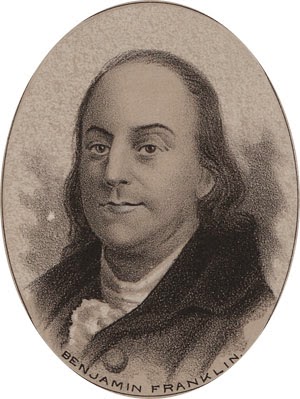
In a bold move to secure a new set of allies in the interior, the American Philosophical Society, a group of intellectuals led by Benjamin Franklin, have decided to send an expedition in search of a fabled Welsh kingdom built around the legendary tale of Madoc, the Welsh prince who is supposed to have landed in the America's centuries before Columbus. This really is a legend in our world, so I found that to be quite interesting.

The intellectuals are joined by the son of their botanist, a young teen named Billy Bartram. They are not traveling by boat or by foot but in a sort of steampunk airship powered by balloons of some kind. The ship is an actual ship and it flies much like a blimp. They fly out to the new fort at what will be Pittsburgh in the distant future (barely escaping French spies as they leave Philadelphia). A sneak attack by French Marines and an encounter with a bearwolf throw the entire expedition off track. Throw in the suspicion that there is a spy in their midst and things have really gone wrong for Billy and this crew of geniuses...

****Spoiler alert****

So, here's the thing for me and this book. I do not mind the steampunk ship or the mastodons or even the legend of the Welsh. I think those made the book fun. But, I have a problem when the book violates its own internal rules and here are three gigantic errors that just don't make sense.

1) The expedition sets off without a single weapon in a time period when people of the frontier did not step out of the house to feed their chickens without a gun at hand. They did this out of fear of Indians and also fear of animal attack. To borrow from another story, imagine if in The Hobbit the expedition set out without a single sword because they knew that swords would be useless against the dragon. Well, that would be silly considering how often they had to fight everything else along the way. In a similar way, the lack of weapons means they cannot defend themselves from animals. Also, they cannot hunt to supplement their food which is a massive mistake in and of itself. This mistake compounds itself

2) The expedition has no weapons because they claim they are a science expedition, not a military one. But, in reality, they are out to find out if the legend of the Welsh is true and make a military alliance with them. That makes them a military expedition.

3) The expedition is attacked by a bearwolf just outside of Pittsburgh. The bearwolf chases the very fast-moving ship on land, somehow tracking it over mountains, across rivers and streams through the little sliver of what is now West Virginia, all along the bottom of Ohio, Indiana, across the Wabash river into Illinois and even across the Mississippi River in some crazed single-minded pursuit of this group so it can attack them for reasons that are never stated. But, really, what animal chases a group of people for hundreds and hundreds of miles?

****End spoilers****

I rate this audiobook 2 stars out of 5. I couldn't get past the internal contradictions. It can be found on Amazon here: The Lost Kingdom.

WOOF (Bowser and Birdie #1)


Published by Scholastic Press in April of 2015


Spencer Quinn is best known for his dog and owner Chet and Bernie detective series. Now, he takes this winning formula in a new direction. Rather than have a police dog (almost) and an army veteran turned detective solve murders, Quinn has re-tooled things for a different series. But, he keeps the most important part the same - the story is told from the point of view of the dog!

In Woof, the first book in the Bowser and Birdie series, Birdie Gaux, a little girl living with her grandmother alongside a swamp in St. Roch, Louisiana. Her grandmother runs what some might call a bait shop and conducts swamp tours in her small boat. Birdie's mother works on an oil rig and talks with Birdie on Skype.

Birdie gets a shelter dog for her birthday and she chooses Bowser. Bowser has had a pretty rough go of it and he hates the shelter. But, boy, does he love Birdie. They make quite the pair as they try to figure out who stole the stuffed Black Marlin that has hung in the bait shop for more than 60 years. There are stories of hidden treasure maps hidden in that marlin and no one wants to hear to the clues that Bowser and Birdie have found. So, Birdie decides to investigate on her own. Of course, Bowser just has to go along...

I was interested to see how Quinn could adapt his Chet and Bernie style into a book for kids. It turns out that he does it fantastically. The book moves along well. Bowser is a good narrator, even if he is easily distracted. The mystery is fairly simple but it could not have been solved without Bowser's help. 

The book can be found on Amazon here: Woof (Bowser and Birdie) 

I rate this book 5 stars out of 5.

Note: I received a uncorrected proof pre-release copy of the book in exchange for an honest review.

SHADOW WARRIOR: WILLIAM EGAN COLBY and the CIA (audiobook) by Randall B. Woods


I have rarely been so glad to have been done with an audiobook as I was with this one.


Published in 2013 by Post Hypnotic Press
Narrated by Michael Puttonen
Duration: 21 hours, 56 minutes.
Unabridged.

William Egan Colby was present at the beginnings of the CIA and served as an inserted commando with the Office of Strategic Services (OSS) in both France and Norway during World War II, pioneering the kind of action he advocated for during his years in the CIA.

The beginning of Shadow Warrior is excellent as it details Colby's life and his World War II exploits. But, as it transitions from World War II to the early years of the Cold War to the Vietnam War the book becomes bogged down, especially in the endless detail about the politics of South Vietnam. Clearly, the Vietnam War was a pivot point for America and for Colby so it should be stressed. However, hours and hours of details about the governing elite of the doomed country were simply tedious.

Colby moves back to America and into the halls of power in the CIA just as the Watergate Crisis is starting to break. America's faith in government was at a low point and people were starting to ask if the CIA should be restrained. Colby had worked his way up to be the Director of the CIA. Colby was as honest as he could be and still keep the CIA open and running as an effective intelligence and counter-intelligence unit. But, once again, the forward momentum of the book is swamped with details. 

Look, I am a high school history teacher. I love history. But, I have rarely been so glad to have done with an audiobook as I was with this one.  
William Colby
(1920-1996)
Making it worse, the reader, Michael Puttonnen insisted on reading quotes from different politicians of the 1960s and 1970s with in an impersonated voice. His LBJ was subtle, but his Nixon and Kissinger voices were not very good and I found them to be distracting
.

I rate this audiobook 2 stars out of 5. I cannot rate it 1 star because I did learn a few things along the way.

Note: I was sent a free copy of the mp3 CD audiobook by the publisher in exchange for a fair review.

It can be found on Amazon.com here: Shadow Warrior: William Egan Colby and the CIA.

A THOUSAND MILES to FREEDOM: MY ESCAPE from NORTH KOREA by Eunsun Kim with Sebastien Falleti. Translated by David Tian


A Remarkable Tale


To be published in the United States on July 21, 2015. 
I received an "Advance Reading Copy" 


Eunsun Kim's tale of her escape from North Korea, along with her mother and her older sister is remarkably easy to read, remarkable engrossing and just a remarkable tale in general.

When Eunsun Kim was 11 years old her mother determined that they could no longer live in North Korea. Eunsun's grandparents were dead, her father was dead, almost everything in the house was sold for money to buy food but there was almost no food to be had because North Korea was in the middle of its Great Famine (1994-1998). Depending on whose statistics you use, the estimates range anywhere from 250,000 to 3,500,000 people starved to death or died from starvation-related causes. Of course, it is hard to say for sure because North Korea is such a closed off society.

Eunsun Kim and her family lived in the northernmost part of North Korea and they decided to cross the Tumen River into China and live as illegal aliens. They would have no promise of safety, no guarantee of work and risked being shot by the border guards on both sides of the border. But, at least they would have chance to eat.

She details several botched attempts at escape and I was pleased to see that at least one border guard was a decent human being. He could see they were starving and desperate and he took pity on them and let them go with a warning - twice! But, he couldn't feed them because there was no food to be had so this small family eventually makes it to China. The family tries to stay together but when Eunsun Kim's mother is sold into sexual slavery (she calls it an unofficial marriage, but the entire purpose of the marriage was to produce a son for her "husband" and no one recognized the marriage as legitimate) the family splits up. The daughters have a better time of it, but it is not easy.

As you can tell by the title, eventually Eunsun Kim makes it to freedom. Their last push to make it to South Korea is tension-filled and her story of how she adjusts to life in South Korea is interesting in and of itself. Now, she lives in South Korea and has lived and travelled all over the world studying (making up for lost years when she had to work to collect wood rather than go to school so they could get food) and promoting her book.

Ironically, A Thousand Miles to Freedom is late to be translated into English (it was published in French in 2012). I say ironically because the United States has had so much involvement with North and South Korea over the last 60+ years. This translation is very good (I teach Spanish and I know how hard it can be to make foreign text sound smooth in a different language). The text flows easily and makes it sound like Eunsun Kim is sitting with you telling her story in everyday, conversational language over a cup of tea.

Last two lines of the book: "The Kim dynasty has so successfully isolated my country that it would be easy for the rest of the world to forget about us. If my memoir can even play a small part in raising global awareness about our suffering and about the tragedies taking place at the hands of this regime, then all that I have endured will not have been in vain."

It can be purchased at Amazon here:  A Thousand Miles to Freedom: My Escape from North Korea

I rate this book 5 stars out of 5.

THE EASTERN STARS: HOW BASEBALL CHANGED the DOMINICAN TOWN of SAN PEDRO de MACORIS by Mark Kurlansky


Published in 2010 by Riverhead Books

The Eastern Stars is more a history of the Dominican Republic than a baseball book, but as author Mark Kurlansky clearly demonstrates, for the last 40 years or so the history of the Dominican Republic has clearly been molded and in some ways defined by its love of baseball. It is also a clear sign of the unhealthy state of economic affairs in a country when so many young people see no hope in moving up in the world except for playing professional baseball in America.

Kurlansky takes his readers through a meandering history of the Dominican Republic, moving backwards and forwards through time detailing a number of interesting stories about this Caribbean country but always coming back to the present to touch base and remind the readers that this is a baseball book, too. 

The Dominican Republic has had a long love affair with baseball thanks to American economic and military excursions into the country. It also has been so poorly managed by it various governments that for decades many young men have sacrificed everything in order to make it on to an American Major League Baseball team roster. Who can blame them - in 2006 ten percent of all major leaguers were from the Dominican Republic (p. 75). So many young men hope to win a contract, play for a few years and then return to the Dominican Republic and live like kings in their gated communities back in their hometowns.

Scouts prowl dusty sandlots looking for some spark of talent, even of the players are using balls made out socks and gloves made out of cardboard, the talent shines through. Or, at least they hope that it does.  Top prospects are enrolled in one of many "schools" that teach a lot of baseball and English and some math and science. In return, these schools get a cut of their contracts for helping to develop their talent. Even the Japanese teams have started sending scouts to the Dominican Republic.

As the title states, the real focus is the small fishing town of San Pedro de Macoris. It is unremarkable in every way except that it keeps producing major league baseball players. 

Why?

Kurlansky never comes out and says it, but after reading so many pages about the Dominican Republic and its sad history the reader just knows that it is because there really isn't anything else. It's either fishing in ever-more-depleted waters for less and less fish for more and more work or its baseball. Meanwhile, you can watch the SUVs of retired major leaguers pick their way around the potholes of roads that haven't been repaired in years and probably won't be anytime soon and know that the only rational choice is to put all of your effort into baseball and only baseball. Everything else is a sucker bet.

Note: many other reviewers have been critical of Kurlansky's detailing of some of the facts about the careers of some of the Dominican players the he describes, getting batting averages wrong and some of the dates wrong. No sport generates factoids like baseball and it is disappointing that Kurlansky has so many errors. But, read the book for what it was intended to be - a history of the Dominican Republic detailing how it became a sort of incubator for major league baseball players.

This book can be found on Amazon here: The Eastern Stars: How Baseball Changed the Dominican Town of San Pedro de Macoris.

I rate this book 4 stars out of 5.

NPR FAVORITE DRIVEWAY MOMENTS: RADIO STORIES that WON'T LET YOU GO by NPR


Published in 2012 by HighBridge Audio
Multicast performance
Duration: 2 hours, 16 minutes

This collection was inspired by listeners who wrote NPR and commented on why these stories from their vast treasure trove of stories have stuck with them for so long. Some are funny, some are sad and some are thought-provoking. They are also a mixed bag. Some are great, some are so-so and some had me wondering why they were included at all.

Pretty typical of the collection is a skit called "Complexities of Modern Love in the Digital Age". It features the two voice actors that you most typically hear when you call a big corporation for customer service and they lead you through the phone tree. In this case, they have the two voices talk to one another and date. The idea is sort of cute but the actual skit was not as funny as the idea of the skit.

A Kathy Griffin interview. Eh. 

The Cookie Monster interview was fun.

I loved the story about a stray cat that wandered into a prison yard and was adopted by the prisoners. They feed it, take turns with it and the amount of discord in the yard has dropped because of this one cat.

I also liked the story of the former KKK member who went from harassing his Jewish neighbors to converting to Judaism thanks to a little human kindness.

The story about pets in the Sarajevo during the war among what used to be Yugoslavia was very interesting.

The story of a young couple in China digging through the rubble after an earthquake looking for their only son and his grandparents who were babysitting was gripping and heartbreaking. Easily the best in the collection.

The story that will stick with me was "Growing Up, Aging Out: The End of Foster Care". It was told from a very sympathetic point of view, wondering what a girl was going to do when she turned 21 and was no longer eligible to be part of the foster care system. But, I found it to be very irritating and the longer I listened the angrier I got. This girl was not physically disabled. She still had not finished high school and she was nearly 21 years old. She was making no moves to get a job or even finish high school. Instead, had been conditioned to accept handouts her whole life and to not work. How would she live without a government check? What would she do? What she was doing was sleeping with her drug dealer boyfriend and trying to get pregnant. I listened to it with my high school-aged daughter and I turned it into a cautionary tale.

So, lots of forgettable stories, some so-so stuff, a couple of really good ones and one really disturbing one.


I rate this collection 3 stars out of 5. It can be found on Amazon.com here: NPR FAVORITE DRIVEWAY MOMENTS: RADIO STORIES that WON'T LET YOU GO.

INSURGENT: BOOK 2 of AMERICA'S FUTURE by Charles Sheehan-Miles


Published in 2012 by Cincinnatus Press 

Insurgent is a worthy successor to the original book in this series, Republic: A Novel of America's Future. Book One details how a fictional confrontation between the state of West Virginia and the federal government over the proper role of the Department of Homeland Security eventually leads to a very short war in which West Virginia is quickly defeated. 

Book Two deals with post-war relations between the occupying federal government, its troops and the people of West Virginia and the closely monitored civilian government of West Virginia.

The flag of West Virginia
The parallels between this fictional war and the Iraq War and the multi-year struggle to create a stable environment in Iraq once Sadaam Hussein was removed from power are striking and, I am sure, quite intentional. And, since this is a book about Americans in a situation similar to that experienced by the people of Iraq, the Iraqi reactions are made all the more understandable to an American reader. 

Sheehan-Miles switches from the point of view of a small military unit helping to keep a crucial road clear to the civilians who interact with that unit to the officials in the limited civilian government and keeps multiple story lines going, including the origins of a nascent insurgent group with powerful weapons and even stronger religious beliefs who starts taking on the occupying troops with bombs, assassination attempts and threats against those who collaborate. 

It is a compelling read and, like I said about the last book, it is guaranteed to make you think.

It can be purchased here on Amazon.com: Insurgent: Book 2 of America's Future

I rate this book 5 stars out of 5.

NOWHERE to RUN (Joe Pickett #10) by C.J. Box


Published in 2010 by G.P. Putnam's Sons

Wyoming Game Warden Joe Pickett is in the last week of his exile to a lonely post - Baggs, Wyoming in Nowhere to Run. Most men would take this last week to fill out the last bits of paper work, say goodbye to new acquaintances and maybe just take it easy. Not Joe Pickett. Joe loves the mountains of Wyoming and he looks at this as one last chance to take a pass through some wild and rugged territory that he may never get to see again. So, he heads off to check into a complaint about butchered elk (a hunter wounded an elk and before he could catch up to it to finish it off someone had already finished it, butchered it and carted off the best pieces) and several comments from long-time locals that the area just felt like something was wrong.

So, Joe heads off with a couple of horses, his nearly useless pistol (Joe is a great guy but a terrible shot with a pistol),his trusty shotgun, and all sorts of camping gear to investigate. He also has his satellite phone that he uses to check in with his wife and family every night.

Sure enough, everything feels wrong and soon Joe comes across Caleb Grim, a giant of a man. Caleb and his twin brother Camish are living illegally in this protected area. Joe stops to cite them. He should have ran when Caleb looked him in the eye and said, "You coulda just rode away." But, Joe is not that kind of guy. 

And, his family knows something is wrong when he doesn't call home that night...

Nowhere to Run is much more action-packed than most of the Joe Pickett novels and C.J. Box does a great job of describing action. It is inspired by a true story of a game warden encountering twin mountain men but it still felt a little forced. It was good, sometimes it was impossible to put down but there were times when it just didn't feel like the story really should have fit together the way that it was being told.  The whole book rates a very respectable 4 stars out of 5. 

I strongly recommend this series.

This book can be found on Amazon.com here: NOWHERE to RUN (Joe Pickett #10) by C.J. Box.

NPR CLASSIC DRIVEWAY MOMENTS: RADIO STORIES THAT WON'T LET YOU GO (audiobook)


Published in March of 2010 by HighBridge Audio

Multicast Performance
Duration: 2 hours

NPR Classic Driveway Moments is a collection comprised of 13 stories (and one intro track) culled from 31 years of NPR radio stories (1979-2010). Most of these stories have depth but not all are equal. 

I was profoundly moved by a story called "My So-Called Lungs" featuring a young woman starting college while struggling with cystic fibrosis. It was engrossing on multiple levels and my high school-aged daughter and I were captivated by the woman's honesty, grace and humor in the face of inevitable death. 

On the other hand, the story "Death of a Child: Losing Adam", featuring a child who was dying from a terminal illness just felt intrusive and maudlin. 

The interview with George Foreman was interesting and quite enjoyable, although NPR being NPR, they found a way to bring a downer note to it by tying the George Foreman grill into it and interviewing homeless people who used it as a cooking appliance of last resort.

The collection ends with a great story, undoubtedly exaggerated, about 2 friends hitch hiking across Nebraska in the 1970s. "Hitching a Ride with Junior McGee" is a great short story told well and is a good way to finish the collection.

Note: this collection is up and down, but the strong stories are very, very strong and are worth listening to.

I rate this collection 4 stars out of 5.

This audiobook can be found on Amazon here: NPR Classic Driveway Moments: Radio Stories That Won't Let You Go

THE ISLANDS of the BLESSED (Sea of Trolls trilogy #3) (audiobook) by Nancy Farmer


Published by Simon and Schuster Audio in 2009.

Duration: 13 hours, 30 minutes
Read by Gerard Doyle

Jack, the apprentice Bard from late 8th century Saxon England and his difficult friend Thorgil, the Viking girl, continue their adventures in The Islands of the Blessed, the conclusion to their trilogy (although there is an opening for the series to continue...). 

As with the other books in this series, Jack and Thorgil come into contact with a host of fairy tale creatures such as Mermen and Mermaids, Hogboons, Half-trolls and even a Viking god as Nancy Farmer demonstrates the depth of her research into European mythology. Jack and Thorgil join the bard on a quest to correct a horrible wrong done by Father Severus on a Mermaid  years ago (the Merpeople are called Fin Folk in this book) that has caused her to become a fearsome ghostly creature that kills and spreads disease and destruction. 
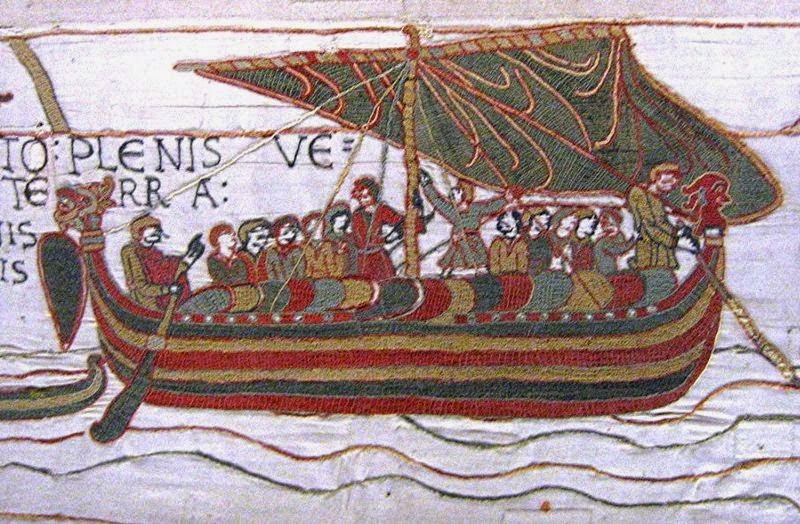
A Viking Longship in the Bayeux Tapestry.
Photo by Urban.

In this book, the adventure returns to the form of the first book and heads out to the open sea in Viking long boats. But, sadly, this book is much more like the second book of the series than the first. The book quickly deteriorates into a series of rather pointless confrontations with random monsters that are the unfortunate by-product of Nancy Farmer's meticulous research. Rather than develop a creature and flesh it out as a character (which the first book did so well with the Trolls and their world) this book just throws the out as a series of obstacles that Jack must overcome in his quest. It reminded me of the worst of the adventures that I helped create when I played Dungeons and Dragons in Junior High and High School.

The best parts of the book are when Jack struggles with the immense changes his world is undergoing. Christianity is a new arrival and Jack struggles with blending his Christian worldview and his pagan worldview.  He struggles with a Christianity that allows Father Severus to be so cruel. But, he has the example of Father Aidan who exudes a much more subtler style of Christianity and who comes so much closer to living up to the ideals of Christianity. Jack respects those ideals and espouses them at a critical moment that I cannot detail here because of spoilers. But, he is also a practitioner of magic that Christianity condemns (or at least discourages, depending on the location).  He also struggles with his friends the Vikings - fantastic friends, loyal to a fault who will gladly slit your throat and sell your sister into slavery and the Viking brand of paganism that glorifies death above all. 

As I listened, I was struck by the idea that the best parts of the book were constantly being subverted by yet another mythical beast's arrival making the book much longer and all the poorer.

Gerald Doyle's narration was extraordinary, as it was in the other two books of this trilogy.

It can be found on Amazon here: The Islands of the Blessed (Sea of Trolls Trilogy)

Click on the Nancy Farmer label below to see the other reviews of the books in this trilogy.

I rate this book 3 stars out of 5. 

CHINESE TURKESTAN: A PHOTOGRAPHIC JOURNEY THROUGH an ANCIENT CIVILIZATION by Ryan Pyle


Published by Ryan Pyle Productions in 2014

Photographer Ryan Pyle has traveled extensively throughout China and India, Luckily, he brings his camera along and takes plenty of pictures. 

His book Chinese Turkestan focuses on the Xinjiang Uyghur Autonomous Region, the most trackless part of the old Silk Road that has connected Europe and China off and on for well more than 2,000 years. The Uyghur are Muslim and their large but sparsely populated homeland lie at the crossroads of Islam and secular Communist China. Their territory touches Tibet, Pakistan, Kyrgyzstan, Kazakhstan and Mongolia.

What Pyle calls Chinese Turkestan is often at odds with the rest of China. The Uyghur are Muslim while China actively promotes secularism. China seems bent on modernizing as quickly as possible but the Uyghur sometimes seemed locked in the past. As Pyle notes in his introduction, "There were many occasions when I stood in a crowded marketplace, enveloped in the early morning haze of coal smoke amidst the cacophony of livestock traders, noodle, bread, and dumpling makers, blacksmiths, knife and carpet sellers, feeling like a time-traveler transported to some bygone era."

Pyle does note the modern world's encroachment with many of his pictures. The first picture in the main body of the book is that of a family playing in one of those grotesque plazas with statues extolling some virtue of an idealized and devoted citizen who is all-too-happy to live for the state that Communist countries excel at creating. 

But, most of the pictures have a National Geographic-type feel to them. They show regular people doing regular jobs pretty much they way that they have been done as long as anybody can remember. Pyle has chosen to shoot all of his pictures in black and white. Black and white can be powerful and it often is in this collection. But, I found myself wishing for just one color photo of the landscape so that I could get a better feel for their environment.

The book can be found here on Amazon.com:  
Chinese Turkestan: A Photographic Journey Through an Ancient Civilization

I rate this book 4 stars out of 5.

Note: I received a copy of this book for free in exchange for an honest review.

NPR DRIVEWAY MOMENTS: DOG TALES: RADIO STORIES that WON'T LET YOU GO by NPR


Published by HighBridge Audio in 2011.
Multicast Performance
Duration: 2 hours, 7 minutes

NPR's Driveway Moments collection are called "Driveway Moments" because the idea is supposed that the stories are so good that the listener sits in the driveway and listens to the end of the story when he/she gets home rather than just turning off the car and going on into the house.

In this collection, the emphasis is on dogs and this collection covers all sort of dogs. From homeless chihuahuas in Los Angeles  to massive sheep dogs in Turkey. There are celebrity dogs, blind dogs, war hero dogs and dogs that go to church. We also hear from two different dog trainers, learn about DNA testing for dogs and learn about a mother dog that adopted a nursing tiger Cub. 

The collection is up-and-down but the strong stories are good enough for me to rate this collection 4 stars out of 5.

This audiobook can be found on Amazon.com here: NPR Driveway Moments: Dog Tales: Radio Stories that Wont Let You Go.

Reviewed on March 7, 2015

NPR MORE FUNNIEST DRIVEWAY MOMENTS: RADIO STORIES that WON'T LET YOU GO


Should be called "Funny People in Rather Boring Interviews" 

Published by HighBridge Audio in 2010
Multicast Performance
Duration: 2 hours, 12 minutes

This collection of performances from NPR's vast radio library is the second volume of "Funniest Driveway Moments." They are called Driveway Moments because the idea is supposed that the stories are so good that the listener sits in the driveway and listens to the end of the story when he/she gets home rather than just turning off the car and going on into the house.

But, most of this 2 CD set should be called "Funny People in Rather Boring Interviews." 

The collection starts out with a run-of-the-mill interview with Joan Rivers (Sorry NPR but discussing her husband's suicide is just not funny) and the most boring interview with Harry Shearer that I have ever heard. There was an interview with Harold Ramis about how to write comedy that was vaguely humorous and I was really beginning to wonder if this would ever pick up.

Thankfully, a clip from "Wait Wait...Don't Tell Me" came on featuring Brian Williams. Despite the recent controversy concerning Williams, this is the best segment of the first CD.

Carol Burnett and Tim Conway come through at the beginning of the second CD and after several slow cuts, another "Wait Wait...Don't Tell Me" cut comes in and picks things up. An interview with Jane Lynch is not terrifically funny but at this point I was glad to settle for interesting and a couple of chuckles. The second CD just sort of eases its way out and I was glad to see it go.

I am a huge fan of NPR's Driveway Moments series but this set is just not all that funny. If you want an NPR-based laugh, find any of the "Wait Wait...Don't Tell Me" CD sets (The Brian Williams track is on one of them) and have a laugh. This was a disappointment.

I rate this audiobook 2 stars out of 5. It can be found on Amazon.com here: NPR More Funniest Driveway Moments: Radio Stories that Won't Let You Go.

Reviewed on March 6, 2015

GETTYSBURG: THE FINAL FURY by Bruce Catton


Published by Berkley Windhover in 1974


Bruce Catton was the most famous Civil War historian of his era and mastered the art of writing narrative history for the masses. I freely admit that I am an unabashed fan of Catton. I am quite sure that he kick-started my interest in the Civil War that has caused me to fill my shelves with over 100 Civil War books.

Catton tells the story of Gettysburg in slightly more than 100 pages His approachable style is in full display here. For example, his description of Confederate General A.P. Hill: "...a heads-down slugger always willing to take a blow in order to land one." (p. 20)   No one is better at telling a Civil War story than Catton and Gettysburg is the single biggest story of the war. He knows how to keep the story moving but to add just enough detail to make it feel like a special re-telling.

The book is full of great maps, illustrations and photographs and is well worth the time of a student of the Civil War or someone who is simply interested in learning more about Gettysburg.

I rate this history 5 stars out of 5. It can be found on Amazon.com here: Gettysburg: The Final Fury by Bruce Catton.

Reviewed on March 5, 2015

NPR ROAD TRIPS: ROADSIDE ATTRACTIONS (audiobook)


Published in 2009 by HighBridge Audio

Multicast Performance

Duration: about 1 hour.

National Public Radio has combed through its broadcast archives and found 13 different stories about the great American institution - the road trip. But, these aren't just any stories. These are stories that feature another great American institution - the roadside attraction. 

The stories cover a variety of quirky attractions including the Elvis Is Alive Museum, The Velveteria (featuring black velvet paintings of Elvis and lots more!), the world's 2nd biggest ball of twine, a series of backyard folk art exhibits in Michigan and even a couple of more famous attractions like Florida's Cypress Gardens and Seattle's Space Needle. A slightly off topic, but very interesting, story about the famed Burma Shave signs is also included. The stories wind up with the story of an epic musical piece written in the classical style about the trials and tribulations of the family car-based vacation.

The stories are all told with a sense of good-natured fun and some, like the story about the Velveteria and the musical tribute to the family road trip have moments where they are laugh-out-loud funny. The first story was fairly weak. But, taken as a whole, these stories are well worth your time.

I rate this audiobook 4 stars out of 5. It can be found on Amazon.com here: NPR ROAD TRIPS: ROADSIDE ATTRACTIONS

Reviewed on February 21, 2015.

WHAT CAUSED the CIVIL WAR: REFLECTIONS on the SOUTH and SOUTHERN HISTORY by Edward L. Ayers


Published in 2005 by W.W. Norton and Company

This wonderful set of nine essays is just about as complete of a discussion of the South, the Civil War, Reconstruction, family, home, historical research and some practical applications of the lessons of the Civil War for us today as I have read.

It seems to me that most of these essays have been published somewhere else first. That being said, Ayers has arranged the essays in What Caused the Civil War in a rough chronological order based not on the historical topic of the essay but on Ayers's own life. He starts with his own childhood in Eastern Tennessee and Western North Carolina and his own growing understand of what it means to be a Southerner. As the essays go along, Ayers goes to college, travels the world a bit and eventually returns to the South to do research and eventually teach at the University of Virginia. 

As Ayers moves through his education and his career he develops a perspective on the Civil War and that perspective changes as he grows in his research.

The best essay was the title essay. Ayers has a surprisingly simple yet nuanced tale of the causes of the war. I have read plenty of books on the war (easily 100 non-fiction books and at least 20 fiction books) and Ayers provided a thoughtful look at this topic. 

In short, he argues that it was slavery, of course, and a complete failure of the politics of the day to deal with changing public attitudes. The Whigs, one of the two major political parties, died by fracturing over slavery in 1840s and 1850s. The reactionary anti-immigrant Know-Nothings and the Republicans replaced the Whigs. The Know-Nothings caused a lot of noise and chaos but had no staying power. The Republicans adopted a mild anti-slavery platform (basically, no new slave states) and this caused the Democrats to fracture into multiple parties. 

Basically, slavery went from being an unhappy but back-burner issue to being
The Issue - the one that could not be compromised on, either way in just a few short years. The fact of the Civil War and its consequences, such as the destruction of the Southern political system and  Emancipation happened in such a short time that the political system simply could not figure out how to respond fast enough.

In our modern culture, gay rights has had a similar evolution and it might serve as a useful comparison. In the 1990's it was considered to be a giant leap forward to let gay soldiers serve under the Clinton's "Don't Ask, Don't Tell" policy. Now, Gay Marriage, a topic that wasn't even on anyone's radar in the 1990's, is a reality in most states and one political party is struggling to deal with this new reality. Churches are split and ugly insults go back and forth across social media as people try to re-work things in their own minds.


I enjoyed the essay on Reconstruction a lot as well. "Exporting Reconstruction" pointed out something obvious that I had never noticed before. Reconstruction was America's first attempt at nation-building- and it was not very successful. The parallels with our experiences in Iraq and Afghanistan are striking. 

I did not enjoy "A Digital Civil War". This essay spoke of Ayers's attempt to coordinate a massive amount of data in the early days of personal computing and how he helped pioneer some new techniques. At first it was kind of fun to remember those "good old days" of small memory and primitive software but it grew wearisome soon enough.

I rate this book 5 stars out of 5. It can be found on Amazon.com here: WHAT CAUSED the CIVIL WAR: REFLECTIONS on the SOUTH and SOUTHERN HISTORY by Edward L. Ayers.

Reviewed on February 13, 2015.

Featured Post

<b><i>BAN THIS BOOK (audiobook)</i></b> by Alan Gratz

Published in 2017 by Blackstone Audio, Inc. Read by Bahni Turpin. Duration: 5 hours, 17 minutes. Unabridged. My Synopsis Ban This Book is t...

Popular posts over the last 7 days