RIPPLES of BATTLE: HOW WARS of the PAST STILL DETERMINE HOW WE FIGHT, HOW WE LIVE, and HOW WE THINK by Victor Davis Hanson


Excellent and Quite Enjoyable.


Originally published in 2003 by Doubleday

We all understand that wars can profoundly change the world. History is full of wars that brought giant transformations, such as Alexander's conquest of Persia (and just about everything else he saw) and the spread of Hellenistic culture, the Spanish conquistadors in Mexico and Peru and the Cold War stand off that shaped the world after World War II. If you have ever heard the phrase "In a post-9/11 world..." that tells you that the world has been changed by the War on Terror. 

The simple idea behind Ripples of Battle is that it's not just wars but oftentimes single battles that change things. And, sometimes, it's not the battle that everyone knows, but a lesser-known battle that causes the most change. He uses the familiar image of a rock tossed into a lake with the outgoing ripples from the point of impact being the change. And, he does a pretty thorough job of showing that these ripples can go on and on for a very long time.

Hanson uses three battles in his formal discussion: Okinawa in World War II (April 1-July 2, 1945, Shiloh in the American Civil War (April 6-7, 1862) and Delium in the Peloponnesian War (November, 424 B.C.). He also draws similar conclusions about the 9/11 attacks in his introduction and epilogue.

Okinawa
Damage to the flight deck of the USS Bunker Hill
by a kamikaze near Okinawa on May 11, 1945.
 

He begins with Okinawa in World War II. In many ways this is personal because his father's cousin and undoubtedly the author's namesake, Victor Hanson, was killed in battle at Okinawa. This was the first battle on an island that was truly considered to be Japanese and the Americans needed it to continue their aerial assault on the Japanese main islands. The 110,000 Japanese soldiers on the island were dug in and determined to make the conquest of the island so difficult that the Americans would be convinced that an invasion of the rest of Japan would be impossible.
The Americans came with an initial invasion force bigger than that used in Normandy the year before with 1,600 ships and 500,000 American fighting men and the potential use of up to 12,000 combat aircraft. These Americans fought against kamikaze aircraft attacks (a harbinger of the suicide bomber and the 9/11 attacks) and against foot soldiers that were ordered to fight to the death, no matter how terrible the odds. The Americans responded with the flamethrower (literally burning out Japanese defensive positions) and by bombing kamikaze airbases before they could even get the planes in the air. Cold and calculating military measures that were effective and preserved American lives.

And, in the end, they came to the conclusion that the Japanese wanted them to reach - the Japanese main islands could not be conquered by traditional means. So, they decided to use nuclear weapons instead. A cold and calculated measure to preserve American lives. A ripple generated by this battle is the belief that America ought to come at its enemies with unimaginable military force to overwhelm them and prevent long, ugly battles like Okinawa. We tried to bomb North Vietnam into submission (with quantity strikes rather than quality strikes), we called the start of the Iraq War "Shock and Awe" in order to demonstrate we could hit our enemies where we wanted when we wanted.

Shiloh

The second battle is Shiloh. This is my favorite section of the book because I am a giant student of the Civil War. Hanson has not written much on the Civil War, which is too bad because he has an amazing grasp on the issues and personalities of the war. 

Shiloh begins with a sneak attack on Ulysses S. Grant's army camped at Pittsburg Landing on the Tennessee River, a few miles north of the Tennessee-Mississippi state line on April 6. For months, Grant and Don Carlos Buell had been defeating and out-maneuvering Confederate armies and had pushed through Kentucky and almost through Tennessee. Buell and Grant were poised to combine their separate armies and there was no way that the combined Confederate defenders could stop it. So, they combined without anyone's knowledge and, using a P.G.T. Beauregard plan and led by Albert Sidney Johnston, they completely surprised Grant's army before Buell could arrive.

On paper, it was a master stroke and for the first few hours it looked to be a complete victory. It would have been but for the rise of William Tecumseh Sherman. Before Shiloh Sherman was largely discredited (he'd had a mental breakdown) and he bears more blame than most for the success of the sneak attack itself. But, he rallied the men, calmly rallying them and turning a rout into an orderly retreat. In the melee he was shot through the hand, he had multiple horses shot out from under him and his coat was riddled with bullet holes. When Grant met up with him during the battle he realized that Sherman had things well in hand (as well as they could be, in any case) and focused on other areas of the field.

This is the moment that Sherman became Sherman - the general that became Grant's trusted second for the rest of the war. It is also the last large-scale pitched battle that Sherman fought in, a fact that I had not realized until Hanson pointed it out. When Sherman fought on his own in the Atlanta campaign and the March to the Sea he avoided the large pitched battle in favor of maneuvering his opponent out of position and forcing a retreat. Not that there was no fighting, but there were no more Shilohs. For Sherman, the war would not be won when the South's armies were vanquished but when it's ability to maintain those armies was destroyed. He invented total war on a large scale and he gutted the Confederacy while hardly losing a soldier, especially when compared to the battles that Grant was waging against Lee in Virginia.


It is also the moment when Albert Sidney Johnston died and the Myth of the Lost Cause came to life (within days of the battle). Whether Johnston would have been able to lead the Confederates to victory in the West is a subject to debate. Johnston's skills as a leader are unclear based on what he achieved before he died. He lost giant chunks of the West and any chance to have Kentucky join the Confederacy due to poor initial troop placements. His skill at making his orders clear in battle was excellent but could the Confederates have overwhelmed Grant's men if Johnston had lived?
Confederate General Nathan
Bedford Forrest (1821-1877)

One Confederate general who comes into his own in this battle is Nathan Bedford Forrest - arguably the South's foremost cavalry man. He was truly a self-taught talent. This battle made his reputation, especially his famed escape after being the last man to be wounded after the battle. His reputation as a scrapper and master of guerrilla war tactics served him well as the first leader of the Ku Klux Klan after the war. He was probably the only man with the enough stature, enough venom and enough anger to have led that Klan to any level of success.

Perhaps most interesting is the case of Lew Wallace, the general who arrived late with the Union reinforcements and paid for it (unfairly, in his mind) with his career. But, he used that sense of being wronged as an inspiration to write Ben-Hur, the story of a man who is wrongly accused and loses everything. Ben-Hur was a publishing phenomenon, much like Harry Potter and Twilight have been nowadays. But, this one was one of the first.

Delium

You have probably never heard of Delium. I know I did not know it by name. I knew of two things that happened at the battle before I read this book, but I did not know the name of the battle itself. I knew that Socrates had almost been killed in a battle but was saved by Alcibiades. And, I knew that Athens lost that same battle. 

This battle was part of the Peloponnessian War - the war between Athens and its allies and Sparta and its allies that lasted almost thirty years. Fifty thousand men fought in it, but no great generals were involved. No Spartans were involved. Instead, this was a sloppy attempt by Athens to defeat a confederation of city states under the leadership of Thebes so that Athens could focus on its more powerful enemies in Sparta.

But, in this battle Socrates lived, rather than died. Alcibiades made his reputation and the birth of Western battle tactics may have been born.

Hanson ends with the discussion of tactics, but it is almost an afterthought to the chapter. In this battle, the army that faced the Athenians was considered to be the equivalent of Ancient Greek rustics - unrefined and definitely not the equal of the Athenians in culture. But, in this battle they did more than the traditional giant scrum match of interlocking shields that made up most hoplite battles. Instead, the held troops in reserve and moved them around during the battle. Basics to us, nowadays, but revolutionary at the time.

Socrates (470/469-399 B.C.)

This change in tactics caused the Athenian line to crumble. Socrates was in that line and he nearly died. Pre-Delium Socratic thought was not the philosophy that he is famous for. His best work came after this brush with death and it is that thought that inspired Plato and through Plato inspired Aristotle. What would Western thought have been without Socrates, Plato and Aristotle?

Alcibiades made his reputation as a cavalry officer in this battle. He was already marked to be a future leader of Athens. His beauty, his attitude, his intelligence and his ability to sway the crowd guaranteed that. But, this battle thrust him to the forefront.  If only he had died...

Alcibiades' career defies explanation. He conceived of and led the Athenian attack on Sicily, widely considered to have been a military disaster of the first order for Athens. However, he defected to Sparta rather than face a tribunal in Athens for defacing religious statues. He led Spartan troops against Athens and was successful until he fled Sparta (he had an affair with the king's wife) and joined with the traditional enemy of the Greeks, the Persians.  After advising the Persians, he went back to Athens and served as a highly successful military leader, then went back to the Persians and was then assassinated.  

Of the three battles, this chapter is the one in most need of a bit of editing, in my opinion. It goes on a little too long, but that is to be expected - Ancient Greece is Hanson's bread and butter.

So, does Hanson prove his point with these three battles? Of course he does. But, he does more than that. He tells three interesting stories of history and demonstrates that no action has occurs in an historical vacuum, especially not battles because so much rides on the outcomes and the sheer chance and chaos of it all. 

I rate this book 5 stars out of 5. This book can be found on Amazon.com here: RIPPLES of BATTLE: HOW WARS of the PAST STILL DETERMINE HOW WE FIGHT, HOW WE LIVE, and HOW WE THINK by Victor Davis Hanson.

Reviewed on July 4, 2014.


STEELHEART (The Reckoners Book #1) by Brandon Sanderson


Excellent.

Published in September of 2013 by Delacorte Press

Imagine a world in which some people, seemingly random people, were given the powers of a comic book superhero. They are called Epics. Some have extraordinary powers, such as the ability to fly or the ability to control electricity or to heal people. Some have minor powers. But, these powers tend to warp the personalities of the Epics - the more they use them the more the Epics are disconnected from the world of regular people - the more they look at regular people as things to be controlled, used and eventually discarded.
Brandon Sanderson sign
Brandon Sanderson. Photo by Ceridwen.

18 year old David is the lead character in Steelheart. He lives in what used to be Chicago. It is now called Newcago and is ruled by an Epic called Steelheart. He has the power to turn anything into steel and he has turned Chicago into a steel-covered wasteland. Plus, he can fly among other powers. In the DC Comic world he would have powers equal to those of Superman. He has a troika of underlings that rule the city and under them are scores more lower power Epics.

Newcago is better than most places if you are not an Epic in that it has electricity and food. But, it has hardly a high quality of life. People are little more than slaves. Some have gone underground, but that is also very, very difficult. 


David scrapes together a legitimate living at various jobs but he also has a secret plan to kill Steelheart because Steelheart killed David's father 10 years ago. This plan just may work because he knows something:

"My mind holds a clue to how Steelheart might be killed...Many of you probably know about the scar on Steelheart's cheek. Well, as far as I can determine, I'm the only living person who knows how he got it.

I've seen Steelheart bleed.


And I will see him bleed again." (p. 16)

Sanderson joins with a secret group of anti-Epic avengers known as The Reckoners and go along for the ride as this ragtag group devises a scheme to kill a nearly unstoppable super-villain and his Epic consorts. 

This is a great action novel with a hard-driving plot and a lot of tension. Everyone knows how its going to end in this David vs. Goliath story (heck, his name is David - can we be more obvious?) but it's a matter of how it will happen and at what cost. Sanderson does not disappoint.

I rate this novel 5 stars out of 5. It can be found on Amazon.com here: STEELHEART (The Reckoners Book #1) by Brandon Sanderson

Reviewed on July 2, 2014

THE PROFESSIONAL FREELANCER (kindle e-book) by Rory Scherer


Published in 2014.

The un-named protagonist of the short (114 pages) e-book The Professional Freelancer has worked in a variety of entry-level jobs (fast-food, telemarketing, door-to-door selling, painting houses, lifeguard and more) and has not had any success at any of them (fires, accidents and government raids have all ended his employment). 


Now, the computer genius friend or the un-named protagonist has used his connections to get the un-named protagonist a job at a software firm. But, three weeks into this job, he loses it thanks to yet another government raid. The government is looking for something and the un-named protagonist has no idea what it is (but...he does have a USB flash drive with some strange code that he has brought home and left in his car - the car that won't start and has been left to sit in the driveway for a while, now).

So, the un-named protagonist goes out, gets dumped by his girlfriend, loses his apartment due to a failure to pay his rent (and two months back rent) because he has no job and moves in with his sister and her bully husband and their child. But, Will comes up with a new career for him - a freelancer, which is a fancy way of saying that he'll do all sorts of odd jobs. He visits someone's grandmother in a nursing home while that person is away on a trip, mows lawns, tutors kids and walks dogs.
Photo by DWD

Eventually, his "cases" lead him to a run-in with a Korean mafia boss. And, eventually, he re-discovers the long-lost USB flash drive and that leads to a run-in with another crime boss, which is where our story starts. The book actually begins with the un-named protagonist being beaten for the information on the USB flash drive and information about his now-defunct employer. The entire story is a flashback interspersed with the action with the mafia boss.

While the story moves along briskly, I found the main character (the un-named protagonist) to be a difficult character to like and to root for. I found myself agreeing with his bully brother-in-law more and more as the story goes on. His comments about wanting put his nephew on Ritalin and the way he treats him pretty much sealed the deal for me. What is supposed to be a story of a lovable loser making good (which is exactly where the story is when the main character helps with the euchre tournament in the nursing home in the middle of the story) just fell short.

Disclosure: A review copy of this e-book was provided to me by the author in exchange for an honest review.

I rate this e-book 3 stars out of 5. It can be found on Amazon.com here: The Professional Freelancer by Rory Scherer.

Reviewed on June 29, 2014

THE CAMEL CLUB (Camel Club #1) (audiobook) (abridged) by David Baldacci


Published by Time Warner AudioBooks in 2005.
Read by James Naughton
Duration: 5 hours, 39 minutes
Abridged

Four outcasts form The Camel Club, a team that keeps an eye on the government so that it can discover the "truth". The club is led by Oliver Stone - not the director but a former CIA assassin who has taken the movie director's name. Stone literally stakes out the White House and watches who comes and goes. Reuben Rhodes is a former soldier and DIA member who works in a warehouse. Caleb Shaw works for the Library of Congress and often dresses like he was in the 19th century. The last member is Milton Farb, a computer genius with obsessive compulsive disorder.

These four witness a murder of a government agent on Theodore Roosevelt Island, D.C. area national park. When it looks like the murder is going to be treated as a suicide, the club swings into action with the support of a friendly Secret Service agent and discovers a conspiracy that was even larger than they could have imagined that extends all of the way into the White House itself.

I listened to this book as an abridged audiobook. The unabridged audiobook (read by a different reader) lasted 16 hours and 10 minutes. My abridged version, read by two-time Tony Award-winning actor James Naughton lasted a mere 5 hours and 39 minutes, making it almost exactly one-third the length of the unabridged version. Taking into account that different readers can read at different paces, this abridged version is still missing about two-thirds of the book - and it shows.

The White House
The abridged version introduces characters with little or no explanation (the Reuben Rhodes character gets the short shrift, for sure) and the plot sometimes jumps forward in a herky-jerky fashion. At first, I thought it was because the book was poorly written but then I finally realized that it was abridged after I read the fine print on the back of the box (it is not disclosed anywhere else). Naughton did a solid job as the reader, but I cannot recommend his abridged version. I have not listened to the unabridged version, but it has to be better than the abridged version. 


I rate this abridged audiobook 2 stars out of 5. The unabridged version can be found on Amazon here: The Camel Club. I couldn't find anyone selling the abridged version.

Reviewed on June 27, 2014.

THE BIG TRIP UP YONDER by Kurt Vonnegut, Jr.


Originally published in 1954 by the magazine Galaxy Science Fiction, Kurt Vonnegut's short story The Big Trip Up Yonder is set in the year 2185 in a time in which old age has been defeated. The main character is Gramps Ford, a man that was 70 when anti-gerasone, the cure to aging was created. He has been 70 years old for 102 years. He is grumpy, vindictive and generally unpleasant - much like you would expect for a man that has has been 70 years old for 102 years.

Kurt Vonnegut, 1922-2007
Galaxy Science Fiction was designed to be thoughtful science fiction rather than laser guns and explosions driven science fiction and Vonnegut's style fits the bill perfectly. He looks at what would happen in a world with no death. It becomes crowded - so crowded that privacy is a rarity and people are forced to live cheek-by-jowl with their families in hallways, living rooms and the like.

If you have ever seen a movie or a TV show in which greedy family members are waiting around the family manor for the eldest family member (who changes the will frequently) to die you will immediately understand the premise of this short story. But, Gramps can't die because he never ages. Until, that is, when he disappears one day...


This is early Vonnegut but his angry whit and sarcastic view of human nature shine through. While mostly filled with a bitter tone, the last two pages save the story and make it end with a funny, almost upbeat tone. Also, like Vonnegut, I am a native Hoosier and I always note his references to his home state of Indiana. In this case, the Indy 500 is referred to twice, although it has now become the Indy 5,000.

This short story was re-printed as a single short story paperback by Aegypan Press. 

I rate this short story 4 stars out of 5.

This short short can be found on Amazon.com here: The Big Trip Up Yonder.

Reviewed on June 23, 2014.

THE THIRD RULE of TEN (Tenzing Norbu #3) by Gay Hendricks and Tinker Lindsay


This series returns to its winning ways.

Published in 2014 by Hay House Visions

Former Buddhist monk and ex-LAPD officer Tenzing "Ten" Norbu returns in The Third Rule of Ten.

Ten continues his search for the perfect girl but his professional life has taken off in a big way thanks to the celebrity connections he made in The Second Rule of Ten. Mac Gannon, an aging action hero star who is an ultra-Catholic with a propensity to cheat on his wife and drink too much and the spout racist venom (clearly inspired by Mel Gibson) hires Ten to find a missing illegal alien housekeeper. That's tricky enough with the hazy documentation comes with being an illegal alien, but Ten has to keep it as quiet as possible since Mac is really hiring Ten so that Bets McMurtry, California's answer to Sarah Palin, does not get tied to her (even though she desperately wants her friend found, she is always aware of the political implications).
Photo by Niels Noordhoek

As Ten starts to search he comes across other seemingly unrelated cases as he digs and discovers it's not just people that are coming across the border and discovers that plenty of people are willing to kill to keep that a secret. 

Despite the overt attacks on anyone on the political right throughout the book (and some might say the Catholic faith as well), I find myself reading the book because I just like the character Ten.  The mystery was good, there is plenty of action and humor as well.  I have read 3 of the 4 books in the series and I am pleased to say that this series is back on its winning ways with The Third Rule of Ten.

Note: I was given a copy of this book by the publisher in exchange for an honest review.

See all of my reviews of book in this series by clicking here.

I rate this book 4 stars out of 5. It can be found on Amazon.com here: The Third Rule of Ten.

Reviewed on June 9, 2014.


STONEWALL JACKSON (Landmark Books #86) by Jonathan Daniels


Published in 1959 by Random House
Illustrated by William Moyers

In the 1950's and 1960's Random House created an extraordinary history series for children called Landmark Books. There were 122 books in the American history series and 63 in the World Landmark series. A very solid description of the series can be found here: link. When I was a kid my little hometown library had what seemed like an endless shelf of these books (I even remember where it was in the library nearly 40 years later). Undoubtedly, these books are part of the reason I am a history teacher.
Thomas J. "Stonewall" Jackson 
(1824-1863)

So, when I found one of these volumes, Stonewall Jackson, sitting all by itself at a book sale my heart leapt like I was seeing an old friend that I have not spoken to for years. It had been purged from a school library, which is very sad in my mind because this entire series is excellent.


This short history (184 pages of text and illustrations, including a six page index) is short on Jackson's youth and long on his experiences in the Civil War. It also includes his service in the Mexican War and his famed appointed to the Virginia Military Institute as an instructor. To put it mildly, he was as poor a teacher as he was an excellent officer during the Civil War.


The description of Jackson's famed Valley Campaign is explained in this book as well as I have ever read and better than in most  books. I found the illustrations to be solid and nothing more, but I remember staring at similar illustrations when I was a kid, coming back to them again and again, trying to absorb what people wore and carried back in those days.


This book is short on causes of the war. Slavery is barely mentioned. States' Rights gets one mention (p. 44) and Virginia seceding because of Lincoln's intent to use the military to keep the Union intact is given a brief mention (p.45). This oversight points to the greatest strength and the greatest weakness of the series. It is long on action and short on analysis. If you are looking for an well-rounded biography of Thomas J. "Stonewall" Jackson, this book will disappoint (thus, the reason for the 4 star rating). However, if you are looking for a solid introduction that kids will want to read and will give a solid foundation for future learning, this book and this series fits the bill, for kids and adults.


Bottom line: I will keep this book in my personal collection and if one of my kids wanted to learn about the war or about Jackson in particular, I would gladly put this book in their little hands as a place to start.


The Landmark series is being re-printed. I do not know if this book is among those that are being re-printed.


I rate this book 4 stars out of 5 and it can be found on Amazon.com here: STONEWALL JACKSON (Landmark Books #86). 

Reviewed on June 3, 2014.


THE HISTORY of the ANCIENT WORLD: FROM the EARLIEST ACCOUNTS to the FALL of ROME by Susan Wise Bauer


Published by W. W. Norton in 2007

Susan Wise Bauer is well-known in the home school community for her well-written histories. I am not a home school parent but I do recommend her History of the Ancient Word for history buffs who would like a long-term general overview of history.

Bauer mines lots of types of sources to build a view of the earliest cities and their beliefs. Bauer's history focuses on political leaders and religious/philosophical beliefs of different civilizations. One thing that I really like was her ability to take myths and legends (like Gilgamesh) and tie them into actual history and demonstrate why those myths and legends mattered to those ancient peoples and give the modern reader a way to have a better understanding of these ancient peoples. 


The book starts with a focus on four major civilizations: Mesopotamia, Egypt, the Indus River Valley (India) and the Yellow River Valley (China). As these groups grow, other areas are added (such as Ancient Greece and Rome).  

The text of this book is 777 pages long and it has almost 90 pages of works cited, notes and an index. One of the real strengths of this book is the inclusion of nearly 100 relevant maps. I was also pleased with the timeline included at the end of every chapter was helpful as well. Each timeline included the civilization just discussed and another of the groups as well so they can be compared.

For all of the strengths, the book does have weaknesses. It rarely discusses technological changes or different agricultural techniques. The book focuses on leaders, wars and battles, the common man of the past is rarely spoken of. To be fair, this book is a chunk as it is - if more detail were included it would be an unwieldy tome. 
Constantine the Great (272-337).
Photo by Jean-Christophe BENOIST

Bauer does delve into philosophical movements, as I mentioned earlier, but, surprisingly, leaves out the entirety of the philosophical movement of Ancient Greece except to quote them when talking about other cultures. Socrates, Plato, Pythagoras, Aristotle, the Stoics - their ideas are not discussed at all. I found that to be so odd that I literally searched the book's index to see if I had just skipped the chapter they are in. Along with Judeo-Christian beliefs, Greek thought was (and is) one of the pillars of Western thought. 

The book does not actually go to the Fall of Rome, which has been traditionally dated at 476 AD. Instead, it ends at 312 AD when Constantine the Great became the sole Roman Emperor (prior to that he was a co-ruler). That is an interesting date to choose because that is the moment when Christianity stopped being a persecuted religion in the Roman Empire. 

NOTE: This book is the first in a multi-part series that is still being published. 

I rate this book 4 stars out of 5. It can be found on Amazon.com here: The History of the Ancient World: From the Earliest Accounts to the Fall of Rome.

A CALL to ACTION: WOMEN, RELIGION, VIOLENCE, and POWER (audiobook) by Jimmy Carter


Published in 2014 by Simon and Schuster (AUDIOWORKS)
Read by the author, Jimmy Carter
Duration: 6 hours, 33 minutes

Jimmy Carter and I have a strange relationship. Don't get me wrong, the 39th President and I have never met and are not likely to. I think that his presidency was, on balance, a well-intentioned mess and his post-Presidential career has been a mix of amazing achievements (Habitat for Humanity, for example) combined with annoying commentary and self-intervention into areas where he was not invited (ask Bill Clinton what he thinks of Carter's self-appointed mission to North Korea during the Clinton Administration).

This book only re-affirms my impressions of Jimmy Carter. I admire his religious faith and his intimate knowledge of the scriptures. I also admire his willingness to learn about other faiths and the fact that he teaches in his church's Sunday school. His work through the Carter Center has also been a mixed bag of amazing work against poverty and disease and less-than-helpful self-insertion into international politics. 

As Carter describes it early in his book, A Call to Action was written because so many people asked him to use his position to call attention to the how religion was being used against women around the world. 

The book also looks at the economic and political status of women and often ties religious views into how women and doing economically and politically. This is mostly a look at Christianity and Islam with some commentary on Judaism but almost none on Buddhism, Hinduism, Shintoism or any of the other faiths of the world.

Carter is especially critical of Christian denominations that do not allow women to be pastors or priests. He lays down his arguments here quite well, which is appropriate since he publicly broke with the Southern Baptists over this topic in 2000 and has laid out his reasoning for doing so many times. 

Former President Jimmy Carter signing
 A CALL TO ACTION in April of 2014. 
Photo by Mark Turner
He is less critical of the Islamic world. Don't get me wrong, he is critical, but spends much less time on the topic than he does in criticizing Christianity. He dismisses a lot of the more obvious things like burkas, not letting women go to school and not letting women receive medical treatment as local tradition. This is true, but it is tradition bolstered by certain verses in the Koran or by attitudes that draw on those verses for strength. 

This leads to the heart of my strange relationship with Jimmy Carter. It is not that he did not have a point about any of this stuff, it is that he points his finger at America and the West for so long in comparison to the other religions and countries.  He gushes over the improvement of the conditions for women in China in a section that focuses on China and brushes over the one child policy, forced abortions (he addresses the forced abortions at the end of the book but only as part of a larger movement) and the number of girls in orphanages. He focuses on the positives and brushes over the negative. When discussing America, he brushes over our positives and focuses on the negatives. Note, I am not saying we are perfect, I am saying his focus is often out of balance. 

The book was read by Jimmy Carter. At first, I thought that this was an odd choice considering his age (he was 89 when this book was released). His weaker voice has only deepened his accent and it does take a few minutes to get used to it. But, in the end, Carter's unique voice, especially if you remember his presidency, was the only one that could read this audiobook - his style is all over the text and you would have been imagining it being read in his voice anyway. At times, his emphasis on certain words while reading express his feelings more than the words themselves would have. Every time he says the phrase "female genital cutting" he practically spits out the word "cutting" - his distaste is obvious.

I rate this audiobook 4 stars out of 5. It can be found on Amazon.com here: A CALL to ACTION: WOMEN, RELIGION, VIOLENCE, and POWER (audiobook) by Jimmy Carter.

Reviewed on May 31, 2014.

THE GREAT UPHEAVAL: AMERICA and the BIRTH of the MODERN WORLD (audiobook) by Jay Winik


Disappointing


Published by HarperAudio in 2007
Read by Sam Tsoutsouvas
Duration: 12 hours, 56 minutes
Abridged.


Jay Winik's April 1865 is one of my favorite Civil War histories - it holds a very safe place on a shelf that has to be purged on a regular basis to make room for new books because it is a brilliant history. 

Before I go on with this review I must note that I listened to the abridged audiobook version The Great Upheaval. Despite the abridgment, this book still clocks in at nearly 13 hours. Some of my criticisms are undoubtedly due to the abridgment.

Winik's thesis in this book is that the time period from 1788 to 1800 was a time of revolutionary ardor and that most of the great European powers were affected. Victor Hugo wrote: “One can resist the invasion of armies; one cannot resist the invasion of ideas.” Winik looks at how the ideas of America's Founding Fathers and the French philosophes affected three countries: The United States, France and Russia.

In 1788, those three countries had almost nothing in common. The United States was small, almost inconsequential to European politics and in the middle of implementing a new Constitution. Mostly, it was a curiosity. France was the most powerful, most important country in Europe and quite possibly the world. Russia was a massive, largely mysterious backwater that hovered on the fringe of the European political scene.

The execution of Louis XVI (1754-1793) on January 21, 1793
Winik presents three different models of how various countries dealt with the new "invasion of ideas." Russia, in the person of Catherine the Great, entertained them on a philosophical level, but on a practical level she smashed them and dug them out by the root. The French King Louis XVI attempted to compromise with them but, in the end, he could not compromise enough to please Revolutionary France and it cost him his life. Worse, the country spun out of control and began to consume itself. The United States institutionalized the conflict between change and tradition by creating political parties and a system of government that allowed give and take without permitting everything to spin out of control (although the Whiskey Rebellion came close to doing just that - Winik discusses the Rebellion in detail but never says why the Western farmers were so upset about the tax on Whiskey. The answer - they had to convert their corn into whiskey to transport it out to sell. It taxed them but not farmers in the East who could sell regular corn).

John Paul Jones (1745-1792)
For me, the greatest weakness of this book is the inclusion of Russia. The discussion about the Russo-Turkish War (1787-1792) was not particularly interesting (I had to turn it off while I was driving because I found myself so bored with the topic that I began to nod off), with the exception of the brief mention of John Paul Jones.  Catherine the Great's reaction to the implementation of the revolutionary ideas of the time was no different than that of almost all dictators of almost all times and all places - she perceived a threat and she destroyed it as thoroughly as she could. In this book she serves as the opposite example of what happened to Louis XVI. As such, she really was superfluous - she was the norm and could have been described in just a few paragraphs or even sentences (for example, "While Catherine the Great loved to read and discuss these new revolutionary ideas, she never tried to negotiate with those who would take away her power as absolute monarch in the name of those new ideas like Louis XVI did. Instead, she engaged those revolutionaries with military power and hunted them down until they were utterly destroyed, much like successful tyrants like Augustus Caesar, Stalin and Kim Jong Il have done throughout history.")

On the other hand, I found the descriptions of the French Revolution to be fascinating. Winik included the grim details, a decision I agree with because those details demonstrate the degree to which the crowds were moved to act. For example, the simple fact that the crowds taunted the Marie Antoinette with the severed head of one of her friends (after they had its hair made up nice) shows that the French Revolution was out of control. Fortunately, the largest portion of the abridged audiobook deals with the French Revolution. The American Revolution section is also very strong.

The narrator of this audiobook was Sam Tsoutsouvas. He is an experienced audiobook reader and his command of French came in very handy when he read the occasional French word or phrase that pops up in this book. On top of that, when the crowd yelled, he would actually yell too which makes the descriptions even more powerful. His greatest strength, though, is the sense of gravitas he gives to everything he reads. If he read my grocery list it would sound as though the security of the nation depended on the purchase of a 2 liter bottle of Coke Zero and a box of Cheerios.

However, when coupled with Winik's often overwritten text this sense of gravitas becomes overwhelming. Winik has invested in a thesaurus and truly loves using it. He repeats himself in long strings of sentences. He loves to restate things with very similar words. He is verbose, wordy, repetitious and long-winded (yes, I did that on purpose). Winik invests a lot into injecting false drama into the story by asking dramatic questions such as, "What would happen next?" and listing a series of adjectives and using this kind format (sorry, I could not write one down - I listen while I drive and it did not seem prudent): "Coca-Cola. Is it brown? Is it fizzy? Is it wet? It is all of that - and more!"

He also likes to describe things and then use this ending to the description to inject doubt: "If - and it was a big if..." and "Yet - and it was a big yet..." and my favorite "But - and it was a big but..." Yes, he actually made the audiobook reader read the phrase "it was a big butt."

So, match this dramatic reader with an overly dramatic writing style and this book approaches parody in its audiobook form. Maybe this sentence is the epitome of the problem: "A bodyguard, a mere boy, was ruthlessly murdered and dragged into the courtyard half dead, becoming little more than a bleeding trophy." Indeed, the murdered boy was half dead.

Once again, I must point out that I did listen to the audiobook and it was abridged so some of the problems may have occurred because the abridgment. 


I rate this audiobook 3 out of 5 stars. It can be found on Amazon.com here: The Great Upheaval: America and the Birth of the Modern World.

Reviewed on May 24, 2014. 
Updated on January 4, 2025.

ORBIT (audiobook) by John J. Nance


Published by Brilliance Audio in 2006
Read by the author, John J. Nance
Duration: approximately 6 hours.


This near future science fiction book is actually a ¨near past¨ book now. Written in 2006 but set in 2009 (why would Nance set the date so close to the date he published it? I just ignored the date and went on). 
 
The premise of the book is that private, simplified space shuttles are regularly flying back and forth to the international space station, to put satellites into orbit and to take space tourists for a day trip into space and back. Kip Dawson, a salesman, has won a trip to space - the fulfillment of a lifelong dream. His wife, however, is sure that this trip will result in disaster and has told Kip that if he goes she is leaving with the kids and going back to live with her father.

Kip decides to go anyway, figuring he will make up with his wife when he comes back. But, when a tiny meteor passes through the shuttle, destroying the radios and drilling a hole right through the head of the pilot Kip realizes that he has to bring the shuttle down all by himself with no outside help or just stay in orbit and die. Turns out his wife was right after all.

John J. Nance, the author, read this audiobook himself. I was a bit leery about this and was not encouraged when I first heard Nance. But, he grows on you and by the end of the story I was riveted (sorry, no details - I want to avoid spoilers).

I rate this audiobook 5 stars out of 5.

This audiobook can be found on Amazon.com here: Orbit: A Novel

Reviewed on May 18, 2014.

GETTYSBURG: THE GRAPHIC NOVEL by C.M. Butzer


Sometimes Brilliant, Sometimes Lacking and Sometimes Just Plain Wrong


Published in December of 2008 by HarperCollins

This is the 65th review of a book that is somehow connected to the Civil War that I have written. I am also a teacher of American history. I only mention this so that the reader knows that I do not come to my critiques of this book lightly.

In Gettysburg: The Graphic Novel, Butzer has attempted to do something that would be tough no matter who the author is - tell the entire story of Gettysburg in just 80 pages of a graphic novel. By the entire story, I mean why the war was going on in the first place, the status of both sides when the battle started, the battle itself and dealing with the dead, the wounded and the dignitaries that came to nose around afterwards. It also includes the decision to make a special cemetery at Gettysburg and the Gettysburg Address and a discussion of the famed speech, plus additional comments and a bibliography.

If I were asked to do this as two typewritten pages I would find it to be a difficult challenge, so I do appreciate the task faced by Butzer.

Butzer's treatment of the Gettysburg Address is brilliantly conceived and wonderfully demonstrates the power of the little speech to the crowd at the cemetery and the power of the speech as it has resonated down through time.

He also does a great job of talking about how difficult it was to deal with so many dead and wounded once the armies had moved on. The awful nature of Civil War surgery is shown (including a pile of amputated limbs).

 However, his focus was just wrong in so many ways and there are at least two factual errors. The battle itself gets just 9 pages out of the 80 - the little skirmish in Gettysburg itself that started the battle gets two complete pages! If you are uninformed as to the particulars of the Battle of Gettysburg, this book will do little to inform you. But, there is a great deal of, in my opinion, wasted space dedicated to Lincoln's trip to Gettysburg and the build up to the dedication ceremony. 

On pages 22 and 23 Pickett's Charge is drawn in one epic sweep, but the dimensions are wrong (the length of the charge is dramatically shrunken) and the height and angle of Cemetery Ridge is greatly exaggerated. It is a low rise, not the steep angle shown in the book. It looks like Pickett is leading a charge up the dam of a man-made lake, not up the gentle heights of Cemetery Ridge. This distinction makes Lee's decision to attack the Union line directly look like less of a calculated risk and more like a cruel suicidal attack on an impregnable position.

The Evergreen Cemetery Gatehouse
On page 38 workers are building the gatehouse to the cemetery in order to prepare for the ceremony. He also alludes to this in his notes at the end of the book. But, this gatehouse was built before the war (its cornerstone was laid in 1855 and it was used as Union General O.O. Howard's headquarters during the battle) as a part of Evergreen Cemetery, not the national cemetery. When I first visited Gettysburg, I also assumed that the gatehouse went with the National Cemetery so it's an understandable mistake - if you weren't writing a book on the topic. When you visit the cemetery they let you about 

So, sometimes brilliant, sometimes lacking and sometimes just plain wrong, I rate this graphic novel 3 stars out of 5.

This graphic novel can be found on Amazon.com here: Gettysburg: The Graphic Novel.

Reviewed on May 17, 2014

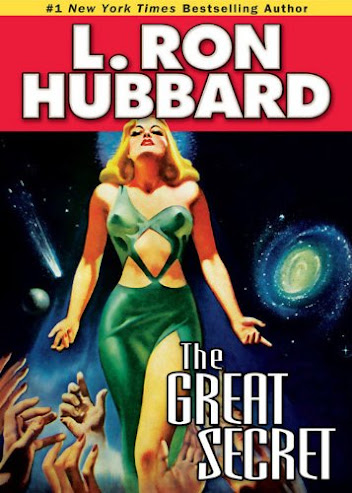
THE GREAT SECRET (Stories from the Golden Age) by L. Ron Hubbard


Re-published in 2008 by Galaxy Press.

These stories were originally published in 1942 and 1943.


Before L. Ron Hubbard became famous for creating Scientology he wrote a whole bunch of short stories for the pulp magazines from 1936 to 1950. Galaxy Press has been re-releasing them in small collections as paperbacks and audiobooks. This collection consists of four short stories.

The first story is "The Great Secret" which was originally published in Science Fiction Stories in April of 1943. It is an okay story about a man who is willing to give anything to find out what the secret of a great, lost civilization was.

Story number two is "Space Can" - the best story in the bunch. Originally published in Astounding Science Fiction in July of 1942 it features a fight between two space fleets and the hand-to-hand combat that ensues.

"The Beast" is a forgettable safari tale based on Venus rather than Africa. But
File:L. Ron Hubbard in 1950.jpg
L. Ron Hubbard (1911-1986) in 1950
, it is filled with submissive natives and a great foreign hunter - just in case you like to ponder how racist a story can be without actually involving human beings being oppressed. Originally published in Astounding Science Fiction in July of 1942.

"The Slaver" (Astounding Science Fiction, June 1942) would have been a good novel if it had been extended but it is an unsatisfying short story. It features an alien race capturing humans and using them as slaves after the humans lost an interstellar war.

The "Stories from the Golden Age" collection is an admirable attempt to preserve stories from the age of pulp fiction but this particular book is mostly not worth the effort. 

Reviewed on May 13, 2014.

I rate this collection 2 stars out of 5. It can be found on Amazon.com here: THE GREAT SECRET (Stories from the Golden Age) by L. Ron Hubbard.

Featured Post

<b><i>BAN THIS BOOK (audiobook)</i></b> by Alan Gratz

Published in 2017 by Blackstone Audio, Inc. Read by Bahni Turpin. Duration: 5 hours, 17 minutes. Unabridged. My Synopsis Ban This Book is t...

Popular posts over the last 7 days