More than 2000 reviews over the last 25 years.
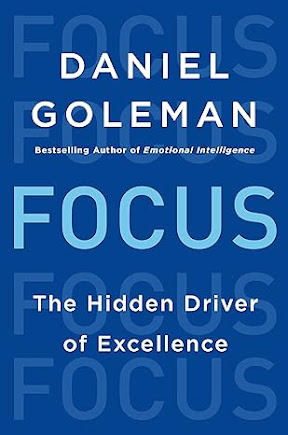
FOCUS: THE HIDDEN DRIVER of EXCELLENCE (audiobook) by Daniel Goleman
"Focus" lacks focus
Published in 2013 by HarperCollins.
Read by the author, Daniel Goleman.
Duration: 8 hours, 8 minutes.
Unabridged
Dr. Daniel Goleman is best known as the author of Emotional Intelligence. In many ways this book is less of a book about the importance of focus and more of a sequel to Emotional Intelligence. It is also a anti-global warming manifesto, an education reform book, a self-help book for business leaders who want to be the real leaders in their offices and there is a little bit about how people are able to focus their attentions a bit more and get better results.
That, of course, is the problem with the book called Focus. The primary topic should be the ability of people to focus and some hints to help you focus better. The book starts out with exactly this...well, focus. We learn how a store detective is able to focus on a crowded room full of bustling and sort out the normal shopping behaviors from the actions of a shoplifter. Goleman discusses how the give-it-to-me-now world of Tweets, Instagram, instant video makes our attention span short (I knew this already - I teach high school and my kids are on their phones all day long and I see the results).
But, then Goleman leaves this area of personal focus largely unexplored and veers into the focus of whole groups of people and uses global warming as his "focus" for this section. I listened to this as an audiobook on CDs and this lasted for more than a CD - well more than an hour of discussion about a topic that is basically off topic. He throws in a suggestion that schools adopt a global warming science project that probably would not hit most state's standards, goes on about carbon footprints, promotes websites that track your carbon footprint, tells how various companies have shrunk their carbon footprints. None of this, not one bit, not one iota, not one word is described in the blurb on the back of the audiobook. I got bored and started skipping whole chunks of text. To his credit, Goleman does point out that the concept of a zero-emission car is a misnomer since electric cars are charged up by an electric grid that is powered largely by coal and coal plants do have emissions (and if you get your electric car charged by a solar panel, there are emissions associated with the manufacture of those panels).
Then we veer into the world of corporate leadership and the book becomes an extended discussion of what makes a good leader. Turn out it is mostly paying attention the the feelings and needs of those that are following you - this is where the book becomes a sequel to his book Emotional Intelligence with a special focus on CEOs. I felt like I was not the intended reader (or listener, in my case).
Speaking of being a listener, the audio portion of this experience needs to be discussed. The author, Daniel Goleman, read his own book. I am always leery of this because sometimes the author may have a perfectly fine speaking voice but just should not read an audiobook. It is more than a reading, it has to be a performance. Goleman does a lot of public speaking (his website has a place to contact his agent to schedule Dr. Goleman to speak to our corporate gig about leadership, emotional intelligence or maybe even global warming) but public speaking is not the same as reading an audiobook. I cannot hear gestures or hear the fact that the speaker moved across the stage or stood up to put more emphasis on a point in an audiobook. It all has to be done with your voice. Goleman's voice is okay, but not great. He does not quite drone, but it is not really lively either. It definitely took on a nagging tone during the extended global warming discussion. Even worse, there was a bass reverb echo while he spoke that I could not get rid of no matter how much I fiddled with the bass in my car. It sounded like that echo sound you hear when someone is speaking to you on the phone in a small, enclosed room. A professional audiobook should not have this problem.
Note: This book was sent to me by the publisher in exchange for an honest review.
I rate this audiobook 1 star out of 5. I was so relieved to finish this thing and it took me forever to listen to it.
If you want to give this audiobook a try for yourself you can find it on Amazon.com here: Focus: The Hidden Driver of Excellence.
Reviewed on January 25, 2014.
THE BACKUP MEN (Mac McCorkle #3) (audiobook) by Ross Thomas
Originally published in 1971.
Audiobook edition published by HighBridge Audio in 2013.
Read by Brian Holsopple
Duration: 6 hours, 1 minute.
Unabridged.
Ross Thomas (1926-1995) is a multiple Edgar Award winner. HighBridge Audio is going back and re-releasing a number of his books as audiobooks.
The Backup Men is #3 in the four part Mac McCorkle series. I had not read or listened to any books by Ross Thomas before this one and, to his credit, Thomas did an extraordinary job of getting this newbie listener up to speed rather quickly.
Mac McCorkle is a part owner of a rather fancy restaurant in Washington, D.C. that he calls a "saloon." His partner is Mike Padillo who used to work for the CIA or a similar government entity (he is never quite clear about this) and is well-known in the professional hitman/bodyguard/spy community.
Padillo is approached by a couple of well-known members of his professional community, a set of nearly identical male and female twins, the Gothars, to be their backup man in an operation. They are guarding the new king of a country next door to Kuwait. Remember that this is still 1971 so the massive oil fields in the Middle East were still being explored and developed. In this case, this little country was just being opened up to Western oil exploration, assuming that the new king lives long enough to sign the contracts, that is.
It turns out a pair of equally well-known spies/thugs/hit men are out to kill this new king. When the male twin is found dead in McCorkle's apartment Padillo agrees to help the surviving twin escort the new king. McCorkle insists on coming along as a "talented amateur" and the chase begins.
Although this is a shorter-than-average audiobook, it just felt like the first half of the book was going nowhere. There was lots of posturing, discussion about what makes a good saloon (on a separate point, it really irritated me that McCorkle insisted on calling his fancy high-end restaurant a saloon. Simple rule: if you have a maitre d' you are not a saloon), a discussion about restoring old cars and their relative worth and lots of talk about Padillo's past that revealed not much about Padillo's past.
Once the story finally gets moving (about 60% of the way into the book) the action drives the story but the ending is just so-so.
Brian Holsopple's reading of the book was quite good. He handled a number of different accents quite well. His performance of McCorkle's nearly non-stop stream of smart aleck comments and internal observations was one of the bright spots of this audiobook.
My short take on this story: McCorkle's quirky point of view on the world of international spying and his smart aleck comments make the story more palatable but it was just not enough to make an okay story a great story.
Note: I was given a copy of this audiobook by the publisher in exchange for an honest review.
I rate this audiobook 3 stars out of 5 and it can be purchased at Amazon.com here: The Backup Men by Ross Thomas.
Reviewed on January 24, 2014.
Ross Thomas (1926-1995) is a multiple Edgar Award winner. HighBridge Audio is going back and re-releasing a number of his books as audiobooks.
The Backup Men is #3 in the four part Mac McCorkle series. I had not read or listened to any books by Ross Thomas before this one and, to his credit, Thomas did an extraordinary job of getting this newbie listener up to speed rather quickly.
Mac McCorkle is a part owner of a rather fancy restaurant in Washington, D.C. that he calls a "saloon." His partner is Mike Padillo who used to work for the CIA or a similar government entity (he is never quite clear about this) and is well-known in the professional hitman/bodyguard/spy community.
Padillo is approached by a couple of well-known members of his professional community, a set of nearly identical male and female twins, the Gothars, to be their backup man in an operation. They are guarding the new king of a country next door to Kuwait. Remember that this is still 1971 so the massive oil fields in the Middle East were still being explored and developed. In this case, this little country was just being opened up to Western oil exploration, assuming that the new king lives long enough to sign the contracts, that is.
![]() |
| Photo by Niels Noordhoek |
It turns out a pair of equally well-known spies/thugs/hit men are out to kill this new king. When the male twin is found dead in McCorkle's apartment Padillo agrees to help the surviving twin escort the new king. McCorkle insists on coming along as a "talented amateur" and the chase begins.
Although this is a shorter-than-average audiobook, it just felt like the first half of the book was going nowhere. There was lots of posturing, discussion about what makes a good saloon (on a separate point, it really irritated me that McCorkle insisted on calling his fancy high-end restaurant a saloon. Simple rule: if you have a maitre d' you are not a saloon), a discussion about restoring old cars and their relative worth and lots of talk about Padillo's past that revealed not much about Padillo's past.
Once the story finally gets moving (about 60% of the way into the book) the action drives the story but the ending is just so-so.
Brian Holsopple's reading of the book was quite good. He handled a number of different accents quite well. His performance of McCorkle's nearly non-stop stream of smart aleck comments and internal observations was one of the bright spots of this audiobook.
My short take on this story: McCorkle's quirky point of view on the world of international spying and his smart aleck comments make the story more palatable but it was just not enough to make an okay story a great story.
Note: I was given a copy of this audiobook by the publisher in exchange for an honest review.
I rate this audiobook 3 stars out of 5 and it can be purchased at Amazon.com here: The Backup Men by Ross Thomas.
Reviewed on January 24, 2014.
THE BLACK BOX (Harry Bosch #18) by Michael Connelly
First published in November of 2012.
To celebrate the 20th anniversary of the first Harry Bosch book, Michael Connelly has Harry re-visit a case from twenty years ago in The Black Box. The book starts with a flashback to the Rodney King Riots in 1992. There were so many questionable deaths during the riots (more than 50) that LAPD put out rolling homicide teams that documented scenes as well as possible until they were called out to yet another death. Harry Bosch and this then-partner Jerry Edgar were one of those teams.
Most of the victims they dealt with were people local to the neighborhoods where they were found so Anneke Jespersen, a foreign press photographer from Denmark stuck out and Harry Bosch always remembered her and felt guilty because he knew that he did not do a good job of starting the investigation into her murder due to the chaos of the riot - the investigation was barely started when they were called to another scene and by the time a true formal investigation was started the trail was long cold. The same could be said for almost all of the murders they looked into during the riots.
Harry Bosch is still working in the Open-Unsolved Unit (the cold case squad) and Anneka Jespersen's case has been referred to them because of a ballistics match with other murders. So, Harry Bosch does his thing which is mostly starting to dig and irritating everyone else around him. The most important feature to the story is Bosch's sense that the end is near - his career has a definite ending date now and Bosch's investigation have picked up a sense of desperation - he will never be able to solve them all.
Connelly works in a nice literary allusion while Bosch is discussing one of his daughter's assignments. She is reading The Catcher in the Rye and they discuss if briefly. Bosch knows almost nothing of the book, but I was struck by the similarity between Bosch and his deep almost unrecognized need to solve as many murders as he can before he is forced to retire and this famous passage, perhaps the best-known passage, from The Catcher in the Rye:
"You know that song 'If a body catch a body comin' through the rye'? I'd like – "
"It's 'If a body meet a body coming through the rye'!" old Phoebe said. "It's a poem. By Robert Burns."
"I know it's a poem by Robert Burns."
She was right, though. It is "If a body meet a body coming through the rye." I didn't know it then, though.
"I thought it was 'If a body catch a body,'" I said. "Anyway, I keep picturing all these little kids playing some game in this big field of rye and all. Thousands of little kids, and nobody's around – nobody big, I mean – except me. And I'm standing on the edge of some crazy cliff. What I have to do, I have to catch everybody if they start to go over the cliff – I mean if they're running and they don't look where they're going I have to come out from somewhere and catch them. That's all I'd do all day. I'd just be the catcher in the rye and all. I know it's crazy, but that's the only thing I'd really like to be. I know it's crazy."
Holden Caulfield wants to save all of the kids in his misunderstanding of the words of the poem - it's the only thing he'd really like to be. Harry Bosch has to solve all of the murders. He has to be the man who finds justice for these victims. It's the only thing he really wants to be.
At one point Bosch is describing the work of his favorite jazz musician, Art Pepper, but the description fits Bosch perfectly as well: "Powerful and relentless, and sometimes sad." (p. 199) This relentless nature earns him the ire of his new boss, Lieutenant O'Toole, and the chief who knows that Harry could very well solve this case on the eve of the 20th anniversary of the riots and it would look bad politically for one of the few solved murders to be that of one of the few white victims. He wants Harry to postpone his investigation for a few months, but Harry just can't do that and continue to be Harry Bosch.
Despite the improbable dramatic ending I found this book to be a most satisfying Harry Bosch story, full of Bosch's disdain for bureaucracy and his willingness to go with an educated hunch no matter the cost. The ongoing story line describing Harry and his daughter is interesting, especially with her possible interest in becoming a police detective after she completes her education. Bosch's love life is giving the short shrift in this story. Bosch and his partner Chu continue to float along - they are partners in only the loosest sense of the world.
On an interesting note, one of Michael Connelly's real-life technical advisers about the workings of the Open-Unsolved Unit, Rick Jackson, makes a couple of extended appearances and works with Bosch.
I rate this book 5 stars out of 5. It can be found on Amazon.com here: THE BLACK BOX (Harry Bosch #18) by Michael Connelly.
Reviewed on January 19, 2014.
To celebrate the 20th anniversary of the first Harry Bosch book, Michael Connelly has Harry re-visit a case from twenty years ago in The Black Box. The book starts with a flashback to the Rodney King Riots in 1992. There were so many questionable deaths during the riots (more than 50) that LAPD put out rolling homicide teams that documented scenes as well as possible until they were called out to yet another death. Harry Bosch and this then-partner Jerry Edgar were one of those teams.
Most of the victims they dealt with were people local to the neighborhoods where they were found so Anneke Jespersen, a foreign press photographer from Denmark stuck out and Harry Bosch always remembered her and felt guilty because he knew that he did not do a good job of starting the investigation into her murder due to the chaos of the riot - the investigation was barely started when they were called to another scene and by the time a true formal investigation was started the trail was long cold. The same could be said for almost all of the murders they looked into during the riots.
![]() |
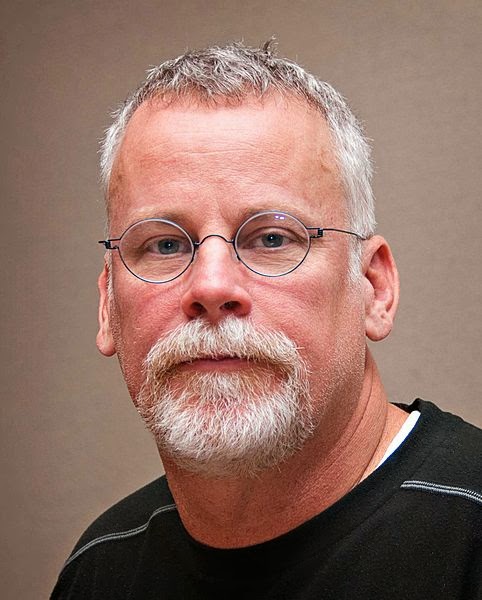
| Michael Connelly. Photo by Mark Coggins |
Harry Bosch is still working in the Open-Unsolved Unit (the cold case squad) and Anneka Jespersen's case has been referred to them because of a ballistics match with other murders. So, Harry Bosch does his thing which is mostly starting to dig and irritating everyone else around him. The most important feature to the story is Bosch's sense that the end is near - his career has a definite ending date now and Bosch's investigation have picked up a sense of desperation - he will never be able to solve them all.
Connelly works in a nice literary allusion while Bosch is discussing one of his daughter's assignments. She is reading The Catcher in the Rye and they discuss if briefly. Bosch knows almost nothing of the book, but I was struck by the similarity between Bosch and his deep almost unrecognized need to solve as many murders as he can before he is forced to retire and this famous passage, perhaps the best-known passage, from The Catcher in the Rye:
"You know that song 'If a body catch a body comin' through the rye'? I'd like – "
"It's 'If a body meet a body coming through the rye'!" old Phoebe said. "It's a poem. By Robert Burns."
"I know it's a poem by Robert Burns."
She was right, though. It is "If a body meet a body coming through the rye." I didn't know it then, though.
"I thought it was 'If a body catch a body,'" I said. "Anyway, I keep picturing all these little kids playing some game in this big field of rye and all. Thousands of little kids, and nobody's around – nobody big, I mean – except me. And I'm standing on the edge of some crazy cliff. What I have to do, I have to catch everybody if they start to go over the cliff – I mean if they're running and they don't look where they're going I have to come out from somewhere and catch them. That's all I'd do all day. I'd just be the catcher in the rye and all. I know it's crazy, but that's the only thing I'd really like to be. I know it's crazy."
Holden Caulfield wants to save all of the kids in his misunderstanding of the words of the poem - it's the only thing he'd really like to be. Harry Bosch has to solve all of the murders. He has to be the man who finds justice for these victims. It's the only thing he really wants to be.
At one point Bosch is describing the work of his favorite jazz musician, Art Pepper, but the description fits Bosch perfectly as well: "Powerful and relentless, and sometimes sad." (p. 199) This relentless nature earns him the ire of his new boss, Lieutenant O'Toole, and the chief who knows that Harry could very well solve this case on the eve of the 20th anniversary of the riots and it would look bad politically for one of the few solved murders to be that of one of the few white victims. He wants Harry to postpone his investigation for a few months, but Harry just can't do that and continue to be Harry Bosch.
Despite the improbable dramatic ending I found this book to be a most satisfying Harry Bosch story, full of Bosch's disdain for bureaucracy and his willingness to go with an educated hunch no matter the cost. The ongoing story line describing Harry and his daughter is interesting, especially with her possible interest in becoming a police detective after she completes her education. Bosch's love life is giving the short shrift in this story. Bosch and his partner Chu continue to float along - they are partners in only the loosest sense of the world.
On an interesting note, one of Michael Connelly's real-life technical advisers about the workings of the Open-Unsolved Unit, Rick Jackson, makes a couple of extended appearances and works with Bosch.
I rate this book 5 stars out of 5. It can be found on Amazon.com here: THE BLACK BOX (Harry Bosch #18) by Michael Connelly.
Reviewed on January 19, 2014.
IN the WAKE of the PLAGUE: THE BLACK DEATH and the WORLD IT MADE by Norman F. Cantor
I Was So Primed to Like This Book...
Published in 2002 by Perennial (HarperCollins)
But...I should have read the back cover of In the Wake of the Plague a little better. Right at the top is the Ring around the rosies children's nonsense song:
Ring-a-round the rosie,
A pocket full of posies,
Ashes! Ashes!
We all fall down.
A pocket full of posies,
Ashes! Ashes!
We all fall down.
This is followed by the assertion: "a children's rhyme about the Black Death."
Sadly, this is not true and I have known this since the late 1980s when I was doing my undergraduate studies at Indiana University. Why sadly? Because this would have been such a cool fact! I am a high school history teacher and it would be great to able to say, "Look! Here's a children's rhyme we all know and it has this collection to the Black Plague - see how this historical event reverberates through time and even touches our lives now?"
Yeah. That would have been cool. And it is a fact that Norman F. Cantor (1929-2004), a leading medievalist should have known, especially if he is writing a book about the Black Plague. Instead, he doesn't just reference this little song, he embraces it and uses it as the way to introduce the entire concept, even going so far as to assert that this is the way little kids used to deal with the fear of the plague and deal with the frightening concept of sudden death (pages 5-6).
If this were the only problem, I could forgive Mr. Cantor.
Historians should never judge the people of history by the values of their own modern time and they should always check for their own biases. For example, he goes after the English nobility like a dog goes after a chew toy. He goes after their sexual preferences, their private religious chapels, their political posturing, their wars and more and criticizes them: "Fourteenth-century people lacked the moral categories that could transcend political and social roles. They lacked a critical value system that judged rulers by consequences and not the formal categories in which their behavior was structured." (page 39) In other words, everyone had a part to play and no one ever questioned it. In fact, he goes even farther on pages 58-59 to assert that these folks showed an astonishing lack of self-awareness, unlike today's modern well-educated elites, of course.
Yes, he does actually assert that modern elites are very reflective. Now, if I say to you name 5 vacuous elites in 15 seconds, could you do it? Can you name 5 people that you know that have a college degree but are still dumber than a box of rocks? Of course, because people nowadays are really about the same as they were then. But, he compares rulers of the past to modern rulers and sincerely sees a difference in the way modern elites act, believe and think about things. On page 39 he attacks Edward III as "a kind of destructive and merciless force." The fact that Edward III's contemporaries believed him to be "a constitutional king and the very model of chivalry and aristocratic honor" merely "illuminates a gap between our world and fourteenth-century Europe."
Really? President Obama won the Nobel Peace Prize and yet he bragged that he was "really good at killing people" with the drone program (and he is, too - according to UK's The Guardian drones killed more than 500 people in 2012). My point is not to disparage President Obama but to point out that we (even our leaders) are all able to live with a great deal of dichotomy in our lives - not just back then, but now. It is a part of the human condition and an experienced historian should have known that.
There are also lots of snarky comments, including a really cheap shot at former Prime Minister Margaret Thatcher (1925-2013) on page 93. He is discussing how servant girls who were fired for theft would be expelled from their village to become beggars and/or prostitutes and most likely die on the streets. He notes that this is the kind of welfare program that Thatcher would approve of ("Margaret Thatcher would have loved late fourteenth-century and fifteenth-century England.") Whatever Thatcher thought about the welfare state, I hardly think she was for having young ladies become prostitutes or die of exposure rather than be on the public dole. Over the top, off topic and inaccurate.
Most of the book reads like it was cobbled together from a combination of
already printed articles with an obsessive focus on England and a few members of the royal family and which parts of France produced wine and how much that wine was worth and who drank the wine and how much of the wine they imported and ...well, you get the idea.
There is just no focus on what the book is supposed to be about - how the Black Plague changed Europe and through Europe changed the world. There is an excellent explanation of the English legal system in the area of real estate and how that legal system helped to consolidate the holdings of some families. But, there is not much explaining how English society was before and after the Black Plague. And, speaking of England, why does Cantor just focus on England for so much of this book?
The last third of the book is much less snarky and actually deals with the topic that is detailed in the title. The chapter on how many in Europe blamed the Jews for the plague was by far the best written, confirming that blaming European Jews for Europe's troubles has a long, documented history. And, for a change, he actually moved the focus away from England and got out as far as Poland. The chapter on the origins of the plague at the end of the book seemed misplaced (shouldn't it be in the beginning?) and included a serious discussion of the extraterrestrial origin of the Black Plague (yes, he actually discusses and gives credence to a panspermia-type origin to the epidemic).
The last chapter, "Aftermath" is the outline that should have been fleshed out into the entire book. There is an interesting mention of the fact that the Church had to fill hundreds of open positions and the average age of becoming an ordained priest dropped from age 25 to age 20. "It was a younger, much younger Church that came suddenly into being, and now one staffed heavily with under-educated and inexperienced people." (page 206) Rather than just paragraph on the topic, it would have been worthwhile to explore how the Church changed and if these changes led to the conditions that caused the Protestant Reformation 140 years later.
I rate this book 1 star out of 5. The one good chapter out of ten does not redeem it.
This book can be found on Amazon.com here: IN the WAKE of the PLAGUE: THE BLACK DEATH and the WORLD IT MADE by Norman F. Cantor.
There are also lots of snarky comments, including a really cheap shot at former Prime Minister Margaret Thatcher (1925-2013) on page 93. He is discussing how servant girls who were fired for theft would be expelled from their village to become beggars and/or prostitutes and most likely die on the streets. He notes that this is the kind of welfare program that Thatcher would approve of ("Margaret Thatcher would have loved late fourteenth-century and fifteenth-century England.") Whatever Thatcher thought about the welfare state, I hardly think she was for having young ladies become prostitutes or die of exposure rather than be on the public dole. Over the top, off topic and inaccurate.
Most of the book reads like it was cobbled together from a combination of
![]() |
| Illustration of people suffering from the bubonic plague (note the buboes, or raised bumps) |
There is just no focus on what the book is supposed to be about - how the Black Plague changed Europe and through Europe changed the world. There is an excellent explanation of the English legal system in the area of real estate and how that legal system helped to consolidate the holdings of some families. But, there is not much explaining how English society was before and after the Black Plague. And, speaking of England, why does Cantor just focus on England for so much of this book?
The last third of the book is much less snarky and actually deals with the topic that is detailed in the title. The chapter on how many in Europe blamed the Jews for the plague was by far the best written, confirming that blaming European Jews for Europe's troubles has a long, documented history. And, for a change, he actually moved the focus away from England and got out as far as Poland. The chapter on the origins of the plague at the end of the book seemed misplaced (shouldn't it be in the beginning?) and included a serious discussion of the extraterrestrial origin of the Black Plague (yes, he actually discusses and gives credence to a panspermia-type origin to the epidemic).
The last chapter, "Aftermath" is the outline that should have been fleshed out into the entire book. There is an interesting mention of the fact that the Church had to fill hundreds of open positions and the average age of becoming an ordained priest dropped from age 25 to age 20. "It was a younger, much younger Church that came suddenly into being, and now one staffed heavily with under-educated and inexperienced people." (page 206) Rather than just paragraph on the topic, it would have been worthwhile to explore how the Church changed and if these changes led to the conditions that caused the Protestant Reformation 140 years later.
I rate this book 1 star out of 5. The one good chapter out of ten does not redeem it.
This book can be found on Amazon.com here: IN the WAKE of the PLAGUE: THE BLACK DEATH and the WORLD IT MADE by Norman F. Cantor.
THE DANGEROUS DIMENSION (Stories from the Golden Age Series) (kindle e-book) (short story) by L. Ron Hubbard
Originally published in the magazine Astounding Science Fiction in 1938.
Re-published in e-book format by Galaxy Press in 2010.
On the internet you can find rumors that this was L. Ron Hubbard's first science fiction story. Purportedly, the editor was looking for something that was breezy, funny and easy-to-read. I have no idea if this really true, but this short story is certainly all of those things.
Sadly, it's just not a very good short story.
Dr. Henry Mudge has worked out the mathematics of how to transport oneself instantly from one place to another just by imagining that place. He calls this formula Equation C.
But, controlling your mind enough to use this technique is difficult. Try not to think of a place when you hear someone talk about it. So, when someone says a place to Dr. Mudge he goes there, including the moon and Mars. Meanwhile, he is supposed to be giving a major presentation at his university to a group of professors if he can just get there and stay there without bouncing off somewhere else...
While a cute concept, the story just does not work all that well if you think it through. The internal consistency is just not there. Also, despite the fact that the cover has an exploding space ship on it, there are no space ships in this short story.
The story is accompanied by an uncritical, enthusiastic biography of Hubbard that mostly skips over the Scientology stuff.
I rate this short story 2 stars out of 5. It can be found on Amazon.com here: THE DANGEROUS DIMENSION (Stories from the Golden Age Series) (kindle e-book) (short story) by L. Ron Hubbard.
Re-published in e-book format by Galaxy Press in 2010.
On the internet you can find rumors that this was L. Ron Hubbard's first science fiction story. Purportedly, the editor was looking for something that was breezy, funny and easy-to-read. I have no idea if this really true, but this short story is certainly all of those things.
Sadly, it's just not a very good short story.
Dr. Henry Mudge has worked out the mathematics of how to transport oneself instantly from one place to another just by imagining that place. He calls this formula Equation C.
But, controlling your mind enough to use this technique is difficult. Try not to think of a place when you hear someone talk about it. So, when someone says a place to Dr. Mudge he goes there, including the moon and Mars. Meanwhile, he is supposed to be giving a major presentation at his university to a group of professors if he can just get there and stay there without bouncing off somewhere else...
While a cute concept, the story just does not work all that well if you think it through. The internal consistency is just not there. Also, despite the fact that the cover has an exploding space ship on it, there are no space ships in this short story.
The story is accompanied by an uncritical, enthusiastic biography of Hubbard that mostly skips over the Scientology stuff.
I rate this short story 2 stars out of 5. It can be found on Amazon.com here: THE DANGEROUS DIMENSION (Stories from the Golden Age Series) (kindle e-book) (short story) by L. Ron Hubbard.
BRANDED OUTLAW (Stories from the Golden Age series) by L. Ron Hubbard
Originally published in 1938 in "Five-Novels Monthly" magazine
Re-published by Galaxy Press in 2011.
I read this as a kindle e-book, which seemed sort of appropriate considering L. Ron Hubbard's standing as a world class science fiction author. When this story was originally written in 1938 my standard-issue Kindle HD tablet would seem to be nothing short of science fiction.
You may not be aware that Hubbard wrote plenty of westerns back in the days of pulp serial magazines (and long before his name became synonymous with Scientology.) His familiarity with western life came from his childhood in Montana when Montana was still only a few steps away from its rough-and-tumble cowboy past.
Branded Outlaw is an all out Western adventure with all of the familiar elements fans of Westerns are readily familiar with. Lee Weston is coming from Wyoming after being summoned by his father to his ranch in New Mexico. When he arrives he finds his father dead and a smoldering ruin where his father's ranch had been. He is sure that the biggest rancher in the area is the source of this trouble and he is determined to get his revenge.
When he arrives in town he finds himself in a gunfight with the hired hands of this rancher and he is forced to flee town and nurse his wounds. While hiding out he is discovered by a beautiful, headstrong girl who patches him up. Lee falls for her only to find out she is his enemy's daughter...
While none too subtle, this book is about as action-packed as a book can be. It is followed by an interesting biography of the almost unbelievable life of L. Ron Hubbard.
I rate this book 4 stars out of 5. It can be found on Amazon.com here: BRANDED OUTLAW (Stories from the Golden Age series) by L. Ron Hubbard.
Re-published by Galaxy Press in 2011.
I read this as a kindle e-book, which seemed sort of appropriate considering L. Ron Hubbard's standing as a world class science fiction author. When this story was originally written in 1938 my standard-issue Kindle HD tablet would seem to be nothing short of science fiction.
You may not be aware that Hubbard wrote plenty of westerns back in the days of pulp serial magazines (and long before his name became synonymous with Scientology.) His familiarity with western life came from his childhood in Montana when Montana was still only a few steps away from its rough-and-tumble cowboy past.
Branded Outlaw is an all out Western adventure with all of the familiar elements fans of Westerns are readily familiar with. Lee Weston is coming from Wyoming after being summoned by his father to his ranch in New Mexico. When he arrives he finds his father dead and a smoldering ruin where his father's ranch had been. He is sure that the biggest rancher in the area is the source of this trouble and he is determined to get his revenge.
When he arrives in town he finds himself in a gunfight with the hired hands of this rancher and he is forced to flee town and nurse his wounds. While hiding out he is discovered by a beautiful, headstrong girl who patches him up. Lee falls for her only to find out she is his enemy's daughter...
While none too subtle, this book is about as action-packed as a book can be. It is followed by an interesting biography of the almost unbelievable life of L. Ron Hubbard.
I rate this book 4 stars out of 5. It can be found on Amazon.com here: BRANDED OUTLAW (Stories from the Golden Age series) by L. Ron Hubbard.
THE K-FROST CAPER by James Blakley
Published in 2013.
In his sophomore effort author James Blakley introduces a new character but stays in familiar territory. His previous book, The Steel Deal, featured a private investigator that stumbled into something much larger than he had imagined when he took a case,
In The K-Frost Caper Luna Nightcrow, a Cherokee insurance investigator from Oklahoma, is sent to Miami to look into a suspicious life insurance application. It seems that the company paid out life insurance money a few years ago for the drowning death of a man with the unlikely name of Kelvin Frost. His body was never recovered and now a person was applying for more life insurance in Miami with the same unlikely name.
![]() |
| The Miami Skyline. Photo by Marc Averette |
The company, Charmed Life Mutual, already sent one investigator but he has dropped off the grid so Luna Nightcrow is sent to investigate this Kelvin Frost person and find the other investigator. But, when she arrives in Miami she discovers that the Kelvin Frost case is much more convoluted than she could have imagined. Plus, she's being followed by the white car and the detective she is supposed to liaison with in Miami is so darned attractive...
Chock full of odd names and quirky characters and topped off with just a dash of romance, The K-Frost Caper is a light detective story that I would normally call beach reading. But, since it is 14 degrees as I write this on January 3rd, I will suggest that this could be a fun book to read as you while away a snowy day. If you like your detective stories full of grit and gore this will be bound to disappoint - despite the fact that all kinds of people die it is much more like an old Remington Steele mystery than No Country for Old Men. But, if that is your style than you should find The K-Frost Caper to be a fun, quick read.
I rate this book 4 stars out of 5. It can be found on Amazon.com here: The K-Frost Caper by James Blakley.
Note: I received a copy of this book from the author in exchange for an honest review.
WITH GOD on THEIR SIDE (kindle e-book) by John Frye
Just Does Not Live Up to the Promise of Its Title
Published by Endeavour Press Ltd. in 2013
Estimated length: 361 pages
I am a huge student of the Civil War. I own more than one hundred books (fiction and non-fiction) on the topic, a fact that my wife tolerates but only sort of understands. I think that there is something to be learned in well-researched historical fiction as well as the history texts because excellent historical fiction has the ability to place the reader in someone's shoes at the moment.
Taking on the topic of the Civil War in historical fiction can be a thankless undertaking - misstate the caliber of a weapon and the purists are all over you. Go on about slavery too much and the revisionists are after you. Fail to mention it at all and everyone else is after you. I thought Frye did just fine with all of those aspects in this book. I read nothing that did not seem correct as far as the details went.
With God on Their Side is about a Confederate General named William Page. Page is an expert in artillery and attended West Point before he became an Episcopal minister. He has a keen interest in the politics that led to the war but he has serious doubts about the role of a minister in the army. Eventually, he is pressured by his friends and neighbors into becoming their officer when they join up and he has great success at the the First Battle of Bull Run/Manassas.
![]() |
| A smashed Confederate artillery battery at the Battle of Fredericksburg. |
Page seems to be very decisive in that battle but, in reality, he has much more in common with Union General George McClellan - he is easily spooked, overly concerned about protecting his guns rather than using them and is a genius at training and organization and a disaster at the actual business of war.
Page seems to be loosely based on an actual Civil War figure - William N. Pendleton who was an Episcopal minister, was from the same town as the Page character (he married a woman with the last name Page), had a similar panic attack as Page did after the Sharpsburg/Antietam campaign and surrendered with Lee at Appomattox Court House. Both lost sons who were aides to Stonewall Jackson to battlefield injury.
Unlike the Page character, Pendleton seems to have been mostly an administrator, not a battlefield general at the end of the war.
Frye decided to give his main character a variety of roles in many battles rather than falling to the temptation of making him the centerpiece of every battle. For example, Frye decided to place Page in Fredericksburg during the Battle of Chancellorsville - you never hear much about the few troops that were left in Fredericksburg when Lee divided his smaller army to keep part of the much larger Union army out of the main fight in Chancellorsville and he had rear guard duty after Sharpsburg/Antietam campaign.
Slavery was a topic but he dealt with it mainly through his main character's family slaves (they were by far more interesting than the Pages, the family that owned them). The slave Wilson, who accompanies Page during the war as a manservant is interesting as he debates escaping to be a free man (he has two obvious chances) or staying with Page to whom he feels a certain amount of loyalty even if it is betrayed at one point. Wilson also knows that escaping to freedom means never seeing his wife, his family and everything he has known his whole life ever again, especially if he the Confederacy were to win its independence. His wife told him to take the chance when he got it but...
Back on the home front Union soldiers go around the front lines and raid into Confederate territory. The varied reactions of the slaves left back at home to the Union soldiers are interesting, much more interesting than the reaction of the white families (mostly horror) because to the slaves these soldiers represent a threat (possibility of rape for the female slaves), disruption, chaos, danger but also hope.
The book fails, I think, at the primary mission that is indicated by both the title and the book description. Was God on the side of the South? Was he on the side of the North? Does he take sides in war? If so, how does he show it? This is hinted at throughout the book but the best we get is the notion that the war just changed everything. Page's dithering is to be explained by extensive soul-searching, but to me it seemed like he was over-concerned with losing his guns (he goes on about the possibility of losing his guns in battle at least as much as he does about if God has forsaken the Confederacy.
A much better discussion in a piece of historical fiction about the role of God in the Civil War can be found in Howard Bahr's The Judas Field: A Novel of the Civil War.
I rate this e-book 3 stars out of 5 because it just does not live up to the promise of its title and there was simply too much watching General Page fret and worry and not doing much of anything. The wrong character was made the main character - if Wilson the slave had been the focus this might have been something great.
Note: I did discover that Frye has written another Civil War book that is currently free as a Kindle download on Amazon. I downloaded it and will give Mr. Frye's work another chance.
This book can be found on Amazon.com here: With God on Their Side by John Frye.
BEST of 2013
This is a list of the best of the best of the 101 books and short stories that I read or listened to in 2013. They did not have to be released in 2013.
I broke the books into several categories. The reviews are linked.
* indicates the best book in that category.
Fiction books:
*Breaking Point (Joe Pickett #13) by C.J. Box
His Majesty's Dragon (Temeriare #1) by Naomi Novak
Suspect by Robert Crais
Unthinkable (Jane Candiotti and Kenny Marks #4) by Clyde Phillips
Short Story:
*That Leviathan, Whom Thou Hast Made by Eric James Stone
Overtime in the Woods by Ryan Sean O'Reilly
Sledge by Ernie Lindsey
Cage Life by Karin Cox
Non-Fiction books:
*Under the Wire: Bestselling World War II of an American Spitfire Pilot and Legendary POW Escape Artist by William Ash and Brendan Foley
A Dream So Big: Our Unlikely Journey to End the Tears of Hunger by Steve Peiffer with Gregg Lewis
A Portrait of Jesus by Joseph F. Girzone
Blood and Smoke: A True Tale of Mystery, Mayhem, and the Birth of the Indy 500 by Charles Leerhsen
Parliament of Whores: A Lone Humorist Attempts to Explain the Entire U.S. Government by P.J. O'Rourke
Fiction audiobook:
*Civil War (Marvel Comics) by Stuart Moore (Multiple performers)
Doctor Sleep by Stephen King (Read by Will Patton)
Star Wars: The Original Radio Drama by Brian Daley (Multiple performers)
Streets of Fire by Thomas H. Cook (Read by Ray Chase)
The Intercept by Dick Wolf (read by Peter Ganim)
Two for Texas by James Lee Burke (read by Will Patton)
Short Story audiobook:
*UR by Stephen King (Read by Holter Graham)
Rendezvous by Nelson DeMille (Read by Scott Brick)
Titanium Rain, Volume One by Josh Finney (multiple performers)
Stationary Bike by Stephen King (Read by Ron McClarty)
Non-fiction audiobook:
*Scarcity: Why Having Too Little Means So Much by Sendhil Mullainathan and Eldar Shafir (read by Robert Petkoff)
The Presidents Club: Inside the World's Most Exclusive Fraternity by Nancy Gibbs and Michael Duffy (Read by Bob Walter)
My Mother Was Nuts: A Memoir by Penny Marshall (read by Penny Marshall)
Master of the Mountain: Thomas Jefferson and His Slaves by Henry Wiencek (Read by Brian Holsopple)
Wait Wait...Don't Tell Me! Famous People Who Returned Our Calls: Celebrity Highlights from the Oddly Informative News Quiz by NPR (multiple performers)
I broke the books into several categories. The reviews are linked.
* indicates the best book in that category.
Fiction books:
*Breaking Point (Joe Pickett #13) by C.J. Box
His Majesty's Dragon (Temeriare #1) by Naomi Novak
Suspect by Robert Crais
Unthinkable (Jane Candiotti and Kenny Marks #4) by Clyde Phillips
Short Story:
*That Leviathan, Whom Thou Hast Made by Eric James Stone
Overtime in the Woods by Ryan Sean O'Reilly
Sledge by Ernie Lindsey
Cage Life by Karin Cox
Non-Fiction books:
*Under the Wire: Bestselling World War II of an American Spitfire Pilot and Legendary POW Escape Artist by William Ash and Brendan Foley
A Dream So Big: Our Unlikely Journey to End the Tears of Hunger by Steve Peiffer with Gregg Lewis
A Portrait of Jesus by Joseph F. Girzone
Blood and Smoke: A True Tale of Mystery, Mayhem, and the Birth of the Indy 500 by Charles Leerhsen
Parliament of Whores: A Lone Humorist Attempts to Explain the Entire U.S. Government by P.J. O'Rourke
Fiction audiobook:
*Civil War (Marvel Comics) by Stuart Moore (Multiple performers)
Doctor Sleep by Stephen King (Read by Will Patton)
Star Wars: The Original Radio Drama by Brian Daley (Multiple performers)
Streets of Fire by Thomas H. Cook (Read by Ray Chase)
The Intercept by Dick Wolf (read by Peter Ganim)
Two for Texas by James Lee Burke (read by Will Patton)
Short Story audiobook:
*UR by Stephen King (Read by Holter Graham)
Rendezvous by Nelson DeMille (Read by Scott Brick)
Titanium Rain, Volume One by Josh Finney (multiple performers)
Stationary Bike by Stephen King (Read by Ron McClarty)
Non-fiction audiobook:
*Scarcity: Why Having Too Little Means So Much by Sendhil Mullainathan and Eldar Shafir (read by Robert Petkoff)
The Presidents Club: Inside the World's Most Exclusive Fraternity by Nancy Gibbs and Michael Duffy (Read by Bob Walter)
My Mother Was Nuts: A Memoir by Penny Marshall (read by Penny Marshall)
Master of the Mountain: Thomas Jefferson and His Slaves by Henry Wiencek (Read by Brian Holsopple)
Wait Wait...Don't Tell Me! Famous People Who Returned Our Calls: Celebrity Highlights from the Oddly Informative News Quiz by NPR (multiple performers)
ENDER'S GAME (The Ender Quintet #1) by Orson Scott Card
I decided to take the plunge and see what all of the hype was about.
Originally published in 1985.
Winner of the Nebula Award (1985).
Winner of the Hugo Award (1986).
Ender's Game is a classic and I had not read it until now. Why? I don't know. I was reading a lot of science fiction when it came out, but I just missed it. Of course, I couldn't miss all of the sequels and prequels that came in the ensuing years but I figured that I was just too far behind to catch up.
But, when the movie came out this fall a cousin of mine told me that he had gone to see it because he read it multiple times as a kid and loved it. So, I decided to take the plunge and see what all of the hype was about.
The positives:
![]() |
| Orson Scott Card. Photo by Nihonjoe |
-The descriptions of the command school battles and the way that the command school operates are quite good - in fact, the battle scenes are excellent.
-Considering that the book was written in 1985 (and edited a bit in 1991) Card's descriptions of the internet and internet forums and online news agencies that are reminiscent of the Huffington Post are amazing, simply amazing.
I liked the ending with the computer game simulation - which I will not go into to avoid spoilers.
The negatives:
-The story line involving Ender's sister and brother, Peter and Valentine and their plot to manipulate public opinion to take over the world is weak and I found it to be an unwelcome distraction from the much more interesting Ender at the Command School story arc.
I rate this book 4 stars out of 5.
This book can be found on Amazon.com here: Ender's Game (The Ender Quintet)
Reviewed on December 29, 2013.
Note: this book was challenged by a parent of a 14 year old student in South Carolina. This resulted in a police investigation of the teacher for distributing pornography. In my review I mentioned nothing pornographic. From the various articles I found, the parent was objecting to curse words. See this link for more info.
THE DROP (Harry Bosch #17) by Michael Connelly
Published in 2011 by Little, Brown and Company
I am a big fan of the Harry Bosch series, having read 15 of the 16 books in the series (so far) and given all but one top marks. The Drop continues that excellent trend. This is a gritty mystery story (really, it is two mysteries) with a number of twists and turns and a morally ambiguous ending.
Bosch is part of the D.R.O.P program - the Deferred Retirement Option Plan. This allows police officers to work up to five years past their mandatory retirement age, with the department making the decision as to how long he will work. When the story starts Harry has 3 years left in the DROP program and he is working cold murder cases with a young partner named David Chu.
Harry sees the end of his career coming and he wants to get as many cases solved as he can. When a DNA hit on a rape/murder from the late 1980s points to a convicted child molester who would have been nine years old when the victim was killed Harry suspects that something else is going on.
Just as he starts to dig into this case he get called into a current case involving the death of his son of his nemesis, former cop and current city councilman Irvin Irving. The preliminary investigation suggests that Irving's son jumped from the balcony of a hotel room, Irving suspects that it was murder and wants Harry to be involved so that it will be investigated properly.
The book goes back and forth between the cases and introduces a new love interest for Harry Bosch who forces Harry to consider why he is a detective in the first place. The strain of these cases strain the new partnership with David Chu and Harry is dismayed to hear that his daughter might be interested in police work as well (but proud as she participates in a target shooting contest).
Like all of the books in this series, The Drop is often brooding and intense as the reader watches Harry pursue the case over everything else. Simply one of the best series going.
I rate this book 5 stars out of 5. It can be found on Amazon.com here: The Drop (Harry Bosch #17) by Michael Connelly.
I am a big fan of the Harry Bosch series, having read 15 of the 16 books in the series (so far) and given all but one top marks. The Drop continues that excellent trend. This is a gritty mystery story (really, it is two mysteries) with a number of twists and turns and a morally ambiguous ending.
Bosch is part of the D.R.O.P program - the Deferred Retirement Option Plan. This allows police officers to work up to five years past their mandatory retirement age, with the department making the decision as to how long he will work. When the story starts Harry has 3 years left in the DROP program and he is working cold murder cases with a young partner named David Chu.
Harry sees the end of his career coming and he wants to get as many cases solved as he can. When a DNA hit on a rape/murder from the late 1980s points to a convicted child molester who would have been nine years old when the victim was killed Harry suspects that something else is going on.
Just as he starts to dig into this case he get called into a current case involving the death of his son of his nemesis, former cop and current city councilman Irvin Irving. The preliminary investigation suggests that Irving's son jumped from the balcony of a hotel room, Irving suspects that it was murder and wants Harry to be involved so that it will be investigated properly.
The book goes back and forth between the cases and introduces a new love interest for Harry Bosch who forces Harry to consider why he is a detective in the first place. The strain of these cases strain the new partnership with David Chu and Harry is dismayed to hear that his daughter might be interested in police work as well (but proud as she participates in a target shooting contest).
Like all of the books in this series, The Drop is often brooding and intense as the reader watches Harry pursue the case over everything else. Simply one of the best series going.
I rate this book 5 stars out of 5. It can be found on Amazon.com here: The Drop (Harry Bosch #17) by Michael Connelly.
QUINN CHECKS IN (Liam Quinn #1) by L.H. Thomson
Originally published in 2013.
From the opening lines of Quinn Checks In I was hooked. Literally, the opening sequence was so cleverly done that I knew I had see what else L.H. Thomson (new to me, but he has a good-sized list of titles) had to offer in this book.
Liam Quinn is an artist gone bad but then turned back to the good. He used to make money making copies of someone else's art and then selling it as the real thing. But, once he was caught and went to prison he straightened out and now works as an insurance investigator in his hometown of Philadelphia. He does a little bit of everything but he is really on the payroll as the art expert. He is also working off the court-ordered restitution for his criminal past.
But, things are not all wonderful for Liam Quinn. His father was a beat cop and one of his brothers still is. It is hard for a cop to have an ex-con brother. But, Quinn keeps on plugging along.
Quinn gets a big art case that comes with a big reward for him if the insurance company can find the art rather than pay for it. An art gallery was robbed during the middle of an art showing (there was a party, food, people standing around, etc.) and only one piece of art was stolen, which seems odd because you could make even more money if you stole more art.
So, Quinn gets the case and starts investigating and soon enough finds himself being questioned by the police, a local mafia figure and, even worse, he must answer to his mother about missing her Sunday dinner!
The mystery in this mystery story is just so-so. But, the characters are so vivid and Quinn and most of his family (and his should-be but isn't girlfriend who works at the Philadelphia Museum of Art) are so likable that you just want to read more. This is a solid book and an especially good start for a new series. This is a self-published effort and that can be a problem sometimes. This book, however, is not one of those times. Thomson has built a very solid foundation to build a series here, and it should be an interesting one.
Nice quote from the book: "You can never undo a wrong; you can only try to do right from there on."
NOTE: I was sent an e-copy of this book in exchange for an honest review.
I rate this book 4 stars out of 5. It can be found on Amazon.com here: QUINN CHECKS IN (Liam Quinn #1) by L.H. Thomson.
From the opening lines of Quinn Checks In I was hooked. Literally, the opening sequence was so cleverly done that I knew I had see what else L.H. Thomson (new to me, but he has a good-sized list of titles) had to offer in this book.
Liam Quinn is an artist gone bad but then turned back to the good. He used to make money making copies of someone else's art and then selling it as the real thing. But, once he was caught and went to prison he straightened out and now works as an insurance investigator in his hometown of Philadelphia. He does a little bit of everything but he is really on the payroll as the art expert. He is also working off the court-ordered restitution for his criminal past.
But, things are not all wonderful for Liam Quinn. His father was a beat cop and one of his brothers still is. It is hard for a cop to have an ex-con brother. But, Quinn keeps on plugging along.
Quinn gets a big art case that comes with a big reward for him if the insurance company can find the art rather than pay for it. An art gallery was robbed during the middle of an art showing (there was a party, food, people standing around, etc.) and only one piece of art was stolen, which seems odd because you could make even more money if you stole more art.
So, Quinn gets the case and starts investigating and soon enough finds himself being questioned by the police, a local mafia figure and, even worse, he must answer to his mother about missing her Sunday dinner!
![]() |
| The Philadelphia Museum of Art and the famed Rocky Balboa statue Photo by Bobak Ha'Eri |
The mystery in this mystery story is just so-so. But, the characters are so vivid and Quinn and most of his family (and his should-be but isn't girlfriend who works at the Philadelphia Museum of Art) are so likable that you just want to read more. This is a solid book and an especially good start for a new series. This is a self-published effort and that can be a problem sometimes. This book, however, is not one of those times. Thomson has built a very solid foundation to build a series here, and it should be an interesting one.
Nice quote from the book: "You can never undo a wrong; you can only try to do right from there on."
NOTE: I was sent an e-copy of this book in exchange for an honest review.
I rate this book 4 stars out of 5. It can be found on Amazon.com here: QUINN CHECKS IN (Liam Quinn #1) by L.H. Thomson.
DANCE HALL of the DEAD (Joe Leaphorn #2) (audiobook) by Tony Hillerman
Originally published in 1973.
Audiobook version released in 2005 by Harper Audio.
Read by George Guidall.
Duration: 6 hours, 2 minutes.
Unabridged.
Winner of the 1974 Edgar Award, Dance Hall of the Dead is an early entry in the Leaphorn series and is one of the best.
Joe Leaphorn of the Navajo Tribal Police is called into a case that technically occurred on the Zuni reservation but there is a Navajo involved. Ernesto Cata, a middle school-aged Zuni boy and his friend George Bowlegs are missing. All that is left behind is an immense amount of blood that makes it clear that one or both of the boys died. Joe is brought in by the FBI who is coordinating a joint FBI/Zuni/Navajo task force to find the boys.
Leaphorn has the feeling that the Zunis think the Navajo boy killed the Zuni boy and he has just been brought in to lead a manhunt as far as the Zunis are concerned. The FBI makes it clear that they think it is related to drug trafficking and they think the boys were just in the wrong place at the wrong time.
Leaphorn thinks that it might be best to learn all he can about George Bowlegs and then try to figure out what happened to them. Leaphorn's investigation leads him to George's pathetic drunken father and George's miserable family life, a group of hippies that have moved into an abandoned Navajo property and a professional archaeological dig site looking into a theory about Folsom Man.
The more he digs, the more interesting things that Leaphorn finds out about young George Bowlegs and the more interesting ideas he has about what may have happened to Ernesto Cata and George Bowlegs...
As I said before, this is one of the better Leaphorn novels and would make a fine place to start into the series of you are new to it. The reader is introduced to the Zuni and Navajo cultures as well as getting a first-class mystery.
George Guidall read this audiobook. He has read most, if not all, of the Leaphorn and Leaphorn/Chee audiobooks. He has a solid feel for the series and his pacing suits its unique landscape and mood.
I rate this audiobook 5 stars out of 5 and it can be found on Amazon.com here: DANCE HALL of the DEAD (Joe Leaphorn #2) by Tony Hillerman.
Reviewed on December 26, 2013.
Audiobook version released in 2005 by Harper Audio.
Read by George Guidall.
Duration: 6 hours, 2 minutes.
Unabridged.
Winner of the 1974 Edgar Award, Dance Hall of the Dead is an early entry in the Leaphorn series and is one of the best.
Joe Leaphorn of the Navajo Tribal Police is called into a case that technically occurred on the Zuni reservation but there is a Navajo involved. Ernesto Cata, a middle school-aged Zuni boy and his friend George Bowlegs are missing. All that is left behind is an immense amount of blood that makes it clear that one or both of the boys died. Joe is brought in by the FBI who is coordinating a joint FBI/Zuni/Navajo task force to find the boys.
Leaphorn has the feeling that the Zunis think the Navajo boy killed the Zuni boy and he has just been brought in to lead a manhunt as far as the Zunis are concerned. The FBI makes it clear that they think it is related to drug trafficking and they think the boys were just in the wrong place at the wrong time.
Leaphorn thinks that it might be best to learn all he can about George Bowlegs and then try to figure out what happened to them. Leaphorn's investigation leads him to George's pathetic drunken father and George's miserable family life, a group of hippies that have moved into an abandoned Navajo property and a professional archaeological dig site looking into a theory about Folsom Man.
The more he digs, the more interesting things that Leaphorn finds out about young George Bowlegs and the more interesting ideas he has about what may have happened to Ernesto Cata and George Bowlegs...
As I said before, this is one of the better Leaphorn novels and would make a fine place to start into the series of you are new to it. The reader is introduced to the Zuni and Navajo cultures as well as getting a first-class mystery.
George Guidall read this audiobook. He has read most, if not all, of the Leaphorn and Leaphorn/Chee audiobooks. He has a solid feel for the series and his pacing suits its unique landscape and mood.
I rate this audiobook 5 stars out of 5 and it can be found on Amazon.com here: DANCE HALL of the DEAD (Joe Leaphorn #2) by Tony Hillerman.
Reviewed on December 26, 2013.
REDLINERS by David Drake
Published in 1996 by Baen
David Drake is well-known for his various series of military science fiction books. Redliners is a rare stand-alone book for this prolific author.
There is a struggle between humanity and an alien species called the Kalendru. The Kalendru are similarly built to people, more slender and covered with fur. But, unlike people they cannot conceive of the idea that humans and Kalendru can coexist as equals since their own society has no such concept. They have a definite pecking order within their own society and they want to put humans below the Kalendru in the galactic pecking order.
Strike Force Company C41 is roughly analogous to an American Special Forces unit - they are elite soldiers, they are sent in when the situation is nigh-well impossible and in this case, Strike Force Company C41 is pretty much used up after an attempt to create a beach head during an aborted attack on a Kalendru planet. The soldiers are tired and suffering from combat fatigue, PTSD or "the thousand mile stare." The current term for this condition in this book is Redlined, as in pushing an engine past its safety limits on a tachometer.
The computer-enhanced leader of humanity decides to re-assign Strike Force Company C41 to something that should be fairly lightweight duty - providing security while a new colony is established on Bezant 459. The company is surprised since they are not really ready for extended public contact - they have been prone to violence when told, "No" by people outside of their company.
But, they head off in a quickly made transport designed to be broken apart to provide the start of a new colony once they arrive. But, on their way they learn that scans of Bezant 459 show that it is an unfriendly place in the extreme. Even the plants actively hunt the animal life. The Strike Force works out a rough plan only to find that they don't land in the right location, the ship is damaged during the landing and the plant life is much worse than they ever imagined. It is enough to make settlers and soldiers alike to wonder why they were even sent here in the first place...
Filled with brilliantly-described battle scenes, Redliners is a throwback science fiction adventure. Sadly, the ending falls a bit flat, making this a 4 star book out of a possible 5 stars.
This book can be found on Amazon.com here: Redliners by David Drake.
David Drake is well-known for his various series of military science fiction books. Redliners is a rare stand-alone book for this prolific author.
There is a struggle between humanity and an alien species called the Kalendru. The Kalendru are similarly built to people, more slender and covered with fur. But, unlike people they cannot conceive of the idea that humans and Kalendru can coexist as equals since their own society has no such concept. They have a definite pecking order within their own society and they want to put humans below the Kalendru in the galactic pecking order.
Strike Force Company C41 is roughly analogous to an American Special Forces unit - they are elite soldiers, they are sent in when the situation is nigh-well impossible and in this case, Strike Force Company C41 is pretty much used up after an attempt to create a beach head during an aborted attack on a Kalendru planet. The soldiers are tired and suffering from combat fatigue, PTSD or "the thousand mile stare." The current term for this condition in this book is Redlined, as in pushing an engine past its safety limits on a tachometer.
The computer-enhanced leader of humanity decides to re-assign Strike Force Company C41 to something that should be fairly lightweight duty - providing security while a new colony is established on Bezant 459. The company is surprised since they are not really ready for extended public contact - they have been prone to violence when told, "No" by people outside of their company.
But, they head off in a quickly made transport designed to be broken apart to provide the start of a new colony once they arrive. But, on their way they learn that scans of Bezant 459 show that it is an unfriendly place in the extreme. Even the plants actively hunt the animal life. The Strike Force works out a rough plan only to find that they don't land in the right location, the ship is damaged during the landing and the plant life is much worse than they ever imagined. It is enough to make settlers and soldiers alike to wonder why they were even sent here in the first place...
Filled with brilliantly-described battle scenes, Redliners is a throwback science fiction adventure. Sadly, the ending falls a bit flat, making this a 4 star book out of a possible 5 stars.
This book can be found on Amazon.com here: Redliners by David Drake.
Subscribe to:
Posts (Atom)
Featured Post
<b><i>BAN THIS BOOK (audiobook)</i></b> by Alan Gratz
Published in 2017 by Blackstone Audio, Inc. Read by Bahni Turpin. Duration: 5 hours, 17 minutes. Unabridged. My Synopsis Ban This Book is t...
Popular posts over the last 7 days
-
Published in 2025 by Listening Library. Read by the author, John Green. Duration: 5 hours, 35 minutes. Unabridged. Goodreads Choice Award Wi...
-
Published in 1998 by Sergeant Kirkland's Museum and Historical Society, Inc. Bonekemper lived the dream of most students of the Civil ...
-
Published in 2018 by Licensed Publishing. Written by Charles Soule. Art by Guiseppe Camuncoli, Daniele Orlandini, and David Curiel. Synopsis...
-
Winner of the Anthony Award for Best Paperback Original. Winner of the McAvity Award for Best First Novel. Originally published in 1987. Pub...
-
A bit of nostalgia Published 1959 by Random House 180 pages Many, many years ago Random House published a series of more than 100 books...
-
Originally published in book form in 1990. Published in 2017 by Blackstone Audio. Read by Paul Heitsch. Duration: 12 hours, 33 minutes. ...
-
Originally published in 2001 by NBM Books. Ted Rall's graphic novel 2024 is a loose re-telling of George Orwell's classic novel 1...
-
Published by DC Comics in 2023. Story by John Ridley. Art by Giuseppe Camuncoli, Cam Smith, and Arif Prianto. Synopsis Batman - One Bad Day:...
-
Published in 2024 by Grand Central Publishing Read by Charles Halford and Christine Lakin. Duration: 10 hours, 44 minutes. Unabridged. Synop...
-
Published in 2019 by Simon and Schuster Audio. Read by Robon Miles. Duration: 5 hours, 53 minutes. Unabridged. Erica Armstrong Dunbar brin...