The Presidents Club: Inside the World's Most Exclusive Fraternity (audiobook) by Nancy Gibbs and Michael Duffy


Very Interesting History of the Modern Presidency


Published by Simon and Schuster Audio in 2012
Read by Bob Walter
Duration: 22 hours, 1 minute
Unabridged

Nancy Gibbs and Michael Duffy, both editors at Time, have delivered a very listenable, fascinating look at each American president from Harry Truman to Barack Obama. No matter their political persuasion, their life experiences or their qualities as a human being, all 12 of these men share one thing: they were once President. This is an exclusive club and it seems that just about every president has looked to a former president for a shoulder to lean on, advice or even as a personal envoy sent to convey a sense of urgency to the message.

The Presidents Club is told in a rough chronological order starting with Truman. When Truman was President there was only one other member of the Presidents Club: Herbert Hoover. Yes, the same Hoover that Truman and FDR disparaged for 12 years. However, to his credit, Truman sent out feelers and discovered that Hoover was still willing and able to help. Together, they set up the ground rules for this "club." Hoover was tapped by Truman to get food to Europe at the end of World War II (Hoover did this at the end of World War I as well) and to help re-organize the Executive Branch.

Gibbs and Duffy discuss how each President interacted with his predecessor and his successor and even other presidents (for example, Nixon interacted with every President from Truman to Clinton). Gerald Ford had a similar lengthy history. They also discuss how the "Club" grew and shrank over the years. During Bill Clinton's presidency, there were as many as six members (Nixon, Ford, Carter, Reagan, Bush41 and Clinton). At one point in the Nixon years, there was only Nixon.
The current "Presidents Club" membership:
George H.W. Bush (41), 
Barack Obama,
George W. Bush (43), Bill Clinton and Jimmy Carter.

If you are a political junkie or a fan of modern American history, this anecdote-filled book is a must-read. It gives a different feel for the men, their personalities and their legacies. For example, I was surprised at how often Johnson reached out to Eisenhower for advice and reassurance concerning the Vietnam War.  I was even more surprised at how often Johnson was out hustled politically by Richard Nixon. I know Johnson was a world class politician, but Nixon maneuvered him and manipulated him throughout 1968. Johnson fared no better in his post-Presidential years.

Nixon comes off as talented but very deeply flawed. The authors quote longtime advisor to multiple presidents, Brent Scowcroft, calling Nixon a "shit" and former President George H. W. Bush (Bush41) referred to him as "first-rate intellect but also a third-rate person." However, you do have to admire how Nixon calculates how to get to the forefront of American politics again and again and again. Reagan comes off surprisingly cold. Carter, as an enigma. Gerald Ford comes off as principled and maybe even heroic for his decision to pardon Nixon and destroy any chance he had to be elected. The Clinton-Bush41 friendship was a joy to learn about and the source of some of the best stories.

Leadership lessons abound in this book. Every president had his own style in office and some even managed to exert a large influence long after they left office. Some Presidents chart the general path and expect their subordinates to follow it. Others are intimately involved in so many decisions that they are spread too thin. Some are charmers. Some intimidate. Some scheme and plan every move. No matter the president, Gibbs and Duffy take the reader behind the scenes and give a sense of the times and the way their administrations worked.


I found this audiobook to be thoroughly enjoyable. Bob Walter's narration was excellent. He varied his rate, read with a lot of emphasis and made a 22 hour long audiobook fly by. I particularly enjoyed his very slight inflections he put in his quotes. For example, his LBJ quotes had a small amount of Texas twang and his Reagan quotes had his characteristic tone to them (If you were alive during the Reagan Administration, think about his famed "Well...").

I rate this audiobook an enthusiastic 5 stars out of 5.

This book can be found on Amazon.com here: The Presidents Club.

Reviewed on February 1, 2013

Note: This audiobook was provided to me free of charge by the publisher in exchange for an honest review. I honestly thought this was an exceptional audiobook.

Under the Wire: Bestselling WWII Memoir of an American Spitfire Pilot and Legendary POW Escape-Artist by William Ash and Brendan Foley


Re-published by CreateSpace in November 2012.

Despite the fact that this will be the third posting of the year for me, Under the Wire was actually the first book that I read in 2013 and it may very well be the best book that I will read all year.

95 year old World War II veteran William Ash and his co-author Brendan Foley have created an immensely readable, very enjoyable story. Young Bill Ash was an American who joined the Brits in fighting the Nazis by flying a Spitfire (a fighter plane) before America even joined the war.

Ash begins his story by telling about the difficulties of growing up in the Great Depression in Texas. Somehow, he managed to get a college degree, even though there were no jobs to be found for this new college grad. So, he hit the road, riding trains, traveling the country and living in hobo camps. One day he heard that the Canadians were looking for fighter pilots to send to England and they would even take Americans who renounced their citizenship.

The last operating Spitfire to survive The Battle of Britain.
Photo by Adrian Pingstone in 2008.
Ash's reasons for joining are a rather vague mishmash of looking for adventure, wanting a steady paycheck, wanting to fly and wanting to fight the Nazis, but that's okay. The story has been good so far and it only gets better as Ash talks about the joys of a full belly and learning to fly. Soon enough, he's off to England and set up in a Spitfire, England's hotshot iconic fighter plane of the war.

Ash's description of this plane and the way it handled makes you love it and appreciate the skill of Ash and all of his comrades. Eventually, as indicated by the lengthy title of this book, Ash is shot down over France. The story of how he hides for weeks from the Germans and eventually ends up in a POW camp is told in an entertaining and suspenseful manner.

In fact, the book is quite remarkable - it somehow manages to keep a sense of tension alive throughout the book even though the reader knows how it all ends after reading the three page foreword. Bill Ash survives the war despite being shot out of the sky and being kept in multiple POW camps. He makes an incredible number of escape attempts, trying for a "home run" (a successful run all of the way back to Allied territory). But, Bill's sense of humor shines through and you just keep rooting for this crazy character who starts plotting his next escape as he sits through the solitary confinement he received as punishment for attempting his last escape.

The story can be heartbreaking, often gritty and matter-of-fact about abuses he and his fellow prisoners endured. I was struck by the descriptions of how they dug tunnels under the fence. If you have seen the movie The Great Escape, you know the basics of how it was done but Ash and Foley's re-telling is so vivid and visceral that it caused me to have a claustrophobic panic attack (I suffer from claustrophobia). I had to put the book down and then I picked it up and finished that section so I wouldn't have to go through two panic attacks. It is that good.

But, none of this detail would matter if you just didn't love Bill Ash, his sense of humor and his ever-hopeful personality.

I rate this book 5 stars out of 5.

This book can be found on Amazon.com here: Under the Wire.

Reviewed on January 21, 2013.

Note: I received a copy of this book from one of the authors, Brendan Foley, in exchange for an honest review. Honestly, this is a fantastic read.

Master of the Mountain: Thomas Jefferson and His Slaves (audiobook) by Henry Wiencek


Published by HighBridge Company in 2012
Read by Brian Holsopple
Duration: 11 hours, 5 minutes.
Unabridged

I am a history teacher. My favorite area of study is the American Civil War but the American Revolution comes in at a close second. I cannot even count the number of books that I have read about the Revolutionary Era and I thought that I had a pretty solid handle on Jefferson - until I read Master of the Mountain: Thomas Jefferson and His Slaves.

I had always pictured Jefferson as a Unitarian (who was willing to go "more" religious for political reasons) who wrote eloquently about freedom and tyranny but somehow compartmentalized this in his own life when it came to slavery. Or, was unable to free his slaves due to crushing debts incurred because he was a philosopher and not a businessman.

The debts are always mentioned, usually in conjunction with the renovations to Monticello, reinforcing the impression that the philosopher was happily spending his way to oblivion for the sake of beauty and architecture, thus adding an air of tragedy to Jefferson. Poor Mr. Jefferson, he wanted to free his slaves but his profligate spending on esoterics caused him to have to compromise his ideals and keep his slaves. Poor Jefferson, he always wanted to free his slaves, but he could never get the law changed to make him do it. Poor Jefferson, circumstances made him look like a hypocrite.

Poor Mr. Jefferson, indeed.

Weincek looks at Jefferson's plantation records, the archaeological record, Jefferson's own writings and what other slave-owning planters did to fight slavery or make it more humane. The picture of Jefferson the slave-owner has forever been changed in my mind thanks to this book.

Martin Luther King, Jr. (1929-1968)
giving his "I Have a Dream"
Speech in 1963.
Note: I will always revere Jefferson for his ability to point the way, even if he had no intent of going that way, especially in his older years. After all, Jefferson's soaring prose in the Declaration of Independence is America's mission statement and was the catalyst of so much good work. For example, take this line from MLK's "I Have a Dream" speech:

In a sense we've come to our nation's capital to cash a check. When the architects of our republic wrote the magnificent words of the Constitution and the Declaration of Independence, they were signing a promissory note to which every American was to fall heir. This note was a promise that all men, yes, black men as well as white men, would be guaranteed the "unalienable Rights" of "Life, Liberty and the pursuit of Happiness." 

Clearly, Jefferson inspired this and so much more.

But, back to this book. Wiencek goes into sometimes laborious detail into what Jefferson was up to at Monticello. He looks into his plans to grow his plantation into much more than a glorified farm. Instead, it was becoming a self-sufficient economic unit that actually created and sold manufactured goods to the outside world. My impression was that Jefferson moved from being an idealistic anti-slavery agitator to a feudal lord who outright owned his slaves rather than having to depend on serfs.


Jefferson encouraged his slaves to breed (their population grew at 4% per year, meaning their numbers would double every 18 years). The slaves were worth more than gold - after all, gold does not reproduce itself and does not literally work for you. Slaves would make more slaves, work for you and serve as collateral so that he could borrow money to expand his operations.

The last third of the book or so is devoted to the Sally Hemings controversy. Did Thomas Jefferson have children with her or not? Wiencek thoroughly covers this topic, but I think he oversteps what can be completely known by declaring Jefferson the father of Sally Hemings' children. The DNA evidence shows that a Jefferson did it and Wiencek eliminates the alibis that would exonerate Jefferson. But, I think that the best assertion that can be made is that Thomas Jefferson probably is the father of her children. However, the topic has to be included in the book because it is about Jefferson and his slaves and the Hemings children were clearly treated differently than the other slaves.

I was particularly interested in learning about Edward Coles and how he freed his slaves. His correspondence with Jefferson is illuminating and is a study in Jefferson's ability to be publicly  for something (ending slavery) but doing nothing to achieve it and even working actively against it.

Brian Holsopple's narration was very good in that I really did not notice it - it was clearly delivered and his reading of the text was free of insinuation, even when Jefferson's hypocrisy was at its most obvious. He played it straight and let the text speak for itself, which should be the goal of every reader of histories.

I rate this book 4 out of 5 stars. I thought hard about this and I just cannot sanction the outright naming of Jefferson as the father of the Hemings children. This is a tremendous book in all other aspects, though and I highly recommend it.

This book can be found on Amazon.com here: Master of the Mountain.

Reviewed on January 20, 2012.

Tough Guys and Drama Queens: How Not To Get Blindsided by Your Child's Teen Years by Mark Gregston


Published in 2012 by Thomas Nelson


Mark Gregston brings his expertise and experience gained from working with troubled teens for nearly 40 years to a book full of practical advice about how parents can prepare themselves and their teens for the dreaded teen years.

Gregston discusses parenting techniques that don't work (basically, don't be a helicopter parent and don't let your kids fend for themselves too early) and emphasizes the most important thing that keeps teens and their parents connected is a strong relationship. The relationship is key, especially in a larger culture that may not share your values.

Keeping that relationship strong requires lots of quality time and requires parents to not create a stifling environment that makes teens feel like a prisoner in their homes (We all know they are not prisoners, but the book's title does make a point about drama queens).  Gregston includes lists of rules he recommends, lots of examples of when to be firm and when to back off and what to do when your teen makes a mistake.

This book is highly readable and provides a lot practical advice, even if I didn't agree with it 100%.

I rate this book 5 out of 5 stars.

This book can be found on Amazon.com here: Tough Guys and Drama Queens.

Reviewed on January 18, 2013.

I received this book for free as part of Thomas Nelson's Booksneeze program in exchange for an honest review.

Lightning Rider [Kindle] by Rick Mofina


Published in 2011 by Carrick Publishing

This short story does a great job of creating a vivid cast of characters. The setting is in an armored car that collects from Las Vegas casinos. The crew is headed up by Elmer Gask, a mouthy sexist racist who is one week from retirement. He is very proud to have never been successfully robbed and is looking forward to getting a reward of $22,000 for 22 loss-free years of carrying millions of dollars every day.

His crew today consists of Latino Gil Perez and Native American Jessica Scout. They are frequent targets of Gask's abusive tongue-lashings, although Scout seems to be a special target because not only is she a minority, she is also an extremely beautiful young woman.


But, as Gask finds out, today will not be a normal day in the armored car...

I rate this kindle book 4 stars out of 5 due to the clunky ending. But the rest of the story is quite good.

This story can be found on Amazon.com here: Lightning Rider

Reviewed on December 31, 2012.

Backlash: A Novelette [Kindle Edition] by Nancy Fulda


Published in 2013.

This kindle short story clocks in at about 31 estimated pages. It is a truly interesting bit of sci-fi. My only complaint is that it felt like the story was just getting started and then it ended. I hope that someday this book is expanded into a full-fledged book.

Eugene Gutierez is a former anti-terrorist agent having dinner with his college-aged daughter and her latest boyfriend. He cannot imagine what she sees in him. Soon the evening collapses when his fortune cookie comes with this message: "Eugene Gutierez. Activation code: pupae." He assumes this new boyfriend has made a cruel attempt at a practical joke and he does not appreciate it. Gutierez suffers from Post-Traumatic Stress Disorder - he gets powerful panic attacks and flashbacks, described as "that gasping feeling as the world sp[ins] out of control."

Gutierez's world will truly spin out of control in the next few hours as time traveling secret agents desperately try to utilize the skills of his former life and he discovers that his daughter is involved in things that could not have imagined...


I rate this short story 5 stars out of 5.

This novelette can be found on Amazon.com here: Backlash: A Novelette

Reviewed on December 31, 2012.

The 1940s: A Brief History [Kindle Edition] by Vook


Published in 2011 by Vook.

Vook is a publisher of e-books enhanced with video clips (Video + Book = Vook). This history is short (Amazon estimates it would be about 32 pages on paper) so it is unlikely to satisfy a history purist. It is very lightweight due to its short length but very readable.

The result is about the same as if you read the chapter on World War II and the 1940s in a standard high school world history book. The broadest of outlines are there but if this is all you knew about World War II and the beginnings of the Cold War you would be one un-educated person indeed. At best, this is an introduction to the topic. Considering how long of a shadow World War II and the Cold War have cast, this is too short and too shallow to be of much value.


The Chapter titles are:

-"The Greatest Generation"

-The Cold War
-Boom Times
-Making Military Technology Civil
-Hurray for Hollywood
-Breaking the Race Barrier
-40s Pop Culture
-Everyday People

I rate this kindle book 2 stars out of 5.


This e-book can be found online at Amazon.com here: The 1940s: A Brief History (Enhanced Version)


Reviewed on December 31, 2012.

Eyes Wide Open by Andrew Gross


Published in 2011 by Harper Fiction

Andrew Gross just keeps on cranking out solid escapist thrillers. This is not life-changing literature but it sure is a book that can make you late for work in the morning because you just can't put it down!

In Eyes Wide Open we follow Jay Erlich, a New York surgeon. His brother, who lives in Morro Bay, California calls and tells him that his nephew has climbed the giant rock in the bay and fallen to his death from it and the police are ruling it a suicide. Erlich's brother and his nephew both suffer from mental illness but his brother is sure that it is not a suicide. Erlich rushes out to comfort his brother and his sister-in-law and help them figure out what happened.

When he arrives, he discovers that there are a lot of unanswered questions and things look suspicious. The more Erlich digs, the more he discovers that there may be a connection between his nephew's death and a long-forgotten connection between his brother and a Charles Manson-type cult that his brother refuses to discuss...
Morro Bay City with Morro Rock in the background.
Photo by K.J. Kolb


I rate this book 4 out of 5 stars.

This book can be found on Amazon.com here: Eyes Wide Open

Reviewed on December 30, 2012.

Old Librarians Never Die They Jump Out of Airplanes: Adventuring Through the Senior Years by


Good advice for all people, not just older folks


Published in 2012 by Hawthorne Publishing.

Marie Albertson found herself an empty nester widow in Plymouth, Indiana after helping raise four children and then taking care of a husband with Parkinson's. What does she do? Go to the local Senior Center every Tuesday and sit home and watch TV?

No. Albertson continues what she always has done - what no one expected. She had already earned a college degree one class at a time having to pay for it herself because her husband thought it was a waste of time for her to get one. (note: she worked at the Plymouth Library which I am familiar with, having lived in Plymouth from 1990-1993). Albertson took her degree and her library experience to Indianapolis and worked for the Indiana State Library and make a new life for herself - at age 63!
Indiana State Library


Not only that, she has determined to go and do all sorts of new things - and that's what this book is all about. Her travels, her willingness to learn new things and do new things and just refuse to sit still. She even suggests running for political office, something she has done twice.

Clearly, Albertson is blessed with good health and has enough financial independence to travel the world, including trips to China and Egypt, a horseback camping adventure in California and riding in gliders in Indiana and Arizona. But, to her credit, she offers other ideas and local options that are not very expensive but would provide a similar experience. She also provides other travel tips as well.

I rate this book 4 stars out of 5.

This book can be found on Amazon.com here: Old Librarians Never Die They Jump Out of Airplanes.

Reviewed on December 30, 2012.

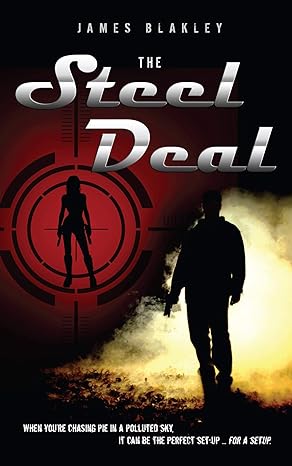
The Steel Deal by James Blakley


Published in 2010 by Inkwater Press

Sonny Busco is a down-on-his-luck 55 year old private detective who is broke. He is so broke that he works more for a security guard company than he does as a private detective. He is so broke that he owes money to loan sharks and he is behind on his payments. He is so broke that he's not sure if his car will start and if it does if it will even get him there. He is so broke that he pawned his gun! 

But, Busco gets the offer of his life - just carry a briefcase to Santa Fe, New Mexico for enough cash to get him out of debt to the loan shark. When Busco borrows a car to meet his new client things fall apart very quickly. Soon he's racing across town in a borrowed car trying to figure out what is really going on and most importantly, keep himself alive in the process.


The Steel Deal starts out very strong. Blakley creates a very detailed world for Sonny Busco. Busco is a likable guy with a great set of friends and connections who support him, even if they are getting a little tired of Busco's hard luck ways. I was reminded of The Rockford Files and Magnum, P.I. and how those characters are always asking their friends for favors and that it was often a team effort, albeit a reluctant one. Busco is that sort of character.

But, to go back to the television detectives again, Busco leaves the more realistic world of Rockford and Magnum once his case starts and enters a surreal world much like that of the old Batman and Get Smart television shows. The characters have matching names like Pixy and Bambi, Sage and Savante, Hans and Franz and Bramble and Thorne, just like the Joker and Catwoman used to do with their henchmen. The story keeps getting odder and odder. Imagine Jim Rockford wandering around in a Batman episode and that's how lost I felt at times.

To me, this was like two different books - one is a gritty noir novel about a down-on-his-luck detective looking for a big score and the other is surrealistic and campy. Both kinds of books are fine and this book did them both well - I just did not enjoy the mixing of the two.

Would I come back for another read if Blakley writes another detective book? Yes, there's lots to like in this book. Blakley shows some skill, especially in character creation in the grittier parts of the book. I especially liked the character Zen, a middle-aged overweight woman in spandex from the gym who carts Busco around throughout the middle of the book in her SUV trying to figure out what's going on while he tries to lose her without hurting his feelings or getting her killed. She shows Busco's desperation but also his decency.

I rate this book 3 stars out of 5.

This book can be found on Amazon.com here: The Steel Deal.

Reviewed on December 29, 2012.

Disclaimer: I received a copy of this book from the author in exchange for an honest review. The author writes a very nice e-mail and has some of the neatest handwriting I have ever seen (really, it's like a font).

Shatner Rules: Your Key to Understanding the Shatnerverse and the World at Large (audiobook) by William Shatner with Chris Regan


Published by Penguin Audio in 2011
Read by the author, William Shatner
Duration: 4 hours, 27 minutes
Non-fiction, biography

If you are a fan of William Shatner, Shatner Rules is a must-read, or a must-listen if you prefer to listen to the audiobook version like I did.

Shatner is unique and if you do not appreciate his odd blend of storytelling, self-promotion and urge to stroke his own ego then please skip this book. But, if you think a little self-promotion (actually, a lot of it) is okay and are willing to tolerate Shatner's ego trips for the sake of a good story than this short audiobook should please.

Most of the book covers the last 5 years or so of his career under the guise of explaining several rules that he  has followed throughout his career. The most important rule and the most consistently followed is his admonition to say yes to opportunity. Throughout the book he talks about the positives that he has had in his career due to his willingness to say yes, including a rather long convoluted story about how his willingness to make the almost universally panned The Transformed Man album in the late 1960's led to his getting the part of Denny Crane and receiving two Emmy Awards in the 2000's.

By and large, though, this book could easily be considered a tongue-in-cheek promo for William Shatner, Inc. He talks about his roles on The Twilight Zone , Star Trek , T.J. Hooker , The Practice , the Star Trek movies, his TekWar books, his current cable shows, his disputes with other members of the Star Trek cast and his part in the Vancouver Winter Olympics closing ceremonies.

I enjoyed it although I could have done without the 5 minutes and 20 seconds of narration in the made up language of Esperanto (he made a movie filmed entirely in Esperanto in 1965). I suggest the audio version so you can get the full Shatner experience.

I rate this audiobook 4 stars out of 5.

This audiobook can be found on Amazon.com here: Shatner Rules.

Reviewed on December 29, 2012.

Bad Luck and Trouble (Jack Reacher #11) by Lee Child


Published by Dell in 2012.
Originally published in in 2007 by Delacorte Press

I must live under a rock. I had not read any Jack Reacher novel until I read this one and I had not even heard of the series until last summer when a fellow blogger was excitedly talking about the latest release.

So, what did I think?

First of all, you do not have to have read any of the rest of the series to follow what is happening in this story. Jack Reacher is a drifter and he has been since he retired from the U.S. Army in 1997. In the military he led an investigation squad of the military police. Like Clint Eastwood's famed "Man WIth No Name" character from The Good, The Bad and The Ugly, Reacher says little, keeps his own counsel and does what he thinks is best, follow his own sense of justice and drifts from place to place.

Lee Child
In Bad Luck and Trouble, Reacher receives a message from a former member of his unit. He tracks her down and discovers that another former member was murdered - dropped from a helicopter in the desert outside of Los Angeles. The re-assemble as many members as they can and soon discover that four former members are missing, presumed dead. They vow to discover who did this and get revenge.

This is an action-packed book and I blew right through it. This is not deep literature, but it is solid escapist story-telling. The characters are under-developed and I got a little tired of the Jack Reacher personae (ultra-stoic tough guy). I appreciate tough guy stories but I really like them to have an abundance of personality like Robert B. Parker's Spenser or Robert Crais's Elvis Cole. Reacher's lack of personality (or, perhaps, an over-abundance of focus on the problem at hand) scream for someone to lighten the mood from time to time.

I rate this book 4 stars out of 5.

This book can be found on Amazon.com here: Bad Luck and Trouble (Jack Reacher, No. 11)

Reviewed December 28, 2012.

A Beautiful Mind: The Life of Mathematical Genius and Nobel Laureate John Nash [Abridged] (audiobook) by Sylvia Nasar


Published by Simon and Schuster Audio in 2001

Read by Edward Herrmann
Duration: 5 hours, 55 minutes
Abridged

I freely admit that I am one of the few people that did not see the movie A Beautiful Mind. So, I decided to give the audiobook a try. Turns out, I have discovered after a little research,  the book and the movie have little in common. Fair enough.

The plot in short is that John Nash was identified as a mathematical genius in college and brought into several special programs to develop that genius. He specialized in what laymen might call "pure" mathematics but he also was intrigued by economics. In 1959, he was diagnosed with paranoid schizophrenia and he spent time in and out of several mental hospitals. Eventually, he was released from those hospitals and he lived in and around the Princeton campus as a shadowy figure who left mathematical equations on the chalkboards when no one was around. After more than 25 years, Nash finally began to emerge from his illness. He groundbreaking work in the 1950's in economics was recognized in 1994 when he received the Nobel Prize for Economics.

I listened to the almost 6 hour long abridged version read by veteran actor and spokesman Edward Herrmann, not the 18 hour unabridged version read by Anna Fields. Keeping in mind that readers read at different paces, it is still quite obvious that a lot of the original book was cut out of my edition.

Sadly, I cannot say that I am sorry that I missed a lot of this book. The best parts of the book describe the community he worked in and his relationships with other people. Unfortunately, there are long descriptions of the very very high level mathematics he worked on. If I were reading these passages in a text, I would skim them, but it is quite difficult to skim with an audiobook in the car CD player. Instead, I endured mind-numbingly confusing descriptions of geometric concepts and game theory.

Even worse, the portrayal of John Nash in the book makes it hard to have any human sympathy for the man when "he slipped into madness" as the blurb on the back of the audiobook describes it. He was cruel to the women in his life, he was cruel to his students, he was indifferent to almost everyone else except for those few that he would obsess over to a level that we would describe as stalking nowadays. What I was struck by was a sense of his being an utter sociopath.

When his illness overtook him I felt less for the loss of a human being and more for the loss of his mathematical genius. I felt the loss of his utility to humanity as a whole and not the loss of his own humanity. He expressed so little human decency before he became so ill that he could not help but feel that his illness was a sort of cosmic Karma punishing him. I am sure that was not the intention of the author (and that these were all symptoms of his mental illness in its early forms), but I was struck by it as I listened and I did not enjoy it. I am sure that is why the movie is so different.

I rate this audiobook 3 stars out of 5. It can be found on Amazon.com here: A Beautiful Mind: The Life of Mathematical Genius and Nobel Laureate John Nash [Abridged]

Reviewed on December 27, 2012

It Worked for Me: In Life and Leadership by Colin Powell with Tony Koltz


Published in 2012 by Harper

Colin Powell updates his 2003 memoir My American Journey with It Worked For Me: In Life and Leadership. The book is really two books. The first part is an expansion on an article that was written about him for Parade magazine in 1989. In that article he listed 13 rules he had for life:
  1. It ain't as bad as you think. It will look better in the morning.
  2. Get mad, then get over it.
  3. Avoid having your ego so close to your position that when your position falls, your ego goes with it.
  4. It can be done!
  5. Be careful what you choose. You may get it.
  6. Don't let adverse facts stand in the way of a good decision.
  7. You can't make someone else's choices. You shouldn't let someone else make yours.
  8. Check small things.
  9. Share credit.
  10. Remain calm. Be kind.
  11. Have a vision. Be demanding.
  12. Don't take counsel of your fears or naysayers.
  13. Perpetual optimism is a force multiplier.
Colin Powell speaking
at the United Nations
Powell then expands on each of these rules, often throwing in interesting real life anecdotes that illustrate the points, including details about his life as a child of immigrants in New York City, his educational career and plenty of stories about his military career at all levels.

The second half of the book is an expansion of his memoir, as noted above. He talks about his life as a professional speaker and other things he has learned over the years (the importance of delegating so you can stay focused on your job, for example, he learned from Ronald Reagan). 

The most interesting part was his descriptions of his time as Secretary of State and his (in)famous speech at the United Nations in which he laid out the details of Iraq's presumed program of building weapons of mass destruction. He uses it to illustrate a larger point that goes with the delegating responsibility lesson I mentioned in the previous paragraph. Clearly he is not happy with the information he was given but he comes short of blaming the Bush Administration of setting him up or of pulling a "bait and switch" operation, which will disappoint some.

I rate this book 5 stars out 5. It can be found on Amazon.com here: It Worked for Me: In Life and Leadership by Colin Powell with Tony Koltz.

Reviewed on December 24, 2012.

The Last Man (Mitch Rapp #13) (audiobook) by Vince Flynn


Published by Simon and Schuster in 2012

Read by Armand Schultz
Duration: Approximately 6 hours
Abridged

In The Last Man, Vince Flynn takes a break from the Mitch Rapp prequels and puts Mitch right in the thick of the American withdrawal from Afghanistan. He is brought in to investigate the disappearance (a presumed home invasion kidnapping) of Joe Rickman, the head of the CIA's clandestine operations in Afghanistan. In fact, he's been involved in so many clandestine operations that he could singlehandedly gut the intelligence agency's efforts in multiple countries around the world.

But, as Rapp and his team start to investigate they find that all of the pieces don't quite fit together. Add to that an FBI agent that believes that Rapp and Rickman have pocketed millions of dollars intended for intelligence efforts in Afghanistan and the reappearance of a deadly man from Rapp's past and you have the basis for a good story.


While the action is solid, there is too much posturing by Rapp and probably too much taken out of this abridged edition of the book. It is 6 hours compared to 12 hours in the unabridged version and the story most likely suffers a lot. The abridged version gets the highlights (Rapp shoots, fights, glowers, curses and throws righteous anger tantrums all over Afghanistan and Washington, D.C.).

There is much that is ridiculous in this book. I am assuming that the abridgement of the book took out all of the important non-action stuff that makes the book makes sense. For example, the bad guy is so blatantly cruel that you have to wonder who would ever want to work with him (at one point he determines that he will have to kill a woman simply because she is ugly - not because she knows too much, but because she knows too much and she is too ugly). Another time, Rapp is badly injured in the story but he recovers so quickly that I wondered why the injury was even worked into the story line in the first place.

So, my recommendation: spend a few more bucks and get the unabridged version of the audiobook. It will most likely be a better experience.

I rate this audiobook 3 stars out of 5. It can be found on Amazon.com here: The Last Man by Vince Flynn

Reviewed on December 22, 2012. Edited on January 19, 2025.

Note: I was sent a copy of this audiobook by the publisher in exchange for an honest review.

Killing Kennedy: The End of Camelot (audiobook) by Bill O'Reilly and Martin Dugard


Published in 2012 by MacMillan Audio
Duration: 8 hours, 25 minutes
Unabridged
Read by the author, Bill O'Reilly

I was a little reluctant to listen to this audiobook because of the author. Not Martin Dugard. This is the third book I have read or listened to that he has written or co-written and I know he can really tell a story. No, it's Mr. "No Spin Zone" that I cannot stand. Our politics are similar but I just find O'Reilly difficult to stomach.

That being said, I enjoyed this audiobook quite a lot.

John Fitzgerald Kennedy
(1917-1963)
O'Reilly narrates Killing Kennedy, which means it's a mixed bag for me. He speaks for a living so he reads it well and knows what phrases and words he wanted to emphasize but, like I said above, a little O'Reilly goes a long way for me. Also, his frequent use of dramatically read foreshadowing that alludes to the date of JFK's assassination got very old very fast.

But, the positives are the way the book is presented. O'Reilly tells the story of JFK from PT 109 forward and gives the reader of the man Kennedy was becoming. JFK's family life, his relationship with his brothers, LBJ and Jackie are explored in great detail and presented in an interesting fashion and really expose Kennedy's good points as well as his considerable failings.

As they tell the story of the Kennedy Administration, O'Reilly and Dugard lay out all of the parties that have been blamed for the assassination: the Cubans, the CIA, the FBI, the Mafia, anti-civil rights crazies and Lee Harvey Oswald. O'Reilly and Dugard acknowledge that these other groups had a grudge against Kennedy but they go with the traditional explanation of Lee Harvey Oswald.

Perhaps the best piece of the book is how well they tell the story of Jackie Kennedy on the day of the assassination. It is a fine piece of writing that brought tears to my eyes at one point (please note, I have not been a particular fan of JFK or of O'Reilly so the fact that a bit of writing read by O'Reilly about JFK brought tears to my eyes speaks volumes about its power).

Well done.

I rate this audiobook 5 stars out of 5.

Reviewed on December 22, 2012

Note: I was provided a copy of this audiobook by the publisher in the hopes of receiving an honest review.

This audiobook can be found on Amazon.com here: Killing Kennedy.

The Sheriff of Sorrow (#1 in the series) (audiobook) by Jack Bates

Published in 2012 by Mind Wings Audio
Read by Joe Barrett
Duration: 1 hour, 6 minutes

Technically, The Sheriff of Sorrow is not a western because it takes place in northern Michigan. However, the story has all of the traditional pieces of a Western: a wild town, miners, rich guys manipulating the town, card games, people accused of cheating at card games, saloons, prostitutes, gun play and a new sheriff in town. Let's face it, in the days of the Old West, most of the rest of the country was not particularly settled, either.

This short story serves as the introduction to a new series about Sorrow, Michigan. Cal Haskell has been brought to town to be the new sheriff. The short story introduces most of the characters, give the listener a feel for the situation and establishes the new sheriff as a no-nonsense tough and smart guy that takes his job seriously - no matter who is involved.

The reader is Joe Barrett. I like Barrett's folksy midwestern voice. He does a good job with the voices of these stock Western characters (old prospector types, tough guys, slick gamblers, naive farm boys, etc.) without drifting into characterture.

This should be a strong series. I look forward to listening to more.

I rate this audiobook 4 stars out of 5.

The kindle version of this book can be found on Amazon.com here: Sheriff of Sorrow.

Reviewed on December 20, 2012.

Note: I received a free download of this book from the publisher in exchange for an honest review.

Here is the link to my review of audiobook #2 in the series: Trouble Comes to Sorrow.

10 Days That Unexpectedly Changed America (audiobook) by Steven M. Gillon


Published in June of 2006 by Random House Audio
Read by Stephen Hoye.
Unabridged
Duration: 8 hours, 51 minutes.

The book and audiobook for 10 Days That Unexpectedly Changed America are companion works for a History Channel series of the same name. They cover the same ten days but are independently researched and written. These dates are not the super-obvious ones like July 4, 1776 and December 7, 1941. One could quibble with the choices (it is part of the fun of a project like this one) but his choices are good ones.

Here are the ten days and a few comments:

1) May 26, 1637

The date of a Puritan massacre of Indians at Mystic. He argues that King Philip's War is the model of American/Indian relations for the next 250+ years.

2) January 25, 1787

Shay's Rebellion and its influence on the Constitution. Emphasized the need for a more centralized government.

3) January 24, 1848

California Gold Rush. Focused on environmental degradation and not so much on the effect of all that gold on the American economy. It was a rather depressing entry.

4) September 17, 1862

The Battle of Antietam and the Emancipation Proclamation

5) July 6, 1892

The Homestead Strike against Carnegie Steel. The date of the battle against the Pinkerton agents. I was struck that the author noted in a single sentence that Carnegie (who comes off very poorly in this whole affair, no matter who is writing it) gave some money to charities. Carnegie gave away 90% of his immense fortune, well over $4 billion dollars in 2010 dollars, to charities across the globe, including having a hand in building nearly half of the public libraries in America (1,689 in total).

Carnegie was a complex man, he gets a one dimensional treatment in this entry.

Theodore Roosevelt (1858-1919)
6) September 6, 1901

The assassination of William McKinley and the subsequent Roosevelt Administration. The rise of activist government.

7) July of 1925

The Scopes Monkey Trial as a harbinger of future culture wars. Interestingly, it was started as a publicity stunt to attract tourists and is almost nothing like the play "Inherit the Wind."

8) August 2, 1939

Albert Einstein's letter to FDR about the possibility of the creation of an atomic bomb. This entry has some poor linkage to the Civil Rights movement and the creation of the Internet (I know it was created to communicate in the event of a nuclear war but this is still a stretch).

9) September 9, 1956

Elvis Presley on the Ed Sullivan Show. Focuses on the rise of teen culture, ending racial divisions and loosening sexual mores. This was an exceptionally long and interesting entry.

10) June 21, 1964

"Freedom Summer"

In a lot of ways, this entry was really and addendum to the points made in date number 9. It is a powerful entry and exceptionally well-read by the narrator, Stephen Hoye, who includes very good Southern accents when reading quotes by Southerners.

This will be an interesting listen for any history buff. Be prepared that the author's comments tend to drift to the political left. Nonetheless, it is well worth your time.

This audiobook can be found on Amazon.com here: 10 Days That Unexpectedly Changed America (History Channel Presents)

I rate this audiobook 4 stars out of 5.

Reviewed on December 18, 2012.

Featured Post

<b><i>BAN THIS BOOK (audiobook)</i></b> by Alan Gratz

Published in 2017 by Blackstone Audio, Inc. Read by Bahni Turpin. Duration: 5 hours, 17 minutes. Unabridged. My Synopsis Ban This Book is t...

Popular posts over the last 7 days