The 1990s: A Brief History [Kindle Edition] by Vook

Published in July of 2011 by Vook

Vook is a publisher of e-books enhanced with video clips (Video + Book = Vook). This history is short (Amazon estimates it would be about 32 pages on paper) so it is unlikely to satisfy a history purist. However, for a 32 page history of the United States in the 1990s, it is pretty solid (but admittedly lightweight due to its short length) and very readable.

The most famous image from the
1995 Oklahoma City bombing.
The topics covered include:

-A New World Order/Fall of the USSR;
-Clinton's Impeachment;
-Creation of the World Wide Web;
-Cloning/Genetic therapies;
-David Koresh/Oklahoma City bombing/First Twin Towers Bombings;
-The 1992 NBA Olympics "Dream Team";
-Grunge Music.

I rate this e-book 3 stars out of 5.

This e-book can be found on Amazon.com here: The 1990s: A Brief History

Reviewed on November 6, 2012.

Tempting Yerva (kindle) by Chris Turner


Published in 2011 by Innersky Books


Tempting Yerva is a Kindle short story. If it were on paper it would be about 13 pages long, according to Amazon.

An adolescent girl named Dore is a young nun in the Yerva sect. Like monks and nuns across most faiths, her life is a lot of hard work, meditation and discipline and this young girl is miserable. She hates it. She is bored and her raging hormones make her think an awful lot about sex.

The religion seems to have a superficial similarity to Buddhism in that the goal of the aspirant is to achieve "bliss" - a sense of nothingness. Dore has no interest in any of this. One day, alien (literally from another world) voices start to whisper to her and promise her powers, sex and more in exchange letting them use her. She agrees.

Her wildest fantasies come true, she is granted magical powers, no temptation is left unsatisfied and the entire sect is endangered.

My takeaway? Dore has been untempted in her life, but once she is allowed to "sin" she nearly destroys and perverts everything. I don't want to ruin the end of this very short story - you will have to read it to see where her unrestrained activities lead.

I rate this story 2 stars out of 5. Too short. Not explained well enough.


This short story can be found on Amazon.com here: Tempting Yerva by Chris Turner.
Reviewed on November 6, 2012.

Indomitable Will: LBJ in the Presidency by Mark K. Updegrove


Published by Crown Publishers in March of 2012

Indomitable Will: LBJ in the Presidency is a biography composed mostly of snippets of interviews edited together to tell President Lyndon Johnson's story.

The book is designed to give the reader a view of Lyndon Johnson - the man. Johnson was a controversial man  - easily one of the most controversial of the 1960's. He is easily caricatured and mis-characterized. This ambiguity is odd considering that he was one of the most successful presidents of all time when it came to pursuing and passing a legislative agenda. If not for the Vietnam War, his legacy might be much different today.

Lyndon Baines Johnson
(1908-1973)
While I learned a lot more facts about Johnson than I knew before reading this book, I did not get a better read on the man himself. His motivations were so mixed and his outbursts so frequent that I could not (and still cannot) tell if he put himself behind legislation like the Civil Rights Act of 1964 to make a name for himself, because it was the right thing to do or if it was done just to confound people. Perhaps it was all three. Was he a bully, a flirt, a schmoozer or just the most versatile politician of his era?

Johnson's stormy relationship with Eastern elites shines through, but this is well-known. Johnson's frequent womanizing is alluded to just once despite numerous pages dedicated to the relationship between LBJ and "Lady Bird" Johnson. This issue is emblematic of a problem with the book in general. The author if the director of the Lyndon Baines Johnson Presidential Library Museum in Austin, Texas. As such, he has access to more of Johnson's papers than just about anyone else. But, I think it is clear that this book was written from the perspective of a fan of LBJ. Fans diminish (or even explain away) the negatives and focus on the positives.

The oral history format of the book was sometimes interesting, but oftentimes it was very repetitive with multiple people expressing the same or very similar thoughts back to back on LBJ and the issues of the day.

Bottom line: the book does little to shed light on the mercurial personality of LBJ. I you know nothing about LBJ, this is a solid place to start. If you know something about him already, you will know more after the reading the book and still not really know the man.

I rate this book 3 stars out of 5.

This book can be found on Amazon.com here: Indomitable Will: LBJ in the Presidency

Reviewed on November 4, 2012

Fact. Fact. Bullsh*t!: Learn the Truth and Spot the Lie on Everything from Tequila-Made Diamonds to Tetris's Soviet Roots-Plus Tons of Other Totally Random Facts from Science, History, and Beyond! (Kindle edition) by Neil Patrick Stewart


Before You Try to Impress Your Friends with All of Your New-Found Factoids, Verify Them 

Published by Adams Media in 2011

This book was a first for me in a way. Fact. Fact. Bullsh*t! was the first book I ever read on my phone thanks to the Kindle app for my android phone. In a way, this book was made for reading on a little phone screen. It is entirely composed of a topic with three "facts" that follow. After that the reader will find out that at least one of those "facts" will be correct and at least one will be incorrect, or bullsh*t as the title notes. The  facts and the bullsh*t answers are explained.

This makes for fairly interesting short-term reading but it is not built for the long haul. This would be a great book to have for standing in line at the bank or if you have to wait for a bus or a train because you can get in and out of a topic in just a few minutes.

But...some of Stewart's facts are more factual than others. For example, he incorrectly states as a "fact" that Thomas Jefferson was the fourth president and the third vice president. In reality, he was the third president and the second VP.

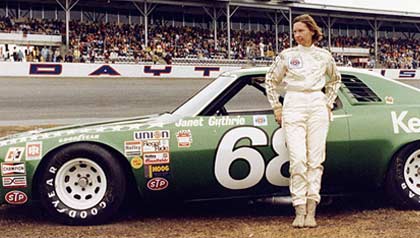
Janet Guthrie at the 1977 Daytona 500.
When it comes to the NASCAR set of "facts" there are multiple problems. He addresses the widely held belief that Danica Patrick is the first woman to race for NASCAR's Winston Cup, which he notes is incorrect, but on multiple levels that he fails to mention. Danica is not the first woman to race in NASCAR, which he correctly notes. However, he only mentions Janet Guthrie, who first competed in NASCAR in 1976. Other women competed in NASCAR's top level as early as 1949, but they are not mentioned. Also, he fails to note that Danica never competed for the "Winston" Cup since its name was changed in in 2004. Also, he notes in his "fact" section that the largest NASCAR event can hold as many as 170,000 fans. That is incorrect. The Brickyard 400 race at Indianapolis Motor Speedway has 280,000 seats available.

So, in short, this is a fun little book but don't trust everything that you read in it. Before you try to impress your friends and co-workers with your newfound factoids, verify them.

I rate this book 3 stars out of 5.

This book can be found on Amazon.com here: Fact. Fact. Bullsh*t!

Reviewed on November 2, 2012.

War on the Waters: The Union and Confederate Navies, 1861-1865 (audiobook) by James M. McPherson


Published by Blackstone Audio in 2012.
Read by Joe Barrett
Duration: 8 hours, 55 minutes.
Unabridged

James McPherson is undoubtedly the most popular living Civil War historian. He writes in a common, easy-to-understand style that flows nicely and does not dumb down the facts. His latest book, War on the Waters: The Union and Confederate Navies, 1861-1865 continues that tradition.

Union Admiral David D. Porter -
Leader of the Naval forces in the
Vicksburg campaign.
If you read a typical Civil War history you get a just a little bit of the information, usually in passing, about the war on the open sea, in the bays, harbors, up and down the rivers and even in the swamps. McPherson reverses that arrangement in this book and focuses on the strategies, personalities and challenges that faced both navies and mentions the land campaigns in passing. If you are a frequent reader of Civil War books, little of this material will be new. But, the special focus does make the story of the naval forces more cohesive than is usually found in histories.

Starting with Fort Sumter and the formation of the Anaconda Plan, McPherson hits all of the typical highlights, including the Mason and Slidell Affair, privateers, the taking of New Orleans, the repeated tries to take Charleston, the Merrimack (Virginia) vs . the Monitor fight, the river campaigns in the West, including the long struggle for Vicksburg, the taking of Mobile ("Damn the Torpedoes! Full speed ahead!") and more. Typical of McPherson, he includes smaller stories that make the war more real and interesting, such as the time a Union gunboat captured a Confederate train and the cattle rustling gunboats.

Joe Barrett narrated the audiobook. He has sort of a "folksy" reading voice which is pleasant enough. His real strength, however, was the way he gave individual voices to direct quotes, including a soft southern accent for Union Admiral Farragut who was born in and lived in the south but went for the Union and a high-pitched accent for Lincoln. Movie directors love to give Lincoln a baritone voice but all accounts talk about his high-pitched Midwestern accent.

I rate this audiobook 4 stars out of 5. A must-read for all serious students of the Civil War and/or the Navy.

This audiobook can be found on Amazon.com here: War on the Waters: The Union and Confederate Navies, 1861-1865 (The Littlefield History of the Civil War Era) 

 Reviewed on October 25, 2012.

The Time Keeper: A Novel (audiobook) by Mitch Albom


Published in 2012 by Hyperion Audio
Performed by Dan Stevens
Duration: 4 hours, 42 minutes.
Unabridged.

I am torn by this book. I liked the message (just live your life, enjoy the time you have, don't be a clock-watcher) but this short book felt like it was jammed full of padding.

The Time Keeper features a man named Dor who lives at the beginning of civilization. He is happily married to his childhood sweetheart, has kids and is also the first man to measure time. He creates sundials, water clocks, measures the cycles of the moon and notices the days get longer and shorter as the year progresses. His childhood friend is the king and the creator of the Tower of Babel. His friend wants to harness this ability to measure time in some way to build his tower but Dor refuses. They are banished and eventually his wife dies from a disease. Dor returns to the tower and storms up the stairs just as God punishes the builders of the tower (sort of like it is described in Genesis). Dor is not killed. Instead he is placed in a cave and is forced to listen to the prayers and laments of everyone who wants more time, less time, to stop time, to reverse time, or whatever. Dor does not age even though time continues to move forward. He becomes the mythical figure  known as Father Time.

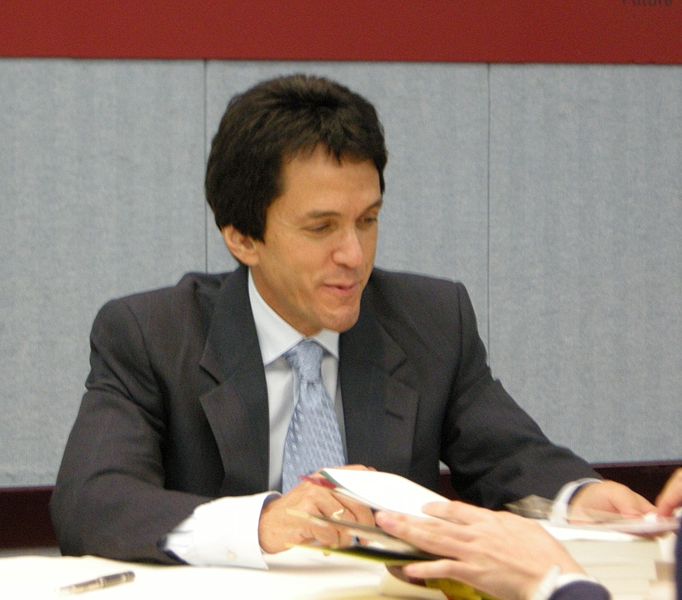
Mitch Albom (photo by Vincent Wagner)
Meanwhile, in the modern world, two people have their own issues with time. An elderly businessman who is dying from cancer wants more time. A high school girl is dealing with issues of bullying and divorced parents needs to slow things down so she can process them.

Dor is finally released from his prison and told that he can finally die if he can help these two people from a future world that he can barely comprehend. He gets to use the tools of Father Time (controlling the speed of time) to help him accomplish this goal. Will he do it? Albom telegraphs that early on - of course. How will he do it? That's the question.

Dan Stevens reads this book with a great deal of skill. His multiple female characters are well done. I teach high school and he catches the cadence and rhythm of high school-speak very well. Even better, he catches the pain and frustration of the elderly businessman's voice wonderfully. As he dies from kidney failure his voice gets weaker and more slurred in scene after scene.

I give this book 3 stars. It is very slowly paced and is only saved by the tear-jerker moments at the end that felt intentionally manipulative.

This book can be found on Amazon.com here: The Time Keeper.

Reviewed on October 25, 2012.

Chimera (The Subterrene War, Book 3) (audiobook) by T.C. McCarthy


Published by Blackstone Audio in 2012.
Duration: 10 hours, 57 minutes
Read by John Pruden.
Unabridged.

Chimera is the third installment of new author T.C. McCarthy's remarkable Subterrene War trilogy. This is not an easy trilogy. It has brutal battle scenes, shows the reader an uncomfortable vision of technology pushed too far and asks important questions about what it is to be human. And, on top of that these three books are well-told, hair-raising trips through three different war zones in a truly dysfunctional world.

In Chimera McCarthy introduces a new set of characters, as he does in every book in the series. Stan Resnick is an assassin. He seeks out and executes germline clones created by the American military to be frontline shock troops in Kazakhstan. They are all female (the males cannot be controlled), start fighting at age 16 and are pre-programmed to die at age 18. But, some have fled the war zone and have escaped to countries all over the world, surviving in a pathetic half-rotted state but still astonishingly dangerous. Resnick's job is to find them and execute them discreetly, if possible.

T.C. McCarthy
After a tough mission in which his long-time partner is killed, Resnick is sent home to decompress. Suddenly, he is called back to duty and is offered a mission that is in all probability a suicide mission. He is teamed with a fully human rookie soldier with a genius level knowledge of tactics and strategy because has been trained with new artificial techniques gleaned from the methods used to train the clone soldiers.

Part of the book deals with Resnick's inner demons. He is unhappy with the state of the world, the state of his personal life, the type of man he has become and his new mission. He is prone to drinking binges because he thinks too much and that is the only way he can stop thinking. The tension between the grizzled veteran and the talented rookie is a common theme in books and movies, but McCarthy manages to put his own twist on it and make it work to the story's advantage.

Resnick and his partner are sent to Thailand to find the leader of a colony of clone soldiers that have turned off the genetic programming that makes them die. Their mission is to recruit her to fight against a Chinese army that is invading Southeast Asia. Or, maybe it is to kill her.

Their mission brought to mind Apocalypse Now and Heart of Darkness as Resnick is escorted along a difficult trail deep into the jungle to complete his mission. The rules change in the jungle and everything boils down to a struggle to survive as they discover the awful new genetic manipulations that pilot new war machines that have been developed by the Chinese military and plans for even worse. At this point the reader realizes that there are two meanings for the title, Chimera. From mythology, you know that a chimera is a mythical animal made of parts of several different animals, a reference to all of these genetic permutations. But, is also a reference to the saying, "Chasing a chimera," or going on a fool's errand because Resnick's mission is unclear and unlikely to succeed.

In the jungle the story becomes a high tech war story with some very powerful questions about what it  means to be human. Is Resnick still human, even though his heart is so hardened that he is really not very different than the clones he hunts? Is his partner human, even though his brain has been tampered with? Are the germline clones human? How about the new genetically modified creatures from China? How about Resnick's "semi-aware" computer that he carries on his back and is his only real friend for most of the book?

And what is McCarthy's answer to this question? It is certainly worth the ride through all three books to find out. This is an amazing first series of books and well worth a read (or a listen).

Interestingly, McCarthy's each book of the Subterrene War trilogy has a different reader, reflecting the three different characters telling their stories. John Pruden read this book and captured the world-weary and grizzled voice of Resnick perfectly. Even better, he has a talent for accents and female characters, helping to make this trilogy an exceptional experience.

I rate this book 5 stars out of 5.

This book can be found on Amazon.com here: Chimera (The Subterrene War)

Reviewed on October 24, 2012

Wear a Fast Gun (audiobook) by John Jakes


Published in 1995 by Sunset Productions

Performed by John Dhyani
Running time: about 3 hours.

Note: I assume that this book was abridged. It's original length in paperback was 182 pages and 3 hours would not normally cover that many pages.

Back in the 1970s and 1980s John Jakes ruled the paperback historical fiction market with series like North and South trilogy and his Kent Family Chronicles. 

Wear a Fast Gun is not one of those sweeping historical epics. It was written in 1956 and is a pretty typical western. A new sheriff named Reb Fallon has come to the town of Longhorn. Longhorn is a dangerous place and Reb Fallon is a hard man so it seem to be a perfect fit.

Fallon sets out right away to confront the random violence associated with the saloons and also with a gang of cattle rustlers that hide behind hoods. Along the way he makes a lot of enemies, a few friends and encounters a possible love interest.

The story itself is neither bad nor good - like I said before, it is a pretty typical western. But, the reader is another story altogether. Almost all of his voices sound like they are stereotypes of characters who should appear in a Western. The voice work sounds like it would be better suited for a humorous car dealer radio ad or a cartoon than for an audiobook. Every character is over the top. There is the old miner guy, the rich swaggering rancher, the little guy who is game for anything and then there's the matter of the bad falsetto for every female character. Throw in Western style transition music that was not matched to the scenes they were transitioning to and from (imagine a dramatic death scene followed by upbeat hoe down fiddle playing and you get the idea) and it was so bad it was almost funny.

Anyway, the so-so story and the bad reading make for a rating for 2 stars out of 5.

This book can be found on Amazon.com here: Wear a Fast Gun by John Jakes.


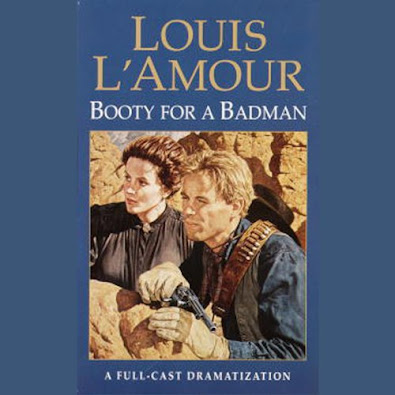
Booty for a Badman (audiobook) by Louis L'Amour


Published by Bantam Audio Publishing in 1991.
Multicast performance. 
Duration: 1 hour, 4 minutes.

 Louis L'Amour's famed Sackett family adventures continue with this full cast dramatization of of a short story about William Tell Sackett. Tell Sackett appears in seven L'Amour novels and two of his short stories.

In Booty for a Badman, Tell Sackett is prospecting for gold and not finding anything. He is close to giving up completely when he is approached by one of his successful gold-mining neighbors with a proposal. The successful miners are piling up quite a stash of gold (50 pounds among the group) but they fear their claims will be jumped if they leave for town to deposit it in the bank for safekeeping. Even worse, they could be robbed and killed along the way - a fate that has struck other miners So, they want Tell Sackett to sneak their gold to the bank in exchange for a small cut of the gold. This way, their gold gets deposited, Sackett can make his money back on his own failed gold mine claim and the miners can defend their successful claims.
Louis L'Amour (1908-1988)


 Sackett agrees to this plan and quietly heads off. Along the way he meets the injured runaway bride of an army lieutenant who knows nothing about the West and he is pretty sure he is being followed. Can he help this young woman? On top of that, is he being followed and if he is, is he being followed by frieds or foes? Will his father's advice that "Women are trouble" prove to be true?

 This audiobook was well-performed by the cast members and was an enjoyable break from what I normally listen to in audiobooks.

I rate this audiobook 4 stars out of 5.

Reviewed on October 20, 2012

This audiobook can be found on Amazon.com here: Booty for a Badman by Louis L'Amour.

Children of Wrath: A Novel (audiobook) by Paul Grossman


I have rarely been carried into another (horrible) world so thoroughly as I was by this audiobook.


Published by HighBridge Audio in April of 2012.
Read by Kyle Munley.
Duration: 12 hours, 13 minutes.
Unabridged.

Paul Grossman's The Children of Wrath is a dark detective story set in one of the most tragic situations in all of history: The Weimar Republic in the weeks before the rise of the Nazis. A series of murders of boys combined with the impending failure of Germany's experiment with democracy, the collapse of the American stock market and the open street fighting between the Nazis and the Communists makes this tragic piece drip with a sense of the impending descent of Germany into the madness that enveloped it after the Nazis took command.

Willi Kraus is the only Jewish detective in the Berlin police force (and perhaps all of Germany). He is a decorated veteran of World War I but his country treats him with no respect because he is Jewish. His fellow detectives refuse to be his partner. His supervisor gives him insulting jobs. In this story he is re-assigned from a murder case (a burlap bag of bones from a boy with teeth marks on them is found washed up from a sewer line) to investigate an outbreak of Listeria that has killed consumers of pork sausage, with the implied insult of having a Jewish detective investigate a case involving the famously non-Kosher pork product.

But, as Willi digs into his new case he finds hints that the two cases might actually be connected and he starts his own private investigation as more and more boys go missing and more bones are found. While Kraus investigates,  Grossman gives the reader a foreshadowing of the horrors and atrocities that await Germany. The railroad cars that come from Poland filled with hogs and cattle to the butchers in Germany will soon enough come full of people headed for slaughter. Hitler leads small rallies that inflame the passions of many who feel lost. Death camps, human skin used as leather, and science gone wild all make appearances while Goebbels spreads his propaganda in the press.  There are references to "useless mouths" and the incessant prejudice against Jews combine to leave Kraus and his family abandoned by co-workers and neighbors alike.

Grossman notes that this was also a time of a rise of the interest in paganism in Germany and that Hitler built on many of those pagan themes. Christians certainly bear plenty of responsibility for the Nazis, but it was certainly not friendly to traditional Christianity and built on a pagan base as well. At the end of the book Kraus comes across a group of  Hitler Youth who are marching in the street and singing:

"We are the joyous Hitler Youth
Our leader is our savior.
The Pope and rabbit shall be gone
We want to be pagans again."

With that we know that Germany's future is sealed - the young people have bought into what Hitler is selling and the tragedy will continue to unfold.


This is by no means a perfect book. The climactic ending is too cheesy. It is dramatic, but it feels like the end of a Batman movie (and not one of the good ones, either). I don't want to go into specifics, but it does not fit well with the rest of this unique, moody, tragic book.

Nonetheless, I will still rate this book 5 stars out of 5. I have rarely been carried into another world so thoroughly as I was by this audiobook. Between the excellent writing and the dark tones of the reader, Kyle Munley, this book really got into my head. Munley's great character voices, precise pronunciation of German words and phrases, and his ability to carry the story through all of its ups and downs make this an exceptional audiobook experience.

Reviewed on October 20, 2012.

This book can be found on Amazon.com here: The Children of Wrath by Paul Grossman.

Mondays With My Old Pastor: Sometimes All We Need Is a Reminder From Someone Who Has Walked Before Us by Jose Luis Navajo


Published in 2012 by Thomas Nelson

Mondays With My Old Pastor is a fictional parable about a relatively young pastor who is starting to experience symptoms of burnout. He has had rough times with some members of his congregation, his family life has suffered as he commits more and more time to work but is dismayed to find work less rewarding and less success-filled as it was earlier in his career. His calling has become a chore.

So, the young pastor contacts his old pastor, a little old man who is now retired from the active ministry and lives with his wife in a little house surrounded by a beautiful garden. The older pastor recognizes the symptoms of burnout and is eager to speak with this young man and teach him some of his "secrets" as well as constantly re-focusing him on the message of the cross.

Altogether, there are 15 secrets which are explained in a repetitive format that involves the younger pastor coming to the house of the older pastor week after week for more insights. The insights are all powerful and worthy of note, such as:  "Everything begins with loving God. Either we love the One we serve, or our service will become arduous and boring work. Don't work for the church of God; serve the God of the church" and "Watch over and preserve the health of your family. One of the most powerful credentials of your ministry is your family, beginning with you marriage."

All of the advice is wonderful but the parable format got mighty tiresome for me by somewhere around page 75. The last 129 pages were tedious because of this rather elaborate parable format and I found myself skimming through all of the window dressing just to get to the parts where the old pastor presented his new insight and explained it.


I give 5 stars to the insight but a mere 1 star to the format. This makes for an average of 3 stars.

This book can be found on Amazon.com here: Mondays With My Old Pastor.

Reviewed on October 19, 2012.

The Wait Album: More of the Best by the cast of Wait Wait...Don't Tell Me


Published by HighBridge Audio in 2012.

Performed by the guests and cast of Wait Wait...Don't Tell Me!
Duration: about 2 hours.

If you have not discovered NPR's weekly radio show Wait Wait...Don't Tell Me! , then I pity you. This clever show is truly one of the funniest shows on radio or television or just about anywhere and this collection is promoted as a distillation of the best of a very funny crop.


The question is, is it truly "More of the Best"?

Yes. It lives up to its own hype.

They truly are all funny. Even the people who I had never heard of like Neko Case and Tavi Gevinson were funny and interesting. Other, more well known personalities (at least to me), like Henry Winkler, Jane Goodall, Vince Gill and Brian Williams were as funny or funnier than I expected.

This audiobook focuses on a part of the show - the "Not my job" segment. In this segment a celebrity is asked 3 questions about a topic about which they may not have any particular expertise and if they get 2 of the 3 correct they win a prize for a listener. For example, Jane Goodall was asked questions about Nicholas Cage. Henry Winkler was asked questions about Ponzi schemes (Ponzi rhymes with Fonzie).

Truly a fun audiobook and a real joy to listen during my commute - I am going to have to look for others in the collection.

I rate this audiobook 5 stars out of 5. It can be found on Amazon.com here: The Wait Album: More of the Best.

Reviewed on October 18, 2012.

NPR Driveway Moments: Cat Tales (audiobook)


Published by HighBridge Audio
Duration: about 2 hours.

Every installment of HighBridge Audio's NPR Driveway Moments series is composed of collections of stories that aired on NPR. In this case, the common theme is cats.  The stories aired from 1984 to 2011 and cover everything from lions to mock youtube videos of a cat running for the Senate (Hank the Cat - see the video below) to the origins of the domestic house cat to cats being used in the fight against AIDS.


But, the heart of the collection are the stories about the connection between every day house cats and the people they live with. There are travelling cats, vacationing cats, a cat that lives in a hotel and several stories memorializing cats who have passed on.

All of the stories in the collection have first-rate production values but, as always happens in any collection, some stories are better than others. The cover of the audiobook promises "Radio stories that won't let you go" and some do that, but a couple of the stories were so maudlin (brooding over cats that had recently died) that it was a relief when they ended.

But, if you are a cat person, this is a great collection for you.

I rate this collection 4 stars out of 5. It can be found on Amazon.com here: NPR Driveway Moments: Cat Tales.

Reviewed on October 17, 2012.

Obama: The Greatest President in the History of Everything (Kindle) by Frank J. Fleming


Published by Broadside e-books on November 15, 2011
Sold by HarperCollins Publishers
Estimated length in pages: 26 pages

Obama: The Greatest President in the History of Everything is political satire from one end to the other. It is not subtle, but it is humorous.

If you are easily offended by political criticism of President Obama, I do not recommend this book for you.

Fleming has written this book as though he is a fawning sycophant of the President - everything is twisted to be something to praise about the president. I imagined the author reading in breathless awe of the man.

Here is a sample:

"When it was time for him to finally enter politics, he headed to the place best known for learning good values in government: Chicago. There he became a community organizer, one of the most important jobs known to man. As a result of his hard work, everyone in his community was alphabetized, placed within the Dewey Decimal, and color-coded. It was the most organized community in the world."

Fleming hits all of the main events of the first two-and-a-half years of the Obama Presidency, including Obamacare, the Stimulus and the death of Osama bin Laden. He also compares the President to literally every other president and explains why Barak Obama is better than every one of them.

Is this sophisticated humor? No way. Was it a fun one-sitting read? Absolutely.

I rate this kindle book 4 stars out of 5 and it can be found on Amazon.com here: Obama: The Greatest President in the History of Everything.

Reviewed on October 16, 2012.

A Beautiful Friendship (Stephanie Harrington #1) by David Weber


Perhaps the Beginning of a Beautiful Series?


Published in 2011 by Baen

So, David Weber decided to make a Young Adult (YA) series.

Yes, a sci-fi author known best for his highly-descriptive military sci-fi works characterized by very long conversations is entering a field where too much violence and too much conversation are both problematic. Well, I thought, this should be interesting.

Weber expanded a short story that first appeared in an short story collection More Than Honor from 1998 as part of the extensive Honor Harrington series. Eleven year old Stephanie Harrington is the main character in A Beautiful Friendship and she is an ancestor of Honor Harrington.

Stephanie lives on the planet Sphinx, a fairly new colony that is part of a star kingdom called Manticore. Stephanie's family has moved to the planet because their skills are needed but Stephanie is bored by frontier life. However, she is intrigued by a mystery that is being reported across the planet - celery is disappearing from gardens and greenhouses across the frontier.

David Weber
Stephanie decides that some native animal must be taking the celery so she sets an alarm to tell her when their greenhouse has been broken into and one dark and stormy night the alarm goes off. Off she goes with her camera and meets a treecat, the previously unknown native sentient species on the planet. Treecats are sort of a mix of cats, racoons and monkeys with nasty teeth and claws.

The treecats live a low-tech lifestyle consisting of hunting, gathering and light agriculture. They do not have a spoken language because they are telepathic. They have an rich culture and are able to communicate over relatively long distances with their minds. It turns out that treecats find celery to be irresistible. When Stephanie and the treecat named Climbs Quickly meet they form an intense psychic bond, stronger than most mated treecats would experience. Despite Stephanie's utter lack of telepathic skills she is still able to "feel" Climbs Quickly and she knows where he is even if they are separated by miles.

The balance of the book involves the exploration of this bond, their difficulties in communicating (he has no spoken language and she is not telepathic), the dangers facing the treecats by human encroachment (no, this is not a mindless environmental book - it recognizes that human society needs natural resources) and a plot that endangers a band of treecats.

So, how does it work as a YA book? My 12 year old daughter loved it. I liked it. I would think that it is too talkative for most teens and pre-teens, but then again my daughter loved it. What do I know? There is action and to Weber's credit he treats his young readers like intelligent people and does not sugarcoat the tendencies of advanced cultures to overwhelm lower-tech cultures. His treecats are a believable society. I just ordered the second book in the series and I will be sure to read it after my daughter reads it.

I rate this novel 4 stars out of 5. It can be found on Amazon.com here: A Beautiful Friendship (Stephanie Harrington #1) by David Weber.

The Art of Procrastination: A Guide to Effective Dawdling, Lollygagging and Postponing (audiobook) by John Perry


Published by HighBridge Audio in 2012
Read by Brian Holsopple
Duration: 1 hour, 48 minutes
Unabridged.

Are you the kind of person who has the best of intentions but continually puts important projects aside to do other things? Is your work environment organized horizontally (stuff spread all over the desk, open chairs and any other flat surface) rather than vertically (in a filing cabinet)? Do you find that even though you put things off you still get a whole lot of stuff done - just not the stuff that you were supposed to get done? If any of these descriptions sound like you than you should check out this audiobook.

I have to admit, all of those descriptions describe me. Right now I am writing a review of a fun audiobook rather than writing one of a book I read three weeks ago that was not a particularly well done book. But, I am writing and that means one more book review will be checked off of my "to-do" list.

John Perry is a philosophy professor at Stanford. What started out as a fun little essay he wrote when he was supposed to be doing something else has blossomed into a movement (see the essay by clicking here) which goes to prove what Perry has purported for years - Procrastination is not as bad as it is cracked up to be. 


In this audiobook Perry discusses "structured procrastination" ("All procrastinators put off things they have to do. Structured procrastination is the art of making this negative trait work for you. The key idea is that procrastination does not mean doing absolutely nothing."), the value of "To-Do" lists and how to make them work for the structured procrastinator, fringe benefits of procrastination and how to work with non-procrastinators among other topics.


This is a fun audiobook - guaranteed to make fellow procrastinators chuckle and laugh throughout it relatively short run time. By the way, it took John Perry 16 years to turn his essay into a book and it may well have been worth the wait.


I rate this audiobook 5 stars out of 5.


This book can be found on Amazon.com here: The Art of Procrastination: A Guide to Effective Dawdling, Lollygagging, and Postponing, or, Getting Things Done by Putting Them Off

Reviewed on October 5, 2012.

The Hobbit (BBC Radio Presents) (audiobook) by J.R.R. Tolkien


A Disappointing Adaptation


Published in 1988 by Bantam Audio Publishing 
Performed by a full cast
Duration: 3 hours, 42 minutes
Abridged and edited for the radio drama format.

Way back in 1968, the BBC created a radio play version of The Hobbit to air in eight 30 minute segments with a full cast, original music and special effects. Due to a dispute between the Tolkien estate and the BBC the original tapes were to have been destroyed. But, the issues were resolved, copies resurfaced and since the late 1980s the BBC has re-issued this version of The Hobbit in various formats. I listened to a 1988 audio cassette version.

J.R.R. Tolkien (1892-1973)
Now, I truly love the story The Hobbit - it is a true classic and I listened to this version to give myself a little reminder of the story before the movie comes out at the end of this year.

However, this audio version has some serious troubles.

First, the positives. The narrator (a character created for this abridgment of the story) is quite good and I rather enjoyed the interaction between the narrator and Bilbo. It reminded me of someone telling a story around a campfire and another person coming in and clarifying a point from time to time as the story was being told.

But, there are problems. The dwarves tended to blend together and sounded like a rowdy, whiny frat party most of the time with a lot of hooting, grunting and complaining. But, with 13 dwarves it would have been very difficult to do much with them anyway, except to cut down on the extra noise of having all or most of them speak at the same time in scene after scene. On top of that, the names are pronounced differently in this version than I have ever heard them. Gandalf is pronounced with the emphasis on the last syllable and sometimes sounds like gand-ELF. Gollum is pronounced Gul-loom.

But, that would have all been understandable and forgivable if that were the worst of the problems. The special effects are horrid. Sometimes they are too loud so that they dominate the scene (as in when they are carried by the giant eagles) and other times they are pathetic. For instance, in the scene with the wargs there is no attempt made to make the wargs sound wolf-like. Instead, the actors are all baying, "Woooo-ooooo-ooo!" at the microphone. Throw in the horrid voices of the thrush and the eagles and scenes that are meant to be a treat becomes something that must be endured. This adaptation was made on the cheap and it shows, especially when compared to the high quality work done by companies like GraphicAudio nowadays.

I rate this audiobook 2 stars out of 5.

This audiobook can be found on Amazon.com here: The Hobbit.

Reviewed on September 22, 2012.

Capitol Murder (Ben Kincaid #14) by William Bernhardt


Originally published in 2006.

Years ago I worked at a used book store and I was introduced to William Berhnardt's Ben Kincaid series by a co-worker. Pretty soon, all of us were reading the series and recommending it to others and they were moving off the shelf pretty briskly. Ben Kincaid does that to you - he is a likable guy with a rumpled suit and no ego that just wants to do what is best for his friends, family and, of course, his clients.

I haven't read a Ben Kincaid novel in a long time (8 years according to the other Ben Kincaid review by me: Murder One). The good and the bad thing is that William Bernhardt's Ben Kincaid is a lot like Janet Evanovich' s Stephanie Plum. Despite all of the different adventures and experiences, the characters just do not change. Read book 5, book 10, book 14 - it does not matter. Just jump right in. Of course, this is a mixed blessing. It is an invitation to being stale, but also a recognition that people like comfortable characters.

In Capitol Murder, an aide to Oklahoma's senior Senator is found dead in his secret hideaway in the capitol building itself just after a video of them involved in a sexual act is released. Ben Kincaid grew up with the senator and Ben is summoned to lead his defense. His investigator, Loving, digs up enough information to discover that there is a lot more to this case and the victim than meets the eye, including a hidden world of vampires and sex clubs.

Bernhardt decides to keep Kincaid's defense hidden from the reader. The reader learns about the strategies as the case proceeds, which is not the way most legal thrillers work. I found it frustrating and I found the back story on the victim to be quite ridiculous.

I have to give this book 3 stars out of 5. It can be found on Amazon.com here: Capitol Murder (Ben Kincaid #14) by William Bernhardt.

Reviewed on September 22, 2012.

Bill Smith Goes to College by David Stag


An Over-The-Top Satire About College

Published by CreateSpace Independent Publishing Platform in 2012.

We all know that going to college is a major life event. Everything changes in a student's daily life - new place to live, new routines, new friends, new responsibilities and, of course, being exposed to new ideas. 

But, those of us who have gone to college know that the happy brochures that prospective parents pore over with their teenagers are not quite reality. Despite the promises to support young academics in their quest for truth and knowledge, incompetent administration, petty professors and arbitrary decisions often act to make college less of a quest for knowledge and more a test of a young per

son's ability to bend and twist to the whims of a bureaucratic system. Can you go along to get along? If so, step forward and get your diploma.

David Stag's Bill Smith Goes to College is a satire, somewhat in the vein of Jonathan Swift's famed essay, A Modest Proposal. Or, if you like a more modern example, it is in the vein of Rush Limbaugh's declaration that he illustrates "the absurd with absurdity." Take the crazy situation and make it even more crazy to make your point.


So, what is Stag's point exactly?


He has a bunch of them. Here are a few:


1) You are on your own when you go to college;


2) Your values will not be respected if they disagree with those sanctioned by the college;


3) Your time will not be respected;


4) There are prescribed classes to take on a list. You need to take them and not worry about what they have to do with your major;


5) Most professors have nothing new to say, even though they are required to publish. And, once they publish, no one really reads what they read anyway;


6) Some people never leave college;


7) Sometimes you are taught things that make no sense. Just go with it;


8) Some people like to protest against everything. They are annoying and mindless (even though they think they are enlightened);


9) On the other hand, think for yourself and act when you need to.


10) College is a racket, a scheme to bilk the government out of a lot of money in student loans and grants.


When Bill Smith arrives at Mountebank University (yes, it is intentional -a mountebank is a person who tricks people out of their money) and finds that he has no dorm room (he has to sleep at the end of the hallway), the showers are co-ed (but don't look too much or you'll be slapped with a harassment suit!) and his schedule doesn't really make any sense. 


As he goes through his first week at college he meets a colorful cast of over-the-top crazy people who make life at college a confusing mess. Every university employee is exaggerated to make Stag's point and most work quite well (with the glaring exception of Adolph Hilter, a character based on Hitler).  However, I really enjoyed the psych professor named Dr. Flake who had a complete breakdown in front of class.


So, if you like sedate satire, the kind that settles in smoothly and causes you to ponder, well...this ain't it. But, if you like in-your-face satire that never lets up and makes it points early and often this is your book.


I rate this book 4 stars out of 5. It can be found on Amazon.com here: Bill Smith Goes to College.


Note: this book was sent to me by the author to be reviewed, but the review is my honest opinion.

Featured Post

<b><i>BAN THIS BOOK (audiobook)</i></b> by Alan Gratz

Published in 2017 by Blackstone Audio, Inc. Read by Bahni Turpin. Duration: 5 hours, 17 minutes. Unabridged. My Synopsis Ban This Book is t...

Popular posts over the last 7 days