Wear a Fast Gun (audiobook) by John Jakes


Published in 1995 by Sunset Productions

Performed by John Dhyani
Running time: about 3 hours.

Note: I assume that this book was abridged. It's original length in paperback was 182 pages and 3 hours would not normally cover that many pages.

Back in the 1970s and 1980s John Jakes ruled the paperback historical fiction market with series like North and South trilogy and his Kent Family Chronicles. 

Wear a Fast Gun is not one of those sweeping historical epics. It was written in 1956 and is a pretty typical western. A new sheriff named Reb Fallon has come to the town of Longhorn. Longhorn is a dangerous place and Reb Fallon is a hard man so it seem to be a perfect fit.

Fallon sets out right away to confront the random violence associated with the saloons and also with a gang of cattle rustlers that hide behind hoods. Along the way he makes a lot of enemies, a few friends and encounters a possible love interest.

The story itself is neither bad nor good - like I said before, it is a pretty typical western. But, the reader is another story altogether. Almost all of his voices sound like they are stereotypes of characters who should appear in a Western. The voice work sounds like it would be better suited for a humorous car dealer radio ad or a cartoon than for an audiobook. Every character is over the top. There is the old miner guy, the rich swaggering rancher, the little guy who is game for anything and then there's the matter of the bad falsetto for every female character. Throw in Western style transition music that was not matched to the scenes they were transitioning to and from (imagine a dramatic death scene followed by upbeat hoe down fiddle playing and you get the idea) and it was so bad it was almost funny.

Anyway, the so-so story and the bad reading make for a rating for 2 stars out of 5.

This book can be found on Amazon.com here: Wear a Fast Gun by John Jakes.


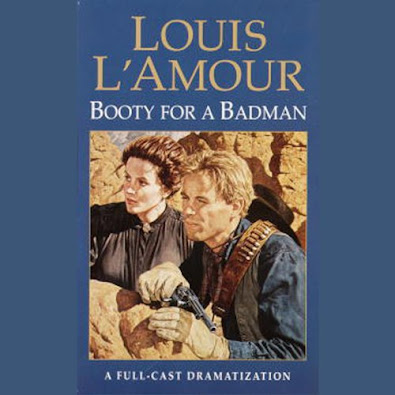
Booty for a Badman (audiobook) by Louis L'Amour


Published by Bantam Audio Publishing in 1991.
Multicast performance. 
Duration: 1 hour, 4 minutes.

 Louis L'Amour's famed Sackett family adventures continue with this full cast dramatization of of a short story about William Tell Sackett. Tell Sackett appears in seven L'Amour novels and two of his short stories.

In Booty for a Badman, Tell Sackett is prospecting for gold and not finding anything. He is close to giving up completely when he is approached by one of his successful gold-mining neighbors with a proposal. The successful miners are piling up quite a stash of gold (50 pounds among the group) but they fear their claims will be jumped if they leave for town to deposit it in the bank for safekeeping. Even worse, they could be robbed and killed along the way - a fate that has struck other miners So, they want Tell Sackett to sneak their gold to the bank in exchange for a small cut of the gold. This way, their gold gets deposited, Sackett can make his money back on his own failed gold mine claim and the miners can defend their successful claims.
Louis L'Amour (1908-1988)


 Sackett agrees to this plan and quietly heads off. Along the way he meets the injured runaway bride of an army lieutenant who knows nothing about the West and he is pretty sure he is being followed. Can he help this young woman? On top of that, is he being followed and if he is, is he being followed by frieds or foes? Will his father's advice that "Women are trouble" prove to be true?

 This audiobook was well-performed by the cast members and was an enjoyable break from what I normally listen to in audiobooks.

I rate this audiobook 4 stars out of 5.

Reviewed on October 20, 2012

This audiobook can be found on Amazon.com here: Booty for a Badman by Louis L'Amour.

Children of Wrath: A Novel (audiobook) by Paul Grossman


I have rarely been carried into another (horrible) world so thoroughly as I was by this audiobook.


Published by HighBridge Audio in April of 2012.
Read by Kyle Munley.
Duration: 12 hours, 13 minutes.
Unabridged.

Paul Grossman's The Children of Wrath is a dark detective story set in one of the most tragic situations in all of history: The Weimar Republic in the weeks before the rise of the Nazis. A series of murders of boys combined with the impending failure of Germany's experiment with democracy, the collapse of the American stock market and the open street fighting between the Nazis and the Communists makes this tragic piece drip with a sense of the impending descent of Germany into the madness that enveloped it after the Nazis took command.

Willi Kraus is the only Jewish detective in the Berlin police force (and perhaps all of Germany). He is a decorated veteran of World War I but his country treats him with no respect because he is Jewish. His fellow detectives refuse to be his partner. His supervisor gives him insulting jobs. In this story he is re-assigned from a murder case (a burlap bag of bones from a boy with teeth marks on them is found washed up from a sewer line) to investigate an outbreak of Listeria that has killed consumers of pork sausage, with the implied insult of having a Jewish detective investigate a case involving the famously non-Kosher pork product.

But, as Willi digs into his new case he finds hints that the two cases might actually be connected and he starts his own private investigation as more and more boys go missing and more bones are found. While Kraus investigates,  Grossman gives the reader a foreshadowing of the horrors and atrocities that await Germany. The railroad cars that come from Poland filled with hogs and cattle to the butchers in Germany will soon enough come full of people headed for slaughter. Hitler leads small rallies that inflame the passions of many who feel lost. Death camps, human skin used as leather, and science gone wild all make appearances while Goebbels spreads his propaganda in the press.  There are references to "useless mouths" and the incessant prejudice against Jews combine to leave Kraus and his family abandoned by co-workers and neighbors alike.

Grossman notes that this was also a time of a rise of the interest in paganism in Germany and that Hitler built on many of those pagan themes. Christians certainly bear plenty of responsibility for the Nazis, but it was certainly not friendly to traditional Christianity and built on a pagan base as well. At the end of the book Kraus comes across a group of  Hitler Youth who are marching in the street and singing:

"We are the joyous Hitler Youth
Our leader is our savior.
The Pope and rabbit shall be gone
We want to be pagans again."

With that we know that Germany's future is sealed - the young people have bought into what Hitler is selling and the tragedy will continue to unfold.


This is by no means a perfect book. The climactic ending is too cheesy. It is dramatic, but it feels like the end of a Batman movie (and not one of the good ones, either). I don't want to go into specifics, but it does not fit well with the rest of this unique, moody, tragic book.

Nonetheless, I will still rate this book 5 stars out of 5. I have rarely been carried into another world so thoroughly as I was by this audiobook. Between the excellent writing and the dark tones of the reader, Kyle Munley, this book really got into my head. Munley's great character voices, precise pronunciation of German words and phrases, and his ability to carry the story through all of its ups and downs make this an exceptional audiobook experience.

Reviewed on October 20, 2012.

This book can be found on Amazon.com here: The Children of Wrath by Paul Grossman.

Mondays With My Old Pastor: Sometimes All We Need Is a Reminder From Someone Who Has Walked Before Us by Jose Luis Navajo


Published in 2012 by Thomas Nelson

Mondays With My Old Pastor is a fictional parable about a relatively young pastor who is starting to experience symptoms of burnout. He has had rough times with some members of his congregation, his family life has suffered as he commits more and more time to work but is dismayed to find work less rewarding and less success-filled as it was earlier in his career. His calling has become a chore.

So, the young pastor contacts his old pastor, a little old man who is now retired from the active ministry and lives with his wife in a little house surrounded by a beautiful garden. The older pastor recognizes the symptoms of burnout and is eager to speak with this young man and teach him some of his "secrets" as well as constantly re-focusing him on the message of the cross.

Altogether, there are 15 secrets which are explained in a repetitive format that involves the younger pastor coming to the house of the older pastor week after week for more insights. The insights are all powerful and worthy of note, such as:  "Everything begins with loving God. Either we love the One we serve, or our service will become arduous and boring work. Don't work for the church of God; serve the God of the church" and "Watch over and preserve the health of your family. One of the most powerful credentials of your ministry is your family, beginning with you marriage."

All of the advice is wonderful but the parable format got mighty tiresome for me by somewhere around page 75. The last 129 pages were tedious because of this rather elaborate parable format and I found myself skimming through all of the window dressing just to get to the parts where the old pastor presented his new insight and explained it.


I give 5 stars to the insight but a mere 1 star to the format. This makes for an average of 3 stars.

This book can be found on Amazon.com here: Mondays With My Old Pastor.

Reviewed on October 19, 2012.

The Wait Album: More of the Best by the cast of Wait Wait...Don't Tell Me


Published by HighBridge Audio in 2012.

Performed by the guests and cast of Wait Wait...Don't Tell Me!
Duration: about 2 hours.

If you have not discovered NPR's weekly radio show Wait Wait...Don't Tell Me! , then I pity you. This clever show is truly one of the funniest shows on radio or television or just about anywhere and this collection is promoted as a distillation of the best of a very funny crop.


The question is, is it truly "More of the Best"?

Yes. It lives up to its own hype.

They truly are all funny. Even the people who I had never heard of like Neko Case and Tavi Gevinson were funny and interesting. Other, more well known personalities (at least to me), like Henry Winkler, Jane Goodall, Vince Gill and Brian Williams were as funny or funnier than I expected.

This audiobook focuses on a part of the show - the "Not my job" segment. In this segment a celebrity is asked 3 questions about a topic about which they may not have any particular expertise and if they get 2 of the 3 correct they win a prize for a listener. For example, Jane Goodall was asked questions about Nicholas Cage. Henry Winkler was asked questions about Ponzi schemes (Ponzi rhymes with Fonzie).

Truly a fun audiobook and a real joy to listen during my commute - I am going to have to look for others in the collection.

I rate this audiobook 5 stars out of 5. It can be found on Amazon.com here: The Wait Album: More of the Best.

Reviewed on October 18, 2012.

NPR Driveway Moments: Cat Tales (audiobook)


Published by HighBridge Audio
Duration: about 2 hours.

Every installment of HighBridge Audio's NPR Driveway Moments series is composed of collections of stories that aired on NPR. In this case, the common theme is cats.  The stories aired from 1984 to 2011 and cover everything from lions to mock youtube videos of a cat running for the Senate (Hank the Cat - see the video below) to the origins of the domestic house cat to cats being used in the fight against AIDS.


But, the heart of the collection are the stories about the connection between every day house cats and the people they live with. There are travelling cats, vacationing cats, a cat that lives in a hotel and several stories memorializing cats who have passed on.

All of the stories in the collection have first-rate production values but, as always happens in any collection, some stories are better than others. The cover of the audiobook promises "Radio stories that won't let you go" and some do that, but a couple of the stories were so maudlin (brooding over cats that had recently died) that it was a relief when they ended.

But, if you are a cat person, this is a great collection for you.

I rate this collection 4 stars out of 5. It can be found on Amazon.com here: NPR Driveway Moments: Cat Tales.

Reviewed on October 17, 2012.

Obama: The Greatest President in the History of Everything (Kindle) by Frank J. Fleming


Published by Broadside e-books on November 15, 2011
Sold by HarperCollins Publishers
Estimated length in pages: 26 pages

Obama: The Greatest President in the History of Everything is political satire from one end to the other. It is not subtle, but it is humorous.

If you are easily offended by political criticism of President Obama, I do not recommend this book for you.

Fleming has written this book as though he is a fawning sycophant of the President - everything is twisted to be something to praise about the president. I imagined the author reading in breathless awe of the man.

Here is a sample:

"When it was time for him to finally enter politics, he headed to the place best known for learning good values in government: Chicago. There he became a community organizer, one of the most important jobs known to man. As a result of his hard work, everyone in his community was alphabetized, placed within the Dewey Decimal, and color-coded. It was the most organized community in the world."

Fleming hits all of the main events of the first two-and-a-half years of the Obama Presidency, including Obamacare, the Stimulus and the death of Osama bin Laden. He also compares the President to literally every other president and explains why Barak Obama is better than every one of them.

Is this sophisticated humor? No way. Was it a fun one-sitting read? Absolutely.

I rate this kindle book 4 stars out of 5 and it can be found on Amazon.com here: Obama: The Greatest President in the History of Everything.

Reviewed on October 16, 2012.

A Beautiful Friendship (Stephanie Harrington #1) by David Weber


Perhaps the Beginning of a Beautiful Series?


Published in 2011 by Baen

So, David Weber decided to make a Young Adult (YA) series.

Yes, a sci-fi author known best for his highly-descriptive military sci-fi works characterized by very long conversations is entering a field where too much violence and too much conversation are both problematic. Well, I thought, this should be interesting.

Weber expanded a short story that first appeared in an short story collection More Than Honor from 1998 as part of the extensive Honor Harrington series. Eleven year old Stephanie Harrington is the main character in A Beautiful Friendship and she is an ancestor of Honor Harrington.

Stephanie lives on the planet Sphinx, a fairly new colony that is part of a star kingdom called Manticore. Stephanie's family has moved to the planet because their skills are needed but Stephanie is bored by frontier life. However, she is intrigued by a mystery that is being reported across the planet - celery is disappearing from gardens and greenhouses across the frontier.

David Weber
Stephanie decides that some native animal must be taking the celery so she sets an alarm to tell her when their greenhouse has been broken into and one dark and stormy night the alarm goes off. Off she goes with her camera and meets a treecat, the previously unknown native sentient species on the planet. Treecats are sort of a mix of cats, racoons and monkeys with nasty teeth and claws.

The treecats live a low-tech lifestyle consisting of hunting, gathering and light agriculture. They do not have a spoken language because they are telepathic. They have an rich culture and are able to communicate over relatively long distances with their minds. It turns out that treecats find celery to be irresistible. When Stephanie and the treecat named Climbs Quickly meet they form an intense psychic bond, stronger than most mated treecats would experience. Despite Stephanie's utter lack of telepathic skills she is still able to "feel" Climbs Quickly and she knows where he is even if they are separated by miles.

The balance of the book involves the exploration of this bond, their difficulties in communicating (he has no spoken language and she is not telepathic), the dangers facing the treecats by human encroachment (no, this is not a mindless environmental book - it recognizes that human society needs natural resources) and a plot that endangers a band of treecats.

So, how does it work as a YA book? My 12 year old daughter loved it. I liked it. I would think that it is too talkative for most teens and pre-teens, but then again my daughter loved it. What do I know? There is action and to Weber's credit he treats his young readers like intelligent people and does not sugarcoat the tendencies of advanced cultures to overwhelm lower-tech cultures. His treecats are a believable society. I just ordered the second book in the series and I will be sure to read it after my daughter reads it.

I rate this novel 4 stars out of 5. It can be found on Amazon.com here: A Beautiful Friendship (Stephanie Harrington #1) by David Weber.

The Art of Procrastination: A Guide to Effective Dawdling, Lollygagging and Postponing (audiobook) by John Perry


Published by HighBridge Audio in 2012
Read by Brian Holsopple
Duration: 1 hour, 48 minutes
Unabridged.

Are you the kind of person who has the best of intentions but continually puts important projects aside to do other things? Is your work environment organized horizontally (stuff spread all over the desk, open chairs and any other flat surface) rather than vertically (in a filing cabinet)? Do you find that even though you put things off you still get a whole lot of stuff done - just not the stuff that you were supposed to get done? If any of these descriptions sound like you than you should check out this audiobook.

I have to admit, all of those descriptions describe me. Right now I am writing a review of a fun audiobook rather than writing one of a book I read three weeks ago that was not a particularly well done book. But, I am writing and that means one more book review will be checked off of my "to-do" list.

John Perry is a philosophy professor at Stanford. What started out as a fun little essay he wrote when he was supposed to be doing something else has blossomed into a movement (see the essay by clicking here) which goes to prove what Perry has purported for years - Procrastination is not as bad as it is cracked up to be. 


In this audiobook Perry discusses "structured procrastination" ("All procrastinators put off things they have to do. Structured procrastination is the art of making this negative trait work for you. The key idea is that procrastination does not mean doing absolutely nothing."), the value of "To-Do" lists and how to make them work for the structured procrastinator, fringe benefits of procrastination and how to work with non-procrastinators among other topics.


This is a fun audiobook - guaranteed to make fellow procrastinators chuckle and laugh throughout it relatively short run time. By the way, it took John Perry 16 years to turn his essay into a book and it may well have been worth the wait.


I rate this audiobook 5 stars out of 5.


This book can be found on Amazon.com here: The Art of Procrastination: A Guide to Effective Dawdling, Lollygagging, and Postponing, or, Getting Things Done by Putting Them Off

Reviewed on October 5, 2012.

The Hobbit (BBC Radio Presents) (audiobook) by J.R.R. Tolkien


A Disappointing Adaptation


Published in 1988 by Bantam Audio Publishing 
Performed by a full cast
Duration: 3 hours, 42 minutes
Abridged and edited for the radio drama format.

Way back in 1968, the BBC created a radio play version of The Hobbit to air in eight 30 minute segments with a full cast, original music and special effects. Due to a dispute between the Tolkien estate and the BBC the original tapes were to have been destroyed. But, the issues were resolved, copies resurfaced and since the late 1980s the BBC has re-issued this version of The Hobbit in various formats. I listened to a 1988 audio cassette version.

J.R.R. Tolkien (1892-1973)
Now, I truly love the story The Hobbit - it is a true classic and I listened to this version to give myself a little reminder of the story before the movie comes out at the end of this year.

However, this audio version has some serious troubles.

First, the positives. The narrator (a character created for this abridgment of the story) is quite good and I rather enjoyed the interaction between the narrator and Bilbo. It reminded me of someone telling a story around a campfire and another person coming in and clarifying a point from time to time as the story was being told.

But, there are problems. The dwarves tended to blend together and sounded like a rowdy, whiny frat party most of the time with a lot of hooting, grunting and complaining. But, with 13 dwarves it would have been very difficult to do much with them anyway, except to cut down on the extra noise of having all or most of them speak at the same time in scene after scene. On top of that, the names are pronounced differently in this version than I have ever heard them. Gandalf is pronounced with the emphasis on the last syllable and sometimes sounds like gand-ELF. Gollum is pronounced Gul-loom.

But, that would have all been understandable and forgivable if that were the worst of the problems. The special effects are horrid. Sometimes they are too loud so that they dominate the scene (as in when they are carried by the giant eagles) and other times they are pathetic. For instance, in the scene with the wargs there is no attempt made to make the wargs sound wolf-like. Instead, the actors are all baying, "Woooo-ooooo-ooo!" at the microphone. Throw in the horrid voices of the thrush and the eagles and scenes that are meant to be a treat becomes something that must be endured. This adaptation was made on the cheap and it shows, especially when compared to the high quality work done by companies like GraphicAudio nowadays.

I rate this audiobook 2 stars out of 5.

This audiobook can be found on Amazon.com here: The Hobbit.

Reviewed on September 22, 2012.

Capitol Murder (Ben Kincaid #14) by William Bernhardt


Originally published in 2006.

Years ago I worked at a used book store and I was introduced to William Berhnardt's Ben Kincaid series by a co-worker. Pretty soon, all of us were reading the series and recommending it to others and they were moving off the shelf pretty briskly. Ben Kincaid does that to you - he is a likable guy with a rumpled suit and no ego that just wants to do what is best for his friends, family and, of course, his clients.

I haven't read a Ben Kincaid novel in a long time (8 years according to the other Ben Kincaid review by me: Murder One). The good and the bad thing is that William Bernhardt's Ben Kincaid is a lot like Janet Evanovich' s Stephanie Plum. Despite all of the different adventures and experiences, the characters just do not change. Read book 5, book 10, book 14 - it does not matter. Just jump right in. Of course, this is a mixed blessing. It is an invitation to being stale, but also a recognition that people like comfortable characters.

In Capitol Murder, an aide to Oklahoma's senior Senator is found dead in his secret hideaway in the capitol building itself just after a video of them involved in a sexual act is released. Ben Kincaid grew up with the senator and Ben is summoned to lead his defense. His investigator, Loving, digs up enough information to discover that there is a lot more to this case and the victim than meets the eye, including a hidden world of vampires and sex clubs.

Bernhardt decides to keep Kincaid's defense hidden from the reader. The reader learns about the strategies as the case proceeds, which is not the way most legal thrillers work. I found it frustrating and I found the back story on the victim to be quite ridiculous.

I have to give this book 3 stars out of 5. It can be found on Amazon.com here: Capitol Murder (Ben Kincaid #14) by William Bernhardt.

Reviewed on September 22, 2012.

Bill Smith Goes to College by David Stag


An Over-The-Top Satire About College

Published by CreateSpace Independent Publishing Platform in 2012.

We all know that going to college is a major life event. Everything changes in a student's daily life - new place to live, new routines, new friends, new responsibilities and, of course, being exposed to new ideas. 

But, those of us who have gone to college know that the happy brochures that prospective parents pore over with their teenagers are not quite reality. Despite the promises to support young academics in their quest for truth and knowledge, incompetent administration, petty professors and arbitrary decisions often act to make college less of a quest for knowledge and more a test of a young per

son's ability to bend and twist to the whims of a bureaucratic system. Can you go along to get along? If so, step forward and get your diploma.

David Stag's Bill Smith Goes to College is a satire, somewhat in the vein of Jonathan Swift's famed essay, A Modest Proposal. Or, if you like a more modern example, it is in the vein of Rush Limbaugh's declaration that he illustrates "the absurd with absurdity." Take the crazy situation and make it even more crazy to make your point.


So, what is Stag's point exactly?


He has a bunch of them. Here are a few:


1) You are on your own when you go to college;


2) Your values will not be respected if they disagree with those sanctioned by the college;


3) Your time will not be respected;


4) There are prescribed classes to take on a list. You need to take them and not worry about what they have to do with your major;


5) Most professors have nothing new to say, even though they are required to publish. And, once they publish, no one really reads what they read anyway;


6) Some people never leave college;


7) Sometimes you are taught things that make no sense. Just go with it;


8) Some people like to protest against everything. They are annoying and mindless (even though they think they are enlightened);


9) On the other hand, think for yourself and act when you need to.


10) College is a racket, a scheme to bilk the government out of a lot of money in student loans and grants.


When Bill Smith arrives at Mountebank University (yes, it is intentional -a mountebank is a person who tricks people out of their money) and finds that he has no dorm room (he has to sleep at the end of the hallway), the showers are co-ed (but don't look too much or you'll be slapped with a harassment suit!) and his schedule doesn't really make any sense. 


As he goes through his first week at college he meets a colorful cast of over-the-top crazy people who make life at college a confusing mess. Every university employee is exaggerated to make Stag's point and most work quite well (with the glaring exception of Adolph Hilter, a character based on Hitler).  However, I really enjoyed the psych professor named Dr. Flake who had a complete breakdown in front of class.


So, if you like sedate satire, the kind that settles in smoothly and causes you to ponder, well...this ain't it. But, if you like in-your-face satire that never lets up and makes it points early and often this is your book.


I rate this book 4 stars out of 5. It can be found on Amazon.com here: Bill Smith Goes to College.


Note: this book was sent to me by the author to be reviewed, but the review is my honest opinion.

Black Mask Stories #7: The Shrieking Skeleton and Other Crime Fiction from the Legendary Magazine (audiobook) edited by Otto Penzler


Hard-boiled detective mysteries at their best


Published by Highbridge Audio in 2012
Duration: 6 hours, 31 minutes.
Narrated by Peter Ganim, Richard Ferrone, Jeff Gurner, David Ledoux

Black Mask magazine was a classic of the era of the pulp magazines. It's specialty was detective stories. If you love the movies with the hard-boiled detective in a trench coat with a smart mouth, a quick gun, and even quicker fists who gets hired by some "dame" then this is your series.

Erle Stanley Gardner
(1889-1970)
In the seventh release of the series, Highbridge Audio brings us five stories of varying lengths read by four different narrators. Every story begins with a short introduction to each author that includes a mini-biography of their career and of the characters featured. Many of these characters that made their way to the Hollywood big screen and the title story (The Shrieking Skeleton) is written by Charles M. Green, a pseudonym of Erle Stanley Gardner, a prolific author best known for creating Perry Mason.

Gardner's story is the weakest - meaning it was merely pretty good, but not great - in this very strong collection. If you like lines like, "It was a perfect setting for murder," this is a good bet for you. These are the classic stories that became the movies that shaped our views of what makes a detective story and they are a lot of fun in their original glory.

I rate this audiobook 4 stars out of 5. It can be found on Amazon.com here: Black Mask Stories #7: The Shrieking Skeleton and Other Crime Fiction from the Legendary Magazine.

Reviewed on September 14, 2012.

Christians on the Move: The Book of Acts: The Continuing Work of Jesus Christ Through the Apostles and the Early Church (What the Bible is All About Bible Study Series) by Henrietta C. Mears, Bayard Taylor and Dr. Gary S. Grieg


A Fine Introduction to New Testament History


Published in 2012 by Gospel Light

Christians on the Move is part of a larger series of Bible studies based on Henrietta C. Mears' larger book that looks at every book in the Bible, What the Bible Is All About. This series takes her commentaries and uses them as the springboard for a Bible study. Personally, I did not do the Bible study. I saw the book and thought it would be an interesting look at the early history of the church. I used it as a history and read it the way the original text was intended to be read, although I did glance at some of the Bible study questions from time to time.

The text is easy to read and very approachable. The author is good about noting when some parts of the original text are a little unsure and gives the reader the most probable answer. For example, it is not entirely clear if Paul worked when he went to a new city to preach, but he probably did based on some of his comments.
Henrietta C. Mears
(1890-1963)


If there are references to texts or ways of thinking that are largely forgotten, the book explains them and shows the connection in order to make the meaning of the original text of Acts more clear. The story is told in a chronological format that follows the text of the Book of Acts and supports the reader with thoughtful questions that reinforce knowledge of the text and encourage the reader to become more active.

This was an enjoyable short history. Note, it is not an exhaustive study, nor was that its intent. It is an introduction and it does a fine job of that.

I rate it 5 out of 5 stars.

This book can be found on Amazon.com here: Christians on the Move.

Reviewed on September 8, 2012.

The Fifth Witness (Mickey Haller #4) by Michael Connelly


Middle of the Road Addition to the Series

Published by Vision (Hatchette Book Group) in 2011

While I am a devoted and enthusiastic fan of Connelly's Harry Bosch series, I am merely a fan of the Mickey Haller Lincoln Lawyer series. On the whole, it just lacks the same brooding intensity of the Bosch series - that sense that the world is not right and Harry Bosch is on the case to sort out at least one little part of it.

In The Fifth Witness, hot shot defense lawyer Mickey Haller has fallen on rough times during a recession and he is forced to take foreclosure defense cases to keep his practice healthy. Fortunately for Haller, the Los Angeles area has plenty of foreclosures and not all of them were done "by the book" so there is a way for a talented lawyer to earn a living.

Michael Connelly
When one of Haller's foreclosure clients is accused of killing the bank officer who has been in charge of foreclosing on her home. She loudly insists that she is innocent and as Haller starts to mount a defense the evidence shows that there may well be larger issues at work here...


I was torn with this book. The book just did not have the oomph factor that the first Haller book did. It sort of cruised along, sometimes with a little jolt to perk things up. There are a couple of nice twists at the end were a surprise, but not enough to make it more than a 3 star out of 5 stars book.

This book can be found on Amazon.com here: The Fifth Witness.

Reviewed on September 8, 2012.

A Blaze of Glory: A Novel of the Battle of Shiloh by Jeff Shaara


A Great Start to a New Civil War Trilogy


Published by Ballantine Books in May of 2012

Jeff Shaara returns to the familiar topic of the Civil War after writing two books about the Revolutionary War, one book about the Mexican War, one book about World War I and four books about World War II. Fans of Jeff Shaara and his father Michael know that they have a special feel for the Civil War and this book shows that Jeff's talents as a writer have only grown.

I don't know if Jeff Shaara could have written about just one battle (like his father did about Gettysburg in the Pulitzer Prize-winning book The Killer Angels) when he wrote the first and third books that completed the Civil War trilogy about the war in the Eastern Theater. However, he pulls it off magnificently in A Blaze of Glory.

Shaara notes in his introduction that his previous books focused on the generals and he has since learned the value of seeing the battle from multiple perspectives. He does it very well here, moving from character to character to keep the pace of the story moving briskly and thoroughly covering this confusing battle.

Confederate General Albert Sidney Johnston 
(1803-1862)
I was particularly interested in seeing how Shaara characterized the Confederate commander Albert Sidney Johnston and his second-in-command, P.G.T. Beauregard. Although I have read dozens of Civil War histories and novels, Johnston is always skimmed over, seeing as how he dies in his first major battle of the war. Typically, most authors try to make it as though Johnston's death was a fatal blow to the Confederates in the Western Theater, almost as if he were another Robert E. Lee. Shaara does not succumb to that temptation. Instead, his interpretation of Johnston shows him to be a complex man, certainly the strongest general in the field that day, but hardly a towering figure. That being said, Shaara suggests that the battle would have ended differently if Johnston had not been killed.

Let me take a moment here to discuss the portrayal of the death of Johnston in the book. Shaara's work in depicting his death is so well done that it is nearly poetic. He does not sugarcoat the foolishness of a general personally leading his men into battle (they tend to get shot) but he also recognizes that sometimes a general needs to be exactly that sort of fool in order to win the battle.

Shaara's treatment of Beauregard is about the same as most Civil War histories. Beauregard's innate need for self-promotion overcomes his talents, although the man clearly had a knack for getting his men to the fight and doing well. He won at the first Battle of Bull Run (Manassas), the Shiloh campaign was mostly his design and he was bedridden during most of it, he saved his army from being surrounded at Corinth, he saved Petersburg (and Richmond) in 1864 while grossly outnumbered. But, there is something about him that doesn't quite work in a large army and Shaara passes that feeling on to the reader as well.

Great beginning to a new trilogy. I can't wait until next year to get my hands on the second book.

I rate this book 5 stars out of 5.

This book can be found on Amazon.com here: A Blaze of Glory: A Novel of the Battle of Shiloh (the Civil War in the West)

Reviewed on September 2, 2012.

A World Out of Time (audiobook) by Larry Niven


To the center of the galaxy and back

Re-published by Blackstone Audio in 2012.
Read by Tom Weiner
Duration: 7 hours, 59 minutes
Unabridged

First published in 1976, A World Out of Time is a grand adventure that literally follows its hero, Corbell,  across the galaxy and across three million years of time as he reacts to one twist after another that eventually finds him carrying the fate of the entire world on his shoulders.

The story begins with Corbell being revived from being frozen in a cryogenic chamber almost 200 years after he had been frozen in the 1970s because he had in incurable form of cancer. He is not in his own body, however. The patterns of his mind have been recovered and scanned into the "mindwiped" empty brain of a criminal by a totalitarian government called "The State." The State controls the entire world and is interested in interplanetary travel. The great distances and times involved have compelled The State to revive some of the "corpsicles" in order to train them to fly seeder ships that will introduce oxygen-creating simple life to likely planets in order to begin the prep work that will make them habitable. They are sending revived people because it will have to be a solo trip and these people have no friends or loved ones that they would miss (and are given no time to make new friends).

Larry Niven (Photo by David Corby)
So, Corbell passes all of the tests and is launched into space. But, his independent nature is not anticipated by The State and he steals the spaceship and heads to the center of the galaxy with nothing but a sarcastic and difficult computer named Peerssa for company. Their travels last for three million years on Earth, but are far less than that on the ship due to the effects of Relativity and a stasis bed.

When Corbell and Peerssa make it back to Earth, but almost nothing about the solar system is recognizable - the sun is too big, the Earth's climate is radically changed, Jupiter is acting like a small sun, planets and moons are missing and orbits are not the same. But, this is Earth and Corbell is determined to return home, even a home that is super-heated, dry and mostly de-populated.

The second part of the story is where the heart of the story lies. Corbell is now an old man exploring a world he barely recognizes. Plants, animals and people have evolved since he last was on earth three million years earlier. Corbell's eventually learns what happened to The State, the solar system and Earth. He also learns that man has found a way to be immortal (actually two ways) and that there was also a literal war between the sexes and the ramifications of that war threaten all of humanity in multiple ways. In fact, the title accurately describes the situation that Corbell finds - a world that is out of time to do anything but find a way to save itself from its own foolish actions.

This book was originally two separate short stories, which goes a long way towards explaining the two distinct parts of A World Out of Time. The overall flow of the book is herky-jerky at best. Sometimes it hums along, other times there are slow sections such as the long, detailed tale of how Corbell made a fire and hunting tools and then stalked, killed, plucked, gutted and cooked a turkey and then had more of it the next day.

The feel of the book reminded me of a lite version of Robert A. Heinlein's Farnham's Freehold. Part of that comes from the fact that both were read by Tom Weiner and he used the same gruff voice characterization for the lead characters in both books. But, they also both feature time travel, loosened sexual mores that would make Larry Flynt blush, a world order turned upside down, and hard men who strive for what they want above all else.

Tom Weiner's voice characterization was solid throughout. He created distinctive voices that matched the personalities of the characters. The story itself is up and down, but Weiner's reading helps it through the worst patches and makes the better parts work a little better.

This is the first of three books about The State.

I rate this audiobook 3 stars out of 5.

This audiobook can be found here: A World Out of Time.

Reviewed on September 1, 2012.

The Aleppo Codex: A True Story of Obsession, Faith, and the Pursuit of an Ancient Bible (audiobook) by Matti Friedman


This story comes to life in the audiobook.

Published by Highbridge in 2012.
Performed by Simon Vance.
Duration: 7 hours, 27 minutes.

"The story of this book...should come as no surprise to any who have read it."

I'm going to be brutally honest here. I picked up The Aleppo Codex on a lark. I thought it sounded like it was going to be interesting but I have a little pile of audiobooks and this one was quickly heading to the bottom of the pile because I was having a serious case of buyer's remorse. It looked like a tedious bit of history and I was imagining a dry, boring lecture about an old book. I literally decided to listen to it just to get it out of the pile so I wouldn't have to dread listening to it any longer.

Happily, I was very wrong about this book.

In its roughest outline this is indeed a book about a very old book but it is much more than that. The story of the Aleppo Codex is told by Matti Friedman, an Israeli journalist through a variety of angles. Sometimes it is a mystery. Sometimes it is told as oral history. Sometimes the Codex itself is the prism used to look at Jewish history under colonial European rule or under Muslim rule in Medieval times or to look at the centrality of the Hebrew Bible, especially the Torah (the first five books) to the Jewish people throughout history.

A page from the Aleppo Codex
The Aleppo Codex is the most perfect copy of the Hebrew Bible that was written by hand. It is not fancy, but it is precise and neat and it was created a thousand years ago. Over the centuries it has traveled here and there, surviving  the sack of Jerusalem in one of the Crusades, re-surfacing in Egypt to be consulted by the famed Jewish scholar Maimonides and eventually working its way to the Jewish community in Aleppo, Syria.  The Aleppo Jews treasured it and locked it away until an anti-Israeli riot broke out in Aleppo in 1947 and the Codex was scattered around the ruins of the synagogue in which it was stored. By the late 1950s the Codex was working its way to Israel and eventually to the Shrine of the Book where it sits on display.

Except, of course, for the fact that is not really there - at least not all of it.  Somehow, about 40% of this ancient manuscript is missing. Friedman starts investigating and finds a lot more questions than answers. People refuse to answer his questions and even threaten him with legal action. Some who have also investigated the mystery have quit in frustration. One may have been murdered to keep the secret.

Friedman peppers his story with interesting people including an old spy, a cantankerous collector, smugglers and refugees. We see the peaceful little world of the Aleppo Jews, the difficult opening days of the state of Israel and ride along with anthropologists fast on the heels of Israeli troops in desperate house to house fighting who are looking for Jewish historical treasures in order to rescue them - even in the middle of a battlefield!

The book was brilliantly read by Simon Vance. His voice lends the whole story an air of gravitas and when combined with Friedman's descriptions created the perfect combination to make a book about a very old book come to life and become a book about betrayal, danger, intrigue, greed, justice, cover-ups and the survival of a nation.

I rate this audiobook 5 stars out of 5.

This book can be found on Amazon.com here: The Aleppo Codex.

Reviewed on August 24, 2012.

Featured Post

<b><i>BAN THIS BOOK (audiobook)</i></b> by Alan Gratz

Published in 2017 by Blackstone Audio, Inc. Read by Bahni Turpin. Duration: 5 hours, 17 minutes. Unabridged. My Synopsis Ban This Book is t...

Popular posts over the last 7 days