The Reborn (The Day Eight Series, Part 1) by Ray Mazza


Published in 2012 by CreateSpace

So, I have on the table next to me three books by Ray Mazza. These books make up The Day Eight Series. They are self-published and most experienced readers know that a great number of the self-published are fair to middling and I am usually tempted to grade them on a curve, the thought process being, " Well, it's pretty good considering it's a do-it-yourself job and she did it all herself." This is much the same thought process I have when I do handyman work around the house and I proudly show it off to my wife - it's pretty good but certainly not professional.

I let these three books sit on my to-be-read pile for about a month.

Why?

I was not in the mood for, "Well, it's pretty good, considering..."

So, I pick up book one, The Reborn, and about 15 pages in I am thinking, "Where is he going with this?" I read the back cover a couple of times and decided to give it a few more pages. Where are the human simulations running on computers? Where's the "catastrophic event" coming from?

By page 35 I decide I kind of like the main character, Trevor Leighton, and I'll ride it out a bit more.

On page 71, we hit pay dirt. My mind is blown. We are introduced to the simulations. Most importantly, we are introduced to how they are developed. Such a simple idea (and complex at the same time). Good sci-fi takes you to new places and shows you some new stuff. Great sci-fi takes what you already know and puts a little tilt to it, a twist that makes you see everything in a new way. It's all the same. It's all different.

Mazza's series is about human beings simulated on a computer. I figure he knows something about this since his bio shows that he has worked on several "Sims" projects. If you are not familiar with the Sims games, well they create a little world for you to interact in. In a way, they are very, very, very limited versions of Artificial Intelligence. They also show the glaring deficiencies of trying to develop it the way we have so far. This book shows a new path to achieving that effort and the series makes you question if you really want to.

So, in this book, Leighton, a talented programmer working for a tech company called Day Eight is screwing around with the firewall on his company's servers so he can download movies at work. That firewall breach starts a chain reaction that knocks out much of the internet and fries the computers in his office. On his flash drive, though, is a message from a dead girl that claims she is trapped. Since his office is closed for the time being, Trevor decides to do a little investigating and that is where the trouble starts.

These three books are not "pretty good, considering they're an indie effort." They are good. Period.

I rate book one in this series 5 stars out of 5.

This book can be found on Amazon.com here: The Reborn (The Day Eight Series, Part 1) by Ray Mazza.

Reviewed on July 16, 2012.

Bad Moon Rising (Sam McCain #1) (audiobook) by Ed Gorman


Published by AudioGo in 2012
Read by Joe Barrett 
Duration: 6 hours, 6 minutes.
Unabridged


This is the first book I have read (or for that matter even seen) in the Sam McCain series. Normally, I would not recommend jumping in on the tenth book in a series, but it is a testament to the skill of the author, Ed Gorman, that I was able listen to Bad Moon Rising and join right in and not feel lost at all. The titles in the series all come from music from the general time that the book is set in.

 It is late August 1968. It is hot in Black River Falls, Iowa. The book starts with Sam McCain at a party watching the violence of the Democratic National Convention. Hippies are on TV and hippies are in Black River Falls. They are a source of controversy as their free love lifestyle, long hair and drug usage rankle a lot of people in small town Iowa. They live on an old farm with a history of tragedy and that history continues as the daughter of the local millionaire is found dead in a barn on the commune. She was a frequent visitor on the farm and was known to date a resident so the finger of suspicion is immediately pointed at the hippies. Sam McCain is called out by the leader of the commune because he is the only attorney in town that will have anything to do with them. Tensions escalate as McCain tries to figure out what happened.

Ed Gorman
McCain is an interesting character. He sees why the hippies would want to "drop out" of society, but knows they aren't really going off the grid. He is irritated at the mindless anti-hippie reactions of many of his neighbors, but he is very aware that some of these folks cause serious trouble. He admires their talk about freedom, but notes that they live in a commune controlled by an iron-fisted dictator. What kind of guy is Sam McCain? He is the kind of guy that you like but your wife thinks is an asshole. And you know what, you'd  both be right. He is full of contradictions. He likes the hippies but he is a member of the National Guard. He likes to poke his finger in the eye of authority but he does a lot of investigative work for a judge.

I like this book for a lot of reasons. Number one, it's a good old-fashioned mystery. Number two, it's a bit of a history lesson, reminding readers of the upheaval of 1968. Number three, Ed Gorman reminds everyone that the Midwest is not all corn-fed country boys and girls riding on tractors. As a native of Indiana I can tell you that this is not "flyover country" - life happens here, too.

Reason number four for liking the book is the reader, Joe Barrett. Personally, I hate hearing audiobooks with "out of place" accents - British people that sound like people from California that sound like Kentuckians. Barrett hits "Midwest" over and over again perfectly. His sheriff actually sounds almost exactly like a guy I know. Excellent job.

I rate this book 5 stars out of 5. It can be found on Amazon.com here: Bad Moon Rising (Sam McCain #10) by Ed Gorman.

Reviewed on July 15, 2012.

The Salvationist (audiobook) by Nancy Cole Silverman


A Clever Twist on the Typical Western.

Published by Mind Wings Audio.
Read by Emily Durante.
Duration: 1 hour, 3 minutes


This short story is a clever twist on the typical western story. Many westerns have the theme of the banker, or other powerful businessman exploiting the townspeople for his own nefarious purposes only to have the local drifter come in and confront him and eventually save the day.

A Salvationist from the 1880s
Nancy Cole Silverman has a similar situation with the most powerful man in Bisbee, Arizona, a mining boom town, exploiting the local miners and young women by gobbling up their claims (in the case of the miners) or coercing them into becoming prostitutes in his brothel (in the case of the young women). The hero is not a cowboy or a gunfighter.  Instead, she is a bumbling, well-intentioned and brave rookie evangelist (Salvationist) named Fannie Johnston who has come to town with the Salvation Army as part of a team sent to evangelize to this rowdy boom town.

Loosely based on events in the life of the author's great-great grandmother, the story is often amusing and, even though it ends abruptly, it is still a solid western story and perhaps a bit more close to the truth than the more popular gunslinger stories.

Emily Durante does a nice job of voicing the great variety of characters (newspapermen, Salvation Army members, miners, young people, the sheriff and several more). Nicely done.

I rate this audiobook 4 stars out of 5. It can be found on Amazon.com here: The Salvationist by Nancy Cole Silverman.

Reviewed on July 13, 2012.

The Lowdown: A Short History of the Origins of the Vietnam War (audiobook) by Dr. David Anderson


Delivers what it promises


Published by Creative Content Ltd in 2011.
Narrated by Lorelei King
Duration: 1 hour, 20 minutes

Creative Content has a whole series of short audiobooks and kindle books in its "The Lowdown" series. The main feature of the series is that they are short (a little more than an hour or about 35 "pages" on the Kindle) and give the reader a quick look at a topic.

In this case, the topic is the origin of the Vietnam War. Note, this is not a history of the entire war, but if you ever wondered just how the United States got involved in the Vietnam War, this nifty little history will do the job just fine.

President Lyndon Johnson signs the
Tonkin Gulf Resolution in August of 1964
Anderson roots his history in the aftermath of World War II. There are two major factors at play. The first is the desire of the French to re-establish their pre-war colonial empire and re-assert themselves as a major player on the world scene despite their being conquered by the Germans at the beginning of  World War II. The second factor is America's determination to contain Soviet Communism. Anderson traces these two movements and demonstrates that they led to a collision with Ho Chi Minh's anti-colonial communist movement in Vietnam. He follows them through the Truman, Eisenhower, Kennedy and Johnson administrations. He ends with the Tonkin Gulf Resolution that was widely interpreted to give Johnson permission to act in Vietnam as he saw fit.

This is an easy to digest history. I would recommend it to anyone who wants to know a little more about the Vietnam War or for use in any class that is looking for a relatively short reading (or listen) in a 20th Century American history class. The audiobook version is read by Lorelei King. King's reading is well done. She reads at the perfect pace - not so fast that you cannot absorb the new facts that she is presenting, not so slowly the listener's attention starts to lag. Nothing less than I would expect from a true audiobook pro.

Link to this audiobook at Amazon.com: The Lowdown: A Short History of the Vietnam War.

I rate this history 5 stars out of 5.

Reviewed on July 13, 2012.

Rights at Risk: The Limits of Liberty in America by David K. Shipler


Highly Recommended


Published by Alfred A. Knopf in 2012

Last summer I read David K.Shipler's first book on this topic, The Rights of the People: How Our Search for Safety Invades Our Liberties (see my review by clicking here) and I found it to be the most profound book I read that summer and maybe all year. I began my review of that book with this thought:

"I always tell people that the traditional left-right continuum used to describe someone's politics is so inaccurate as to be useless. Really, what is the difference between an aging hippie living on a hill somewhere  raising some dope for personal use and telling the government to get out of his business and a Barry Goldwater-type conservative (like me) living by himself on a hill somewhere that tells the government to get its nose out of his business? Some dope. Otherwise, they are both determined advocates of civil liberties - keep out of my business if it is not hurting anyone else."

When I read the first book I was expecting to get a snoot full of political commentary that I disagreed with from a New York Times reporter with a left-wing agenda. To be blunt, I was expecting one of those political attack books that Al Franken, Michael Moore, Ann Coulter and David Limbaugh produce with regularity (Well, Al Franken is busy being a Senator now so I suppose he has stopped). Instead, I found the book to be politically balanced and quite remarkable. This book is just as remarkable, if a little less balanced by the inclusion of a half-dozen snide comments that should have been edited out, in my opinion.


Rights at Risk focuses on multiple topics but here are the chapter titles (with descriptions): Torture and Torment (being abused while being investigated), Confessing Falsely (how some people, especially young people and the mentally impaired, are tricked into confessions), The Assistance of Counsel (the defense side of the trial), The Tilted Playing Field (the prosecution side of the trial), Below the Law (the lack of rights of immigrants, legal and illegal), Silence and Its Opposite (freedom of speech in turbulent times), A Redress of Grievances (spying on protesters, "free speech zones") and Inside the Schoolhouse Gate (freedoms of students and teachers).

Torture and Torment includes a discussion of jailhouse torture such as physically abusing suspects and CIA torture. It demonstrates that the famed water-boarding sessions have poisoned several other cases. The good news in the cases of the police abuse is that the system, in the cases Shipler cited, mostly worked to flush out the bad cops. Mostly, but not always. A weaker part of Shipler's argument comes from the discussion of people wanted for trial in America but arrested in foreign countries. He argues, correctly, that many countries do not offer any protection for defendants. But, his arguments are not as tight here and led me to the inevitable conclusion that anyone who confesses to a crime in a foreign country can just claim that they were tortured into confessing and the confession should be dropped. Arrested in Luxembourg? Claim torture and post-traumatic stress disorder.
The chapter entitled Confessing Falsely is quite interesting. Shipler discusses the various training methods police learn on how to question suspects and how those very methods can lead to false arrest and false trials and leave the real criminals out on the streets. He also writes about instances in which the rights of the accused were short-circuited in order to facilitate a confession. He includes a recommendations for how to address these problems, including the videotaping of all interrogations and prohibiting the questioning of children without the presence of his or lawyer or a parent.

You know the old adage, "You get what you pay for?" Well, the chapter The Assistance of Counsel was disturbing because it proves it. Public defenders in areas that have professional public defender offices are overwhelmed. In states and locales that have court-appointed public defenders from the general ranks of area defense attorneys there are serious issues of quality. Shipler encountered judges that admit to appointing certain defense attorneys over and over because they don't fuss much in court. Others appoint lots and lots of cases to their political contributors. Those attorneys make a good living on the sheer volume of these cases. But, appointing cases based on these criteria is not a solid foundation for justice. On top of that, court-appointed defenders have almost no budget for experts and in most cases, there are no funds available for appeals. It really is stacked against poor defendants.

The Tilted Playing Field looks at all of the tools the government has to coerce cooperation, including threats of deportation, violation of probation, plea bargaining and asset forfeiture. I was disturbed by the practice of sentencing based on parts of the case that were dismissed. For example, if you have a gun illegally and are brought up on charges of trafficking drugs and are found not guilty of the drug charge, some courts will still sentence you more severely for the gun charge because of the drug charge, that you were acquitted of.

Below the Law discusses the status of legal and illegal immigrants in the justice system. To be blunt, they don't have much status. I was especially disturbed to discover that a great number of immigration judges have no particular experience in immigration law except for a single short class with an online quiz taken the next day (page 144). This makes for poor justice when the judge is not an expert. Would you go to probate court with a judge who know next to nothing about wills? The case of the political refugee who was arrested for not having his papers and was on the deportation list is especially disturbing. Luckily, the refugee learned from other detainees that he did not need papers as a refugee. He told his attorney who educated both the prosecutor and the judge on this legal point. They were directed to a page on their own website that explained the law. (pages 184-5)

The chapter Redress of Grievances demonstrates that we spend an awful lot of time spying on groups that exercise their right to protest. While most of these groups would be silly to spy on, Shipler seems that there would never be a need to look at any of these groups at all. I don't know where the line is, but it is clear that some law enforcement groups are over-zealous and act spitefully towards protesters. For example, the Maryland State Police surveilled an anti-death penalty group and listed some of its members in an anti-terrorism database despite having no evidence of a crime. (page 229) In at least one case, Shipler does hurt his own argument. He notes the famed WTO riots in Seattle in 1999 (nicknamed the "Battle in Seattle" by some) one page and argues that the Washington, D.C, police had no reason to be worried about planned demonstrations against World Bank and the IMF meetings six months later. (pages 234-236) Shipler ends the chapter with a long discussion on flag-burning, which has been ruled legal for a long time and is still news to some and the Westboro Baptist Church protesters.

Inside the Schoolhouse Gate was the most interesting chapter for me because I am a teacher. It is a maxim that students have the right to express political opinions. But, since attendance at school is compulsory, it is also a maxim that you have the right to attend school and not be harassed. For example, is a Malcolm X t-shirt a threat to white students? Is a Hank Williams, Jr. t-shirt with a Confederate flag on it a threat to black students? Are both, or neither, disruptive to school so that teaching becomes difficult? Can high school newspapers be censored by their schools? (page 274, 278-9) Even worse, in my mind are the speech codes  at universities and designated "free speech zones," especially on public university campuses. Silly me, I thought the entire country was a free speech zone. I suppose we don't want students to discover new and different thoughts while being educated...

Shipler concludes with this thought: "If every American school taught the Bill of Rights in a clear and compelling way, if every child knew the fundamental rules that guide the relationships between the individual and the state, then every citizen would eventually feel the reflexive need to resist every violation. We had better begin now, for rights that are not invoked are eventually abandoned."

As a social studies teacher, I wholeheartedly agree and I worry because we are cutting those very classes across the country in order to make sure we pass the math and English standardized tests. The school I taught in last year cut 20% of the social studies classes in the third 9 weeks in order to provide more time for  English practice (language arts stuff, not English for non-English speakers) with a prescribed, decidedly non-social studies curriculum. I wonder what was cut?


I rate this book 5 stars out of 5.

This book can be found on Amazon.com here: Rights at Risk.

Reviewed on July 13, 2012.

Grant: Savior of the Union ("The Generals" series) by Mitchell Yockelson


Published in 2012 by Thomas Nelson

Grant: Savior of the Union is an enjoyable, easy-to-read biography of Ulysses S. Grant, the Union General that seemingly came from nowhere to become the man that engineered the conquest of  the Confederacy.

Yockelson covers Grant's entire life and also a bit of his father's life, with an appropriate emphasis on Grant's military service in the Mexican War, his resignation from the army between the wars, his difficulties as a civilian and his return to the service once war broke out between the Union and the Confederacy. Two-thirds of the book covers the four years of service in the Civil War. His Presidency and retirement years are quickly brushed over.

Grant's career is dealt with fairly throughout the book. His great decisions are applauded, his mistakes are pointed out (Cold Harbor, in particular) and the reader gets strong feel for his calm, determined leadership style and his emphasis on substance over style. This is a much more balanced biography than the Sherman biography in this series (click here for my review of
Ulysses S. Grant (1822-1885)
Sherman: The Ruthless Victor
).


That being said, the book is in serious need of maps and lots of them. There are a few pictures scattered throughout, but no maps. Also, there are times when the book tends to repeat itself, such as in the chapter on his Presidency.

Still, this is a solid biography recommended for the beginner or the serious student of the Civil War who just has to read everything that he or she finds (like me).

 I received this book from Thomas Nelson Publishers for free in exchange for an honest review.

This book can be found on Amazon.com here: Grant: Savior of the Union.


I rate this biography 4 stars out of 5.

Reviewed on July 9, 2012.

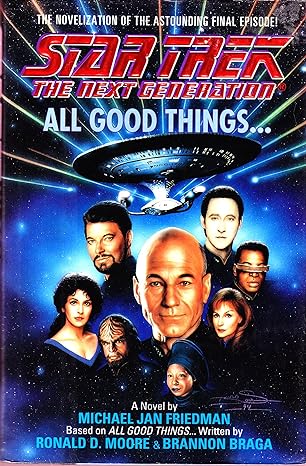
All Good Things... (Star Trek: The Next Generation) (audiobook) by Micheal Jan Friedman


Published by Simon & Schuster Audio in 1994
Read by Jonathan Frakes
Duration: 2 hours, 55 minutes.
Abridged
Based on a script by Ronald D. Moore and Brannon Braga

All Good Things... is an abridged audiobook presentation of the novelization of the two hour series finale of Star Trek: The Next Generation.  There is a lot of room there for errors to be made. Will the reader interpret the material well? Is the abridgment done well? Is the novelization of the script done well? That's a lot of steps between the original authors and the audiobook listener and any of them done poorly could result in a poor audiobook presentation.

Jonathan Frakes as
Commander Will Riker
This audiobook was done quite well. The novelist is a prolific author of Star Trek books so he knows his material. The abridgment was done well. The reader was Jonathan Frakes. Frakes played Commander Will Riker throughout the show's run (and directed several of them) so he knows how everyone is supposed to sound, how the show is paced, etc.  Frakes does an amazing impersonation of Patrick Stewart as Captain Jean-Luc Picard, captures the voice of Q and Data very well. His Lt. Worf voice is laughable, however. Happily, Worf's lines are few and far between while Picard speaks throughout.

In All Good Things... Picard is plagued by time travel. He is slipping backwards and forwards to three different moments in time. The earliest time is the time period covered by the first episode of the series. The second point is seven years later, the time period covered by the last episode of the series. The third point in time is in the far future when Picard is elderly and possibly suffering from a incurable dementia. The audiobook ties together the entire series (in a way) and let's the listener get a taste of the future lives of Worf, Crusher, Picard, LaForge, Riker and Data.

Picard keeps sliding between these times and as he goes along he is confronted by Q who lets him know that if he does not figure out what to do he will be responsible for the disappearance of all of humanity from the galaxy. Picard works to solve the problem from all three times, each with its own set of challenges.

I rate this audiobook 4 stars out of 5.

This audiobook is available through Amazon.com here: All Good Things...

Reviewed on July 8, 2012.

Resonance (audiobook) by AJ Scudiere


Audio version published by Skyboat Road Company in 2008.
Multicast Performance
Duration: 16 hours, 25 minutes
Unabridged.

The premise behind Resonance is simple - the magnetic poles are starting to switch and it is starting to cause frogs to be born deformed, messing up migration patterns and kill people who are in "hotspots" (areas where the reversal has already started).

Scudiere does a great job of creating believable characters and her five main characters are quite strong. We have two young doctors from the Centers for Disease Control and their boss (played by Arte Johnson of Laugh-In fame), a young narcissistic geologist and a young biologist who specializes in frogs.

These five race around the country documenting "hotspots" and trying to figure out why people exposed to them die. As they travel, we learn a lot more about the characters and a romance starts to bloom.

Well, it would start to bloom except for two things: 1) the entire world suddenly shifts causing half of the world's population to die and 2) the guy just somehow can't muster up the guts to tell her how he feels even though everyone knows it except for her for about 6 hours of the audiobook.

In fact, the book just goes into some sort of holding pattern about two-thirds of the way through. The explanation behind the mass deaths is discovered (because why would magnetic reversals kill people? If it so bad than an MRI would be fatality-inducing) and there is a Twilight Zone-esque ending that is fairly clever but takes too long to resolve.

What is not discussed is the concept of the world still running along like normal even though half of the population has died. No mass chaos. No nuclear power plants overloading. No rogue nations deciding "Hey! It's the end of the world so let's go ahead and nuke such-and-such country!" Deliveries are still made, the phones still work, bureaucrats are still filing forms and accountants are still watching the bottom line. Having never seen the end of the world, I can only assume that it would be less like a Midwestern blizzard and more like Hurricane Katrina when it hit New Orleans and the social fabric was torn to pieces.

This audiobook is billed as an "AudioMovie" because it has special effects and multiple actors reading the different parts, much like an old-fashioned radio show. Several audiobook producers are using this format and it can be a superior way to tell a story. The actors did a great job, especially Arte Johnson who stole every scene he was in with his role as the elderly brilliant but cranky CDC administrator.The special effects were relatively rare and did not intrude as can happen with some companies that have used this format.

This was a book in serious need of a thorough editing. Three or four hours could have been removed from this book without hurting it. Repeated conversations abound and the ending with a twist just lingered until it  eventually lost its punch.

I rate this book 3 out of 5 stars. This book can be found on Amazon.com here: Resonance by AJ Scudiere

Reviewed on July 6, 2012.

Top of the Rock: Inside the Rise and Fall of Must See TV by Warren Littlefield with T. R. Pearson


Published by Doubleday in 2012

If you remember the giant television shows of NBC's heyday in the 1980s and 1990s, Top of the Rock will be fascinating. Shows like Cheers, Cosby, Law & Order, ER, Will &  Grace, Friends, Frazier, 3rd Rock From the Sun, Mad About You and Seinfeld ruled the airwaves. Thursday nights were dominated by NBC and NBC usually made more money on that night than the other six nights combined - literally billions of dollars.

Warren Littlefield was directly involved in the creation of these shows or the in the decision to put them on the air. Littlefield tells the story of "Must See TV" through the voices of the participants themselves. The book is literally a series of quotes with very little in the way of narration from Littlefield himself. Littlefield calls it "oral history" format. If this book were a movie, it would be one of those "talking head" documentaries full of people talking.

But, what a documentary it would be!

I had my reservations about this book, especially when I saw its format. But, once I started it I blazed right through it. The stories behind the creation of these beloved television shows are interesting and told very well. Some stories are more interesting than others, of course, but the book zips along and is full of interesting tidbits like this one - Fred Dryer was the frontrunner for the part of Sam Malone of Cheers, instead of Ted Danson.

The inside story of what was going on in corporate NBC is interesting and, I suspect, a little self-serving on Littlefield's part. He is especially tough on Don Ohlmeyer (who does sound like a difficult person to work with) and makes it sound like NBC has not broadcast much in the way of quality programming since he left.

Nonetheless, this is an interesting book and I rate it 5 stars out of 5. This book can be found on Amazon.com here: Top of the Rock: Inside the Rise and Fall of Must See TV.

Reviewed on July 6, 2012.

Isard's Revenge (Star Wars: X-Wing #8) (audiobook) by Michael A. Stackpole


Published by Random House Audio in 1999

Read by Anthony Heald
Duration: 2 hours, 59 minutes.
Abridged

Probably no one, even George Lucas himself, knows more about the Star Wars universe than prolific author Michael A. Stackpole. He has authored comics and novels and helped to build the entire post-Return of the Jedi storyline.

Isard's Revenge is set several years after the last movie. The New Republic (the government that took over from the  Rebel Alliance in Episodes IV, V and VI) is mopping up the various bits and pieces of what is left of the Empire. Several warlords have set themselves up here and there and the New Republic is negotiating or fighting with them. 

In this storyline, a warlord named Ysanne Isard, the former Director of Imperial Intelligence, presumed defeated and dead, has returned. She has put together a rather complicated plot to draw Wedge Antilles (newly promoted to General by Admiral Ackbar) and his Rogue Squadron into a trap so she can wipe them out to get her revenge for her defeat at their hands that was detailed in Book #4 of this series.

Admiral Ackbar
Read by Anthony Heald who covers a wide variety of voices, accents and species with apparent ease, this book is long on speeches and action and very short on character development. I could blame the abridgement for that. It almost certainly cut out  too much of the interesting secondary story involving an attempt by an inter-species couple to deal with cultural prejudice as they try to adopt a baby to raise as their own. But, let's face it, the appeal of these books lies in the dogfights and the almost corny speeches the officers give to their pilots before the big fight.

While the audiobook version is abridged, it does two things the book will never have: 1) real Star Wars sound effects; 2) snippets from the original Star Wars soundtracks by John Williams. For old fans of the movies, it is awfully fun to hear the music and the blaster fire and the R2 units as the X-Wings roar into battle.

I rate this audiobook 3 out of 5 stars.

This audiobook can be found on Amazon.com here: Star Wars: The X-Wing Series, Volume 8: Isard's Revenge

Reviewed on June 29, 2012.

Lords of Creation by Tim Sullivan


Published in 1992 by AvoNova (Avon Books)

Tim Sullivan's Lords of Creation tries (and really tries hard) to pull together a whole lot of ideas and one really big one and put them all into a 242 page sci-fi paperback novel.

It is set in the year 1999. Instead of a successful first Gulf War,  America gets bogged in a protracted fight that saps its political vitals at home. The Republicans work with a growing Christian Milleniallist movement who believe that the end of the world as we know it is coming and America should be prepared. A Department of Morality is developed and led by a preacher who attacks all of paleontology as "the work of Satan." Entire university departments are shut down due to a lack of funding and only amateur paleontologists can continue to dig.

A fossil dig in Montana. Photo by SD Public Broadcasting
One group of such amateurs are digging at a remote site in Montana when they find a odd metal box buried deep in a fossil bed, with the fossils. They remove it and sneak into the lab of the local university , quickly have it confiscated by the Department of Morality and when it is opened five dinosaur eggs are discovered inside - they have been held in stasis by the box for millions of years. Soon enough, they are hatched and these dinosaurs are not anything that the paleontologists recognize. They have larger brains, grow incredibly fast and work together very well. Also, there are lots of grandstanding arguments between the leader of the paleontologists, David Albee and Flanagan, the head of the Department of Morality. Flanagan admits that he acts the way he does to impose morality upon America just to save America from itself - drinking, drugs, abuse, etc.

 ****Spoilers*****

Up to this point, the book seems to be a kind of screed against religion in general (they're all fanatics, they're stupid and they hate dinosaurs!). But, suddenly, the story switches. An alien spaceship comes, summoned from "sleep" in the asteroid belt by the opening of the egg box. The alien reveals that its species created the super smart dinosaurs that were just hatched and it froze them again because their reptilian brains lacked any sense of morality and all of that brainpower with no morality was a disaster. They destroyed rather than build.

So, the alien waited until primates evolved and made them super smart because they had morality. The innate sense of morality would "drive [the] species forward. It is absolutely correct in its moral imperatives, that these imperatives are larger than the individual and must be asserted. Those who stand against it are always incorrect, though their opponents believe that their version of morality is just as correct. This conflict is the process that culminates in a planetary civilization, and leads ultimately to the stars." (p. 236)

Now we have an interesting premise, the most important thought of the book and it is laid out and never touched again, despite all of the questions it begs such as:

-Is Flanagan bad  or good in light of this philosophy?

-Is the constant struggle really a good thing or not?

-Is the Department of Morality necessarily a bad thing - is it the realization of a planetary civilization thus stepping stone to the stars?

-If that is the cost, is it worth it?

Man, if there was ever topics to discuss, why aren't these being discussed? Instead, it wraps up in six pages and we are done.

One other issue. I know that authors have very little to do with the covers of their books, so these three comments are aimed at the person or persons that choose the art for the cover: 1) The book is set in Montana. There are no Saguaro cactus in Montana. 2) There is only one alien, not two. 3)  The alien looks nothing like the ones on the cover.

*****End Spoilers*****

So, a really huge idea is brought up to discuss and it lays there and dies. The rest of the book is an okay space alien story.

I have to give it 3 out of 5 stars for the rest of the book. Add 1 star for the really big idea. Total: 4 out of 5 stars.

Reviewed on June 28, 2012

This book can be found on Amazon.com here: Lords of Creation by Tim Sullivan.

The Blessing Way (Joe Leaphorn #1) (audiobook) by Tony Hillerman


Published by Borders/Recorded books in 1990.
Narrated by George Guidall.
Duration: Approximately 6 hours, 30 minutes.
Unabridged

The Blessing Way is the first of the Leaphorn books but, ironically, Leaphorn is a mere supporting character throughout most of the second half of the book. College professor/archaeologist Bergen McKee is the main character - the one who has the most growth and teaches the reader the most about Navajo society and culture.

Tony Hillerman (1925-2008)
Nevertheless, The Blessing Way is an enjoyable book. I have read all of Hillerman's books at one time or another so I am going back and listening to some of the older ones as a high-quality diversion from my boring work commute.

I intentionally picked this one, the oldest of the series, since I recently read and reviewed the newest of the series (The Shapeshifter), which, ironically enough, also prominently featured the Navajo Wolf/Witch/Shapeshifter. His descriptions of Navajo society in the two books would make an interesting comparison - a study in the ongoing process of diffusion of Belagana (white) culture throughout the reservation.

I figured out who did it with about an hour to an hour and a half of listening to go. However, that did not dim my enthusiasm for listening to an exciting escape, a chase through the desert and a great climax.

George Guidall did a strong job of reading the story - his pacing and ability to convey the appropriate emotion of the story were quite good.  I enjoy his readings of the Leaphorn/Chee series.

I rate this audiobook 5 stars out of 5.

This audiobook can be found on Amazon.com here: The Blessing Way by Tony Hillerman.


Reviewed on December 20, 2006.

Cold Mountain by Charles Frazier


An American Odyssey


-Slow start, but once you get past the first 50 pages or so you won't want to put it down.

Winner of the 1997 National Book Award

Originally Published in 1997 by Atlantic Monthly Press

Cold Mountain is really a set of very, very short stories all tied together into two main narrative lines. It can be very frustrating to some who just want to get the story moving, but that the main plotlines are not really the point. The wonder and randomness and beauty and brutishness of this thing we call life is the point.

This is no "Pilgrims Progress" in which the main characters struggle and eventually reach a higher consciousness and understanding. 

However, it is a Post-modernist American Odyssey. In the original Odyssey, Odysseus goes from one adventure to the next on his way home from war. In the telling it the reader (originally the listener since it was originally an oral story, not a written story) learns life lessons and Odysseus comes home a better man for all of his troubles.

Charles Frazier
Inman and Ada's adventures remind me of that but without the over-arching themes (thus, it is post-modernist), unless you consider the utter randomness and chaos, both good and bad, of life a theme. Are Ada and Inman better people as a result of their struggles? No, just different. Some characters become better people as a result of the war, some worse.

-Great book. Enjoyable read. I have not yet seen the movie, but I wonder how it can possibly do this book any justice.

I rate this book 5 stars out of 5. It can be found on Amazon.com here: Cold Mountain by Charles Frazier. 

In November of 2023 it was announced that the group Moms for Liberty had challenged more than 300 books in Florida. This is one of the books that the Moms challenged. Read more about the books here.

Looking for Rachel Wallace (Spenser #6) (audiobook) by Robert B. Parker


Published in 1989 by Books on Tape, Inc.

Read by Michael Prichard
Duration: 4 hours, 45 minutes.
Unabridged.

I read Looking for Rachel Wallace years ago, but I don't have a great memory for all of the plot details so I am re-enjoying the Spenser books as audiobooks. In this case, Spenser and Rachel Wallace kept me company while I wrapped presents and fed my one-year old. And they were quite good company.

Rachel Wallace is a lesbian feminist activist who lives to shock and provoke the sensibilities of middle America in the late 1970s. Her activism has made her the recipient of several threats so Spenser is hired to protect her. If Rachel Wallace is anything, she is an ultra-feminist and no ultra-feminist (at least not in this book) is going to run to a big strong man for protection. Rachel Wallace realizes this and fires Spenser.

But, soon enough, Rachel Wallace is actually kidnapped and Spenser goes on the hunt for her out of a sense of personal obligation. The climax of the book is one of the more memorable scenes in this long and venerable series.

Robert B. Parker
(1932-2010)
My audiobook was read by Michael Prichard who does a decent Spenser but does a great near-humorless Rachel Wallace.

What can I say about the Spenser books that has not already been said. They're a bit formulaic (wisecracks, meet Susan for some snuggling, fistfights, cooking, etc.) but I love the formula so I enjoyed this one thoroughly. I consider it to be one of the stronger books, despite the fact that the protestations against feminism and lesbianism seem outdated in the year 2006. It almost makes it seem like a period piece. Interesting how the world changes, isn't it?

I rate this book 5 stars out of 5.


This audiobook can be found on Amazon.com here: Looking for Rachel Wallace: A Spenser Novel

Reviewed on December 25, 2006. Updated in 2010.

Mysteries and Intrigues of the Bible: Extraordinary Events and Fascinating People by Jonathan A. Michaels


What this book is and what it is not


Published by Tyndale House Publishers in 1997. 

I picked Mysteries and Intrigues of the Bible up somewhere along the way and I am sure when I bought it I thought that it was something that it is not.

What I thought the book was:

-I thought it was a Graham Hancock-type (ironically, Graham Hancock is referred to in the text of this book) look into some of the oddities of the Bible. What really happened at Jericho? What does the archaeological record say? Where did Moses and the Israelites cross the Red Sea? Are there possible explanations for a parting of the Red Sea besides a divine one? What about those that claim that Jesus did not really die on the cross? Is the popularly referred to "Swooning" of Jesus an explanation for his resurrection. If not, why not. The kind of stuff you get on the History Channel from time to time

That is not what this book is (although if anyone knows of such a cool book, let me know!)

What this book is is a compilation of a number of odd stories from the Bible. They are re-told here in loose categories in no particular order under such topics as "Unlucky Seventies" (times when 70 people died); "Family Customs" (polygamy, circumcision and the like - why they were done) or such ongoing categories such as "Strange but True" and "FAQs". A good feature is the listing of the verses where the strange story can be found in the Bible after every entry.

While well-written, I kept on wondering why it was written. I suppose I was not the target audience. I was quite familiar with 95% of the stories that were told and very little new information on the mysteries themselves were revealed.

So, my recommendation is that if you know your Bible backwards and forwards, this book will have little to offer. If you are relatively new to the study of the Bible, this one may help spur your interest.

I rate this book 3 stars out of 5.

This book can be found on Amazon.com here: Mysteries and Intrigues of the Bible: Extraordinary Events and Fascinating People by Jonathan A. Michaels.

Reviewed on December 25, 2006.

Enemy Mine DVD


This movie swings for the fence with every pitch...


Directed by Wolfgang Petersen 
Released in 1985

This movie swings for the fence with every pitch. If you are not a baseball fan, that is saying that a batter swings for the fence means that he only goes for home runs and does not try to just get on base. And, for you baseball fans out there, you know that the long ball hitter that swings for the fence with every pitch strikes out an awful lot. But, the fans love him anyway because when he gets hold of a good one it's a home run!

Enemy Mine is a lot like a long ball hitter - the director tries to go for a home run on so many levels that you end up alternating between shaking your head at the cheesiness of it all and wiping at a tear at the way some of the scenes work so perfectly.

The premise is that two enemy fighter pilots in a bitter intergalactic war shoot each other down over some horrible planet that will barely support life. One is human. One is a drac, a humanoid reptile species. They learn to trust one another and depend on one another and, eventually, the alien (Louis Gossett, Jr.) gives birth to a child (their species reproduces asexually). 

However, when the alien dies in childbirth the human (Dennis Quaid) raises it as his own and is forced to act when the child is captured by human slavers. Louis Gossett, Jr. was very good throughout. Quaid alternates between over the top ridiculousness and touching. The soundtrack is too much - too sentimental, too adventurous, etc. It gets in the way more than anything else in the movie.

The special effects are sometimes great (especially Gossett's make-up) and usually bad - think Star Trek original TV series quality, but the story mostly makes up for it.

All in all, I give this movie 3 stars for its up and down nature. The values and message are good, but sometimes the medium that transmits those values and that message is too saccharine for my tastes.

This movie can be found on Amazon.com here: Enemy Mine

Reviewed on December 29, 2006.

The Places In Between by Rory Stewart


A Scotsman, a mastiff and a feudal nation

Published by Mariner Books in 2006.

When the United States first invaded Afghanistan one of my friends wondered aloud if we intended on keeping it as a colony. I quipped that we already owned a mountainous desert area full of people that have a religion that we don't understand - we call it Utah (with apologies to my Mormon friends out there).

After reading The Places In Between I truly realize the depth of our misunderstanding of the situation in Afghanistan. I keep up on the news better than most. I've spoken with veterans who have returned from Afghanistan. Yet, as I read Stewart's account of his walk across Afghanistan just weeks after the fall of the Taliban, I realized that this truly is a foreign culture - as alien to me as any on the planet. I am amazed that the mission in Afghanistan has been as successful as it has been.

Stewart introduces us to the variety of cultures that Afghanistan possesses. He also makes us see that the very concept of an "Afghanistan" is nebulous at best. His commentaries on the United Nations are biting and ring of truth. While the news has commented that Afghanistan is a feudal society, I always took their word "feudal" to be code for technologically backward. Stewart experienced that it truly and literally is feudal and for some parts of Afghanistan, life is like stepping into a time machine and going back in time to the Middle Ages - both politically and technologically.
Rory Stewart


Stewart's book is a joy to read. While I wonder at the sense in walking by yourself across a war-torn nation during the dead of winter (with the exception of some companions who were forced upon him by concerned governments from time to time and an adopted mastiff dog he picked up along the way), I am pleased that he did. His impressions of what he witnessed and experienced were wonderfully conveyed. Stewart is truly a gifted writer.

This book is truly a wonderful experience. I cannot recommend it highly enough. What a great read to finish up the year with!

I rate this book 5 stars out of 5.

This book can be found on Amazon.com here: The Places In Between.

Reviewed on December 31, 2006.

Featured Post

<b><i>BAN THIS BOOK (audiobook)</i></b> by Alan Gratz

Published in 2017 by Blackstone Audio, Inc. Read by Bahni Turpin. Duration: 5 hours, 17 minutes. Unabridged. My Synopsis Ban This Book is t...

Popular posts over the last 7 days