Death Waits at Sundown (audiobook) by L. Ron Hubbard


Lots of fun in a small package.

Duration: 2 hours, 22 minutes.
Multicast Performance
Published by Galaxy Press.
Unabridged,

First published in Western Story Magazine in 1938, Death Waits at Sundown is part of a large series of books and stories that are being re-published by Galaxy Press as part of their Golden Age Stories series. In reality, they are a collection of L. Ron Hubbard's early works that were published in magazines and as pulp fiction books. Hubbard was a prolific writer and he wrote a lot of action stories that translate quite well into the multicast performance audiobook format.


This audiobook is actually three short stories. The first story is the title story of the collection. It features a wrongly accused man named Frank Taylor. He has been convicted of murder and robbery so that the new town sheriff can confiscate his land. But, the new sheriff never counted on Frank's brother, a famed gunslinger from Texas, comes to town to save his brother.

The second story (Ride 'Em Cowboy) is a love story that takes place during three rodeo events. I think it is the strongest of the three stories. Long Tom Banner (a national rodeo champion) has a crush on Vicky Steward, the most successful woman on the rodeo circuit. But, sparks fly as he tries to express his feelings while they compete against one another in three rodeo events.

The Boss of the Lazy B is the last story. It also features a frustrated man but the story is much more complicated and the ending was less satisfying than that of Ride 'Em Cowboy. Big Bill Bailey is the area's most successful local rancher. He leads a posse to arrest Spick Murphy, a well-known rustler who is rumored to have killed more than a dozen men - and nearly gets killed in the process. Bailey's love interest, Susan Spice, decides that Murphy has been wrongly accused, succeeds in helping Murphy defend himself in the trial and then hires Murphy as a hand at her ranch. But, can Murphy be trusted and will Big Bill Bailey get past this insult to his judgment?

This series is a great bit of escapist fiction.  The multicast performance sounds like an old-fashioned radio drama. Lots of fun in a small package.

I rate this audiobook 4 stars out of 5. This audiobook can be found on Amazon.com here: Death Waits at Sundown by L. Ron Hubbard.

Reviewed on May 17, 2012.

Morning of Fire: John Kendrick's Daring American Odyssey in the Pacific by Scott Ridley


Well-researched but ultimately fails in its goal


Published by William Morrow in 2010

John Kendrick was a well-respected sailor from the Boston area during the Revolutionary War era. He was rumored to have participated in the Boston Tea Party. He captained a privateer, captured prizes and was highly regarded by political and business leaders and the men who sailed on his ships.

As America struggled to revive its foreign trade after the Revolutionary War (The United States was officially cut off from English trade) tales came to Boston about the beautiful furs available along the Northern Pacific coast of North America. Investors hired Kendrick to lead an expedition of two ships to explore the trading opportunities in the Pacific. Kendrick set off in 1787 to find new markets for American goods. He ended up visiting what is now Alaska, Washington State and British Columbia, Hawaii, China and Japan. He nearly sparked a war between Spain and England, got involved in a brutal war in Hawaii, nearly was killed by officials in Japan (if he had been discovered), survived a monsoon, suffered through the bureaucratic shenanigans of Chinese port officials and was betrayed by the captain of the second ship of his expedition.

Reading about all of that adventure makes Morning of Fire sound like it would be exciting, but this book does not live up to the exciting life lived by Kendrick.

What this book does well:

-This book is extraordinarily well researched. I would imagine that Ridley laid his eyes on every known scrap of paper that mentioned Kendrick or his voyage that has survived to the modern day. He includes dispatches sent to the court of Spain and England, notes from his American employers and more.

-America's place in the geopolitical situation of the day is laid out nicely. Spain was declining, Britain was pushing to take over its role as master of the Pacific, Russia was pushing into the Northern Pacific from its Asian ports, France was floundering in the throes of the French Revolution, China was involved in trade only, Hawaii was coveted by all of the major powers as a place to refit ships in the middle of the Pacific.

What this book does poorly:

-Ridley establishes that Kendrick was the first American in the area and he compares him to the likes of Daniel Boone and explorers Lewis and Clark. However, that is not an apt comparison. Daniel Boone and his generation of explorers directly led to the American occupation of the Ohio River Valley and the Tennessee Valley. Lewis and Clark's route to the Pacific, especially their trip up the Missouri River was, quite literally, the route taken by hundreds and later thousands of settlers within a generation or two of their trip. Kendrick's men were the first Americans to reach the Washington State area, but it was largely settled by Americans who followed Lewis and Clark's route.

-I found this book caught up in its own minutiae, and the larger goal (why Kendrick's long trip was important) was lost in the ups and downs of fur prices and blow-by-blow details of negotiations. I learned about the prices of furs in China, the nasty wars of Hawaii's various kings and how Western involvement was a factor, about how England and Spain nearly came to war over the Pacific (what Kendrick does not stress is that England and Spain nearly came to war over some thing or another many, many times while England was ascending and Spain was declining on the world stage). Spain's strategies to recapture its actual control of the Mississippi and Ohio River Valleys (it had the Mississippi Valley in name, but not much control in reality) were discussed. So much detail was involved that I often felt like I was slogging through the book. The telling of the story drowns in the sea of details. When Ridley pulled out of full detail mode the book was quite excellent. But then the extraneous details would start to fill the book again. I literally read dozens of histories a year and I am a history teacher. I love reading history and this book was a chore for me to read.

-Too much of the historical record has been lost. Ridley has reference after reference to what Kendrick "may have" or "probably" did. While these leaps of faith and logic all made sense, it may have been more prudent for the author to have pulled away from his devotion to detail and simply lay out the facts he had and tell the story in a broader sense rather than insisting on a detailed look at facts he really did not have.

I rate this history 2 stars out of 5.

This book can be found on Amazon.com here: Morning of Fire.

Reviewed on May 12, 2012.


Kill Shot: An American Assassin Thriller (Mitch Rapp) (audiobook) by Vince Flynn


Continuing with the "prequels" of the Mitch Rapp story


Published in 2012 by Simon and Schuster Audio

Read by George Guidall

Duration: 10 hours, 49 minutes.

Unabridged.

Vince Flynn's long-running character Mitch Rapp was introduced and developed as a successful and established CIA counter-terrorism agent - sort of an American James Bond, if you will. He is dangerous, effective, and willing to break the rules in order to get the job done. After ten books featuring Rapp, author Vince Flynn decided to explore Rapp's early years. This is the second book in that exploration of his early years.

Rapp's bosses have developed a list of terrorists that Rapp is supposed to terminate. These assassinations have all been quick, clean affairs - there is no collateral damage, no clues are left behind and terrorists around the globe are left to wonder who is next on the list. The book starts with Rapp on a mission to assassinate a Libyan terrorist who is visiting Paris and staying at a high class Paris hotel. All seems to go well until Rapp is surprised by a team of armed men and he is forced to fight his way out of the terrorist's hotel room and flee for his life. Rapp assumes that his mission was compromised by someone at the CIA - someone has gotten their hands on the list and was waiting for him. The firefight at the hotel kills 9 people and the CIA assumes that Rapp has gone rogue. Rapp searches for the men who set him up and for anyone he can trust in the CIA while the CIA tries to find him and sort through all of the mayhem and destruction to find the truth.


The action in this book is first rate. The premise is also first rate. The book would have been better if there had been less long conversations amongst all of the conspirators and more summaries of those conversations. An hour could easily have been edited out of this audiobook and it would have done nothing but make it better.

That being said, George Guidall's strong narration and easy mastery of multiple accents (French, Spanish, Arab, British, Southern and even more) make the book an enjoyable listen. Perfect way to make the morning commute a bit more interesting.

Get this book on Amazon.com here: Kill Shot by Vince Flynn.


I rate this audiobook 4 stars out of 5.

Reviewed on May 5, 2012.

Why We Suck: A Feel Good Guide to Staying Fat, Loud, Lazy and Stupid (audiobook) (abridged) by Denis Leary


Published in 2008 by Penguin Audio
Read by the author, Denis Leary
Duration: 5 hours (abridged)

Denis Leary. If you have never seen his act before, catch a bit of him on the internet and see if he suits your tastes. If he does, this book is just a lot more of the same - Leary's acid commentary on stupid parents, the Catholic Church, why there won't be many female race car drivers, obese people, helicopter parents, George W. Bush, his family and just about everything else are designed to outrage as much as entertain. Do not listen to this book if foul language or rude comments are a deal-breaker.

Leary's tales of his childhood are actually quite endearing and they make up the best part of the book. His anger at the Catholic Church is only partially tempered by respect for the Catholic school that he attended as a child (in reality, the Catholic Church becomes the whipping boy for all organized religion) and his politics clearly run to the Democrat side of the spectrum. His arguments are entertaining (usually), but not always coherent. He never quite addresses the issue of correcting the problem that too many Americans are "fat, loud, lazy and stupid" except to stress the importance of family.

Leary reads the book himself and any listener familiar with Leary's performances will recognize that this book is essentially an extended version of his live show - it is well-polished, smooth and comes off feeling fresh.

Get this book at Amazon.com here: Why We Suck: A Feel Good Guide to Staying Fat, Loud, Lazy and Stupid by Denis Leary.

I rate this audiobook 4 stars out of 5.

Reviewed on May 4, 2012.

Rabbit in the Moon (audiobook) by Deborah Shlian and Joel Shlian


Published in 2011 by Spoken Word, Inc.
Read by Barbara Whitesides
Duration: 12 hours, 40 minutes.
Unabridged.

If I told you that I had just listened to a thriller set in China during the Tiananmen Square protests in 1989 involving secret plots among the top levels of the hardline Chinese leadership, the underground protest movement, an adventurous young Chinese-American doctor who is just beginning to learn about her Chinese roots, an intricate plot to keep her trapped in China by an evil man, a budding romance, Chinese gangsters, a corrupt Korean businessman, a motorcycle chase, gunfights, daring escapes, an introduction to Taoist philosophy and a possible cure to aging you would think that this would be a real whiz-bang listen.

The book revolves around Dr. Lili Quan, a Chinese-American doctor who is offered the chance to study in China. It turns out that certain members of China's corrupt leadership have brought her to China to use her as a tool to get at her grandfather's (he is also a doctor and Lili thought he was dead) secret cure to aging. Meanwhile, the Tiananmen Square protests are starting up and Lili Quan finds herself being torn by loyalty to her family, the lure of new medical discoveries,  her new romantic interest and her desire to escape to freedom in America.

But, slow pacing, incessant  flashbacks (surely there must be a different way to remind the listener about an important point than a flashback to the scene just a few pages back that repeats the character verbatim?) and a budding romance that goes into way too much detail and angst for this guy just drags the book down. A couple of hours of this audiobook could have been edited out and made it a much more exciting read.

Barbara Whitesides does give a strong performance. She is especially strong with the variety of Chinese accents (male and female, old, and young). However, the story is just not as strong as her skills.

I rate this audiobook 3 stars out of 5. It can be found on Amazon.com here: Rabbit in the Moon.

Reviewed on May 4, 2012.

Abraham Lincoln and Frederick Douglas: The Story Behind an American Friendship by Russell Freedman


Another winning book by Russell Freedman


Published in June of 2012 by Clarion Books (DWD's Reviews received an advance copy for review purposes)

Russell Freedman received the Newbery Medal for his 1989 book Lincoln: A Photobiography and he returns to familiar ground with this dual biography. He begins with Douglass and then alternates back and forth between the two men, highlighting important aspects of their lives and the areas that they had in common (such as being self-educated, self-made men).

The almost square shape of Abraham Lincoln and Frederick Douglass: The Story Behind an American Friendship lends itself to pictures and Freedmen fills the book with drawings, etchings and photographs of the era, including the image I have included here of a "Watch Meeting." Thousands of people gathered together to await word of Lincoln signing the Emancipation Proclamation (he had promised to do so several months earlier unless the Confederate States returned to the Union). I had no idea that such events occurred, but Freedman includes the image I have posted on the left above and makes the day and the event come alive as a point of intersection of these two lives.


The first time these men met was after the Proclamation was signed. Douglass was concerned about the African-Americans who were now permitted to join the regular army by the Emancipation Proclamation. He wanted to insure that they would really be able to join the fight, that they would receive the same pay as white soldiers and that they would be able to become officers. He and Lincoln talked for a long time and even though Douglass had sometimes been a bitter critic of Lincoln (he thought he moved too slowly on emancipation), he came away impressed. He and Lincoln seem to have gotten along quite well and Douglass left impressed. For his part, Lincoln told Douglass to come see him whenever he came to Washington, D.C.

Calling Lincoln and Douglass friends is, of course, an exaggeration. They got along well, they respected one another and, if there had been enough time, probably would have become friends. Sadly, the assassination of Lincoln makes that all just speculation.  But, they certainly had an excellent friendly relationship and it always interesting to see how two towering figures of American history interacted with one another.

This is an excellent dual biography for students in middle school and upper elementary and certainly belongs in every school library and social studies classroom library that has students of that age.

I rate this book 5 stars out of 5. It can be found on Amazon.com here: Abraham Lincoln and Frederick Douglas: The Story Behind An American Friendship.

The Phantom Patrol (audiobook) by L. Ron Hubbard


Duration: Approximately 2 hours
Multicast Performance
Published by Galaxy Press in 2011.

First published in 1935, The Phantom Patrol is part of a large series of books and stories that are being re-published by Galaxy Press as part of their Golden Age Stories series. In reality, they are a collection of L. Ron Hubbard's early works that were published in magazines and as pulp fiction books. Hubbard was a prolific writer and he wrote a lot of action stories that translate quite well into the multicast performance audiobook format.


The Phantom Patrol is the story of Coast Guard Chief Petty Officer Johnny Trescott who commands a patrol boat looking for drug smugglers off of the coast of Louisiana. He and his small crew have been working for months to catch one smuggler in particular and are close to catching him. While closing in on this smuggler, they are called away by a distress call from a plane that has made an emergency landing in the water. The smuggler turns the tables and gets the drop on the Coast Guard boat and captures it, the crew and the survivors of the plane wreck...and that's just the beginning of an action-filled adventure with romance, gunfights and plenty of intrigue.

The fact that this book was performed by multiple cast members makes this story very entertaining - very much like the old-time radio shows that were popular when these stories were written.

I rate this audiobook 4 stars out of 5.

This audiobook can be found on Amazon.com here: The Phantom Patrol.

Reviewed on April 11, 2012.

Flameout: The Rise and Fall of Burger Chef by John P. McDonald


Lessons on how to grow and then kill a restaurant chain

Published in 2011 by CreateSpace

In Flameout, John P. McDonald tells the story of Burger Chef, the one burger company that outpaced McDonald's and could have taken its place at the top of the fast food heap. In 1971 there were 1,200 Burger Chef restaurants and less than 1,300 McDonald's restaurants. By 1982, what was left of Burger Chef was folded into the Hardee's chain and was no more.

I was particularly interested in this book because when I was a kid, the Burger Chef Fun Meal with Burger Chef and Jeff and all of the punch out things you could make with the tray/box were just about the best restaurant experience a little boy could have.

This could have been a very boring tale, but McDonald makes it interesting. He tells about the innovations that took Burger Chef from being just a demonstration restaurant (it was designed to showcase the restaurant equipment manufactured by General Equipment) to the fastest growing restaurant chain in America. And, just as clearly, he details the leadership confusion that led Burger Chef to disaster.


This was a good read, especially for all of us fans of the Fun Meal!

I rate this book 5 stars out of 5.

This book can be found on Amazon.com here: Flameout: The Rise and Fall of Burger Chef

Reviewed on April 10, 2012.

Roadwork (audiobook) by Stephen King (writing as Richard Bachman)


A story of a man whose world has fallen apart


Published in 2010 by Penguin Audio
Read by: G. Valmont Thomas
Duration: 9 hours, 40 minutes.
Unabridged

Way back in 1981 Stephen King released Roadwork under the pseudonym Richard Bachman. Bachman was the name King used to sell pulp fiction type stories so that he could afford to pay his bills and not hurt his reputation as he waited for his work he submitted under his name to take off. King opens this book with an interesting introduction that explains his rather complex relationship with his pseudonym.

Roadwork, on the surface, is simple enough. A man in this forties is losing his house, his job and the memories that he holds dearest to the expansion of a highway through his neighborhood. Due to imminent domain, Barton George Dawes will lose his last connections to his son who has died three years earlier due to a brain tumor. He will lose the house that he and his wife scraped and scrimped to buy. He will lose his career at the local laundry and the memories of the brothers who loaned him the money to go to college so that he could help them with their family business. His son is gone, the laundry has been swallowed up by a large corporation (he manages it for them and they show little interest in the business), his wife has become less of a friend and lover and more of a roommate.

Basically, Dawes' life has fallen apart and he is angry about it. Very angry.

Stephen King
Dawes refuses to look for a new place to live, even though the rest of his neighbors have sold out and moved on. He refuses to search for a new location for the laundry. Instead, he quietly goes behind everyone's backs and purchases weapons and contacts a local mobster about buying explosives so he can blow up the highway.

As a forty-something myself, I found myself sympathizing with Dawes to a point. Dawes has invested everything in a life that has come to nothing - no family, no job, not even the house he has worked for all of these years.

G. Valmont Thomas did a remarkable job of voicing Dawes, his internal alter-ego (Dawes often talks to another person in his mind) and the supporting characters in this tragedy. There is no great moral in this book,  no happy ending. It is a tragedy in the original sense of the word - everyone can see it coming from a mile away but what can a man do when he has nothing left to lose?

I rate this audiobook 4 stars out of 5.

This audiobook can be found on Amazon.com here: Roadwork

Reviewed on April 6, 2012.

The (Honest) Truth About Dishonesty: How We Lie to Everyone - Especially Ourselves by Dan Ariely


Published in June of 2012

Note: DWD's Reviews received an uncorrected proof advance copy from the publisher (Harper) in exchange for an honest review.


Dan Ariely's The (Honest) Truth About Dishonesty is a fun look at a serious topic - lying. Ariely, a professor of behavioral economics at Duke University, describes his simple experiments and details his results in a light, easy to understand way. His results are often surprising and counter-intuitive.

For example, it is often considered that people are dishonest because they have calculated the risk of being caught and the reward if they get away with the dishonesty and act accordingly. Ariely demonstrates that this is incorrect and spends the rest of the book showing what conditions are more likely to cause dishonest behavior and what conditions decrease dishonesty.

This could have been a stupefyingly dull book, but Ariely has a deft touch and makes it a very fun and very quick read.

I rate this book 5 stars out of 5.

This book can be found on Amazon.com here: The (Honest) Truth About Dishonesty: How We Lie to Everyone---Especially Ourselves

Reviewed on April 3, 2012.

Imperfect: An Improbable Life by Jim Abbott and Tim Brown


Entertaining Sports Autobiography

Published by Ballantine Books in April of 2012

Jim Abbott will always be known as "that one-handed pitcher" and in Imperfect he discusses the fact that his life has always been defined by his birth defect. Or, has it? As I read this book I found myself wondering if his missing hand limited him, propelled him or if he would have gone just as far if he had had both hands?

Abbott and Brown work together to create a very readable, entertaining book. I found the descriptions of 1970s and 1980s era Flint, Michigan and his life growing up just as compelling as his stories of how he overcame the difficulties he encountered by having just one hand.

I was aware of Jim Abbott as he played but as his career waned I lost track of him. Also, I had no memory of his playing in the 1987 Pan-American games in Indianapolis even though I have always lived in Indiana and those games were a very big deal when Indianapolis hosted them.

Abbott tells the story as a series of flashbacks told as he describes his no-hitter he pitched on September 4, 1993 against the Cleveland Indians. It is an interesting way to build the book - the book ends with his success in the game as he describes a frustrating erosion of his skills as a pitcher that caused him to retire in 1999. We hear precious little about his post-baseball life. If the assumption was that the average reader would not care, that is a disservice. I would have enjoyed reading more about his transition to the non-baseball world.

I was especially touched by his tales of parents bringing kids to meet him when he was a major leaguer. He grew weary of them because they could be emotionally draining, but he ended up appreciating the fact that he was a living example of overcoming a problem that certainly would have stopped most people. It is a testament to Abbott that he grasped his value of his celebrity and used it in such a personal way.

I rate this book 4 out of 5 stars.

This book can be found on Amazon.com here: Imperfect: An Improbable Life

Reviewed on April 3, 2012.

Where the Action Was: Women War Correspondents in World War II by Penny Colman


Published in 2002 by Crown Publishers (Random House)

This book is aimed at students from grades 5-12, although I found it interesting and learned a lot.

World War II histories abound. Histories of the complete war, various theaters, biographies of units and single officers fill the bookshelves. I have seen books that look at the role of women in the war - the home front, as pilots, intelligence officers and so on. But, I have never seen anything about female war correspondents. I did not even know that there were female war correspondents in World War II - I simply assumed that the sexist attitudes of the day would have not allowed them to work.

Happily, I have been enlightened by Penny Colman and her book Where the Action Was. She tells the story of the war through the eyes of several female war correspondents - sometimes through direct quotes, sometimes through reproductions of the headlines of their articles that are placed throughout like in a scrapbook. The history of the war and the story of these war correspondents was woven together seamlessly and very well done. The pictures are either pictures of the women correspondents or pictures taken by them (or both).

Female correspondents were everywhere - at the taking of the Sudetenland by Germany, scooping the rest of the world on the Nazi-Soviet Pact of 1939, among the refugees fleeing Paris, in Moscow when Germany attacked the USSR, in Europe, on Iwo Jima, there when concentration camps were liberated, in Italy and on and on and on.

I rate this book 5 stars out of 5. It can be found on Amazon.com here: 
Where the Action Was.

Reviewed on April 2, 2012.


Car Talk: The Greatest Stories Ever Told: Once Upon a Car Fire (audiobook) by Tom Magliozzi and Ray Magliozzi


Published in 2006 by HighBridge
Duration: 1 hour

Usually Ray and Tom Magliozzi's "Car Talk" show on NPR is a mixture of humor, stories and lots of advice on car repair and maintenance. This collection, though, is all funny stories (only the barest amount of car advice is given).  There are sixteen stories in all, with topics ranging from the dangers of carrying plywood on the roof of your car to what to do if a customer brings in a really smelly car to how one of the brother's did during his stint in the army as a young man (hint: not well). Some are really funny, some are merely amusing but if you are a fan of the show you will enjoy this collection.

Get this audiobook from Amazon.com here: Car Talk: The Greatest Stories Ever Told: Once Upon a Car Fire.

I rate this audiobook 4 stars out of 5.

Reviewed on April 1, 2012.


Star Trek IV: The Voyage Home (abridged audiobook) by Vonda N. McIntyre, Leonard Nimoy, and Harve Bennett


Published in 1986 by Simon and Schuster

Read by Leonard Nimoy and George Takei
Duration: 90 minutes
Abridged.

I picked up this audiobook of Star Trek IV: The Voyage Home on cassette at a clearance book sale in the "who's going to want this stuff?" section. Mostly, it was serious junk. Educational software that only operates on Apple IIe,  VHS copies of movies that I've never heard of starring some guy that was on some TV show that I barely remember and DVDs of some pastor's sermons on any number of topics (still in the plastic!). And, suddenly, I find a memory from my high school and college years - a genuine Star Trek audiobook from 1986!...on audiocassette! And...narrated by George Takei and Leonard Nimoy! So, I scuttle out of there like I've found a gold bar and pop it in car's cassette player - one of the advantages of having an old car is that it has a multimedia (CD and cassette) stereo system.

Back in the day, audiobooks were almost always abridged, sometimes criminally. This 274 page book is abridged to a mere 90 minutes. To be honest, if it weren't for my faded memories of the movie, I don't even know if there is enough plot here to tell the story.

George Takei from a scene in the
movie Star Trek IV
But, I enjoyed it immensely - I am a fan . Takei reads the story except for the internal musings of Spock, which are, of course, handled by Nimoy. It turns out that George Takei is a very strong audiobook narrator. His Scottish accent for Scotty is very strong, his southern accent for McCoy is smooth and understated and his Kirk is interesting. Several times Takei sneaks in his take on Shatner's stilted....way...of...pausing....when...he...speaks. I loved it.


So, in a sentence, the book is way too abridged but the fact that it was narrated by Takei and Nimoy made it a joy to listen to anyway.

Get this book as a audio download from Audible on Amazon.com here: Star Trek IV: The Voyage Home (Adapted) .

I rate this audiobook 4 stars out of 5.

Reviewed on April 1, 2012.

The Good Fight: How World War II Was Won by Stephen E. Ambrose


Great book for school age kids

Published in 2001 by Atheneum Books for Young Readers

Stephen E. Ambrose is perhaps best known as the author of Band of Brothers, the book that inspired the HBO mini-series of the same name. His passion for World War II continues in this book aimed at upper elementary through high school students.

A Kamikaze plane about to hit an American ship
(In the book on page 78)
While there is nothing new in The Good Fight, it is a fantastic introduction to the war. All of the major theaters are covered and, perhaps best of all, there is a full page 10" x 10"  picture from the war that show everything from the home front to kamikaze planes to Hitler in a elaborate Nazi rally to Holocaust victims and even more. Those pictures and the little ones scattered on the other pages make the book much more vivid. There are also plenty of pictures of the young men and women that were involved - pictures that make the war seem more real. Throw in Ambrose's mastery of the details and great writing and this is a must have book for any library or grades 5-12 history classroom.

I rate this book 5 out of 5 stars.

This book can be found on Amazon.com here: The Good Fight : How World War II Was Won.

Reviewed on March 29, 2012.

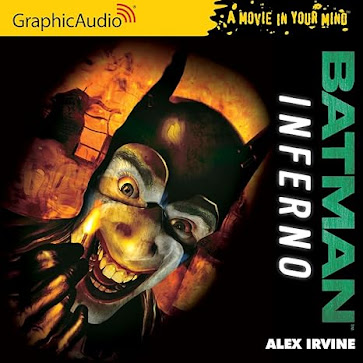
Inferno (Batman) (audiobook) by Alex Irvine


Okay story, great production

Published in 2009 by GraphicAudio
Multicast performance featuring 26 actors
Duration: Approximately 7 hours.

Batman is called to duty to fight Enfer, a new villain whose name means "Hell" in French. Enfer is skilled with fire and explosives and suffered a transformation similar to that of Joker but his change involved a massive explosion. Enfer is hired to free the inmates of Arkham Asylum by its director, Dr. Crane. His arson burns the asylum and lets dozens of inmates free, including the Joker.

While escaping through Gotham City's sewer system, the Joker accidentally stumbles into a back entrance into the Bat Cave. The Joker assaults Alfred, steals a Bat Suit and the BatMobile and starts a crime wave while pretending to be Batman, turning public opinion against Batman.

Enfer continues to burn the city. He wishes to attract the attention of The Joker in hopes of joining forces. Can Batman stop Enfer and The Joker before his reputation is completely ruined or the city is burnt to a crisp?

As always, GraphicAudio does a top notch job of creating "A Movie In Your Mind" with their production. The characters are well-portrayed, the background music is great (there is a cloying musical "theme" for Enfer's innermost thoughts and memories that helps create a haunting ambience). Throw in the sound effects and you can see why these audiobooks are so popular. 

This story had giant holes.  At one point, there is a giant push to get a DNA sample of the Joker. No one has one. Are we really supposed to believe that no one has taken a sample of it - not the courts, not the Asylum even though the man has been in and out of the system dozens of times- no one, not even Batman? Really??? Not even Batman????

Even worse,  the plot hatched by Crane and Enfer is never quite explained so we never know why Arkham Asylum was burned. The whole story turns on this event and it is a mystery.

But, the old-fashioned radio show format is so well done that plot issues become secondary. It's just entertaining and engrossing.

I rate this audiobook 4 stars out of 5.

This audiobook can be found on Amazon.com here: Inferno.

Reviewed on March 27, 2012.

Berserker (Bersker series #1) (audiobook) by Fred Saberhagen


Published in 1983 by Recorded Books
Narrated by Aaron Lustig and Henry Strozier.
Duration: approximately 6.5 hours
Unabridged


I just stumbled upon Berserker, not realizing that there is an entire series of these books. I'm not terribly surprised, the structure of the first book lends itself to sequel after sequel.

The premise of the book is that giant intelligent killing space machines are out to destroy all of the life they discover. Why? We are never told, but we assume that they are by-products of a long-ended war by a long-forgotten people.

Fred Saberhagen (1930-2007)
Photo by Beth Gwinn
This first volume was written in the late 1960s. The only reason I point this out is that I believe that the 1960s was an especially fertile time for science fiction, especially sci-fi that wanted to discuss big issues and themes. For example, TV's "Star Trek" and "Twilight Zone" are often more than a creepy story or a space alien story - they explore deep themes, such as "What is beauty?" and "What does it mean to be human?". Saberhagen openly explores these themes and more.

Saberhagen bounces around from one episode in humankind's struggle against these machines to another, giving the reader (in my case, listener) a bit of the flavor of the struggle as a whole. There are minor battles, major battles, backroom political struggles, stories of prisoners, accidental encounters and attempts to make peace. All stories are told by an alien historian in short story format. Some characters overlap from story to story but many do not.

Abuse of power, treason, forgiveness, revenge and what it means to be human are themes that Saberhagen explores. The quality of the stories vary. The first one is particularly weak in my opinion, so don't let it deter you from continuing on.

The audiobook is well read, with Aaron Lustig and Henry Strozier sharing the work - one acts as the historian narrator that introduces each short story while the other reads the main body of the book.

This audiobook can be found on Amazon.com here: Berserker #1 by Fred Saberhagen.

Reviewed on October 26, 2007

I rate this audiobook 4 stars out of 5.

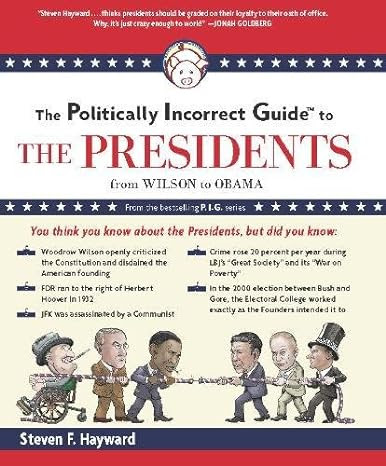
The Politically Incorrect Guide to the Presidents from Wilson to Obama (P.I.G. Series) by Steven F. Hayward


An entertaining read and a great way to rate the presidents

Published in 2012 by Regnery Publishing, Inc.

First and foremost, the latest entry in the P.I.G. series is a great read. Steven Hayward is to be commended for making what could have been a very stale read into an entertaining read - he has a light touch.

Secondly, how sad is it that grading presidents by how well they "preserve, protect, and defend" the constitution is a unique idea?

Hayward begins The Politically Incorrect Guide to the Presidents with a look at what the founders wrote about the office of the president and compares that to the modern presidency. He then looks at the presidency in the 19th century and how most presidents took the restrictions of the Constitution very seriously.

As Hayward proceeds to grade the 17 presidents we have had from 1913 until the 2012 (from Wilson to Obama) on an A to F scale (just like in school) he gives a thumbnail sketch of each president with the major issues of the election and/or his time in office, where he diverged from the Constitution (or supported it) and how the Supreme Court justices he appointed fared by way of the Constitution as well.

Each president gets about 8-12 pages per term in office and the text includes sidebar boxes with recommended readings, great quotes and interesting factoids. The overall grade is presented on the first page of each president's particular chapter and the last page explains how it was arrived at.

Richard Nixon, president from 1969-1974
So, what did I think? I agreed with the great majority of the grades given, although there were some I would have been a little tougher on or a little easier on (a C+ vs. a C- type of thing). I very much disagreed with the C+ for Richard Nixon - and not because of Watergate (although Hayward largely excuses it with the "the other guys did it, too!" defense) . The growth of the regulatory bureaucracy under Nixon was incredible - according to a factoid on page 173 it grew by 121% under Nixon. Throw in federal wage and price controls and I don't see how you can give Nixon the C+ that Hayward does.

But, that is just one grade out of 17 (and even that chapter was interesting). This is a book that I am going to keep handy for those great online political debates. Nothing like a great Warren G. Harding quote like this one: "There is not a menace in the world today like that of growing public indebtedness and mounting public expenditure" to get a little discussion going in this election year, huh?

Note: I would love to see an expanded re-issue of this book with 2 co-authors. One co-author would be a presidential historian who would provide a lot of the heavy lifting for the section detailing the history of each president's administration. The third co-author would be someone from the left politically. This would be a much larger book, but also a much more comprehensive and accurate book. 

I rate this book 5 stars out of 5.

This book can be found on Amazon.com here: The Politically Incorrect Guide to the Presidents from Wilson to Obama.

Reviewed on March 23, 2012.

The Girl Next Door (Carter Ross #3) by Brad Parks


Entertaining Mystery

Published by Minotaur Books on March 12, 2012.

Carter Ross is a good reporter on the staff of a struggling newspaper in Newark, New Jersey. When a delivery person for his paper is killed in a hit and run accident, Ross decides to do a little human interest piece for the paper. But, as he starts to interview her friends and family for the background material some things just do not add up. Throw in the insistent claims from her sister that she was murdered and the strange behavior of his paper's publisher and Ross gets curious and starts to do some digging of his own. Of course, things do not
Brad ParksPhoto by
James N. Lum.
 go smoothly and Ross gets involved in all sorts of dangerous (and embarrassing) situations.


Ross is a likeable character and his cast of friends and colleagues that fill the book make this a very entertaining read. This is not a dark,  gritty, hard-edged novel although the mystery is plenty convoluted and quite satisfying. I have not read Brad Parks before and I will certainly keep an eye out for his other books.

I rate this mystery 4 stars out of 5.

This book can be found on Amazon.com here: The Girl Next Door.

Reviewed on March 17, 2012.


Featured Post

<b><i>BAN THIS BOOK (audiobook)</i></b> by Alan Gratz

Published in 2017 by Blackstone Audio, Inc. Read by Bahni Turpin. Duration: 5 hours, 17 minutes. Unabridged. My Synopsis Ban This Book is t...

Popular posts over the last 7 days