David Farragut and the Great Naval Blockade (The History of the Civil War Series) by Russell Shorto


Solid history for grade 5 and above.


Published in 1991 by Silver Burdett Press
119 pages of text. 9 pages of timelines, sources and and index at the end.

David Farragut and the Great Naval Blockade is part of a larger series (The History of the Civil War Series). It is very readable with a good balance of national history versus the biography of David Farragut.

Farragut joined the United States Navy at age 9 in 1810, fought against the Barbary Pirates and in the War of 1812. Until the Civil War, Farragut was known as an great officer, the kind of officer that sailors were glad to work under, but also the kind of officer that just missed doing something great. He was not sent to "open" Japan with Matthew Perry. He tried to get involved in the Mexican War but the fighting in Veracruz was over by the time his ship arrived.

When the Civil War began, it was assumed that Farragut would go with the Confederacy. After all, he was born in Tennessee, he lived in Norfolk, Virginia and his wife was also a Southerner. But, Farragut was a U.S. Navy man so he moved to New York and soon found himself in charge of the blockade of the Gulf states (from Texas to Florida).

David Farragut in 1858
Farragut's ships took New Orleans and Mobile, Alabama. Both conquests involved a great deal of clever strategy and a lot of nerve. While his ships were going through a mine field (called torpedoes in Civil War times), his men were scared and stopped moving forward into Mobile Bay. Farragut yelled out, "Damn the torpedoes! Full speed ahead!" and on they went to victory.


Due to health issues, Farragut headed home to New York. He became the first person in American history to become a vice-admiral and in 1866 he became the first admiral. Farragut died in 1870. The date of his funeral was a national holiday and 10,000 soldiers and sailors marched in the funeral procession, led by President Grant.

This book is a solid introduction to the role of the Navy in the Civil War as well as being an great little biography of Farragut. The maps are simple and the maps of the Battles of New Orleans and Mobile Bay are excellent. Lots of pictures help to tell the story.

I rate this biography 4 stars out of 5.

This book can be found on Amazon.com here: David Farragut and the Great Naval Blockade.

Reviewed on March 17, 2012.

Black Like Me (audiobook) by John Howard Griffin


Extraordinarily Powerful As An Audiobook Experience


Published in December 2011 by AudioGO
Read by Ray Childs
Duration: approximately 7 hours.
Unabridged.

In 1959, John Howard Griffin (1920-1980), an author and journalist decided to go check out the serious rumblings of the Civil Rights movement for himself. Griffin was white and he decided to medically darken his skin (and smooth out the rough spots with dye and shave his head) and go as a black man. His plan was to see if things truly were different on the other side of the color line.

Black Like Me is a novelization of his experiences (meaning things were edited and re-arranged to make the story work better) and it starts with him pitching his idea to a publisher and his family. Once he gets funding and permission from his family (after a lot of serious talk about how dangerous this could be) Griffin heads off to New Orleans for his medical treatments. He picks New Orleans because of its more liberal racial attitudes, figuring that it would be easier for him to learn the new rules and expectations (if there were any) in a more forgiving environment. He tours the city, both black and white areas as a white man and once his transformation is complete he makes the same trips as a black man.

John Howard Griffin (left) and Sterling.
Photo by Don Rutledge.
Griffin discovers that the world was indeed a different place for a black man in the south in 1959. He was denied entry to most places. He was routinely given what he called the "hate stare" by complete strangers, and had great difficulty with the basics of life such as getting something to drink and finding a restroom. He was coached in the basics by a shoeshine man named Sterling that he had befriended as a white customer. Sterling was astounded by the change and fearful for Griffin's life if he was ever found out. But, Sterling's lessons become the first real introduction that Griffin and the readers get to the differences between life as a black man and life as a white man.

Griffin spends quite a bit of time in New Orleans and details a lot of inequities in housing, eateries, stores, hotels and so on. In fact, just about the only place that gives Griffin an even break is a Catholic book store. Griffin decides to travel to Mississippi to visit an area that had had a recent lynching.  He also hitchhiked across Alabama, visited Atlanta. He experiences city life, rural life and everywhere there is the pervasive presence of racism. Griffin's prose is oftentimes moving. He commented at the beginning of the book that this book was written quickly and not very polished. Griffin completely underestimated the power of his writing - it may have been quick, but it was very well done.

This edition includes an epilogue written for the 2nd edition of the book printed in 1977. The epilogue details the dangers suffered by Griffin after the publication of Black Like Me in 1961 and his usefulness as an intermediary between white and black members of communities throughout the U.S. However, the epilogue does not end on a hopeful note as Griffin is quite frustrated with the slow pace of racial reconciliation in America. He died in 1980 so we do not know what he would have thought about how things have gone in the last 30 years.

The audiobook reader, Ray Childs, does a masterful job with dialects, creating new voices (voices of different races and different sexes from different regions - all done perfectly). He reads the text with great effect and helps to make many poignant scenes even more profound.

With the exception of just a few minutes of the description of Atlanta (not being from Atlanta, I found the recital of African American neighborhoods and the lengthy listing of their community leaders a bit dry) this is a moving book that pulls the listener in and keeps the listener listening.

I rate this book 5 stars out of 5.

This audiobook can be found on Amazon.com here: Black Like Me.

Reviewed on May 17, 2012.

Note: This book was placed on a censorship list in Tennessee. There is a searchable database in the article because the list has more than 1,100 unique titles. I guess history is scary to some people.

Socrates in 90 Minutes (audiobook) by Paul Strathern


Very enjoyable short listen

Published by Blackstone Audio in 2009.
Read by Robert Whitfield
Duration: 90 minutes

This unabridged lecture on Socrates covers all of the major aspects of the life of the famed Ancient Greek philosopher including his personal life, his military career (he served with distinction as a hoplite, the Athenian equivalent of a buck private), the sordid story of his execution by the government of Athens, his influences, who he influenced, his impact, both good and bad, on Western society and more. Throw in the entertaining (and surprisingly approachable considering it is about philosophy) text and the great delivery by narrator Robert Whitfield and this short little audiobook is a well worth listen.

I rate this audiobook 5 stars out of 5. It can be found on Amazon.com here: Socrates In 90 Minutes.

Reviewed on March 11, 2012.


Hard Knocks by Howie Carr


Ultra-gritty crime novel

Published  in 2012 by Forge Books.

Hard Knocks is among the grittiest of gritty crime novels. It is set in Boston and in ex-cop turned private investigator Jack Reilly's world, everything is ran by a political machine, the mafia or both. Everyone is on the take, it's just that some people get caught and others are a bit luckier or smoother.

Jack Reilly is not like his brother, an unlucky small time mafia wannabe who rotates in and out of prison. But, he's retired (with a "disability") after he was tainted as being the mayor's bag man who picked up bribes. Reilly is quite clear that he was not a bag man (except when no one else could do it) but he did a lot of work for the mayor as the man who could dig up dirt on anyone and make sure it made it into the right hands - a wife, a reporter, a political opponent.

Reilly gets dragged into a case by Bucky,  a lock-picking friend of his brother from prison who discovered a lot of information and incriminating paperwork about local mafia types and political big shots while he was breaking into safe deposit boxes during a bank heist. Bucky doesn't know what to do with it and is scared that the powers that be on both sides of the law will be gunning for him. Turns out Bucky was right - he is killed in the street right after talking with Reilly and now Reilly feels an obligation to do something about it. He really has no choice since Bucky has dropped it all in the mail for safekeeping and Reilly knows he won't be safe once he receives it.

Soon enough, everyone is gunning for Reilly while he figures out what he can do with these secrets before he ends up dead like Bucky.

Hard Knocks is gritty, but the unrelenting dark nature of the book eventually wore me down - Boston became a place to be endured, not a place to live. I had a hard time getting behind Jack Reilly as well. On the whole, the book is too dark and too despairing for my tastes. I have to give this one 3 of 5 stars.


This book can be found on Amazon.com here: Hard Knocks by Howie Carr.

Reviewed on March 9, 2012.

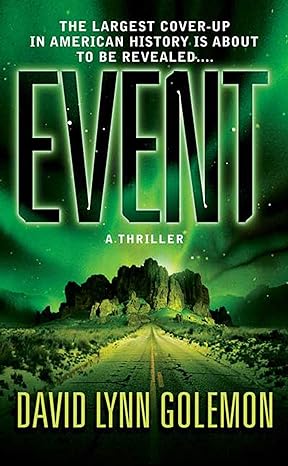
Event: A Novel by David L. Golemon


Borrows heavily from movies and TV, has decent action.

Published in 2006 by Thomas Dunne Books 

Event is not a bad book, per se, but I kept on thinking, "I've seen this before."

The book introduces a secret government agency called the Event Group which investigates historical legends, paranormal activity, UFO sightings, etc. They are sort of an X-Files, Men in Black and Delta Force rolled into one. The Event Group collects items of historical significance and studies them to plan for future disasters. They also keep these items secret.

 Why?

I was never quite clear as to why Noah's Ark, the existence of King Arthur, or the arrival of the Vikings in the Americas in the 800s were state secrets. Plus, comments such as the Event Group not wanting to give King Arthur's body to the Brits because it belongs to "the world" seem silly when the Event Group is just storing Arthur in a vast underground base in Nevada. They are not sharing any of this information with anyone - they are just hording it. The Event Group reminded me of Spielberg's Nazis in "Indiana Jones" that were always searching for relics of power.

There are aliens and their story seems to be a combination of Independence Day, Aliens and Tremors.

The characters were okay and the action was mostly good, but, for me, the story never quite gelled. I kept wondering why Noah's Ark was a state secret and the rest of the story broke down from there. To use a Bible analogy (in honor of Noah and his hidden-away Ark) - that was the story's "feet of clay."

I rate this book 2 stars out of 5.

This book can be found on Amazon.com here: Event: A Novel.


Reviewed on November 9, 2007.

Undaunted Courage : Meriwether Lewis, Thomas Jefferson and the Opening of the American West (abridged) (audiobook) by Stephen E. Ambrose


Wonderful, just wonderful.

Published by Simon and Schuster Audio
Read by Cotter Smith
Duration: 4.5 hours 
Abridged

A family friend gave me the abridged audio version of Undaunted Courage. It has been on my "to read" list for years and I'd never quite gotten around to it but, boy, am I glad I finally did.
Meriwether Lewis
(1774-1809)

In Ambrose's hands the story of the Lewis & Clark expedition is lifted from the stale and stilted pages of the history textbooks and it becomes an exciting narrative - full of adventure, wonder and tons of hard work.

Ambrose is a gifted writer. I am reminded of the David McCullough quote: "No harm's done to history by making it something someone would want to read." No danger of that with Ambrose. Not only has he read everything there is to be found on the topic but has traveled the route several times.

William Clark
(1770-1838)
Cotter Smith did a great job of reading the text and keeping up with its lively prose (with the single exception of mis-pronouncing the capital city of South Dakota - he called it Pierre, like the French name, but they proudly pronounce it "peer".) 

Stephen Ambrose himself handled the intro and conclusion. I can't wait to pass on this audiobook to someone else.

I rate this audiobook 5 out of 5 stars.

This audiobook can be found on Amazon.com here: Undaunted Courage by Stephen E. Ambrose.

Reviewed November 9, 2007.

When Elephants Weep: The Emotional Lives of Animals (abridged) (audiobook)by Jeffrey Moussaieff Masson


Originally published in 1995 by Dove Entertainment, Inc.
Read by David Ackroyd
Duration: 3 hours, 5 minutes.
Abridged

Strengths:

When Elephants Weep is full of moving anecdotes concerning animals and the possibility of them having emotions. It is a pleasant listen and usually not "over the top" in its preachiness. It was well read by narrator David Ackroyd. The authors make a compelling, if not scientifically rigorous argument for animal emotions.

Weaknesses:

The authors are continually preaching against scientists who do not believe that animals have emotions and may even doubt that animals can even feel pain. However, they rarely point out the scientists or the studies that espouse this view. It felt like a straw man argument after a while. They also fail to cite any work that backs their claims besides convincing rhetoric.

In the end, it was a convincing, mostly entertaining book that was a lot more entertaining and pleasant than a PETA brochure, but without much more actual content than such a brochure.

I rate this audiobook 3 stars out of 5.

This book can be found on Amazon.com here: When Elephants Weep.

Reviewed November 9, 2007.

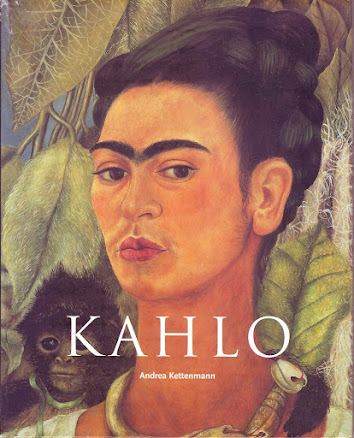
Frida Kahlo: 1907-1954: Pain and Passion by Andrea Kettenmann


A wonderful introduction to Kahlo (a review of the English translation)


Originally published in 1999.

If you saw the Selma Hayek movie on the life of Frida Kahlo and want to know a bit more, this book is a wonderful introduction to her professional life. In fact, the movie and this book complement one another quite nicely, since the movie tended to focus on her personal life.

Andrea Kettenmann's book follows the life of Kahlo and does a great job of explaining the symbolism of Kahlo's work as it pertained to her personal life, her health setbacks and her political beliefs. In my opinion, the intensely personal nature of her work is what makes her such a compelling artist. She was especially good at depicting her pain, both psychic and physical. This book goes a long way to explaining many of her works.

Frida Kahlo with
Diego Rivera in 1932
There are 93 illustrations in this book and most of them are of her paintings. Also includes a couple of photographs of Diego Rivera's works that included images of Kahlo.


This is a small book (less than 100 pages), but it packs a whole lot of punch and is very effective as an introduction to this fascinating artist.

I rate this book 5 stars out of 5.

This book can be found on Amazon.com here: Frida Kahlo: 1907-1954: Pain and Passion.

Reviewed on November 9, 2007.

African Kingdoms (Great Ages of Man Series) by Basil Davidson and the editors of Time-Life Books


Strong history, only limited by the fact that the book itself is practically an antique


At the time of this review, this book is 41 years old. It was published in 1966 by Time-Life books as part of a series of books entitled "The Great Ages of Man."

Of course, several of the photos of contemporary Africa are now hopelessly outdated (but you can choose to look at the book itself as a piece of history and look at those pictures as photographic evidence of historical Africa) and any references to contemporary Africa are not accurate - no mention of any of the tragedies that continent has witnessed over the last 25 years - starvation, genocide, AIDS, etc.

Fortunately, those references are few and far between. Mostly this is a well-written, accessible history that taught me more than the half-dozen or so textbooks that I read in college as part of my coursework.

Its greatest strength is in detailing the civilizations that were built from roughly 1000-1600 AD in West Africa. It does a great job of comparing them with the European explorers that were just beginning to investigate the African coastline in search of trade. Cultural comparisons are also made. So-called "strange" and "barbaric" African customs of the day look pretty run-of-the-mill when compared with the activities of their European and Middle Eastern neighbors.

Beautiful pictures and illustrations round out the book. I would love to see this book updated and re-issued for the the 21st century.

I rate this book 5 out of 5 stars.

This book can be found on Amazon.com here: African Kingdoms.

Reviewed on November 22, 2007.

With Bowie Knives & Pistols: Morgan's Raid in Indiana by David L. Taylor


Nice history of Indiana's "moment" in the Civil War

Published in 1993 by TaylorMade WRITE

From July 8-13, 1863, Indiana became the focus of attention in the Civil War. Despite the massive losses incurred by the Confederacy from the surrender of Vicksburg on July 4, 1863 and the Battle of Gettysburg on July 1-3, the Confederacy still had enough life to mount an invasion into the North (albeit small) and it caused a first-rate scare throughout the Midwest.
Confederate Brigadier General
 John Hunt Morgan


"With Bowie Knives and Pistols": Morgan's Raid in Indiana is a good, detailed history of the Indiana portion of the raid (it continued on into Ohio). Taylor starts with a short general biography of Morgan and his famed cavalry unit. Taylor also describes the situation in the Kentucky theater of war and explains the logic behind Morgan's raid and why he went against his orders to carry the war into Indiana and Ohio.

What could be a tedious read is actually told in a lively manner filled with lots of local stories about the raid as they cut across southern Indiana. A must read for any Hoosier Civil War buff.

This book can be found on Amazon.com here: With Bowie Knives and Pistols.

I rate this book 5 out of 5 stars.

Reviewed on March 1, 2012.

Gun Games (Decker/Lazarus #20) (audiobook) by Faye Kellerman


Poor detective story, mostly the story of a romance between two high school kids


Published by HarperAudio in 2012.
Read by Mitchell Greenberg.
Duration: 12 hours, 1 minute.
Unabridged.

Gun Games is the 20th book in Faye Kellerman's long-running Decker/Lazarus series, featuring police detective Peter Decker and his wife Rina Lazarus. Peter and Rina are serving as foster parents for Gabriel Donatti, a boy with parents who are estranged from him and one another. His father is a mobster and his mother is out of the country starting a new life.

A great deal of the book follows Gabe, although there is a mystery for Peter Decker to solve. It involves a suicide by a student from a local, very expensive private school. The case seems fishy to Decker as he and his team uncover nebulous links to a group of bullies from the elite school who like to pretend they are gangsters, carry weapons and intimidate teens in and out of their school. Unbelievably, these same kids get involved with Gabe and his new girlfriend, Yasmine. Yes, the foster father is investigating a case and the bullies that he can't quite get a handle on end up tangling with his foster son, making the case burst wide open. How many people live in Los Angeles? What are the chances?

My real frustration with the book comes from the lengthy, explicit details of Gabe and Yasmine's exploration into sex. I am in the midst of my 23rd year of teaching high school and middle school students - I am very aware that students have sex. I am a well-read person and hardly am a prude. But, this book crossed the line between demonstrating that Gabe and Yasmine had a strong, physical interest in one another and had begun a sexual relationship and instead went very close to child pornography with its emphasis on details and the constant discussion of Yasmine's physical immaturity when compared to Gabe (she was described as looking like she was 10 years old many times). What could have been a sweet romance between star-crossed lovers quickly (and frequently) became creepy and threw a pall over the entire book.

On top of that, Kellerman's teen characters rarely sound like teens when they talk or text one another. I speak with teens every day and these teens sounded nothing like them. There was very little slang, except for slang that no one under the age of 50 uses (like a boy "taking a shine" on a girl to say that he "liked" her). Most of the teen conversations sounded stilted and overly formal, like teenagers talking to an aged relative at a family gathering. Kids curse - and curse a lot, especially when no parents are around. Even more so when they are trying to act tough, like the gun-toting wannabes from the elite school. Nothing about their conversations sounded remotely authentic.

Narrator Mitchell Greenberg did a solid job with the reading of this story. He is especially good at keeping track of things like mentions that the characters have, for example, runny noses and incorporating that into his voices by making them sound stuffed up.

So, in a sentence - this story has unbelievable coincidences with teens that sound nothing like teens and long, detailed descriptions of underage teens having sex.

I rate this book 1 star out of 5. It can be found on Amazon.com here: Gun Games by Faye Kellerman.

Reviewed on February 27, 2012.

Next by Michael Crichton


Many hated it but I think it may be Crichton's best book


Published in 2006 by HarperCollins

I have not read all of Michael Crichton's books but I have come close. His best books are generally warnings about the dangers of science without the guidance of ethics: Just because you can do something - does that mean you should do it? 

Next delivers that theme in spades. It is all about genetic manipulation - not just genetically modified corn or houseflies. No, Crichton is talking about genetically modifying people to eliminate certain behaviors and even splicing human DNA into animals.

The book comes at the reader in a kinetic mish-mash of bits of plot from several plotlines, news headlines and news articles. This mess finally coalesces into a real story about halfway through the book and I assumed that Crichton's writing had deteriorated when he wrote this thing and he was just not able to juggle it all.
Michael Crichton (1942-2008)


Then, I got it.

This out-of-control story is supposed to be out-of-control. It is haphazard, random and full of too many crazy coincidences that work together. This is the way that Crichton saw our current state of research and funding in science - it is a crazy mix that is working towards "sexy" discoveries but not thinking about their consequences. It is Jurassic Park, but not just restricted to an island. Instead, it is being shotgunned into our everyday lives. As Jeff Goldblum notes in the movie Jurassic Park: "Life finds a way."

Crichton is warning that a willy-nilly rush into these discoveries cannot be reversed.

Yes, the plot is contrived. Yes, there are too many coincidences. Yes, the characters are often shallow. But, Crichton also demonstrated that through coincidence, accident and fraud there will be consequences that we have not imagined.

It is a warning worth considering.

I rate this book 5 stars out of 5.

This book can be found on Amazon.com here: Next.

Reviewed on February 25, 2012.

Ronald Reagan: Our 40th President by Winston Groom


Published by Regnery Publishing, Inc. in 2012.

Winston Groom, forever to be known as the author of Forrest Gump , has busied himself with a series of non-fiction books as of late. His latest is this short biography, Ronald Reagan: Our 40th President. The publisher lists this book as "juvenile nonfiction" but this adult also enjoyed this 148 page biography.

This is not a controversial "let's set the record straight" book. I detected no political bias except for the fact that is a generally friendly book towards Reagan. That being said, Groom covers the lows of Reagan's personal (strained relationships with his children, for example) and political life (Iran Contra - it gets more attention than almost any aspect of his presidency) and covers them as thoroughly as a book of this size should.

Ronald Reagan (1911-2004)
This is a great book for high school students because it is easy to read, does not dwell on topics for too long and covers all parts of Reagan's life well, not just his eight years as President.  It tells the basics of an extraordinary life (Reagan's more than most, but all presidential lives are extraordinary since there have only been 44 of them). I particularly enjoyed the stories of his days as a sportscaster and his early days in Hollywood. Groom also explains that Reagan's transition from Hollywood actor to politician was not abrupt or even an unnatural move, although I did find it interesting to note that his first response was, "I'm an actor, not a politician." (p. 82)

In my real job, when I am not blogging, I am a secondary social studies teacher and I can easily say that if Groom wanted to busy himself writing biographies of all of the recent presidents I would be glad to put them all in my classroom library. This one tells the basics of Reagan's life. Let the student learn that and later on, when they know more, they can start to put value judgments on his actions and choices.

That being said, there is a problem with the book. While Groom may know how to tell someone's life story in an interesting way, he seems to have no head for figures. On page 4 he discusses the impact of a horrific 12% inflation rate (the rate when Reagan assumed the presidency) and he incorrectly asserts that a 12% interest rate means that in 8 years the value of a dollar saved 8 years earlier "would be worth exactly zero." That is not correct. A 12% inflation rate means that in 6 years the prices of everything would be double (following the "rule of 72") and that saved dollar would only buy half as much, but it would still have value. On page 144 he states the United States spent $8 trillion dollars on the Cold War. He states that equals spending $1 billion per day for 8,000 years. Considering that 1 trillion equals 1,000 billion, it would really equal $1 billion per day for 8,000 days (about 22 years).

So, read this book for what it is - a story well told. And, as always, check the other guy's math. Or, as Reagan noted: "Trust, but verify."

I rate this biography 4 out of 5 stars.

This book can be found on Amazon.com here: Ronald Reagan Our 40th President.

Reviewed on February 25, 2012.

Touched with Fire: Five Presidents and the Civil War Battles That Made Them by James M. Perry


A unique biographical collection - a new angle on the Civil War


Published by PublicAffairs in 2003

I am a big fan of Civil War histories. I have more than 75 fiction and non-fiction Civil War books on my bookshelf (mostly non-fiction) so I am hardly a newbie to this area. When I comment that this is a new angle, I an really saying something.

It's not that James M. Perry has uncovered new documents or new information in Touched with Fire, but he has re-shuffled the "same old" information into a new pattern. In this case, he has focused on the five Presidents that fought in the Civil War (Grant, Hayes, Garfield, Harrison and McKinley). Perry includes a modest pre-war biography of each of the men and then goes into greater detail on their war experiences. The level of detail is neither skimpy nor excessive - he strikes a nice balance.

As a group, they all had many things in common. To a man, they all became competent officers of brevet Major or higher, they all had extensive combat experience in the Western theater (although Hayes and his men were transferred to the Eastern theater) and they were all Republican (Perry does point out that the Democrats did run Civil War veterans, but none were successful).

Union Major General  (and future President)
James A. Garfield 
(1831-1881)
Mercifully, Perry does not cover the entire career of U.S. Grant since his Civil War biography would essentially be a re-telling of the war itself and his war biography would dwarf those of the other four combined. Instead, he begins with Grant at Forts Henry and Donelson and only chooses to include him again when he interacts in the lives of the other four. The other four are hardly a homogeneous group, despite all being Republicans. Their temperaments range from stoic and quiet to loud and openly scheming. Their ages range from 18 to 38 and previous military experience range from a West Point education to none at all.

Perry includes a chapter at the end telling the post-war political history of each of the five men which is also a basic history of Gilded Age politics. Perry points out the powerful influence that Civil War veterans groups such as the Grand Army of the Republic had.

Interesting. Easily accessible. Worth the read by Civil War buffs and devotees of the Presidency.

I rate this book 5 stars out of 5 and it can be found on Amazon.com here: Touched with Fire: Five Presidents and the Civil War Battles That Made Them by James M. Perry.

Reviewed on November 16, 2007.

Now and Then (Spenser #35) by Robert B. Parker


Parker and Spenser go over old ground, but it's still a lot of fun


Published in 2007.

Spenser is on the case again in Now and Then. This time, a simple "check and see if my wife is cheating on me" case becomes a double murder and takes Spenser back onto a college campus investigating yet another campus radical.

It is not terribly surprising that Parker is going over old ground - this is his 35th Spenser book. Hawk and others are brought in to help, as happens in most all of the newer Spenser books. However, the interplay between Spenser and the others is one of the best features of a Spenser book so that is not disappointing. All in all, this is one of the better Spenser offerings in years.

I enjoyed this book and was well on the way to giving it a 5 star rating until I got to the end. It was just too pat.

Still, it's a solid addition to the series and a must-read for fans.

I rate this book 4 out of 5 stars and it can be found on Amazon.com here: Now and Then by Robert B. Parker

Reviewed on November 16, 2007.


The Best of John Mellencamp: 20th Century Masters: Millennium Collection


A review from a Mellencamp fan from way back

Released by Island in 2007

I was kind of torn about giving this collection a 5 star rating - not because it is not a quality sampling of his work, because they are all good choices. But, there's so much that has been left out. But, reality has to set in and the CD publisher just has to leave stuff out - there is only room for ten songs in this collection series.

I always check out the "20th Century Masters" series when I am browsing in the CD section because they usually get a strong cross-section of an artist's work. This is fairly easy if the artist is a flash-in-the-pan type, but Mellencamp has been cranking out hits for more than 25 years. Sure, his best days as a top seller are long gone, but he continues to put out quality work and scores an occasional top 40 song. The wealth of hits to choose from must have made the choices a bit tricky.

This album is arranged in reverse chronological order, covers most of his albums and definitely samples his changes in style. The only album that is represented with two songs is 1985's "Scarecrow". This is arguably his best album and although I personally like "Lonely Ol' Night" much better than "R.O.C.K. In the U.S.A.", "R.O.C.K." is one of his best-known hits and has more than earned its place on this compilation.

This is most likely not an album for the serious Mellencamp fan (or Mellenhead as some prefer or Mellencamper as John's concert T-shirts say) because a serious fan would have all of these songs on the original albums or on the greatest hits album ("Words and Music") that he recently released. But, it is a good starting point for the casual fan or as a gift for someone who is just starting to convert over to a digital collection (like I said, I'm a fan from way back - I still have Mellencamp on cassette tapes and even on a few on vinyl.)

I rate this collection 5 stars out of 5.

This CD can be found on Amazon.com here: The Best of John Mellencamp: 20th Century Masters: Millennium Collection.

Reviewed on November 18, 2007.

Star Wars: I Jedi (audiobook) by Michael A. Stackpole


A review of the abridged audiobook


Published by Random House Audio in 1998
Duration: 2 hours, 54 minutes
Read by Anthony Heald
Abridged

I was not a fan of this book. I'm not sure if it was the abridgment or the writing style, but I'll give the author the benefit of the doubt and blame the abridgment.

Like most abridged books, I, Jedi was too abridged (where are the Reader's Digest abridgers when you need them?). Characters, ships and situations show up without preamble but we're expected to be familiar with them. The whole book seemed hurried.

The typical special effects that Lucasfilms provides their audiobooks are a bonus, but they were somewhat haphazardly applied in this case - sometimes the music overpowered the text and jungle background noises were on a continuous loop that was too loud and too repetitive. The lightsaber sound effects are wonderful, but they were not timed with the text very well - sabers were being turned on before the text mentioned danger and off during battles (which made me wonder if someone was trying to do the Obi Wan Kenobi letting-himself-get-killed thing from Star Wars Episode IV).

Anthony Heald read the text and did a strong job, as he always does. But, there was only so much he could do with this one.

Corran Horn's quick welcome into the secretive pirate group (the Survivors) as a pirate seemed contrived and I'll credit that to the abridgment. Think of pirates as a street gang and try to imagine joining a street gang as a full-fledged member over a drink at a bar and you'll see what I mean.

Also, the use of a Star Destroyer as a smuggler ship boggles my mind, and not in a positive way. Smugglers depend on the importation of small quantities of goods to keep the price high to justify the risks they take. They use stealth to avoid the law. A Star Destroyer is neither small nor stealthy. It would overwhelm the market and make prices plummet and it would be so obvious that it would demand government attention. Think of a drug smuggler pulling into San Diego harbor with an aircraft carrier full of drugs. It would be: A) super obvious; and B) a disaster for the local drug market prices. But, you'd have to unload the product there because the cost of operating such a ship precludes stopping off at little ports all over the coast and doling out little amounts.

I did like this quote: "Selflessness is the only antidote to evil."

So, I cannot recommend this one - I listened to it and liked parts of it, but on the whole, it was unsatisfying.

I rate this audiobook 2 stars out of 5.

This audiobook can be found on Amazon.com here:   Star Wars: I, Jedi

Reviewed on November 21, 2007.

Chasing the Dime by Michael Connelly


Inspired by an event in the author's life, a bit of "film noir" on paper


First published in 2003.

If you are familiar with the movie style called "film noir" than you get a good idea what Chasing the Dime is like. In a "film noir" movie the protagonist is a regular guy with a secret. He gets sucked into the criminal underworld (or into the world of spies) by events he cannot control and does not understand. Betrayals make him question everything and his old life is shattered.

Well, all of that happens here. Henry Pierce gets a new phone number and a series of calls intended for the old owner of the number. He gets curious as he tries to tell the old owner, a prostitute who advertises herself on a porn site as an escort, to change her number. From that point on he gets sucked in to an out of control situation.

I wasn't in to this one for the first 75 pages or so. But, once it gets going this one really had me. Connelly noted in the book that he was inspired to write this book when he got a new phone number and got a number of questionable phone calls.

I rate this book 5 stars out of 5.

This book can be found on Amazon.com here: Chasing the Dime.

The Petty Story & The Wrestler DVD


 Not a great movie, but a must for Richard Petty and early NASCAR fans (from a Petty fan from way back)

Just so you know, I've given this movie 4 stars - not because it is a great movie. It is not, unless you are a die hard Petty fan. But, it is a valuable piece of NASCAR history - a little gem that I picked up in the super-cheap DVD section of a local store. It is a snapshot of the beginnings of the modern heyday of stock car racing.

Released in 1972 and full of footage from the early days of NASCAR, the production values in this one are not great, which is a mixed blessing. The old footage does not stick out from the rest of the film because the film itself is pretty grainy and has questionable sound at times.

Richard Petty plays himself and he comes off as a fairly wooden actor, which would be a pretty unfair assessment to make if you are not familiar with Richard's personality. He is slow-talking (careful with his words), casual, straight-backed and was as hard a driver as there ever was. So, Petty pretty much plays himself as I've always seen him.

Long-time mechanic Dale Inman plays himself. Darren McGavin (most famous for his role as the dad in "A Christmas Story") plays Lee Petty and Noah Beery, Jr. (most famous for his role as Rockford's dad in "The Rockford Files") plays Richard Petty's grandfather.

The plot of the movie is basically a set of flashbacks from the Petty family while Richard is in the hospital after a bad wreck in the World 600.

The 2nd movie on the disc is "The Wrestler" starring Ed Asner. It was released in 1974. Asner is a wrestling promoter. The movie features a number of famous wrestlers from the old days such as Dick the Bruiser, Ric Flair, and Dusty Rhodes. The sound quality on my DVD was very poor (very quiet).

I rate this DVD 4 stars out of 5 and it can be found on Amazon.com here: The Petty Story & The Wrestler.


Reviewed on November 25, 2007.

A Committee of One and Other Essays by Chuck Avery

Thoughtful Ruminations of a born and bred Hoosier

Published in 1997 by D and C Publishing

Chuck Avery writes a column for the Richmond Palladium-Item, the local paper in Richmond, Indiana. His typical essay could be classified as one of those slice-of-life pieces - a little reminiscing, a little wry observation, a bit of good-natured humor. Avery is also a teacher.

I never heard of Chuck Avery before I picked up this book at a local book sale (ironically, he describes picking up books in a similar sale in one of his essays  - the essay that gives the book its title). A Committee of One is one of those rare books that gets better as it goes along.

I particularly enjoyed the essays "Clevenger's Pond" (a humorous look at human nature and why his farm pond is no longer open to the public), "The Allure of Instant Esteem" (a look at the self-esteem movement in the classroom and why it makes no sense unless you have actually done something), "Solitude and Reform" (the world of instant communication vs. the need to talk to those closest to us and even to work on ourselves).

I particularly liked this serious line from a humorous essay called "Food: The Chore of Eating:" 

"In our continuing effort to make life effortless, we have made child rearing frightening to parents, pushed education beyond the scope of even the most competent teachers, confounded the family to the point that we must have psychologists to untangle relationships."

A little humor, some serious points. All in all, a good read.

I rate this book 4 stars out of 5.

This book can be found on Amazon.com here: A Committee of One and Other Essays.

Reviewed on February 18, 2012.

Featured Post

<b><i>BAN THIS BOOK (audiobook)</i></b> by Alan Gratz

Published in 2017 by Blackstone Audio, Inc. Read by Bahni Turpin. Duration: 5 hours, 17 minutes. Unabridged. My Synopsis Ban This Book is t...

Popular posts over the last 7 days