Chicano Visions: American Painters on the Verge by Cheech Marin


A great collection, a terrific exhibition


Published in 2002 by Bullfinch.
160 pages

I caught this exhibition at the Indiana State Museum while it was on a nationwide tour. It was so interesting that I took full advantage of my museum membership and came back and saw it several times while it was here in Indianapolis. I picked up the book Chicano Visions as the exhibit was winding down but only recently read the well-written introductory essays that make up the first 35 pages or so of the book.

Cheech Marin has created a high-quality full color text of this travelling show which is mostly comprised of pieces from his own personal collection. Marin's taste tends to run towards political art, but there is plenty that speaks of life for artists who are both Chicano and American, as the exhibition title (also the book title) imply.

Artists that grabbed my attention include:

Carlos Almaraz - his car crash paintings were gigantic attention getters in the gallaries. His other works are great as well.

David Botello - his Monet-like style is fascinating.

One of the best paintings may well be "Janine at 39, Mother of Twins" by Margaret Garcia. Cheech Marin's comment on page 67 hits it on the head: "If there is a visual definition of the lushness, the strength, and the beauty of women, this painting is it."

Cesar Martinez's "Hombre que le Gustan las Mujeres (The Man who Loves Women)" is funny and a sadly realistic portrayal of the ways that men see women.

Patssi Valdez's "Room on the Verge"
Patssi Valdez was the painter that stole the show in Indianapolis, at least from the comments I heard. Her pictures are so bright and have the power to make the viewer feel as though he or she is being drawn in to the canvas, especially with works like "Room on the Verge." Another painting of hers graces the cover of the book.

I did not care for the works of a couple of established artists: Gronk and Mel Casas. The Casas pieces in this show seemed less like a work of art and more like very large, not very clever political cartoons. That being said, it was entirely appropriate to include their works considering their standing in the Chicano art movement.

I rate this book 5 stars out of 5.

This book can be found on Amazon.com here: Chicano Visions: American Painters on the Verge.

Reviewed on February 17, 2008

Stranger in Paradise by Robert B. Parker


I think I've read this one before...


Published in 2008 by Putnam
304 pages

I am a gigantic fan of Robert B. Parker. I've read all of the Spenser books, the Stone books and the Randall books. And I'm slowly "re-reading" the Spenser books as audiobooks.

It is not lightly that I give Stranger in Paradise two stars.

The Stone novels were always different than the Spenser / Sunny Randall novels. Spenser and Sunny always have that buddy network to fall back on (especially Hawk and Spike, respectively) Jesse has always been alone, except for his on-again off-again ex-wife, who actually makes his sense of being alone even stronger.

The whole formula for Jesse Stone is thrown out. Instead, we have a re-make of Spenser's April Kyle and Paul Giacomin stories told under Jesse Stone this time around with a girl named Amber.

Stone is not a lone, principled character this time. Instead, Parker reverts back to a mainstay of the formula he uses in the Spenser novels - the amazing sidekick. Rather than Spenser's Hawk (a mysterious, unstoppable African-American who operates on the wrong side of the law that the ladies find irresistible and shares witty racial banter with Spenser) we now have Stone's Crow (a mysterious, unstoppable Native American who operates on the wrong side of the law that the ladies find irresistible and shares witty racial banter with Stone). Hawk. Crow. C'mon!
Robert B. Parker 
(1932-2010)


Parker often recycles previous plots (how can he not - he's written so many books!) but this was just too much for me. The story is easy to read, interesting and enjoyable, but it has too many recycled features for my taste.

I rate this book 2 stars out of 5.

This book can be found on Amazon.com here: Stranger in Paradise.

Reviewed on February 20, 2008.

The Invention of Hugo Cabret by Brian Selznick


The book that turned into a phenomenon.

Published 2007 by Scholastic.
533 pages.
Text and illustrations by Brian Selznick

The Invention of Hugo Cabret was a gift to my daughter by her great aunt way back when she was in 3rd grade. She was at a critical time when some of her friends were losing interest in books (how sad to throw away such a powerful thing as reading for pleasure) and her great aunt stepped in in a big way with this book. The sheer magnitude of the thing made her eyes open wide and she looked at her great aunt dubiously as if to say, "Can I read anything this big?" Of course, she read it - that night. And, she got up again and read it again at 4 o'clock in the morning. She was so thrilled that she could read something with this much heft that she has never shrunk from another book again. And, she has read it at least once a year (if not more) since then.


So, because of my daughter I loved this book even before I read it. But, what did I think about it?

I enjoyed it. The pictures are great and they tell the story well. The writing is also good. It is simply told but not a simple story. I very much enjoyed both parts of the story. I appreciated the respect paid to old movies, to history in general and the honor given to people who are very talented with their hands. It does a great job of creating a whole new world and putting the reader right into it.

Very loosely inspired by real events, the plot involves an orphan named Hugo who lives in the Paris train depot and works as the keeper of the clocks. All of the clocks are powered by springs and have to be turned to keep running on time. Hugo is an orphan and his uncle was the keeper of the clocks and gets a room to stay in at the depot as a part of his pay. However, his uncle has now passed away and Hugo keeps the clocks running as though he is still alive just so he can have a place to live. Hugo is also afraid that he will lose an automatos (robot-like machines that look like people powered by gears) that his father was restoring at the time of his death. He has been stealing gears from a toymaker/seller in the depot to work on his automaton and at the beginning of the story he gets caught and everything looks like it will fall apart for Hugo...

I rate this book 4 stars out of 5.

This book can be found on Amazon.com here: The Invention of Hugo Cabret.


Reviewed on December 30, 2011.


Blaze by Richard Bachman (Stephen King)


Blaze is Stephen King's twist on Steinbeck's "Of Mice and Men."

Hardcover edition - published June 2007 by Scribner.
285 pages.

Stephen King and DWD's Reviews have had an "on again off again" relationship. 25 years ago I read everything the man wrote and very much enjoyed it. It is one of my favorite books. But somewhere around Insomnia I got very tired of the Stephen King train and I got off for about 15 years. I picked up Cell at the library and I enjoyed it. Since then, I've done a little more Stephen King reading (and audiobooks) but not a lot. I've missed a lot of his books and will slowly work my way through many of them. I always enjoyed his Bachman books - Thinner and The Running Man have stayed with me for decades (especially The Running Man - King predicted reality television even better than he would have imagined way back when) so I picked this one up at a local bookstore and decided to give King another whirl.

Stephen King
Blaze can be summed up in just one phrase: "What if George and Lennie from Of Mice and Men moved from the Steinbeck novel to a Stephen King novel?" Of course, this world will be even darker than Steinbeck's world (which was dark enough) and our two main characters are not goodhearted day laborers, one worldly and one mentally retarded, trying to make their way through the world, they are con men and car thieves trying to make that one big score.

Bachman/King's book is much more detailed that Steinbeck's tiny classic, but it is every bit as interesting. This is an enjoyable, yet sad book that goes into the detail of Blaze's life (Blaze is the nickname for the Lennie character) and his attempt to follow through with a rather complicated kidnapping of a baby even though George died several months earlier. Blaze hears the voice of George in what I would assume is a personification of Blaze's own thoughts. Or, since this is Stephen King, it could be a ghost of George. It is never made clear.

It is an engrossing book that has the reader ironically pulling for a kidnapper. It is also a story of multiple "What ifs...?" at several points in Blaze's life. King is at his character-creating best in Blaze (I think that he gets overlooked for his ability to create rich and full characters) and when the book ends by a river in an homage to the ending of Steinbeck's Of Mice and Men. King acknowledges the inspiration in an entertaining introduction ("...kinda of hard to miss," he notes on page 4) and he also includes a short story first published in 2006 called Memory at the end of Blaze.

I rate this novel 5 stars out of 5.

This book can be found on Amazon.com here: Blaze by Richard Bachman (Stephen King).

Reviewed on December 30, 2011.

Note: This book was banned by a school district in Florida in the 2023-2024 school year. Here is a link to the extensive list of books that were banned in Florida that year.

If You Want To Walk On Water, You've Got to Get Out of the Boat by John Ortberg


A Great Bible Study

Published 2001 by Zondervan
220 pages.
10 chapters with a Preface.

John Ortberg does not specialize in deep, seminary-level Bible studies. He is perfectly able to operate at that level, I am sure, but that is not the way to reach the common man or woman and this is a Bible study aimed at the regular church-going Christian that feels like he or she should be doing more (whatever that may be) and trusting in God or help in doing whatever that "more" is. The inspiration for the book comes from the story of Jesus walking on water and Peter being so inspired by the sight of it that he leaps out of the boat to join Jesus...for a few steps, anyway.

Jesus walking on water from the 
Codex Egberti (10th century)
For those that are concerned about this being a book about works-righteousness, Ortberg is not teaching that. He is teaching that God has called you to work in his Kingdom and Christians need to take a risk and step out in faith to do whatever it is they are called to do. Ortberg's strength is solid, interesting, often funny writing with a point. He does not waste many words - he gets to his point without bludgeoning or badgering his readers. Each chapter includes review and discussion questions. There is also a workbook and a DVD - both are designed for small group studies and are helpful to create meaningful discussions (I did participate in just such a study).
I rate this book 4 stars out of 5.

This book can be found on Amazon.com here: If You Want to Walk on Water, You've Got to Get Out of the Boat

Reviewed on December 29, 2011.


Odyssey of the Gods: The History of Extraterrestrial Contact in Ancient Greece (audiobook) by Erich Von Däniken


More of the same from Von Däniken, but it is still interesting and entertaining.


Read by William Dufris
Duration: 7.5 hours
Published in October of 2011 by Tantor Audio
Unabridged.

Erich Von Däniken’s bestselling 1968 book Chariots of the Gods? helped to popularize what is now known as the “ancient astronaut” theory. This theory was featured in the 1970s NBC documentary In Search Of Ancient Astronauts and has even made it to Hollywood with the X-Files and the latest installment of the Indiana Jones movies. In short, the theory is that humanity, thousands of years ago, was visited by aliens who built gigantic structures such as the pyramids and Stonehenge and were mistaken for gods by our ancestors. They are the inspiration behind much of the ancient mythology around the world and the fantastic beasts included in many of those myths are actually the result of genetic experimentation.

In Odyssey of the Gods Von Däniken looks at three tales of ancient Greece and applies his broader ideas to those tales. The three tales are: 1) Jason and the Argonauts; 2) The Iliad/The Odyssey; 3) Atlantis. A great of deal of time in this audiobook is spent simply reciting these stories (easily one-third of the audiobook) and then stopping from time to time to offer insight based on his theories and fitting them back into his larger theory by noting how some aspects of the stories are similar to other tales from other ancient cultures, such as the Assyrians, ancient India, ancient Israel and even the Mayans, Aztecs and Incas.

As one can imagine, Von Däniken offers an interesting perspective on these stories. All of the creatures and heroes are the result of alien/human crossbreeding or genetic manipulation. Von Däniken allows no room for exaggeration – every tale is taken at face value, especially if it has great detail. He asserts that unnecessary detail in a story makes it less likely to be fiction (because no one would waste their time in creating it), which prompted me to wonder if he had ever read anything about the immense amount of unpublished extra details that J.R.R. Tolkien created just to lay down the backstory for his tales of Middle Earth.

Nonetheless, I did not listen to Von Däniken’s Odyssey of the Gods to look for a fight. As a history teacher, I truly enjoy a multitude of perspectives on history. I really do not take his entire theory seriously but he does, up to a certain point, have a valid question: how did our ancestors build giant pyramids and cities and create entire mythologies when they were literally just a few generations from being unorganized farming villages? It is a giant leap to go from simple farmers to highly organized priesthoods, advanced mathematics and the ability to build with multi-ton stones hauled from far away quarries and right now history has only the vaguest of answers as to how this happened. Throw in historical quirks like the Piri Reis map and the geometric web pattern that he claims covers all of the holy sites of ancient Greece and you have some good reasons to at least give Von Däniken a chance to lay out his theory.

Von Däniken is featured in an audiobook-exclusive interview after the book. His rather strong Swiss-German accent does nothing to hide his enthusiasm and infectious nature  – you just have to like him no matter what you think of his ideas. It is also obvious that the reader, William Dufris, strived to catch that aspect of his voice while reading the book. He did a remarkable job of reading the book and making it seem less like a textbook and more like an exceptionally well-presented seminar.

I rate this audiobook 4 stars out of 5.

This audiobook can be found on Amazon.com here: Odyssey of the Gods.

Reviewed on November 22, 2011.

Micro: A Novel (audiobook) by Michael Crichton and Richard Preston


Although it is a collaboration, it reads remarkably like a typical Crichton novel

Published 2011 by Harper Audio
Read by John Bedford Lloyd
Duration: 14 hours
Unabridged.

Michael Crichton died in 2008 and left Micro as an unfinished manuscript. I have no idea how much of this book is actually Crichton's and how much belongs to Richard Preston. To me it felt like a typical Crichton novel.

A typical Crichton novel for me is a mixed bag. It has grand themes - truly big, big ideas with foundations in real science. Grand themes about the dangers of too much innovation without enough ethical considerations, lots of Gee Whiz stuff (think of the movie Jurassic Park where the paleontologists are mesmerized when they first see the dinosaurs) and laughable plot lines with sketch characters (the worst for me was State of Fear in which the big menacing bad guys were wedging themselves into Toyota Priuses as they stalked their opponents - yes, the Prius, the ultimate pursuit car!).

This book has all of that in spades.

The plot revolves around NanoGen, a Hawaiian start up company that has figured out (or stolen) how to shrink full-sized objects down to a very, very small size. People are about one half of an inch tall when they are shrunk. NanoGen claims to be using the technology to thoroughly search the Hawaiian rain forest for biological discoveries that  could be used to help create medicines. Their plan is to search the micro-world bit by bit (literally square foot by square foot) in tiny detail so that even creatures that cannot be seen with the naked eye can be harvested and investigated for possible uses in a bio-technology laboratory.
Micheal Crichton (1942-2008)


But, the bad guy in charge of the project also wants to use these tiny robots as weapons and has made plans to corrupt the original vision of NanoGen's founders. So, murder and mayhem result and soon enough we are following a group of college graduate students who have been shrunken and dumped into the rain forest in an attempt to get rid of even more witnesses (why weren't they immediately squished and flushed down the toilet? The bad guy is so over-the-top in his sadism that he wants to prolong their punishment, which of course eventually backfires.).

So, when our seven college graduate students are dumped in the rain forest (in the micro world as Crichton/Preston usually refer to it) we have several scenes that are reminiscent of Jurassic Park, except we don't have T. Rex and Velociraptors. Rather, we have centipedes, spiders, wasps and ants - all armored and all very dangerous to very tiny people. This part of the book is by far the best - the descriptions of the bugs, their habits, their defenses and their weapons are all fascinating. If it weren't for these details I would have to rate this novel poorly, but the descriptions are entertaining in and of themselves.

John Bedford Lloyd's narration of the book was solid but really did little to enhance or detract from the book.  His voices were solid. To be fair, most of the plot was inane, so it was not like he was working with a literary classic. His deep voice did add a lot to the menacing descriptions of the bugs.

I rate this audiobook 3 stars out of 5.

This book can be found on Amazon.com here: Micro: A Novel.

Reviewed on December 27, 2011.


Bully! The Life and Times of Theodore Roosevelt by Rick Marschall


Easily the best biography I read this year.

Published in 2011 by Regnery History.

Bully! The Life and Times of Theodore Roosevelt is exactly the kind of book that will ensure that printed books will always have a place, no matter how many e-readers are sold. This is an absolutely beautiful book. It has a satisfying heft, it is printed on high quality paper (think coffee table book quality) and is chock full of political cartoons from an era when many political cartoons would have been full color and the size of an entire newspaper page. This book inspires the reader to flip through the pages, browse a bit, admire the art and do a little reading.


A larger, better reproduction of this cartoon appears in the book. 
I included it as a sample of the beautiful artwork.
Fortunately, Rick Marschall's text is every bit as accessible and enjoyable as the cartoons he has chosen to illustrate the hyperactive, hyper-productive, hyper-successful life of Theodore Roosevelt, the 26th President of the United States. Marschall covers it all rom his very early entry to the world of politics (much of this was addressed in political cartoons as well), to his ranching days, his work in the Navy Department, to the Battle of San Juan Hill, his political climb from Governor of New York to Vice President to the Presidency. Not only that, we are treated to his trip to Africa, a European tour, the rain forests of Brazil, the Bull Moose Party controversy and, most of all, his vitality. Roosevelt was a force of nature. All of it was delicious material for the nation's prolific newspapers and their cartoonists and the story is much enriched by their inclusion. It gives the reader a great feel for how Roosevelt was actually viewed by the American public.

This book has completely reformed me from my wayward and youthful outlook on Theodore Roosevelt, a point of view discussed by the author on pages 400 and 401 in the "Acknowledgements" section. He notes that Roosevelt has become symbolic of all that is considered evil today on many of America's college campuses: "Hence, he became a virtual devil in much of academia, especially contrasted to Woodrow Wilson, who was painted as a dreamy internationalist and idealist who, if he had not been thwarted by Neanderthals at home and abroad, would have delivered heaven on earth." That was how I was taught. I was sure that Wilson was not what he had at first seemed (the more I learn, the more I am repulsed) but now I see TR in a new light as well.

My next book on the to-be-read pile was also a biography. Out of fairness to that biography, I am going to have to put it back into the pile and read something else in a different genre- this biography is so strong that I am quite sure that the other one will suffer unfairly in comparison.

I rate this biography 5 stars out of 5.

This book is available on Amazon.com here: Bully! The Life and Times of Theodore Roosevelt.

Reviewed on December 27, 2011.

Need You Now by James Grippando


A readable but uninspired thriller


Published in 2012 by Harper.

Did you ever read a book that was more interesting for the places that the characters went than it was for the characters themselves? Well, this book is one of those.


Not that this is a bad book - it starts with an interesting underlying plot involving a Bernie Madoff type of ponzi scheme and a hint that the government had worked to keep the scheme going long after it should have been discovered. Bring in contract killers, terrorist connections, a dying former mobster in the witness protection program, cell phones infected with GPS tracking viruses, a love story gone bad (but maybe on the rebound?), secret identities, a mathematical genius and a cub scout leader and you would think that you would have the makings of a fine thriller.

Instead, the book just cruises on autopilot. The characters feel a bit shallow. The story bounds from one twist and turn to another but they just felt a bit forced.

Once again, not a bad book - just not a great one.

I rate this book 3 stars out of 5.

Note: I received a preview copy of this book from the publisher in exchange for an honest review.

This book can be found on Amazon.com here: Need You Now.

Reviewed on December 17, 2011.


Redwall (Redwall #1) by Brian Jacques


The first of a prolific series


Originally published in 1986.

Listed as on Time Magazine's list of 100 greatest fantasy novels.


My 11 year old daughter picked up Redwall at a local bookstore and loved it so I decided to give it a try, figuring that it must be pretty solid considering that there are more than 2 dozen books in the series, including prequels and other side stories.

But, I was not captivated by the story. I did not dislike it, but the grown up in me had some questions that pestered me throughout. The storyline is fairly simple - the peaceful community of animals that lives in and around the Abbey of Redwall is under attack by an army led by an evil one-eyed rat named Cluny the Scourge. The scholars of the Abbey believe that the sword of their ancient hero, Martin the Warrior, will help in the defense and dispatch an initiate into their order (Matthias) to find that sword. The plot follows the progress of he siege and Matthias' search.

I was bothered by many things in this book that caused me to enjoy it less than my non-critical daughter.

1) Why do the creatures of the Abbey look to young Matthais to be the leader of their defense of the Abbey? Vague reasons are offered but they make no sense;

2) Scale. Badgers fight alongside mice. The badger in the book is larger than the mice, but not to the scale it would be in the real world. The scale with almost every animal is off;

3) Why are some buildings mice-sized and some buildings are seemingly built by humans? Where are those humans?

The plot itself is fairly basic and predictable - rookie hero goes off to find the secret weapon and be the hero, the plucky good guys hold off the evil enemies.Unlikely alliances offer greater strength.

My daughter may try to read the rest of the series but I will not.

I rate this book 3 stars out of 5.

This book can be found on Amazon.com here: Redwall by Brian Jacques.


Reviewed on December 10, 2011.

Founding Rivals: Madison vs. Monroe, The Bill of Rights, and the Election That Saved a Nation by Chris DeRose


A refreshing perspective on the Founding Fathers

Published 2011 by Regnery History

I am an avid reader of American history and one of my favorite areas to study is the American Revolution and the Founding Fathers. There is no shortage of books about the build up to the Declaration of Independence, the Revolutionary War and Washington, Jefferson and Adams (as of late) but there is a real scarcity of books about the difficulties experienced by the Articles of Confederation government and the debates that led to the creation of the Constitution. Of course, there are the famed Federalist Papers and the lesser-known Anti-Federalist Papers but not much written as a study.

James Madison (1751-1836)
In Founding Rivals, DeRose tells the story as a parallel biography of Madison and Monroe - two Founding Fathers, two future presidents, both close friends of Thomas Jefferson. This is more than a bare bones biography but there were times that I found myself wanting more such as when DeRose discusses Monroe's trips to the frontier. I would have been interested in hearing more about how that influenced his decisions later on in life. For Madison, mentions in one brief sentence that he wrote or co-wrote 29 of the Federalist Papers as part of the debate in New York about the ratification of the Constitution. I would have thought that his essays would have been explored a bit since they do show insight into his political philosophy but there is only the one sentence.

But, the book is not meant to be a complete dual biography, it is the story of one election to Congress and how that election impacted America. That part of the story actually occurs relatively late in the book. Once DeRose has finished demonstrating the weaknesses of the Articles of Confederation and why Madison (known as the primary author of the Constitution) wanted to scrap it (no one had more experience with the deficiencies of the Articles of Confederation than Madison) we are easily two-thirds into the book. Frankly, I was starting to wonder when the "Rivals" part was going to kick in. In a way, it really does not. Madison and Monroe were friends. They respected one another's experiences and opinions and their rivalry seems to have been a gracious one. Interestingly, they did not seem to harbor any ill feelings towards one another during and after the election.

James Monroe (1758-1831)
They strongly disagreed on the new government created by the Constitution. Anti-Federalist Monroe wanted to go to Congress to limit the ability of the Congress to directly tax the people and create a Bill of Rights. Madison wanted to be able to directly tax the people and was one of the few Federalists that also wanted a Bill of Rights. Madison was bothered by states (like his native Virginia) that had an official religion and taxed its residents to pay for that religion and he had a long record of opposing those sorts of laws.

Madison wins the election and is one of the leaders of the movement to add the Bill of Rights to the Constitution. DeRose persuasively maintains that if Madison had not won the election, there would not have been enough support from Federalists to pass the first 10 amendments to the Constitution and that is how this election "saved a nation." It's a strong argument and the book presents an interesting look at the Founding Fathers and the arguments and friendships that created America.

I rate this book 4 stars out of 5.

This book can be found on Amazon.com here: Founding Rivals: Madison vs. Monroe.


Reviewed on December 7, 2011.


City of Dreams: A Novel (!Hero Series #1) by Stephen R. Lawhead and Ross Lawhead


An interesting "What if...?" take on the story of Jesus.


Published in 2003 by Navpress

This may be the most pointless review I have ever written. There is something sad about a stillborn trilogy. In this case, only the first book was published, although co-author Ross Lawhead claimed the 2nd and 3rd books are written in his blog. So, this reminds of an unfinished building - lots of big plans but someone pulled the plug before it was completed.

Nonetheless, here is the review:

The premise is simple. What if Jesus did not come into the world about 2,000 years ago, but instead was born in Bethlehem, Pennsylvania in the here and now. As a history teacher I very much enjoyed reading the alternate history aspect of this book - how would the world be different if Christianity did not eclipse the old religions of Europe? Would the worship of Jupiter, Thor and Diana have continued? Would Europe have developed the same sort of political structures? These topics are hinted at but are not really the main focus of the book.

The book features Special Agent Alex Hunter, an investigator for ICON (International Confederation of Nations), a one world government organization that has been experiencing difficulty with religious groups who want to break free from ICON's iron grip. Hunter is a tarnished agent, having mishandled a standoff with a religious splinter group in the recent past. The standoff went bad and a bloodbath ensued. He has been brought to New York City to investigate a Zionist splinter group (turns out that Judaism survives in this alternate, but still experiences plenty of difficulties).

Intrigue, plots and plots within plots are discovered and Agent Hunter is not sure who to trust - ICON, the local government or perhaps even the group he has infiltrated. Along the way, he meets Washer John, the character that corresponds to John the Baptist and his cousin Joshua, the character that corresponds to Jesus (Jesus is the Greek-ification of Yeshua or Joshua, if you are wondering about the name change).

The first book ends with Agent Hunter making a major decision about who he can trust in a cliffhanger situation designed to make the reader look for the second book. Unfortunately...there is no second book. Too bad, it would have been an interesting read.

I rate this book 4 stars out of 5.

This book can be found on Amazon.com: City of Dreams: A Novel.

Reviewed on December 6, 2011

No Time for Goodbye: A Thriller by Linwood Barclay


Delivers what it promises - tension, thrills and escapism


Published 2007 by Bantam

Linwood Barclay has quickly become one of my favorite authors. His books often feature a happy family in which some event intrudes into their lives and turns everything upside down, very much like the classic black and white noire movies where the regular guy gets pulled into a seedy underworld that he had no idea even existed.  Note, these books are not deep, they are not fine literature in any sense. But, they drag you in and make you read right through to the end and the story is well worth the price of the book.

No Time for Goodbye is no different. The story is about Cynthia and Terry Archer. They have one daughter. He's a high school teacher. She works in a women's clothing store. They are a happy couple except for one dark moment twenty-five years before when Cynthia was 14 years old. One day she woke up and her entire family was gone - her mom, her dad and her brother. No note. No luggage gone. No one packed anything. They were just gone.

So, on the 25th anniversary of their disappearance, Cynthia decides to work with a reality television show and have them tell her story in the hope that someone will remember something and give her a clue as to what happened.

Soon enough, things start to happen, but not what they had hoped for. Someone breaks into their house. A strange car starts to follow Cynthia and then things really start to spin out of control.

Great thriller. I rate this book 5 stars out of 5.

This book can be found on Amazon.com here: No Time for Goodbye.


Reviewed on December 5, 2011.

Pershing: Commander of the Great War by John Perry


An interesting, well-written biography


Published: 2011 by Thomas Nelson

I've read several of the biographies in Thomas Nelson's "The Generals" series and found Pershing: Commander of the Great War to be the best of the bunch so far. The book is well-written, flows nicely and really gives the reader a feel for the bristly personality of "Black Jack" Pershing.

Perry introduces us to Pershing, a man who wanted to be a teacher, maybe a lawyer,  but accepted an appointment to West Point because he could not afford to pay for school himself. Pershing was not particularly interesting in being a soldier, but found that the lifestyle suited him. Pershing's early service in Cuba during the Spanish-American War taught him plenty of lessons about the need for proper supply lines that he took with when he commanded the American army in Europe in World War I.

World War I General 
John J. "Black Jack" Pershing
Pershing also served as an observer in the Russo-Japanese War, the Philippines and, of course, was in charge of the expedition that fruitlessly chased Pancho Villa in Mexico. For his time, Pershing was surprisingly open to different cultures, which probably explains his willingness to lead all black units in the segregated army (and is the source of his nickname "Black Jack"). But, he is most famous for commanding the American forces in World War I. Perry covers all of these events well and keeps it interesting. Perry is especially good at discussing Pershing's personal life and the tragic fire that took most of his family.

 I received this book from the publisher, Thomas Nelson, in an exchange for an honest review.

I rate this biography 5 stars out of 5.

This book can be found on Amazon.com here: Pershing: Commander of the Great War.

Reviewed on December 4, 2011.

Heat Rises (Nikki Heat #3) (audiobook) by Richard Castle


Surprised and impressed!


Performed by Johnny Heller
Duration: 11 hours, 15 minutes
Published 2011 by Hyperion Audio
Unabridged.

I freely admit that when I got this audiobook I was not expecting much. The premise behind the whole series is an inside joke to begin with since this is supposed to be the books written by an author in the fictional television series Castle. So, I am reading about a fictional character in the books of a fictional author based upon the life of another fictional character in a TV show. It pretty much hurts my brain to think about it - like an Escher painting gone bad.

So, I got the audiobook of Heat Rises and figured that, if nothing else, this could be good for a laugh. My original instincts were reinforced when I noted that the main character is named Nikki Heat (like a character in a bad 80's Stallone movie or something) and, of course, she is physically stunning as well as being the best detective in her squad.

But, as I listened I warmed to the characters. The case was interesting, the characters all have distinct and interesting personalities and the book knows how to be both funny and dramatic. This book pulled me in and had me looking forward to the chance to get in the car and listen to it as I made my daily commute. I expected little and got an interesting, action-packed case with plenty of drama and humor.

In Heat Rises New York City detective Nikki Heat is assigned to the case of a local parish priest who is found dead in the torture room of a local bondage club. As the case progresses, her mentor and boss, Captain Montrose intervenes in ways that cause Heat to doubt his intentions. Add in a local group with ties to a Latin American terror group, a CIA-affiliated contractor with a history of human rights abuses and multiple attempts on Heat's life and you have the recipe for a successful bit of escapist fun.
Actor Nathan Fillion as fictional 
author Richard Castle


This book is truly performed by Johnny Heller who makes all of the characters seem unique by creating a diverse amount of accents and voices for dozens of characters, including changing his pitch and pacing. I listen to a lot of audiobooks and his work on this audiobook stands out.

I rate this audiobook 5 stars out of 5.

This audiobook can be found on Amazon.com here: Heat Rises by Richard Castle.

Reviewed on December 3, 2011.

FTC Full Disclosure - this work was sent to me by the publisher so that I could review it. The review, however, is my honest opinion and was not influenced by being sent a free copy.

Riders of the Purple Sage by Zane Grey


A Classic

Set in 1871 and written in 1912, Zane Grey's Riders of the Purple Sage is a classic, perhaps THE classic of the Western genre.

The plot is a little more complicated than most Westerns - it features two concurrent stories. Jane Withersteen is a wealthy Mormon with no husband. Her local church leader (an Elder) wants to marry her, in fact has all but ordered her to do so even though she has no interest in him. Tull orchestrates a plot to have the local Mormons shun her as much as possible (including not working for her) and not help her as rustlers steal entire herds of cattle that are no longer tended.

Zane Grey (1872-1939)
In the meantime, a stranger named Lassiter arrives. He has a reputation as a Mormon-hater and a gunslinger and becomes a defender of Jane Withersteen. Meanwhile, one of her last employees (Venters) goes after a herd of cattle that is being rustled and discovers a secret pass and a secret valley that they have been using. The story splits at this point and largely becomes the story of Venters and the story of Withersteen and Lassiter. The stories come together from time to time until the final culmination.

The question is, of course, does this 99 year old story still hold up after all of these years? Yes, after you get used to the stilted language. Grey is wordy and given to using some phrases over and over again. But, the story is solid and entertaining. There is an exciting chase scene towards the end that is quite riveting.

If you are a fan of Westerns you should take a look at this one - it is the one that set the parameters of the genre.

Note: If you are a member of the LDS church, you will probably be offended by some of Grey's comments about the Mormon church. Grey is not dismissive of the entire church, but he is clearly not a fan of the early Mormon pioneers of Utah, especially the men. He thinks they abused the rules of the religion to manipulate others. On the other hand, Jane Withersteen is a Mormon and she is quite faithful to the ideals of the church, so it is a mixed bag.

I rate this book 4 stars out of 5.

This book can be found on Amazon.com here: Riders of the Purple Sage by Zane Grey.

Reviewed on November 23, 2011.


Ain't Nothing But A Man: My Quest to Find the Real John Henry by Scott Reynolds Nelson with Marc Aronson

A Fascinating Investigation into American History


Published 2008 by National Geographic

Scott Reynolds Nelson went on a search to see if there was a real John Henry that inspired the songs and the legend of the man with the hammer who beat the steam drill in a contest.

First and foremost, this is a book written for children, but it was interesting to this grown up as well. The topic was interesting, the pictures are great - lots of real pictures from the past of men on railroad work crews with their equipment. Nelson goes on to explain how the songs were used by work crews not just for entertainment but to keep time while moving tracks and pounding on spikes. Lastly, he explains, step-by-step how he makes his investigation. This could have been extraordinarily boring, but Nelson keeps it interesting. He actually creates a sense of tension as he tracks down his information.

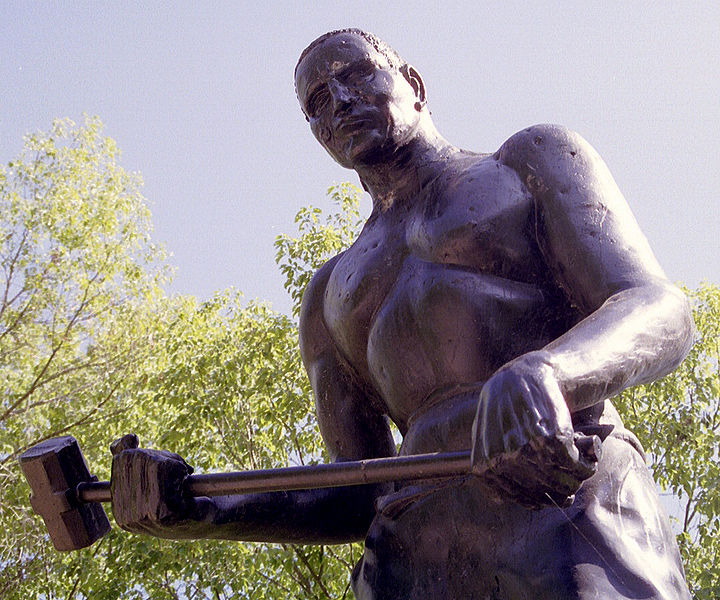
John Henry statue near Talcott, West Virginia
Nelson does come up with a potential source of the legend, provides a ton of internet resources, including websites to hear versions of the John Henry song and other similar songs, as well as other books. Aronson steps in with a easy-to-read short essay with 6 steps on "How to Be a Historian."


Nice book. Should be in every library.

This book can be found on Amazon.com here: Ain't Nothing But A Man.

I rate this book 5 stars out of 5.

Reviewed on November 19, 2011.


Featured Post

<b><i>BAN THIS BOOK (audiobook)</i></b> by Alan Gratz

Published in 2017 by Blackstone Audio, Inc. Read by Bahni Turpin. Duration: 5 hours, 17 minutes. Unabridged. My Synopsis Ban This Book is t...

Popular posts over the last 7 days