Fyodor Dostoevsky by Peter Leithart


A tepid introduction to Dostoevsky


Published in 2011 by Thomas Nelson.

I freely admit to knowing only the barest of details about Fyodor Dostoevsky before starting this book. I was aware of the arguments of some of his works and am familiar with the broad strokes Tsarist Russian politics before the Revolution.

I picked up this book after becoming intrigued with some of Dostoevsky's ideas while reading a book by A Point in Time by David Horowitz. Horowitz quotes extensively from Dostoevsky and talks about his thoughts about evil in the world, God's place in the world, if there is one. Sadly, I learned more about Dostoevsky's philosophy from Horowitz than I did from this slender biography dedicated to the man.

Fyodor Dostoevsky
(1821-1881)
Don't get me wrong, this is a solid little book to learn about the details of his personal life, but it suffers from the lack of in-depth discussion about his ideas and the use of reconstructed conversations throughout that really makes it much more like a piece of well-researched historical fiction than like a true biography.

Note: I received a copy of this book at no cost from Thomas Nelson publishers in exchange for an honest review of the work.

I rate this biography 3 stars out of 5. This book can be found on Amazon.com here: Fyodor Dostoevsky by Peter Leithart.

Reviewed on October 8, 2011.

After the Golden Age by Carrie Vaughn


An entertaining superhero story with a twist

Published 2011 by Tor.

Imagine if your parents were both legendary superheroes and you have no super powers at all. In fact, the closest you have come to being physically heroic is winning a silver medal at a high school swim meet.They have been "outed" and everyone knows them by their regular identities and as superheroes and you are a frequent target of various super criminals who kidnap you to try to influence your parents. It happens so often that it would be funny if it wasn't interrupting your attempt to blend in, be normal and succeed in your career as an accountant.

Carrie Vaughn
That's the premise of After the Golden Age, a book that promises a superhero story with a twist and delivers. Celia West is a promising young accountant whose parents are the larger-than-life superhero duo of Captain Olympus and Spark. He's a Superman knock off with the nasty attitude and wealth of Batman. She creates fire at will. They have founded Commerce City's version of the Justice League. They are legends. They are beloved. They are just so-so parents and Celia has major issues with her parents.

Celia has tried to distance herself from her parents but the trial of a super criminal has demanded her skills as a forensic accountant. As she digs and digs in the records of the case she may have discovered information that no one wants disclosed about the origins of both the superheroes and the super criminals as her love life heats up, a new type of crime wave is sweeping the city and the mayor begins a crackdown on the vigilante actions of the superheroes.

I rate this book 5 stars out of 5.

Reviewed on October 4, 2011.

Killing Lincoln: The Shocking Assassination That Changed America Forever (audiobook) by Bill O'Reilly and Martin Dugard


An interesting history that has been told plenty of times before.


Read by the author, Bill O'Reilly
Duration: 8 hours
Published by Macmillan Audio
Unabridged.

Probably no figure in American history has received more attention than Abraham Lincoln. Political commentator Bill O'Reilly was, in the early 1970s, a high school history teacher. He wrote this book out of a true passion for Abraham Lincoln. It is clearly not a professional work since it does contain many simple mistakes (for instance, he refers to the Oval Office when it was not actually added to the White House until the early 1900s).

I listened to the audio version of Killing Lincoln. To be honest, I was reluctant to listen to it since it is narrated by O'Reilly and I am not a huge fan of his work as a political commentator. In fact, O'Reilly's rather odd style of speech both made the read more interesting.

John Wilkes Booth
(1838-1865)
The book tells the story of the last few days of Lincoln's life, including the flight of Robert E. Lee's Army of Northern Virginia from the lines of Petersburg, the surrender at Appomattox Court House, the celebrations in Washington, Booth's various plots to kidnap and/or kill Lincoln, the assassination of Lincoln and the manhunt for Booth.

O'Reilly is known for taking stands on issues and defending those points of view loudly and vociferously. He does the same here. The historical figures are simplified: Lincoln is the long-suffering hero, Booth is evil personified (not that I sympathize with Booth, but O'Reilly comes on a little strong). The history is enthusiastic, if not particularly deep. His descriptions are strong and the story is paced quite well. Much to the chagrin of my ever-patient wife, I am a serious student of the Civil War (I personally own more than 100 books on the topic and have read dozens more) and I found the book to be entertaining, well-told and I even learned a couple of new things.

I rate this audiobook 4 stars out of 5.

This audiobook can be found on Amazon.com here: Killing Lincoln.

Reviewed on October 3, 2011.

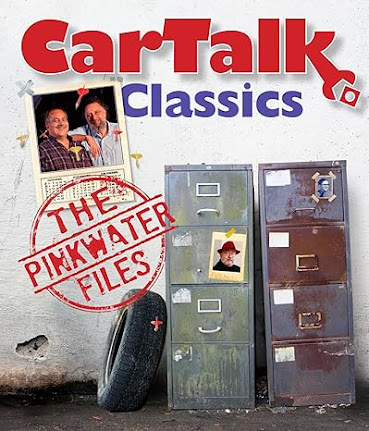
Car Talk Classics: The Pinkwater Files (audiobook) by Tom and Ray Maggliozzi


Fun and you just might learn something.


Narrated by Tom and Ray Maggliozzi
Duration: 3.5 hours.
Publisher: HighBridge Audio

Tom and Ray Maggliozzi's car repair show, Car Talk, has been a NPR staple for years now. The show features the two wise-cracking brothers as they field questions about cars and car repairs from all over the country.

Car Talk Classics: The Pinkwater Files features four complete shows from the mid-1990s that featured phone calls from author and NPR commentator Daniel Pinkwater. Pinkwater's sense of humor is different than the Maggliozzi brothers, but they roll with him quite well and those four phone calls are the highlight of the collection. Pinkwater never really has a question for the brothers but instead offers his observations concerning his struggles with getting a car that fits his stocky build, how to know when your dog is going to throw up in your car and the Theory of Displaced Misery (this theory states that a person can only have so much misery in their life and if you buy a French car, the rest of your life will be quite happy).

The rest of the collection is enjoyable as well. This was a welcome respite during a difficult week for me - it was great to know that my extra-long commute was going to be alleviated by the Magglioni brothers' humor (and their car diagnoses are informative as well!)

I rate this collection 4 stars out of 5.

This audiobook can be found on Amazon.com here: Car Talk Classics: The Pinkwater Files

Reviewed on September 18, 2011

Portrait of a Spy (Gabriel Allon #11)(audiobook) by Daniel Silva


A smart spy thriller


Published in 2011 by HarperAudio.
Read by Simon Vance
Duration: 12 hours, 15 minutes
Unabridged.

Daniel Silva's Portrait of a Spy features Israeli master spy Gabriel Allon, now semi-retired and living and working in rural England as a restorer of paintings. Europe is suffering a wave a suicide bombings. While in London on business he spots a suicide bomber on his way to blow himself up in a London open-air area of markets and restaurants. He steps in with his weapon but is stopped by UK agents that think that he is the threat and the bomber detonates himself.

Allon is told to walk away but he is haunted by his failure. When he is approached with the chance to infiltrate the financial network of the same terror network he leaps at the chance. This is a joint CIA/Israeli operation and the muddled politics of our current administration (make grand overtures, continue the rendition program, bomb some dictators, not others) are mirrored in this fictional administration. Silva has brought the "Arab spring" in as well so the book has a real current events feel to it.

The plan they develop is just simple enough and just crazy enough to have some sort of chance. Silva does a great job of giving the "feel" of the cities and countrysides that the book travels through - London, Paris, rural France D.C., Dubai, the Empty Quarter. He takes the time to flesh out plenty of supporting characters. But, sometimes the story drags as a result.

Reader Simon Vance does a great job with every character except for Gabriel Allon, who sounds more like a sleepy Alec Guinness than a confident, professional spymaster. I kept imagining him in Jedi robes, rather than carrying a pistol and tracking terrorists.

I rate this audiobook 4 stars out of 5.

This audiobook can be found on Amazon.com here: Portrait of a Spy by Daniel Silva.

Reviewed on September 16, 2011.

Omar Bradley: General At War by Jim DeFelice


Published in 2011 by Regnery History

Regnery Publishing's newest imprint, Regnery History has found something new to tell about one of the most written-about parts of World War II: D-Day. You may ask yourself, what else can be said about D-Day that hasn't been said? We have had powerful, visceral movies like Saving Private Ryan, The Longest Day and Patton and the famed HBO series Band of Brothers. Article after article and book after book have been written about D-Day, the Battle of the Bulge and the final days of Nazi Germany but somehow we have failed to have had a serious biography of one of the invasion's central planners and one of the men who engineered the entire campaign from the beaches of Normandy until the defeat of Germany: American 5 star general Omar Bradley.


The problem with Omar Bradley and historians is that he is not Patton. Patton is brash, daring and iconic. Bradley did not chase headlines and did not wear fancy pistols. He was daring, but not as daring as Patton. He knew that he should keep his mouth under control and he was too humble for his own historical reputation. But, one could seriously doubt if Patton could have been the remarkable general he was without the support of Omar Bradley - a man who kept Patton supplied (no small task) and innately understood and supported the battlefield tactics and strategy that Patton espoused so loudly.


Omar Bradley
Jim DeFelice's Omar Bradley: General At War tells the complete story of Bradley's life, from his humble beginnings in rural Missouri through the war and on to being the chair of the Joint Chiefs of Staff after the war, but mostly focuses on the campaigns in North Africa, Sicily (where he worked under Patton) and France (where Patton worked under him). He paints a sympathetic picture of a likable man who never shirked his duty and who pioneered a number of innovations such as a mobile command center (in the back of a truck) and joint land and air operations with coordinated air strikes during the breakout from Normandy.

While DeFelice clearly admires Bradley (Ernie Pyle practically gushed over the man which is about as good of a character reference as you can get in my book), he does not cover up his mistakes and shortcomings. Bradley never concerned himself with the larger world scene (he was shocked when the possibility of a post-war rivalry with the Soviets was pointed out to him). The "bulge" in the Battle of the Bulge happened in his zone due to a calculated risk on his part. But, he was quickly able to adapt himself to the situation and turn a momentary retreat into a larger victory.

In the end, the lesson of Omar Bradley may be that the nice guy, the guy that works hard and does not demand special attention sometimes can win, and win big.

This is a solid entry as Regnery History's first book. It is well-researched and an enjoyable read. If the rest of their catalog is as solid as Omar Bradley: General At War, this will be a welcome addition to the history section of your favorite bookseller. That being said, Regnery History did make a rookie mistake with the maps. They are all located in an appendix at the end of the text and there are simply not enough of them. This book screamed for maps and lots of them and there were just not enough. I have never heard any history lover complain that a book had too many maps.

I rate this book 4 stars out of 5.

This book can be found on Amazon.com here: Omar Bradley: General at War

Reviewed on September 13, 2011.

Note: This book was provided at no charge by the publisher in exchange for an honest review.

Stealing You Blind: How Government Fat Cats Are Getting Rich Off of You by Iain Murray


Overreach hurts the overall argument

Published in 2011 by Regnery Publishing.

I feel I must establish my bona fides here. I am an Iain Murray fan. I really enjoyed his book The Really Inconvenient Truths (to see my review click here). On my favorite quotes page on this blog, there is an Iain Murray quote (really!). But, while I am a fan, in this book, I think that Murray has made many, many valid points but overreached on others. The over-argument weakens the overall book, in my opinion.

Also, in the interest of making everything clear, I have chosen to be a member of public employee union - the Indiana State Teacher Association (we choose to be a member or not in Indiana). I have actually gone to state level meetings as a representative of my local union. I have been invited multiple times to attend trainings so that I can become more involved but I have not done so due to family commitments. That being said, I can clearly see that there are tensions between being a political conservative and being a union member. Most people do not realize that the local union is, sadly, often the only counterweight to school administrations that may not act wisely and often offers great advice on issues like consolidations and programs that can be trimmed (I once listened to my union rep explain to my superintendent that if we followed through on the superintendent's planned staff cuts some of our schools would no longer be accredited by the state because we would be in violation of state laws that require schools to offer so many hours of this and that subject per week to maintain accreditation. Should our superintendent have known the law? Sure, but he didn't and this was not the first time, either.) Also, so as not to be accused of being biased towards public employee unions and/or teachers, I will leave those aspects of the book out of this review.

What Stealing You Blind does right:

-The government cannot keep growing indefinitely. All organizations tend to add bureaucracy and government at all levels, from your locals schools to the White House like to add it on even quicker. Throw in the ability to make regulations that have the effect of law and you have a recipe for disaster - an ever-growing bureaucracy creating more rules that need even more personnel to check for compliance....

-Some functions (but not all) can be privatized.

-On page 80, he makes perhaps the most important point in the book: "The key question is...should the federal government really be doing that in the first place?" This, of course, was the central question in the budget debate this summer and we failed to answer that question. It should have been the central point of the book but too often it is not.

-Employees should never use their employers' resources to supplement their on-the-side projects like being a real estate agent.

What he gets wrong:

-Iain Murray continually harps on the costs of maintaining urban professional (paid) fire departments, claiming that volunteer firefighters (mostly rural) are cheaper.

Volunteers are absolutely cheaper and they do a great job in rural areas. I happen to live in Indianapolis, very close to the headquarters of what used to the fire department that once claimed to be the "world's largest volunteer fire department". This fire department covered part of the city and the airport for decades. It used to be an all volunteer department until it just could not be staffed at safe levels any longer. It had to become a paid department.

Rural volunteer fighters are wonderful for their community. I grew up with one in my rural Indiana community and at least one of my relatives was a volunteer firefighter. That being said, volunteer fire departments often arrive after the house is fully engulfed - how can they get there any earlier when they have to drive to the station, suit up and then go to the fire?

If that is our standard, we will lose entire neighborhoods to fire in cities due to the proximity of the homes to one another, like what happened in Chicago in 1871. That event was called The Great Chicago Fire and no one wants a repeat of an out of control urban fire consuming neighborhood after neighborhood. A professional fire department in urban areas is like car insurance - you hope you'll never need it but you pay for it anyway. Anything else is foolishness.


-Sometimes Murray goes for the cheap applause line like on page 21 when he notes that in the 1800s half of Americans lived on the farm and the USDA only had 2,000 employees. Now it has 100,000 employees. He makes it sound like every farmer has his own personal bureaucrat with a secretary watching over him. I can easily imagine him amongst the soybeans sitting at his desk. He fails to note that the USDA has added many, many responsibilities such as administering the school lunch program, the food stamp program, crop insurance, food safety inspections, and more. Should they be doing all of these things? Great question, but he does not ask it, instead he goes for absurd image of this small number of farmers with a large number of bureaucrats watching over them.

-He is fond of comparing public employee salaries to private sector salaries, but he usually does not compare workers of the same skill level. For example, on page 31 he compares the salaries of IRS employees (one would presume that there are a lot of accountants and other people with a high degree of training)  to the average male income in the United States. The numbers are $48,100 for the IRS and $33,161 for the average male. Outrageous, right? But, I looked up his source (it is right here - table 700) and it includes all males age 15 or higher. Yes, that kid at the McDonalds and your grocery store bagger is thrown into the mix as well. I bet they drag the average down, what do you think?)

***UPDATE on 7/21/19: That table from the Census Bureau that I linked to above has moved and I can't find it. Too bad, because it was Murray's source as well - I just typed in the internet address from his endnotes. Here is another table from the Bureau of Labor Statistics for 2019 that shows income for full time workers. You can see that the 16-24 year olds really drag the average down.


-Sometimes he indulges in a bit of "thesis drift." The book is about how government is stealing you blind through lavish retirement plans and byzantine regulations,  but on occasion he wanders about the private sector taking whacks at different folks. For example, he takes a few whacks at the UAW on pages 121-123 for voting to let a GM factory in Indianapolis (my city) close down rather accepting a deal with a buyer for the plant that included a 50% pay cut. Clearly, the wisdom of choosing to have no job at all rather than a $15.50/hour job in this economy is questionable, but this is not the topic of the book at all - this has nothing to do with public employees or crazy regulation.

I have other examples, but you get the idea. I am not trying to bludgeon Mr. Murray. Like I said, I am a fan and these critiques are offered as a fan that is disappointed in the quality of this work. This book really felt like the extract of a larger, more complicated in-depth book that was going to take a serious look at all of the issues and discuss them thoroughly. If a fan sees that many of the arguments are too often flimsy straw man arguments, will they do anything to inspire new thinking or is it just chum tossed out to churn the waters of the faithful? This book asks some of the right questions, but not enough of them and does not really ask the most important question of all - Should the government be doing these things?

I rate this book 2 stars out of 5.

This book can be found on Amazon.com here: Stealing You Blind: How Government Fat Cats Are Getting Rich Off of You.

Reviewed on September 3, 2011.

Iron House (audiobook) by John Hart


Not good.

Published by MacMillan Audio in 2011
Read by Scott Sowers
Duration: 15 hours, 1 minutes
Unabridged

Multiple Edgar Award-winning author John Hart delivers a dud with Iron House, a book with too many disparate themes, too many stereotypical storylines and characters that might have been stolen from central casting at any Hollywood B movie and with too much detail about the scenery. Combine it with an overly dramatic reading by Scott Sowers and it makes for an altogether unsatisfying audiobook experience.

In Iron House we have a mafia crime boss on his death bed. His adopted son, Michael, has asked to be released from his obligations to the family business so that he might pursue a normal life with his pregnant girlfriend. But, as everyone knows, you cannot just walk away from the mafia, especially if you are known as the most effective hit man in the organization. So, Michael becomes a target of the organization he helped build. After he kills his adopted father (a mercy killing - he was dying from cancer and had been resuscitated several times against his wishes) the crime family comes after him with guns, bombs and assassination teams.

Michael and his girlfriend Elena go on the run. They head for the home of Michael's brother, a person that Elena has never heard of until the mafia family threatens his life. Micheal reveals that he and his brother Julian grew up in a dystopian orphanage named Iron House in the rural south - a community full of stereotypes such as the hilljack inbred (but very sexy) witch family, rampant mental illness and rich families that use and abuse their neighbors and women who are willing to sell everything, including their bodies and possibly their souls to get out of crushing poverty. Micheal's brother Julian was adopted by a rich senator billionaire (imagine the most stereotypical "southern senator" character you have seen in a movie and you understand this character -distinguished, a serial philanderer, abusive of his power, more concerned about his career than his family, etc.) and his young beautiful wife the very day that Michael ran away from the orphanage.

Every character except Michael is absorbed in their own selfish designs. Orphanage managers are bribed, neighbors steal from one another, sex is used as a weapon by nearly everyone. Even Michael's girlfriend Elena is so concerned about the safety of her unborn child that she argues that Michael should not check on the safety of his own brother because she and the baby are his family now - not his brother. Really? I cannot imagine my wife abandoning my family to mafia killers who will torture people for information.

The mixing of the mafia story with the Southern Gothic theme is, at best, a difficult one. It can be done since both story lines often emphasize family bonds, loyalty and shocking violence but Hart does not handle it well. The scenes with the adopted mother of Julian, Abigail, have stilted, awkward language. There are seemingly endless descriptions of scenery, including roofing tile, reflections of sunlight, telephone poles, floor tile patterns, gates, lawn and trees. Throw in strange phrasing like "he was 4 inches over six feet tall", a saccharine sweet ending, and Scott Sowers overly dramatic reading style and you have the makings of an unsatisfactory audiobook experience.

I rate this audiobook 2 stars out of 5.

This audiobook can be found on Amazon.com here: Iron House by John Hart.


Reviewed on September 3, 2011.

Compelling Evidence (Paul Madriani #1) by Steve Martini


The book that launched the series


Originally published in 1992.

Back in 1992 the first book in the Paul Madriani series was released. Over time, it has morphed into less of a legal thriller series into more of an action series with a legal thriller bent to it. But, the first one is a good old-fashioned murder mystery and courtroom drama - and a surprisingly good one for a debut effort.

In Compelling Evidence we are introduced to Paul Madriani, a struggling solo practice attorney who has recently left a big league law firm because he was having an affair with a senior partner's wife. In the office next door is a new friend, Harry Hinds (his law partner in later books). When that same senior partner is found dead, Martini is hired to defend the widow in a wild and wooly murder trial in which everyone seems to have a motive, including Madriani.

This is truly a great legal thriller. It may very well be the best in a very solid series. It has aged very well and is a must-read for fans of the series.

I rate this novel 5 stars out of 5.

This book can be found on Amazon.com here: Compelling Evidence (Paul Madriani Novels Book 1)

Reviewed on September 3, 2011.

A Point in Time: The Search for Redemption in This Life and the Next by David Horowitz


A Big Change of Pace for Horowitz


Published in 2011 by Regnery

David Horowitz is best known as a fearless in-your-face political brawler. He will literally go anywhere to debate anyone about any political topic - the more strident the opponent, the better he seems to like it. My local news and talk station interviews Horowitz once a week and I have heard a great deal of those interviews over the years. Horowitz is a formidable debater - a partisan of the first rank. To be honest, it never occurred to me that Horowitz had another gear (which, of course, is silly - we all have other interests) so when I read the description of this short book I knew I had to check it out.

In A Point in Time: The Search for Redemption in This Life and the Next, Horowitz waxes philosophical on time, how things change in this world (or more properly, how nothing ever seems to change), the way dogs live their lives compared to the way people live their lives, the paradox of the fragility and strength of horses, how out history is not really "going" anywhere and how living in a world with no faith at all is worse than living in a world with follower that follow their faiths imperfectly.

Each of A Point in Time's three chapters have unique and overlapping perspectives. In the first chapter we are introduced to Horowitz's dogs - three little sparks of life that he enjoys immensely. He considers this to be an odd proposition because he is a relative latecomer to dog ownership. All dog owners know that every dog is unique and, sometimes, the best thing they can do for us is remind us to take joy in the moment.

From there, Horowitz moves to a quote from famed Stoic Marcus Aurelius, the "philosopher king" of the Roman Empire: "He who has seen present things has seen all, both everything that has taken place from all eternity and everything that will be for time without end..." Or, as King Solomon put it: "There is nothing new under the sun."

Horowitz's point here is not to dispute our technological advances. Instead, he is commenting that people have not changed, and life is essentially the same. This is part of a well documented dispute he has had with his father who was an avowed communist that believed the world was moving in a "forward march" toward a future workers' paradise because human nature would eventually change with the right guidance.

Horowitz moves on to Dostoevsky. As he puts it on page 35, "Dostoevsky understood the dilemma we face if our existence has no meaning." To put it simply, men need a higher power to inspire them or, if nothing else, make them fear divine judgment. This is a powerful thought from a confirmed agnostic.

Horowitz comments on a rug that President Obama had installed in the Oval Office that states in its stitching: The arc of the universe is long but it bends towards justice." He questions that. How can it when the human species keeps doing the same awful things to one another that we have always done? Are we moving forward? Horowitz insists the answer is no. Instead, "The arc of the moral universe is indeed bent, but there is no one and no way to unbend it." (p. 101)

This is a melancholy work. Horowitz mourns the death of his daughter, muses on his own serious health problems and even notes that one of his beloved dogs is now too old to take long walks with him. He notes that people die before they have all of their loose ends tied up. His daughter died and left behind a great deal of unpublished writings. He gathered the best of them together in a collection for a posthumous work. So, he notes in the last line of this book, did Mozart. Mozart died while writing Requiem - even working on it the very day he died. Perhaps, that is enough - the very stoic concept of doing what is laid before you to do and not expecting the world to change.

I rate this book 4 stars out of 5.

Reviewed on August 22, 2011.

This book can be found on Amazon.com here: A Point in Time by David Horowitz.

1776 by David McCullough


Another great history from McCullough


Published in 2006 by Simon and Schuster

David McCullough's 1776 is yet another well-written history from David McCullough, the two-time winner of the Pulitzer Prize and two-time winner of the National Book Award.

David McCullough
Many academic historians discount McCullough's work as being too "popular" - a complaint that I think is pure bunk. McCullough's works are popular because he is a good writer, not because he is chasing popular topics. He is not skimping on these topics or slanting them a particular way. 1776 is a perfect example of this. McCullough does not paint a picture of George Washington, the perfect general. Rather, Washington is portrayed as the man who is quite a bit over his head, but still the best man for the job because he understands the larger goals of the colonies and is finally beginning to understand the tactics and strategies required for a ragtag army supplemented with local militia to take on a British army with superior training, superior discipline, superior supplies and the freedom to roam the Atlantic Seaboard at will.

As its name implies, 1776 is the story of the American Revolution in 1776, specifically the story of Washington and the brand new Continental Army. The story begins with the American siege of Boston, moves on to the poorly handled defense of New York City and ends with the Battle of Trenton, a battle that McCullough clearly sees as a turning point of the war, the battle that vindicates Washington as a leader after his very poor showing in New York.

Henry Knox (1750-1806)
This is an easy to read history - it flows nicely. It flows so well that at times I felt like I was reading a novel. McCullough does an especially good job of relating the story of the challenges faced by young bookseller Henry Knox and his men when they brought the cannons from Ticonderoga to Boston. This move surprised the British so thoroughly that they soon left Boston rather than face those cannon in their new locations since they threatened the ships that were supplying the city.

I really have only one serious complaint about the book and that is a simple lack of maps. There is a photograph of a map of Boston made during the siege and another of a map of New York just prior to the invasion, but these were inadequate. This book just screamed for maps and lots of them.

Despite the issue with maps, this is a very fine history.

I rate this book 4 stars out of 5.

This book cab be found on Amazon.com here: 1776 by David McCullough.

Reviewed on August 20, 2011.

People of Darkness (audiobook) by Tony Hillerman


One of Hillerman's best


Originally published as a traditional book in 1980.
Read by George Guidall
Duration: 7 hours, 2 minutes
Unabridged.


People of Darkness is one of Hillerman's best and happens to be the first of the Jim Chee novels. It is set, like most of Hillerman's mysteries, in the Navajo reservation in the Four Corners Area. In this case, Jim Chee is working in the southeast corner of the reservation, in an area commonly called the "Checkerboard" because it consists of a series of parcels of reservation and privately-held land parcels that are interspersed with one another.

Even though he is an officer with the Navajo Tribal Police, Chee is contacted to do some work as a private citizen who lives off of the reservation using his vacation time. It seems a multi-millionaire's wife wants Chee to investigate the theft of some of her husband's private "momentos."

Chee starts to look into it and his curiosity draws him to the case, despite being warned away by the local sheriff and the multi-millionaire.

Plenty of action and even more Navajo cultural lore fill this book. This book is one of Hillerman's best - if you are a fan of his newer works and have not yet read the older ones do yourself a favor and get this one! It was a joy to listen to. This version of the audiobook was narrated by George Guidall who did a strong job with the variety of voices.

This audio version lasts about 7 hours. It is unabridged.

I rate this audiobook 5 stars out of 5.

This book can be found at Amazon.com here: People of Darkness by Tony Hillerman.

Reviewed on February 28, 2008.

Over the Edge of the World: Magellan's Terrifying Circumnavigation of the Globe by Laurence Bergreen


Good - recommended reading, but not without its faults


First things first: this history teacher strongly recommends reading Over the Edge of the World: Magellan's Terrifying Circumnavigation of the Globe. Magellan and the early European explorers have long been overlooked - I can only assume due to Politically Correct attitudes among "professional" historians at the university level. Too bad. One does not have to admire everything that Magellan, Columbus and the other explorers did to admire bravery, audacity and the urge to explore that these men displayed.

Positives:

-Bergreen's text is very approachable. He tells the story in a well-paced manner and sets up the political background quite well. His portrayal of Charles I and all of the crises he faced intrigues me so much that I am going to look for a book about him.

-Bergeen uses research resources that have not been used before in a popular work - more information and perspectives is always better.

Negatives:

-Maps. This book has almost none, and the ones included are mostly examples of 16th century map work - they are not in conjunction with the text. Bergreen includes a NASA photo of the Straits of Magellan that I find as indecipherable as an ultrasound. A conventional map would have been so much more welcome.

Ferdinand Magellan
(1468-1521)
-Endnotes. Bergreen did a lot of research for this book, but he does not use a single note in the text (I would not let my high school students get away with this oversight). His endnotes are organized by chapter, but this style makes it very hard to tie specific facts with specific endnotes. Also, if you are going to make commentary in your endnotes, be a decent fellow and make them footnotes so the reader does not have to flip back and forth to the end to see your comments.

-Opinion inserted into the text. It is impossible to eliminate bias from a work of history. The simple process of choosing what to include and what to leave out demonstrates that bias. However, several times Bergreen includes gratuitous comments about the commanders of Magellan's fleet after Magellan died. When critical of their choices, he would say things like "it was just the sort of mishap that Magellan would likely have prevented..." (363) and "Not even Magellan would risk taking one, and only one, ship all the way from the Spice Islands back to Spain." (363-4) One cannot know what Magellan would do and it is best to avoid (or at the very least, seriously limit) speculation.

All of that being said, I still strongly recommend this book.

I rate this book 4 stars out of 5.

This book can be found on Amazon.com here: Over the Edge of the World: Magellan's Terrifying Circumnavigation of the Globe.

Reviewed on March 4, 2008.

After America: Get Ready for Armeggedon by Mark Steyn


"If something cannot go on forever, it will stop"

Published in 2011 by Regnery.

The above quote is from the economist Herbert Stein. Besides being a clever little bit of the obvious, a Yogi Berra-type quote, it is also part of a scary thought about America itself that Mark Steyn points out in After America - America cannot keep doing what it is doing forever and hope to lead the world - it will stop. It cannot keep  borrow 40% of its budget forever and hope to keep its economy afloat or offer its children a decent future. America cannot hope that a post-America world will be pleasant - as Steyn notes on page 14 "...it's not hard to figure out how it's going to end."


After America: Get Ready for Armageddon is really the sequel to America Alone: The End of the World As We Know It a book that details how low birth rates, a general cultural malaise and a nanny state stupor threatens to overwhelm the same countries that once led the world in political, military and cultural might. Now, he warns of the same sorts of danger happening to America itself - we will not be "America Alone" but something different - different culturally, maybe more than one country, maybe nothing but a hazy memory.

Mark Steyn
Mark Steyn is truly one of the wittiest writers I have ever read. I have always enjoyed his columns, but in a larger format Steyn truly shines. He builds on what he has already written about so well that it almost becomes like an extended conversation with the man. He almost seamlessly ties together point after point. Steyn makes you laugh at the absurdity of the situation and then, while in mid-chuckle you stop and think, "Wait! That's not really funny at all. That's outrageous (or sad, or scary)." This is simultaneously the funniest and the scariest book that I have read this year.

What are his points? Steyn starts with commentary about the national debt that seems as fresh as if it were a column written today thanks to the government's extended wrangling over the debt ceiling this summer. He also comments about how politically correct thought, excessive regulation and years upon years of erosion of free speech rights and property rights are changing this country from a can-do country to an entitlement country.

Steyn changes his style a bit in a chapter called After: A Letter from the Post-American World. This is a sobering, even depressing chapter As the title suggests, this is a letter from the future and it shows how when the West hamstrings itself, the whole world suffers and it does not become a place you would want your children to live in. Or your Jewish friends. Or your gay friends. Or perhaps even your Christian friends. It's not like we aren't being warned about this possibility now - Steyn points out headline after headline, trend after trend that should be screaming to us. But, we have Facebook to play with and Jersey Shore to watch. Plus, who are we to judge? So, Steyn predicts on page 306: "...incremental preemptive concession was the easiest option. To do anything else would have been asking too much."

This is not a perfect book. Not all of Steyn's arguments hold water, in my opinion. But, most of them do and this is a must-read book for anyone interested in big picture history. In this entertaining and sobering book Steyn predicts that we are at one of those hinges of history moments and we are not going to succeed.

Sadly, I can't say that I disagree with him on that point at all.

****

On a separate note, I criticized America Alone because it had no footnotes or end notes. It didn't even have a bibliography. This book has extensive end notes with bibliographical reference and is meticulously indexed so the reader can easily find this information and articles for him(her)self and inform others.

This book can be found on Amazon.com here: After America: Get Ready for Armageddonhttps://www.amazon.com/gp/product/1596983272?ie=UTF8&linkCode=ll1&tag=dwsre-20&linkId=2eab2c08509115bf6ec1ce9a430d6ff4&language=en_US&ref_=as_li_ss_tl.

The Secret Scroll by Ronald Cutler


Not good, not bad

Published in 2008 by Beaufort Books.

Some have reviewed The Secret Scroll very harshly. I am unwilling to do this, despite my opinion that this is not really a good book. I give it 3 Stars. As I told someone else, it is neither drek nor a Pulitzer Prize winner. It's kinda like watching an episode of Matlock - it beats watching nothing but it sure isn't To Kill A Mockingbird, despite being set in the south and having courtroom drama.

Positives:

-The plot moves along at a quick pace.

-Lots of action.

-The bad guys are truly bad.

-a love story.

-I was interested in seeing where Cutler was going with his depictions of Jesus and Paul.

-The short (2-5 pages) chapter style makes it an easy book to put down and pick up again.

Negatives:

-It is set around a scroll that is discovered by an American archaeologist that is supposedly written by Jesus of Nazareth. Cutler makes the text of such a scroll accessible to readers who are unfamiliar with ancient texts by totally ignoring their normal style and making these writings of Jesus sound like those of a blogging twenty-something.

-Most Christians are bound to be frustrated with this book as its characterization of both Jesus and Paul run counter to the understanding of most Christians.

A guide for book club groups is included at the end.

I rate this book 3 stars out of 5.

This book can be found at Amazon.com here: The Secret Scroll.

Reviewed on March 7, 2008.

The Deed: A Novel by Keith Blanchard


Hasn't this book already been written?


Published in 2003

Keith Blanchard's premise in The Deed is that the fabled sale of Manhattan Island by the Manhata Indians to the Dutch is actually incorrect. Instead, the island was sold a second time by the starving Dutch colony to a Dutch man who sympathized with the Manhata, married a Manhata woman and insisted on a deed for the island so that he and his heirs could hold it for the native peoples who did not understand these legal machinations.

It's an interesting premise, but one that was explored 4 years earlier by Larry Jay Martin in his book Sounding Drum. Interestingly, it was also a quirky comedy, it also involved a romance, the mafia and Indian casinos.

Regardless of those similarities, this book should be judged on its own merits. I liked the historical section and the actual mystery of the deed. I truly disliked Blanchard's description of Hansvoort and his friends. Page after page in this book involve the bar scene and the consumption of literally gallons of alcohol. If Blanchard was trying to show us the dichotomy between Hansvoort's pointless career and the empty lives he and his friends live and that of the Indians he failed because he did not explore the lives of the Indians. Maybe he was just writing what he knows, as the old adage goes. If that was the case, it left me out completely.

On the whole, this book failed to go farther than just being OK for me - the white characters were unlikable, the Indians were mysterious and barely developed as characters and the mafia characters were menacing until it came to actually menace - then they were duds.

I rate this book 3 stars out of 5.

This book can be found on Amazon.com here: The Deed: A Novel.

Reviewed on October 18, 2006.

Featured Post

<b><i>BAN THIS BOOK (audiobook)</i></b> by Alan Gratz

Published in 2017 by Blackstone Audio, Inc. Read by Bahni Turpin. Duration: 5 hours, 17 minutes. Unabridged. My Synopsis Ban This Book is t...

Popular posts over the last 7 days